

Jurong Engineering Limited, the Singapore-based engineering company behind power and industrial projects across more than 30 countries, has adopted Microsoft 365 E5, Entra, Sentinel, Defender XDR, Intune, Defender Threat Intelligence, and Security Copilot to unify global security operations, collaboration, identity governance, and AI-assisted response in 2026. The move is not just another customer win for Microsoft’s security business. It is a useful case study in how mid-to-large industrial firms are turning cybersecurity from a collection of defensive tools into a centralized operating layer. For WindowsForum readers, the interesting part is not the marketing phrase “AI-powered security,” but the architecture choice underneath it: JEL is betting that integration now matters more than tool diversity.
For more than 50 years, Jurong Engineering Limited has operated in the physical world: power plants, industrial facilities, fabrication yards, remote project sites, and cross-border engineering programs. That kind of business traditionally treats IT as an enabling service, important but secondary to safety, scheduling, procurement, and execution. Microsoft’s new customer story makes clear that this hierarchy is changing.
JEL’s expansion across regions created the usual digital burden: more users, more endpoints, more cloud workloads, more collaboration channels, and more logs than a lean IT team can comfortably correlate by hand. The company had already begun modernizing in 2014, moving from on-premises servers to Microsoft 365 and Azure. That first migration solved a familiar infrastructure problem: agility, availability, and scalability.
The next problem was harder. Once the cloud estate matured, the security operation itself became fragmented. Email security, endpoint telemetry, identity events, cloud logs, privileged access, and device management were all producing signals, but signals are only useful when an analyst can see the relationship among them. JEL’s leadership appears to have reached the point many IT organizations eventually reach: the limiting factor was no longer whether tools existed, but whether the team could make those tools behave like one system.
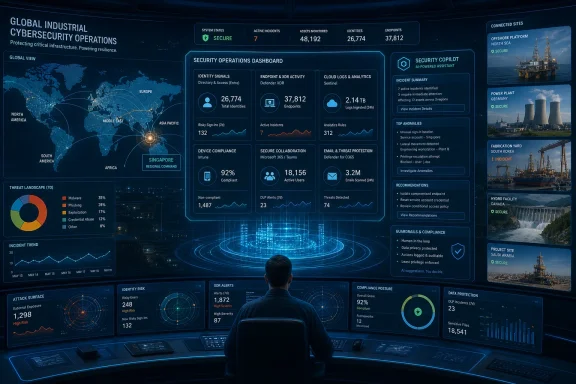
That is the strategic significance of the deployment. JEL is not merely adding Microsoft Sentinel or Security Copilot as standalone products. It is consolidating around the Microsoft security stack as a common control plane for detection, investigation, response, identity governance, and collaboration.
Security teams rarely suffer from a lack of alerts. They suffer from a lack of context. An endpoint alert without identity state is incomplete. A suspicious sign-in without device posture is incomplete. A malicious email without lateral movement visibility is incomplete. A privileged account change without lifecycle governance is incomplete.
Microsoft’s pitch to JEL is that the stack can collapse those partial views. Microsoft 365 E5 brings together enterprise collaboration and security capabilities. Entra handles identity and access. Defender XDR correlates across endpoints, email, identities, and cloud apps. Sentinel provides the cloud-native SIEM layer. Intune manages devices. Security Copilot sits on top as an AI-assisted analyst interface for summarization, query help, log interpretation, and investigation acceleration.
This is not a neutral architectural choice. It increases reliance on one vendor’s telemetry, licensing model, portal experience, and roadmap. But for a lean global IT team, the alternative can be worse: paying for diversity in tools while losing time to operational fragmentation. JEL’s story is therefore less about Microsoft replacing a single product and more about Microsoft replacing a coordination problem.
In traditional SIEM deployments, centralization could become another form of burden. Logs arrived, storage bills grew, correlation rules needed tuning, and analysts still had to know exactly where to look. Microsoft’s more modern argument is that Sentinel should not merely collect telemetry but participate in a broader SIEM-and-XDR workflow, with Defender XDR providing correlated incidents and Security Copilot helping analysts move faster through the evidence.
JEL says investigations that once required hours of manual correlation have become faster. That claim should be read carefully. Microsoft’s customer story does not provide a quantified before-and-after metric, and customer stories are not independent benchmarks. Still, the operational logic is sound: if the same platform connects email, endpoint, identity, cloud, and threat intelligence signals, the time spent gathering evidence should fall.
For industrial and engineering firms, this can have practical consequences beyond IT dashboards. Project sites may operate with constrained connectivity, mixed device types, and teams that move between offices, yards, and remote facilities. A security model that depends on local tribal knowledge or manual reconciliation is fragile in that environment. Centralizing telemetry is not glamorous, but it is often the difference between a contained incident and an investigation that begins after the damage has already spread.
That is a more plausible near-term role for generative AI in security operations. The bottleneck in many SOC workflows is not grand strategy; it is the accumulation of small, high-friction tasks. Analysts need to translate logs, build or modify Kusto Query Language searches, understand alert chains, summarize what happened, and decide whether the next step is containment, escalation, or closure. If AI can reduce the time spent on these repetitive analytical chores, it can change the economics of a small security team.
The risk is that the phrase AI-assisted response can blur the line between acceleration and authority. A model that summarizes an incident can also omit context. A model that suggests a query can also produce one that is syntactically valid but operationally misleading. A model that highlights anomalies can also train a team to trust an abstraction instead of the underlying evidence.
JEL’s implementation appears to acknowledge this distinction. The company talks about hands-on demonstrations, guardrails, stronger IT expertise, and consistent workflows. That is the right framing. Security Copilot is most credible when treated as an interface for experienced judgment, not a replacement for it.
JEL has adopted automated lifecycle management, risk-based conditional access, Privileged Identity Management, and scheduled access reviews. The goal is straightforward: only the right people should have the right access at the right time. The phrase is common enough to sound bland, but in a global engineering organization it is brutally practical.
Employees join projects, leave projects, change regions, move between job sites, and work with internal and external stakeholders. Manual access workflows do not scale well in that environment. Access that should have expired remains active. Privileged accounts become standing privileges. Former project roles quietly persist in shared resources. None of this requires a dramatic failure; it just requires normal business motion.
By linking Entra governance with Sentinel, Defender XDR, and Security Copilot, JEL is trying to make identity state part of the security narrative. A risky sign-in is more meaningful if the system knows whether the user holds privileged access. An endpoint incident is more urgent if the device belongs to an administrator. A cloud app anomaly becomes easier to triage when access reviews and lifecycle controls are current. This is where integration can move from convenience to control.
For Windows and Microsoft 365 administrators, that connection is familiar. Collaboration platforms are where business actually happens, which makes them both operationally indispensable and security-sensitive. Documents, drawings, schedules, commercial data, credentials, approvals, and project communications move through the same systems users treat as everyday workspaces.
JEL’s use of Intune adds the device-management layer to this picture. Rugged devices running Microsoft applications are being used to connect teams in remote or industrial environments. That creates obvious management challenges: device compliance, app protection, update posture, conditional access, and the ability to enforce policy when users are not sitting on a corporate LAN.
The important shift is that collaboration and cybersecurity are no longer separate programs. Jack Ng says Copilot and Sentinel now sit at the core of a connected system across the group. That may sound like vendor language, but the underlying point is valid. A file shared in Teams, a sign-in through Entra, a device compliance state in Intune, an email alert in Defender, and an incident in Sentinel are different views of the same enterprise activity.
This is the Windows gravity well at enterprise scale. Once identity, productivity, device management, and cloud workloads live in Microsoft’s ecosystem, the argument for Microsoft security becomes operational as much as technical. The security stack sees the users, the devices, the mailboxes, the files, the app activity, and the cloud events without requiring a patchwork of third-party connectors for every core workflow.
That does not mean Microsoft is automatically the best tool in every category. Large enterprises will still compare Sentinel with Splunk, QRadar, Chronicle, and other SIEM options. They will compare Defender XDR with CrowdStrike, Palo Alto Networks, SentinelOne, and other endpoint or XDR platforms. They will compare Security Copilot with emerging AI tooling from nearly every major security vendor.
But JEL’s decision suggests that feature-by-feature comparisons may matter less when the operational problem is integration. A slightly better isolated tool can lose to a good-enough integrated platform if the integrated platform reduces investigation time, governance friction, licensing sprawl, and administrator overhead. That is the uncomfortable reality for point-solution vendors in the Microsoft ecosystem.
For some organizations, that concentration is unacceptable. Regulated industries, multi-cloud-heavy businesses, or companies with mature SOCs may prefer a more heterogeneous stack, even at the cost of additional integration work. They may want independent telemetry pipelines, third-party detection engines, or separation between identity provider and security analytics platform.
For JEL, the calculus appears different. The company wanted a secure, resilient, integrated platform that could scale without expanding the IT team. That last phrase is crucial. If staffing is constrained, integration becomes a staffing strategy. Automation, consolidated portals, AI-assisted investigation, and policy consistency can be more valuable than vendor diversity.
The right criticism, then, is not that JEL chose Microsoft. It is that any organization following this path must know what it is trading. Integration lowers one kind of operational risk while increasing dependency risk. The winning architecture is not the one with the most logos or the fewest logos; it is the one whose risks are explicit and managed.
JEL’s Tan Yi Ming frames the threat model in terms of attacker speed, coordination, and increasing use of AI. That is now the standard justification for defensive AI: if attackers automate reconnaissance, phishing, malware variation, and social engineering, defenders need comparable acceleration. The challenge is that “AI versus AI” can become a slogan faster than it becomes a measurable operational improvement.
The practical test is whether the team closes incidents faster, misses fewer important signals, reduces analyst burnout, and improves consistency. It is whether junior analysts can ask better questions without being misled. It is whether senior analysts spend less time translating platform syntax and more time making decisions. It is whether the AI layer improves investigation quality, not just investigation speed.
JEL’s emphasis on guardrails and demonstrations is encouraging because it treats adoption as organizational change, not just feature enablement. Security AI will fail in enterprises where it is simply turned on and trusted. It has a better chance where teams define workflows, validate outputs, and keep human judgment in the loop.
The Microsoft story mentions intellectual property protection, predictive maintenance, proactive threat hunting, automated identity governance, and AI-assisted incident response. That combination reflects the direction of industrial IT: the line between operational efficiency and security resilience is narrowing. Data from assets, projects, users, and devices increasingly feeds business operations, and that same data becomes part of the attack surface.
A firm like JEL is not just protecting laptops and mailboxes. It is protecting project execution. A compromised account can disrupt collaboration. A ransomware incident can delay engineering deliverables. A leaked document can expose commercial or technical IP. A poorly managed device at a remote site can become the weak link in a much larger environment.
This is why Microsoft’s customer story is strategically useful for Redmond. It shows the security platform not as an abstract SOC product but as part of a real-world operating environment with engineers, project managers, field devices, and globally distributed teams. Microsoft wants buyers to see Sentinel and Security Copilot not as exotic tools for elite SOCs, but as extensions of the Microsoft 365 and Azure estate they already run.
The first question is whether your identity foundation is clean enough to support security automation. Conditional access, Privileged Identity Management, lifecycle workflows, and access reviews are only as good as the organizational model underneath them. If user roles, groups, devices, and ownership records are messy, AI-assisted investigation will inherit that mess.
The second question is whether your telemetry is truly centralized or merely duplicated. Sending logs to a SIEM is not the same as building an investigation workflow. Administrators need to know which alerts become incidents, how incidents map to response playbooks, which data sources are authoritative, and what happens when signals conflict.
The third question is whether AI has an adoption plan. Security Copilot can help with KQL, summaries, and incident interpretation, but teams still need validation practices. Administrators should decide where Copilot output is advisory, where it can trigger automation, and where human approval remains mandatory.
The fourth question is cost. Microsoft 365 E5, Sentinel ingestion, Defender components, Entra ID P2, Intune, Defender Threat Intelligence, and Security Copilot can deliver integration, but integration is not free. The business case must account for licensing, ingestion, storage, training, workflow redesign, and any services partner involvement, not just product names.
Security modernization fails when it is treated as a procurement exercise. Buying Sentinel does not create a SOC. Buying Entra ID P2 does not create good governance. Buying Security Copilot does not create an AI-ready analyst team. The technology can enable a better operating model, but it cannot substitute for one.
JEL’s deployment suggests the company understood that the platform had to change how people work. Engineers needed secure collaboration across regions. Administrators needed consistent identity controls. Analysts needed faster access to correlated evidence. Leaders needed a security model that could scale with the business without simply adding headcount.
This is where Microsoft’s integrated stack has its strongest argument. It can give organizations a coherent place to design those workflows. The danger is complacency: assuming coherence is delivered automatically because the products share a brand. The opportunity is discipline: using the platform to standardize response, governance, collaboration, and continuous improvement.
 JEL Turns Security Into Infrastructure, Not Insurance
For more than 50 years, Jurong Engineering Limited has operated in the physical world: power plants, industrial facilities, fabrication yards, remote project sites, and cross-border engineering programs. That kind of business traditionally treats IT as an enabling service, important but secondary to safety, scheduling, procurement, and execution. Microsoft’s new customer story makes clear that this hierarchy is changing.JEL’s expansion across regions created the usual digital burden: more users, more endpoints, more cloud workloads, more collaboration channels, and more logs than a lean IT team can comfortably correlate by hand. The company had already begun modernizing in 2014, moving from on-premises servers to Microsoft 365 and Azure. That first migration solved a familiar infrastructure problem: agility, availability, and scalability.
The next problem was harder. Once the cloud estate matured, the security operation itself became fragmented. Email security, endpoint telemetry, identity events, cloud logs, privileged access, and device management were all producing signals, but signals are only useful when an analyst can see the relationship among them. JEL’s leadership appears to have reached the point many IT organizations eventually reach: the limiting factor was no longer whether tools existed, but whether the team could make those tools behave like one system.
That is the strategic significance of the deployment. JEL is not merely adding Microsoft Sentinel or Security Copilot as standalone products. It is consolidating around the Microsoft security stack as a common control plane for detection, investigation, response, identity governance, and collaboration.
The Best-of-Breed Era Meets Its Integration Bill
JEL’s Regional Head of IT, Jack Ng, describes an evolution familiar to many enterprise administrators: the company adopted strong tools in individual areas, but those tools did not always integrate or operate cohesively. This is the quiet tax of the best-of-breed model. It looks rational at purchase time because every point solution is defensible on its own merits; it becomes expensive later when every alert requires a swivel-chair investigation across consoles, exports, and manually stitched timelines.Security teams rarely suffer from a lack of alerts. They suffer from a lack of context. An endpoint alert without identity state is incomplete. A suspicious sign-in without device posture is incomplete. A malicious email without lateral movement visibility is incomplete. A privileged account change without lifecycle governance is incomplete.
Microsoft’s pitch to JEL is that the stack can collapse those partial views. Microsoft 365 E5 brings together enterprise collaboration and security capabilities. Entra handles identity and access. Defender XDR correlates across endpoints, email, identities, and cloud apps. Sentinel provides the cloud-native SIEM layer. Intune manages devices. Security Copilot sits on top as an AI-assisted analyst interface for summarization, query help, log interpretation, and investigation acceleration.
This is not a neutral architectural choice. It increases reliance on one vendor’s telemetry, licensing model, portal experience, and roadmap. But for a lean global IT team, the alternative can be worse: paying for diversity in tools while losing time to operational fragmentation. JEL’s story is therefore less about Microsoft replacing a single product and more about Microsoft replacing a coordination problem.
Sentinel Becomes the Place Where the Story Comes Together
Microsoft Sentinel’s importance in this deployment is that it gives JEL a central point for security operations across a distributed environment. The Microsoft story says identity events, endpoint alerts, cloud logs, and email signals now converge into a single accessible view. That matters because investigation speed is often determined before the analyst begins analysis; it is determined by how much evidence the platform already gathered.In traditional SIEM deployments, centralization could become another form of burden. Logs arrived, storage bills grew, correlation rules needed tuning, and analysts still had to know exactly where to look. Microsoft’s more modern argument is that Sentinel should not merely collect telemetry but participate in a broader SIEM-and-XDR workflow, with Defender XDR providing correlated incidents and Security Copilot helping analysts move faster through the evidence.
JEL says investigations that once required hours of manual correlation have become faster. That claim should be read carefully. Microsoft’s customer story does not provide a quantified before-and-after metric, and customer stories are not independent benchmarks. Still, the operational logic is sound: if the same platform connects email, endpoint, identity, cloud, and threat intelligence signals, the time spent gathering evidence should fall.
For industrial and engineering firms, this can have practical consequences beyond IT dashboards. Project sites may operate with constrained connectivity, mixed device types, and teams that move between offices, yards, and remote facilities. A security model that depends on local tribal knowledge or manual reconciliation is fragile in that environment. Centralizing telemetry is not glamorous, but it is often the difference between a contained incident and an investigation that begins after the damage has already spread.
Security Copilot Is Being Sold as an Analyst Multiplier
The most fashionable part of the JEL story is Security Copilot, but the sober interpretation is more interesting than the hype. Microsoft is not claiming that Copilot replaces security analysts. JEL frames it as a force multiplier that summarizes incidents, interprets complex logs, expands KQL queries, and highlights anomalous patterns.That is a more plausible near-term role for generative AI in security operations. The bottleneck in many SOC workflows is not grand strategy; it is the accumulation of small, high-friction tasks. Analysts need to translate logs, build or modify Kusto Query Language searches, understand alert chains, summarize what happened, and decide whether the next step is containment, escalation, or closure. If AI can reduce the time spent on these repetitive analytical chores, it can change the economics of a small security team.
The risk is that the phrase AI-assisted response can blur the line between acceleration and authority. A model that summarizes an incident can also omit context. A model that suggests a query can also produce one that is syntactically valid but operationally misleading. A model that highlights anomalies can also train a team to trust an abstraction instead of the underlying evidence.
JEL’s implementation appears to acknowledge this distinction. The company talks about hands-on demonstrations, guardrails, stronger IT expertise, and consistent workflows. That is the right framing. Security Copilot is most credible when treated as an interface for experienced judgment, not a replacement for it.
Identity Governance Moves From Back Office to Front Line
The Microsoft story gives Entra ID P2 a central role in JEL’s modernization, and that detail deserves more attention than it will probably receive. Identity governance is often treated as administrative hygiene: provisioning, deprovisioning, access reviews, privileged access, and conditional access. In reality, it is one of the main battlefields of modern enterprise security.JEL has adopted automated lifecycle management, risk-based conditional access, Privileged Identity Management, and scheduled access reviews. The goal is straightforward: only the right people should have the right access at the right time. The phrase is common enough to sound bland, but in a global engineering organization it is brutally practical.
Employees join projects, leave projects, change regions, move between job sites, and work with internal and external stakeholders. Manual access workflows do not scale well in that environment. Access that should have expired remains active. Privileged accounts become standing privileges. Former project roles quietly persist in shared resources. None of this requires a dramatic failure; it just requires normal business motion.
By linking Entra governance with Sentinel, Defender XDR, and Security Copilot, JEL is trying to make identity state part of the security narrative. A risky sign-in is more meaningful if the system knows whether the user holds privileged access. An endpoint incident is more urgent if the device belongs to an administrator. A cloud app anomaly becomes easier to triage when access reviews and lifecycle controls are current. This is where integration can move from convenience to control.
Collaboration Is Now Part of the Security Perimeter
Microsoft 365 is not merely the productivity layer in JEL’s deployment. It is part of the security perimeter. The customer story says more than 1,500 JEL employees now use Microsoft 365 for secure collaboration, with Teams, SharePoint, OneDrive, and Exchange Online supporting communication across offices, fabrication yards, power plants, and project sites.For Windows and Microsoft 365 administrators, that connection is familiar. Collaboration platforms are where business actually happens, which makes them both operationally indispensable and security-sensitive. Documents, drawings, schedules, commercial data, credentials, approvals, and project communications move through the same systems users treat as everyday workspaces.
JEL’s use of Intune adds the device-management layer to this picture. Rugged devices running Microsoft applications are being used to connect teams in remote or industrial environments. That creates obvious management challenges: device compliance, app protection, update posture, conditional access, and the ability to enforce policy when users are not sitting on a corporate LAN.
The important shift is that collaboration and cybersecurity are no longer separate programs. Jack Ng says Copilot and Sentinel now sit at the core of a connected system across the group. That may sound like vendor language, but the underlying point is valid. A file shared in Teams, a sign-in through Entra, a device compliance state in Intune, an email alert in Defender, and an incident in Sentinel are different views of the same enterprise activity.
Microsoft’s Security Stack Gains From the Windows Gravity Well
JEL’s story also illustrates why Microsoft has become such a formidable security vendor. The company does not have to win only on SIEM features or endpoint detection alone. It can win by tying security to the infrastructure many organizations already use every day: Windows, Microsoft 365, Azure, Entra ID, Teams, Exchange Online, SharePoint, OneDrive, and Intune.This is the Windows gravity well at enterprise scale. Once identity, productivity, device management, and cloud workloads live in Microsoft’s ecosystem, the argument for Microsoft security becomes operational as much as technical. The security stack sees the users, the devices, the mailboxes, the files, the app activity, and the cloud events without requiring a patchwork of third-party connectors for every core workflow.
That does not mean Microsoft is automatically the best tool in every category. Large enterprises will still compare Sentinel with Splunk, QRadar, Chronicle, and other SIEM options. They will compare Defender XDR with CrowdStrike, Palo Alto Networks, SentinelOne, and other endpoint or XDR platforms. They will compare Security Copilot with emerging AI tooling from nearly every major security vendor.
But JEL’s decision suggests that feature-by-feature comparisons may matter less when the operational problem is integration. A slightly better isolated tool can lose to a good-enough integrated platform if the integrated platform reduces investigation time, governance friction, licensing sprawl, and administrator overhead. That is the uncomfortable reality for point-solution vendors in the Microsoft ecosystem.
The Vendor Lock-In Question Does Not Go Away
A fair reading of the JEL deployment must also confront lock-in. Consolidating on Microsoft can simplify operations, but it can also concentrate risk. Licensing changes, product bundling decisions, portal redesigns, service outages, data ingestion costs, and roadmap shifts become more consequential when one vendor underpins collaboration, identity, endpoint security, SIEM, device management, threat intelligence, and AI assistance.For some organizations, that concentration is unacceptable. Regulated industries, multi-cloud-heavy businesses, or companies with mature SOCs may prefer a more heterogeneous stack, even at the cost of additional integration work. They may want independent telemetry pipelines, third-party detection engines, or separation between identity provider and security analytics platform.
For JEL, the calculus appears different. The company wanted a secure, resilient, integrated platform that could scale without expanding the IT team. That last phrase is crucial. If staffing is constrained, integration becomes a staffing strategy. Automation, consolidated portals, AI-assisted investigation, and policy consistency can be more valuable than vendor diversity.
The right criticism, then, is not that JEL chose Microsoft. It is that any organization following this path must know what it is trading. Integration lowers one kind of operational risk while increasing dependency risk. The winning architecture is not the one with the most logos or the fewest logos; it is the one whose risks are explicit and managed.
AI Security Has to Prove Itself in the Boring Work
Security Copilot’s role in JEL’s environment points to a broader truth about AI in enterprise security: the first durable gains are likely to come from boring work. Summaries, query generation, alert explanation, incident timelines, natural-language investigation prompts, and threat-intelligence synthesis may not sound revolutionary. But they sit exactly where many security teams lose time.JEL’s Tan Yi Ming frames the threat model in terms of attacker speed, coordination, and increasing use of AI. That is now the standard justification for defensive AI: if attackers automate reconnaissance, phishing, malware variation, and social engineering, defenders need comparable acceleration. The challenge is that “AI versus AI” can become a slogan faster than it becomes a measurable operational improvement.
The practical test is whether the team closes incidents faster, misses fewer important signals, reduces analyst burnout, and improves consistency. It is whether junior analysts can ask better questions without being misled. It is whether senior analysts spend less time translating platform syntax and more time making decisions. It is whether the AI layer improves investigation quality, not just investigation speed.
JEL’s emphasis on guardrails and demonstrations is encouraging because it treats adoption as organizational change, not just feature enablement. Security AI will fail in enterprises where it is simply turned on and trusted. It has a better chance where teams define workflows, validate outputs, and keep human judgment in the loop.
The Industrial Sector Is Becoming a Microsoft Security Showcase
JEL’s industry context matters. Architecture, engineering, and industrial services companies are attractive targets because they sit near critical infrastructure, energy projects, construction programs, intellectual property, supply chains, and government or quasi-government work. They may not always have the security budgets of banks or hyperscalers, but the operational stakes can be high.The Microsoft story mentions intellectual property protection, predictive maintenance, proactive threat hunting, automated identity governance, and AI-assisted incident response. That combination reflects the direction of industrial IT: the line between operational efficiency and security resilience is narrowing. Data from assets, projects, users, and devices increasingly feeds business operations, and that same data becomes part of the attack surface.
A firm like JEL is not just protecting laptops and mailboxes. It is protecting project execution. A compromised account can disrupt collaboration. A ransomware incident can delay engineering deliverables. A leaked document can expose commercial or technical IP. A poorly managed device at a remote site can become the weak link in a much larger environment.
This is why Microsoft’s customer story is strategically useful for Redmond. It shows the security platform not as an abstract SOC product but as part of a real-world operating environment with engineers, project managers, field devices, and globally distributed teams. Microsoft wants buyers to see Sentinel and Security Copilot not as exotic tools for elite SOCs, but as extensions of the Microsoft 365 and Azure estate they already run.
Administrators Should Read This as a Roadmap, Not a Template
The temptation with customer stories is to treat them as proof that a vendor stack should be replicated. That would be the wrong lesson. JEL’s path is a roadmap of questions, not a universal template.The first question is whether your identity foundation is clean enough to support security automation. Conditional access, Privileged Identity Management, lifecycle workflows, and access reviews are only as good as the organizational model underneath them. If user roles, groups, devices, and ownership records are messy, AI-assisted investigation will inherit that mess.
The second question is whether your telemetry is truly centralized or merely duplicated. Sending logs to a SIEM is not the same as building an investigation workflow. Administrators need to know which alerts become incidents, how incidents map to response playbooks, which data sources are authoritative, and what happens when signals conflict.
The third question is whether AI has an adoption plan. Security Copilot can help with KQL, summaries, and incident interpretation, but teams still need validation practices. Administrators should decide where Copilot output is advisory, where it can trigger automation, and where human approval remains mandatory.
The fourth question is cost. Microsoft 365 E5, Sentinel ingestion, Defender components, Entra ID P2, Intune, Defender Threat Intelligence, and Security Copilot can deliver integration, but integration is not free. The business case must account for licensing, ingestion, storage, training, workflow redesign, and any services partner involvement, not just product names.
JEL’s Real Lesson Is That Security Modernization Is Organizational Modernization
The most revealing line in the Microsoft story is not about a product. It is Jack Ng’s statement that hands-on demonstrations and clear guardrails helped teams gain confidence, while strengthened IT expertise and consistent workflows made it easier to trust both process and technology. That is the heart of the matter.Security modernization fails when it is treated as a procurement exercise. Buying Sentinel does not create a SOC. Buying Entra ID P2 does not create good governance. Buying Security Copilot does not create an AI-ready analyst team. The technology can enable a better operating model, but it cannot substitute for one.
JEL’s deployment suggests the company understood that the platform had to change how people work. Engineers needed secure collaboration across regions. Administrators needed consistent identity controls. Analysts needed faster access to correlated evidence. Leaders needed a security model that could scale with the business without simply adding headcount.
This is where Microsoft’s integrated stack has its strongest argument. It can give organizations a coherent place to design those workflows. The danger is complacency: assuming coherence is delivered automatically because the products share a brand. The opportunity is discipline: using the platform to standardize response, governance, collaboration, and continuous improvement.
The Microsoft Stack Becomes JEL’s Control Room
JEL’s adoption is not a declaration that every enterprise should consolidate security on Microsoft. It is a concrete example of why many will. The company’s most important takeaways are operational rather than promotional.- JEL moved from a fragmented tool model toward a unified Microsoft platform spanning collaboration, identity, endpoint security, SIEM, XDR, device management, threat intelligence, and AI-assisted investigation.
- Microsoft Sentinel and Defender XDR give JEL a more centralized view of identity, endpoint, cloud, and email signals, reducing the manual correlation burden on its IT team.
- Security Copilot is being used as an analyst accelerator for incident summaries, log interpretation, KQL query work, and anomaly discovery rather than as an autonomous replacement for security staff.
- Entra ID P2 strengthens JEL’s governance model through lifecycle management, risk-based conditional access, Privileged Identity Management, and scheduled access reviews.
- Intune and Microsoft 365 extend the security story into daily collaboration, especially for distributed teams working across offices, fabrication yards, remote sites, and rugged devices.
- The main trade-off is strategic dependency: JEL gains integration and scale, but it also places more of its operational security posture in Microsoft’s hands.
References
- Primary source: Microsoft
Published: 2026-05-18T16:30:09.265223
Jurong Engineering strengthens global security with Microsoft Sentinel and Security Copilot | Microsoft Customer Stories
Jurong Engineering Limited unified security and collaboration on Microsoft to strengthen resilience, streamline operations, and scale securely worldwide.www.microsoft.com
