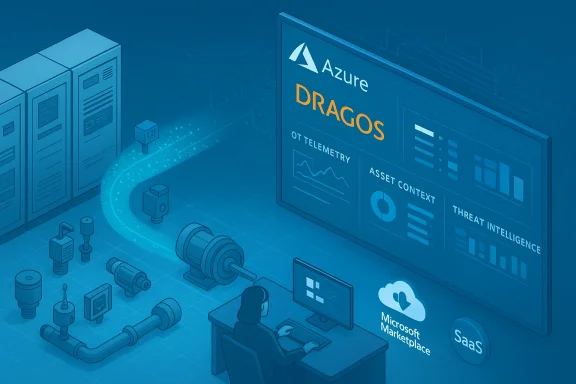
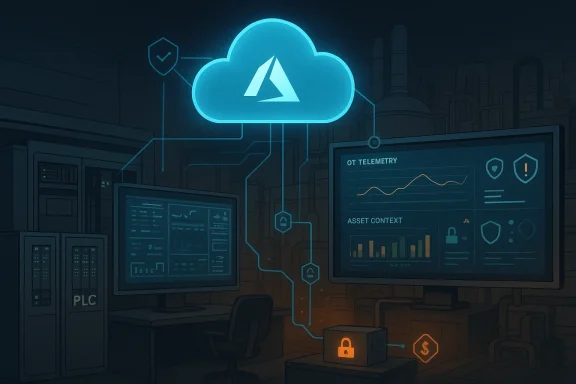
Dragos’s expanded collaboration with Microsoft marks a significant step toward bringing purpose-built operational technology (OT) security into mainstream enterprise cloud and security operations: the Dragos Platform will run on Microsoft Azure, push OT-specific telemetry and asset context into Microsoft Sentinel, and be purchasable through Microsoft Marketplace — with a SaaS deployment option slated to begin in Q1 2026 — creating a direct path for asset-intensive organisations to unify IT and OT detection, investigation, and response workflows inside environments they already use.
Industrial control systems, distributed automation, and other OT environments have historically been insulated from enterprise IT. That model is changing fast: plants, utilities, and other operational sites are increasingly instrumented, connected, and adopting cloud-based analytics and AI for operations, maintenance, and optimisation. The security consequence is straightforward — the attack surface for adversaries targeting physical processes is expanding at the same time that the window between initial compromise and operational impact is shrinking. Vendors and operators alike are racing to close a capability gap: traditional IT security tooling lacks the asset-aware, protocol-level visibility and OT-specific threat intelligence required to meaningfully protect cyber-physical systems.
The partnership announced by Dragos and Microsoft is a response to this market pressure. It combines an OT-focused security platform with one of the largest cloud and SIEM ecosystems in enterprise IT. The companies present the tie-up as enabling unified IT/OT security operations through native integrations — notably, the Dragos Platform’s telemetry and context will be ingested into Microsoft Sentinel, while procurement can be standardised through Microsoft Marketplace and aligned to Azure consumption commitments.
Industry market research underlines the urgency: analysts project the global OT security market to more than double between 2025 and 2030, reflecting rapid growth in investment across energy, manufacturing, utilities, transport and other asset-heavy sectors. That trajectory explains why major cloud and security providers are accelerating OT-focused strategies and partner integrations.
There are caveats: not all Marketplace offers are MACC-eligible. Free and BYOL (bring-your-own-license) offers are typically non-transactable and therefore do not contribute to MACC. Also, MACC benefits generally apply to licenses or software used exclusively in Azure; hybrid or on-premise deployments may not be MACC-eligible. Organisations should verify the offer’s MACC registration and whether licencing models suit their hybrid estates before relying on consumption credits as the primary economics driver.
A few ecosystem dynamics to watch:
As operational processes incorporate AI, the need for OT-aware threat models and curated threat intelligence becomes more pronounced. Attackers can leverage cloud exposure and AI-driven automation to accelerate harmful impacts; conversely, defenders can use the same technologies to reduce dwell time and contain incidents faster if the tooling preserves OT context and safety constraints.
That promise is real, but not automatic. The realisation of unified IT/OT security depends on sound deployment choices, rigorous pilot testing, careful attention to data sovereignty and MACC eligibility, and the hard work of integrating people and processes across IT and operational domains. Organisations that treat the integration as a step in a broader transformation — one driven by clear governance, staged automation, and cross-disciplinary training — will be best positioned to benefit from cloud-scale analytics while preserving the safety, availability, and resilience that operational technology demands.
For asset-intensive industries, the message is clear: cloud-native SIEMs and OT specialists are converging, and the pace of adoption will be determined as much by operational readiness and regulatory reality as by technical capability. The Dragos–Microsoft tie-up lowers several barriers to adoption, but it also raises new questions about procurement models, hybrid architectures, and the operational boundaries of cloud-managed OT security — questions that organisations must answer before confidently turning the key on unified IT/OT operations.
Source: IT Brief Asia https://itbrief.asia/story/dragos-deepens-microsoft-tie-up-to-secure-ot-on-azure/
 Background
Industrial control systems, distributed automation, and other OT environments have historically been insulated from enterprise IT. That model is changing fast: plants, utilities, and other operational sites are increasingly instrumented, connected, and adopting cloud-based analytics and AI for operations, maintenance, and optimisation. The security consequence is straightforward — the attack surface for adversaries targeting physical processes is expanding at the same time that the window between initial compromise and operational impact is shrinking. Vendors and operators alike are racing to close a capability gap: traditional IT security tooling lacks the asset-aware, protocol-level visibility and OT-specific threat intelligence required to meaningfully protect cyber-physical systems.The partnership announced by Dragos and Microsoft is a response to this market pressure. It combines an OT-focused security platform with one of the largest cloud and SIEM ecosystems in enterprise IT. The companies present the tie-up as enabling unified IT/OT security operations through native integrations — notably, the Dragos Platform’s telemetry and context will be ingested into Microsoft Sentinel, while procurement can be standardised through Microsoft Marketplace and aligned to Azure consumption commitments.
Industry market research underlines the urgency: analysts project the global OT security market to more than double between 2025 and 2030, reflecting rapid growth in investment across energy, manufacturing, utilities, transport and other asset-heavy sectors. That trajectory explains why major cloud and security providers are accelerating OT-focused strategies and partner integrations.
Platform integration: what’s being connected — and why it matters
How the integration is described
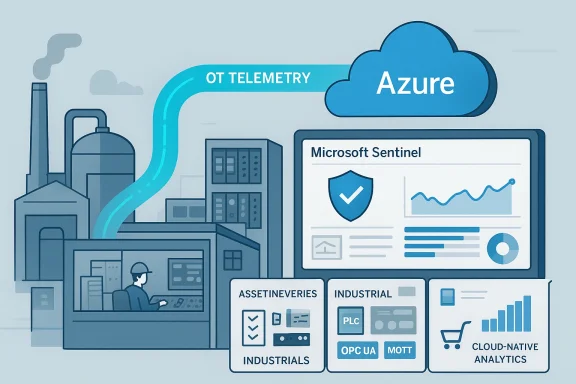
Under the expanded collaboration, the Dragos Platform will deliver OT telemetry, asset inventories, and OT-specific threat intelligence into Microsoft Sentinel. The integration promises:- A data connector or ingestion path that moves OT alerts, telemetry, and asset context into Sentinel’s analytics pipeline.
- Pre-built analytics and mapping so Dragos notifications can create Sentinel incidents with OT-aware entities and context.
- The ability to access raw OT data or alerts for custom queries and investigations inside Sentinel’s data lake and analytic environment.
- Content and automation packaging that reduces the friction of onboarding OT telemetry into existing SOC workflows.
Why OT data and context matter inside a SIEM
OT environments are different from typical IT estates. Key differences include:- Asset lifecycles measured in decades rather than years.
- Proprietary and legacy industrial protocols and control system telemetry.
- Safety and availability constraints that make disruption risk-driven trade-offs unavoidable.
- High value placed on precise asset context (e.g., which PLC controls which turbine) when assessing impact.
Deployment and procurement: SaaS on Azure, hybrid and on-premise continuity
Deployment options and timing
Dragos will continue to support on-premises and hybrid deployments while adding a SaaS option hosted on Azure, with the SaaS roll-out announced for Q1 2026. This matters because many industrial sites insist on localised control and sometimes air-gapped architectures; a one-size-fits-all cloud-only approach would not be viable for large parts of critical infrastructure. The multi-model approach gives organisations choice:- On-premises: full local control where internet connectivity or cloud use is restricted.
- Hybrid: a mix of local data collection with cloud analytics and correlation.
- SaaS on Azure: managed, cloud-native SaaS for centralised visibility, scale, and easier updates.
Marketplace procurement and Azure consumption commitments
Making Dragos available through Microsoft Marketplace streamlines procurement for customers that use Microsoft commercial channels and centralised vendor governance. The integration of Marketplace procurement with Azure consumption commitments (MACC) creates a commercial route where eligible purchases count toward an organisation’s Azure spend commitments — an attractive option for enterprises consolidating cloud budgets or seeking to align security investments with broader Azure consumption.There are caveats: not all Marketplace offers are MACC-eligible. Free and BYOL (bring-your-own-license) offers are typically non-transactable and therefore do not contribute to MACC. Also, MACC benefits generally apply to licenses or software used exclusively in Azure; hybrid or on-premise deployments may not be MACC-eligible. Organisations should verify the offer’s MACC registration and whether licencing models suit their hybrid estates before relying on consumption credits as the primary economics driver.
Security operations impact: unifying IT and OT workflows
What a unified view enables
Bringing OT signals into Sentinel enables security teams to:- Correlate network and identity anomalies in IT with operational anomalies in OT to identify cross-domain attack paths.
- Enrich IT alerts with OT asset context to prioritise investigations based on potential safety or availability impact.
- Use existing SOC playbooks, case management, and analyst tooling to track OT incidents the same way as IT incidents — reducing analyst friction and required retraining.
- Leverage Sentinel’s analytics, hunting, and AI capabilities to surface OT threats that might otherwise be overlooked by traditional OT monitoring tools.
The reality of SOC integration: people, process, and data challenges
While the vendor integration simplifies technical data flows, operationalising unified IT/OT SOC work requires addressing several entrenched challenges:- Skills shortage: OT engineers and SOC analysts speak different operational languages. Cross-training and dual-discipline playbooks are essential.
- Data quality and normalization: OT telemetry formats can be heterogeneous and require careful mapping to Sentinel’s tables and entity models to avoid loss of context.
- False positives and prioritisation: OT systems generate many benign anomalies; poor tuning can drown SOC analysts in low-value alerts.
- Governance and change management: Policies for who can act on OT incidents, when to escalate to plant operators, and how to perform remote response must be codified to ensure safety.
Benefits: what organisations stand to gain
- Improved cross-domain visibility — Security teams can see IT and OT telemetry in one place, enabling faster root-cause analysis.
- Reduced procurement friction — Marketplace availability simplifies acquisition and may enable customers to use existing Azure commercial arrangements.
- Faster time-to-value — Pre-built connectors, analytics, and entity mapping can speed onboarding and reduce custom engineering effort.
- Scalability and analytics — Azure-hosted SaaS enables centralised analytics across geographically distributed sites while benefitting from cloud scale and advanced AI-driven analytics.
- Alignment with cloud and AI strategies — For organisations already committed to Azure and Sentinel, this path reduces architectural friction for OT security modernisation.
Risks and limitations: what the press release glosses over
Connectivity and air-gap realities
Many industrial control sites remain partially or wholly isolated for good operational reasons. SaaS options on Azure are less suitable for fully air-gapped or highly constrained environments unless robust edge collectors and local caching mechanisms are provided. Expect customers with extreme isolation or regulatory constraints to continue using on-premises or hybrid deployments.Data sovereignty and compliance
Operational data often contains sensitive information subject to export controls, regulatory constraints, or contractual obligations. Moving telemetry or asset inventories into a cloud service requires careful mapping of data flows to legal and compliance frameworks; not all jurisdictions permit the transfer of certain classes of industrial data without explicit controls.Licensing and MACC caveats
While Marketplace procurement and MACC alignment are attractive, they carry conditions. BYOL and free product listings are usually not MACC-eligible; only transactable Azure offers that are registered in the MACC program count toward consumption commitments. Additionally, MACC credits generally only apply when the purchased software is used exclusively in Azure, which can limit the benefit to hybrid or multi-cloud deployments.Vendor lock-in and architectural coupling
Deeper integration with Microsoft’s ecosystem can accelerate time-to-value but may also increase long-term coupling to Azure and Sentinel. Organisations with multicloud strategies or plans to retain diverse security tooling should weigh the benefits of native Microsoft integrations against the potential cost of reducing architectural flexibility.Shared responsibility and supply chain risk
Running OT security services in the cloud shifts some operational responsibilities to vendors and cloud providers. Customers must understand where their responsibilities stop and the provider’s responsibilities begin, particularly for incident response and forensic investigations involving OT systems. There is also the broader vendor-supply-chain risk: if a cloud-integrated security provider is compromised, the impact could cascade into industrial estates that rely on these services for detection and response.False sense of security from "integration" claims
Integration does not instantly deliver OT expertise inside an organisation. Dragos brings domain-specific detection and intelligence, but customers must still implement proper segmentation, governance, and response playbooks. Overreliance on a single integrated pipeline without operational validation can lead to blind spots.Technical specifics and verification
Several of the key technical claims made in the collaboration announcement are verifiable against public vendor materials and platform documentation:- Microsoft Sentinel is a cloud-native SIEM and security data lake capable of ingesting signals from many sources and enabling analytics, hunting, and automation. Sentinel supports partner connectors, content publishing, and a developer ecosystem for building and packaging detection and response content.
- Dragos has mature capabilities for OT asset discovery, protocol-level telemetry interpretation, and OT-focused threat intelligence; its platform has been positioned in analyst evaluations for cyber-physical protection.
- Microsoft Marketplace offers transactable pricing and procurement workflows that can count toward Azure consumption commitments, but MACC eligibility is subject to offer type (BYOL vs transactable, Azure-only license usage) and publisher registration.
- The exact data flows — what telemetry is forwarded to Sentinel, what remains local, and how data is normalised.
- The entity and schema mapping — confirm that OT asset identifiers in Dragos map to Sentinel entities in a way that preserves operational context.
- Response automation boundaries — determine what automated actions are safe to execute from the cloud versus which actions must be manual or orchestrated locally.
Practical recommendations for enterprises and security teams
- Start with a risk-driven pilot
- Select a small number of non-critical but representative sites to validate the edge-to-cloud data flow, alert noise level, and incident response choreography.
- Validate MACC and procurement terms
- Confirm whether the Dragos offer you plan to purchase is registered for Azure consumption commitments (MACC) and whether your intended deployment model (Azure-only vs hybrid) will be eligible for MACC credits.
- Define clear IT/OT governance and escalation paths
- Create joint playbooks that define when SOC analysts escalate to plant operators and who has authority to take control-plane actions.
- Protect safety and availability with staged automation
- Avoid fully automated blocking or remediation actions that could impact safety systems; prefer staged automated triage and analyst-confirmed response for OT.
- Keep sensitive data local when required
- Use edge analytics for raw process signals that must not leave site boundaries; forward enriched, de-identified, or metadata-level alerts to the cloud when compliance demands it.
- Invest in cross-discipline training
- Build hybrid teams or training programs so SOC analysts understand OT basics and OT engineers understand cybersecurity detection and investigation workflows.
- Test incident response end-to-end
- Simulate cross-domain incidents that originate in IT and affect OT (and vice versa) to validate detection, notification, and shutdown/containment procedures.
- Evaluate long-term vendor and cloud dependency
- Model migration and exit scenarios to avoid undesirable lock-in; ensure your data extraction and retention policies permit forensic analysis outside the cloud vendor ecosystem if needed.
Vendor and ecosystem considerations
Dragos’s move to deeply integrate with Microsoft brings both opportunity and competition into the OT security market. On one hand, enterprises benefit from established commercial channels, familiar tooling, and potentially faster time-to-value when they already use Azure and Sentinel at scale. On the other hand, the OT security market is crowded with vendors offering on-premises, hybrid, and cloud solutions; customers must evaluate vendor fit not just on integration breadth but on domain expertise, detection fidelity, and incident response maturity.A few ecosystem dynamics to watch:
- Partnerships between OT specialists and cloud providers are accelerating; expect other OT security vendors to pursue similar integrations with leading cloud SIEMs and marketplaces.
- Cloud-native SIEM platforms are rapidly evolving their data lake and analytics capabilities, which benefits OT analytics but also raises expectations for long-term retention, query performance, and provenance of telemetry.
- Regulatory scrutiny of industrial cyber incidents will continue to grow, and cloud-hosted OT telemetry may be the subject of compliance controls in certain jurisdictions — vendors and customers must build compliance-by-design into deployment architectures.
The bigger picture: digital transformation, AI, and cyber-physical risk
The Dragos–Microsoft collaboration is part of a broader industry trend: the convergence of industrial operations, IT cloud platforms, and AI-driven analytics. Organisations are experimenting with AI for predictive maintenance, optimisation, and anomaly detection — and those same capabilities, if misconfigured, can introduce new classes of risk. The benefit of cloud-native analytics is scale and advanced modelling, but the cost of misapplied models in OT can be high. Successful adoption will be the result of disciplined engineering, conservative ramping of automation, and clear alignment between safety engineers and security teams.As operational processes incorporate AI, the need for OT-aware threat models and curated threat intelligence becomes more pronounced. Attackers can leverage cloud exposure and AI-driven automation to accelerate harmful impacts; conversely, defenders can use the same technologies to reduce dwell time and contain incidents faster if the tooling preserves OT context and safety constraints.
Conclusion
Dragos’s deeper integration with Microsoft is a pragmatic step toward bridging the IT/OT security divide. By enabling the Dragos Platform to run on Azure, flow OT telemetry into Microsoft Sentinel, and be procured via Microsoft Marketplace — with a SaaS option arriving in Q1 2026 — the partnership offers a compelling path for organisations seeking unified visibility without ripping and replacing existing enterprise security investments.That promise is real, but not automatic. The realisation of unified IT/OT security depends on sound deployment choices, rigorous pilot testing, careful attention to data sovereignty and MACC eligibility, and the hard work of integrating people and processes across IT and operational domains. Organisations that treat the integration as a step in a broader transformation — one driven by clear governance, staged automation, and cross-disciplinary training — will be best positioned to benefit from cloud-scale analytics while preserving the safety, availability, and resilience that operational technology demands.
For asset-intensive industries, the message is clear: cloud-native SIEMs and OT specialists are converging, and the pace of adoption will be determined as much by operational readiness and regulatory reality as by technical capability. The Dragos–Microsoft tie-up lowers several barriers to adoption, but it also raises new questions about procurement models, hybrid architectures, and the operational boundaries of cloud-managed OT security — questions that organisations must answer before confidently turning the key on unified IT/OT operations.
Source: IT Brief Asia https://itbrief.asia/story/dragos-deepens-microsoft-tie-up-to-secure-ot-on-azure/