

Cohesity’s expanded collaboration with Microsoft marks an aggressive push to turn “dormant” backup stores into active, AI‑enabled sources of security, compliance and recovery intelligence — a move the vendor says produced double‑digit marketplace growth, a tenfold rise in co‑sell engagements and new product integrations that bind Cohesity Gaia, Microsoft 365 Copilot, Azure OpenAI (Foundry), Microsoft Sentinel and Defender into a single, Azure‑native data‑resilience play.
Cohesity’s November 18, 2025 announcement frames the deepened partnership as a response to three converging forces: a persistent ransomware threat landscape, accelerated cloud migration into Azure, and enterprise demand to extract business value from secondary data (backups, archives, file shares). The company reports that fiscal 2025 saw nearly 200% year‑over‑year growth in Microsoft Marketplace sales and more than a tenfold increase in joint co‑selling engagements with Microsoft — figures presented as indicators of commercial momentum across healthcare, finance, manufacturing, retail and public sector customers.
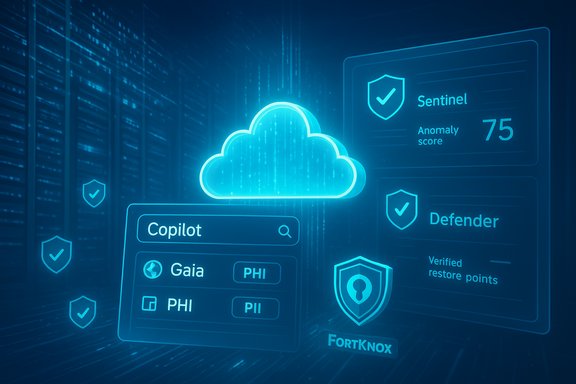
This is not just marketing: the story combines product announcements (notably Cohesity Gaia’s integration with Microsoft 365 Copilot), platform placement on Azure and tightened interoperability with Microsoft security tooling (Sentinel, Defender) to deliver what Cohesity positions as an AI‑first approach to cyber resilience: detect anomalies in backups, classify PHI/PII for compliance, and verify safe restore points before recovery. Independent trade coverage immediately reflected the same claims and customer examples, while Cohesity’s own case study for Bethany Children’s Health Center provides a concrete, healthcare‑oriented scenario.
That said, the vendor’s headline business metrics are company‑reported and should be validated; the technical value depends on disciplined governance, realistic RTO expectations that include verification time, and clear cost modelling for model inference and Copilot usage. For Azure‑centric organisations prepared to do the readiness work, the integration can reduce risk and unlock practical benefits — but the path to production must be conservative, measured and evidence‑driven.
The decisive factor for enterprises will be disciplined validation: measure RTOs with verification active, insist on auditable source citations for any LLM output, model the total cost of inference and Copilot usage, and secure contractual guarantees for data residency and exportability before adopting at scale. When those checks are in place, the offering can legitimately convert secondary data into a strategic asset rather than a long‑term liability.
Source: IT Brief UK Cohesity & Microsoft deepen AI-driven data security & growth
Source: ChannelLife Australia Cohesity & Microsoft deepen AI-driven data security & growth
 Background / Overview
Cohesity’s November 18, 2025 announcement frames the deepened partnership as a response to three converging forces: a persistent ransomware threat landscape, accelerated cloud migration into Azure, and enterprise demand to extract business value from secondary data (backups, archives, file shares). The company reports that fiscal 2025 saw nearly 200% year‑over‑year growth in Microsoft Marketplace sales and more than a tenfold increase in joint co‑selling engagements with Microsoft — figures presented as indicators of commercial momentum across healthcare, finance, manufacturing, retail and public sector customers.This is not just marketing: the story combines product announcements (notably Cohesity Gaia’s integration with Microsoft 365 Copilot), platform placement on Azure and tightened interoperability with Microsoft security tooling (Sentinel, Defender) to deliver what Cohesity positions as an AI‑first approach to cyber resilience: detect anomalies in backups, classify PHI/PII for compliance, and verify safe restore points before recovery. Independent trade coverage immediately reflected the same claims and customer examples, while Cohesity’s own case study for Bethany Children’s Health Center provides a concrete, healthcare‑oriented scenario.
What was announced — the essentials
Product and integration highlights
- Cohesity Gaia + Microsoft 365 Copilot — Gaia indexes backup and secondary data and now surfaces that content inside Microsoft 365 Copilot using Retrieval‑Augmented Generation (RAG) so workers can query backup artifacts in natural language without restoring data. The offering claims RBAC enforcement and audit trails to limit exposure and maintain governance.
- Azure native deployment & Foundry routing — Cohesity emphasizes running services in Azure and offers model routing to Azure OpenAI/Foundry inference where customers need Microsoft‑hosted LLMs for governance and residency requirements.
- Security tool interoperability — DataProtect, Threat Protection, SmartFiles and FortKnox (air‑gapped vaulting) are positioned to export anomaly signals into Microsoft Sentinel and receive Defender telemetry for enriched detection‑to‑recovery automation and playbook orchestration.
- Marketplace & go‑to‑market momentum — Cohesity reports large increases in Microsoft Marketplace transactability and co‑sell activity, which it says drove commercial momentum in fiscal 2025 (Aug 2024–Jul 2025). These are company‑reported business metrics intended to signal traction inside Microsoft’s ecosystem.
Use cases called out
- Ransomware recovery with verified restores — AI scans and anomaly scoring of candidate restore points, combined with immutable backups and FortKnox vaulting, are pitched as a way to reduce recovery errors and business disruption.
- Compliance and e‑discovery — Legal and compliance teams can use Gaia via Copilot to find historic emails or documents preserved in backup snapshots — a substantial time‑saver for audits.
- Security operations — Sentinel enrichment and Defender signals allow backup‑time alerts to feed SIEM correlation and incident orchestration.
Technical deep dive: how the pieces fit
Gaia + Copilot: Retrieval, governance, and grounding
Cohesity Gaia builds an index of secondary data (emails, file systems, VM snapshots, NAS, archives) and exposes that through RAG to Copilot. The practical architecture looks like this:- Index backup artifacts into a secure, versioned vector store (Gaia).
- User asks Copilot a question in Microsoft 365 apps.
- Copilot issues a RAG query that retrieves relevant backup fragments, then invokes an LLM (Azure OpenAI/Foundry if routed) to synthesize an answer.
- RBAC, sensitivity labels and Purview‑style controls filter and redact results before surfacing them.
- All queries and model prompts are logged for auditability.
Sentinel + Defender interoperability
Cohesity’s stack exports anomaly and IOC scores into Microsoft Sentinel for SIEM correlation. Defender signals (from EDR or Office 365 protection) can enrich backup‑time event context, enabling automated playbooks that progress from detection to verified restore or quarantine. Technically, this implies:- Event export connectors into Sentinel (Syslog / REST / data connectors).
- Playbook triggers in Sentinel that run Cohesity APIs (or Logic Apps) to isolate snapshots, initiate malware scanning, or halt restore automation.
- Defender signals feeding anomaly correlation rules so endpoint or mail compromises influence backup verification logic.
FortKnox and immutable architecture
FortKnox provides an isolated, write‑once vault for third‑copy retention. Immutable retention combined with AI‑scanned restore points can materially reduce the probability of restoring compromised snapshots — at the trade‑off of adding scanning time to the restore pipeline. These verification windows must be included in Recovery‑Time Objective (RTO) planning and live drills. Cohesity’s materials and the Bethany case study both describe an immutable + FortKnox pattern as a central resilience control.Business signals and independent verification
Cohesity presents several headline business claims: nearly 200% YoY growth via Microsoft Marketplace in FY25, 10× growth in co‑sell engagements, and an installed base exceeding 13,000 customers with coverage across roughly 70% of the Fortune Global 500. These figures appear in the vendor’s November 18 press release and were repeated by industry outlets and reseller press. Two important verification points for procurement and executive buyers:- These are company‑reported metrics. They indicate momentum inside Microsoft’s ecosystem but rely on vendor aggregation and are not independently audited in the press. Treat them as directional evidence of traction.
- Microsoft co‑sell and Marketplace incentives can amplify growth quickly for transactable listings. A vendor that lists transactable offers and engages Microsoft GTM can indeed see very large YoY marketplace growth; confirming anonymized deal counts or a Microsoft partner contact is the prudent step before treating the numbers as contractual evidence. Independent coverage in IT Brief, ChannelLife and SecurityBrief Asia reproduced the numbers as reported.
Strengths: why this matters for Windows and Azure‑centric organisations
- Turns backup into an active asset — Making backup data searchable and actionable inside Microsoft 365 Copilot materially reduces friction for legal, compliance and security teams that today must restore or hunt across disjoint systems.
- Azure‑native model governance — The option to route inference to Azure OpenAI/Foundry gives organisations a governance path that keeps model lineage, telemetry and residency within Microsoft’s control plane.
- Security composition — Coupling immutable vaulting, AI‑scanned restore points and SIEM‑level orchestration addresses several modern ransomware playbook steps (early detection, safe‑restore verification).
- Faster time‑to‑value via Marketplace — A transactable, co‑sell friendly Marketplace listing can shorten procurement cycles and accelerate POC-to‑production timelines for Azure customers.
Risks, limitations and practical caveats
1) Model governance and hallucination risk
Any LLM‑enabled layer that summarizes or recommends actions from backup content introduces hallucination and prompt‑injection risks. Enterprises must require:- Model lineage and retrieval citations for every generated answer.
- Prompt logging, red‑team testing and human‑in‑the‑loop approval for high‑impact outputs.
- DLP and Purview‑style label enforcement preventing certain sensitive data from being routed into inference pipelines.
2) Restore verification increases RTO unless accounted for
AI IOC scans and anomaly scoring add assurance but take time. Organisations must incorporate verification time into RTOs and validate them in live recovery drills. Cohesity’s guidance explicitly calls this out: verification must be a planned part of RTO exercises.3) Licensing and inference costs
Layered licensing — Copilot seats, Azure OpenAI/Foundry inference, Copilot Studio agents, and Cohesity subscriptions — can create complex cost drivers. Model routing to higher‑cost inference engines must be budgeted and monitored closely. Expect to build three‑year TCOs that include model inference and Copilot credits.4) Operational complexity and lock‑in
Deep agentic workflows (Copilot Studio agents using Gaia indexes) are powerful but create operational dependencies. Require exportability guarantees, documented APIs, and handover plans in managed‑service/SaaS contracts to avoid surprise lock‑in.5) Company‑reported metrics require corroboration
The Marketplace growth and co‑sell multipliers are strong signals but remain company‑reported. Buyers should request anonymized joint deal evidence or a Microsoft partner contact to corroborate the claims before signing large contracts dependent on those numbers.The Bethany Children’s Health Center case: what it actually shows
Cohesity’s published case study for Bethany Children’s Health Center (Oklahoma) illustrates the vendor’s value proposition in a regulated, patient‑safety‑sensitive environment:- Immutable backups on‑premises and in FortKnox.
- AI‑assisted anomaly detection on backup snapshots.
- Faster, granular restores for M365 artifacts.
- PHI/PII classification dashboards to support HIPAA audits.
How IT decision‑makers should evaluate Cohesity + Microsoft
A practical, staged approach will reduce risk and surface real value quickly:- Run a scoped POC that includes:
- End‑to‑end restore tests with representative workloads and verification scans active.
- A Copilot‑enabled query test using Gaia to validate grounding, citation and RBAC enforcement.
- Sentinel integration and automated playbooks that handle false positives gracefully.
- Negotiate contract terms and SLAs:
- Explicit RTO windows that account for AI scan/verification latency.
- Data residency and prompt log retention policies.
- Exportability guarantees and API documentation for index data and metadata.
- Validate governance controls:
- Demonstrate Purview‑style label enforcement and DLP blocking for regulated data prior to production Copilot integration.
- Test prompt‑injection mitigations and red‑team the agentic flows.
- Build realistic TCO models:
- Include Copilot seat costs, Azure model inference (Foundry) estimates, and potential managed service fees for sustained operations.
- Perform adversarial testing:
- Red‑team the LLM outputs and automated restore flows to ensure human involvement for any action that affects production systems.
- Stage rollouts by function:
- Start with legal/compliance or non‑production security queries to validate RBAC and grounding before exposing backup search to broad user groups.
Market and competitive context
Cohesity’s move reflects a broader market shift: backup vendors are becoming security and intelligence platforms. Competitors also race to embed AI for detection and recovery, and Microsoft’s co‑sell and Marketplace incentives accelerate go‑to‑market motion for ISVs that integrate tightly with Azure and Microsoft 365. For Azure‑first organisations, the practical advantage here is cohesive governance and integration — but buyers must scrutinize technical differentiation (index lineage, verification latency, false‑positive rates) and commercial transparency (Copilot/inference cost visibility, exportability).Final assessment — what organisations can reasonably expect
Cohesity’s expanded partnership with Microsoft offers a credible path to making backup data useful again for security, compliance and operational productivity. The combination of immutable backups, AI‑scanned restore points, Copilot‑enabled search and Sentinel/Defender orchestration directly targets real enterprise pain points: slow discovery, costly investigations, and error‑prone restores.That said, the vendor’s headline business metrics are company‑reported and should be validated; the technical value depends on disciplined governance, realistic RTO expectations that include verification time, and clear cost modelling for model inference and Copilot usage. For Azure‑centric organisations prepared to do the readiness work, the integration can reduce risk and unlock practical benefits — but the path to production must be conservative, measured and evidence‑driven.
Practical checklist for executive briefs (one page)
- Confirm Marketplace transactable listing and request anonymized co‑sell deal counts.
- Require contractual SLA for restore windows that include verification time.
- Validate Copilot/Gaia RBAC and Purview label enforcement in a POC.
- Run three realistic live recovery drills including malware scan/verification.
- Produce 3‑year TCO including Copilot seats, Azure inference costs and professional/service fees.
Conclusion
Cohesity’s deeper tie‑up with Microsoft is a pragmatic, well‑timed push to turn backups from passive vaults into active security and intelligence assets for Azure customers. The combination of Cohesity Gaia, Microsoft 365 Copilot, Azure OpenAI/Foundry routing, and Sentinel/Defender orchestration addresses real operational gaps in ransomware resilience and compliance response — and the vendor’s Marketplace and co‑sell momentum suggests commercial traction.The decisive factor for enterprises will be disciplined validation: measure RTOs with verification active, insist on auditable source citations for any LLM output, model the total cost of inference and Copilot usage, and secure contractual guarantees for data residency and exportability before adopting at scale. When those checks are in place, the offering can legitimately convert secondary data into a strategic asset rather than a long‑term liability.
Source: IT Brief UK Cohesity & Microsoft deepen AI-driven data security & growth
Source: ChannelLife Australia Cohesity & Microsoft deepen AI-driven data security & growth
