

Cohesity’s newly publicized expansion with Microsoft marks a significant step in the industry's push to convert passive backup stores into AI-enabled security and compliance platforms, combining immutable recovery controls with generative-AI search and Azure-native tooling to speed ransomware recovery, surface archived insights, and accelerate Marketplace-led procurement momentum.
Cohesity announced on November 18, 2025 that its collaboration with Microsoft produced “exceptional growth and innovation milestones” in fiscal year 2025 (August 2024–July 2025), citing rapid increases in Microsoft Marketplace sales and co-sell engagements, tighter product integrations with Azure OpenAI (Foundry models), Microsoft 365 Copilot, Microsoft Sentinel and Defender, and expanded joint customer deployments across verticals such as healthcare, finance, manufacturing, retail and public-sector organizations. Those company claims were picked up widely by press outlets and trade media the same week; independent industry summaries and regional tech news outlets repeated the headline metrics and technical descriptions while emphasizing that the figures are company‑reported and should be validated during procurement. Why this matters now: enterprises face a three‑fold pressure — a persistent ransomware threat, mass migration of workloads to Azure and Microsoft 365, and the business demand to extract value from secondary data (backups, archives, NAS shares) using generative AI. Vendors that combine backup, air‑gapped vaulting, and an AI layer position themselves to deliver both cyber resilience and searchable intelligence from dormant data. Cohesity’s messaging explicitly targets that intersection.
Cohesity’s November announcement is a meaningful signal that AI and cloud‑native platform economics are reshaping how enterprises approach data resilience: backup systems are becoming active security and knowledge platforms. The technical vision — grounded in RAG, Azure‑hosted inference, SIEM integration and immutable vaulting — is coherent and valuable, but realizing it safely at scale requires disciplined pilots, contractual rigor, and careful RTO/governance planning before wide deployment.
Source: Business Wire https://www.businesswire.com/news/h...-Data-Security-Through-Microsoft-Partnership/
 Background / Overview
Cohesity announced on November 18, 2025 that its collaboration with Microsoft produced “exceptional growth and innovation milestones” in fiscal year 2025 (August 2024–July 2025), citing rapid increases in Microsoft Marketplace sales and co-sell engagements, tighter product integrations with Azure OpenAI (Foundry models), Microsoft 365 Copilot, Microsoft Sentinel and Defender, and expanded joint customer deployments across verticals such as healthcare, finance, manufacturing, retail and public-sector organizations. Those company claims were picked up widely by press outlets and trade media the same week; independent industry summaries and regional tech news outlets repeated the headline metrics and technical descriptions while emphasizing that the figures are company‑reported and should be validated during procurement. Why this matters now: enterprises face a three‑fold pressure — a persistent ransomware threat, mass migration of workloads to Azure and Microsoft 365, and the business demand to extract value from secondary data (backups, archives, NAS shares) using generative AI. Vendors that combine backup, air‑gapped vaulting, and an AI layer position themselves to deliver both cyber resilience and searchable intelligence from dormant data. Cohesity’s messaging explicitly targets that intersection.What Cohesity announced (straight summary)
- Cohesity says it now protects and empowers more than 13,000 organizations worldwide, including nearly 70% of the Fortune Global 500. These customer‑base figures appear across the company newsroom and press distribution.
- For Cohesity’s fiscal year 2025 (Aug 2024–Jul 2025), the company reports nearly 200% growth in Microsoft Marketplace sales and more than 10× year‑over‑year growth in joint co‑sell engagements with Microsoft. These are presented as headline go‑to‑market metrics.
- Product and integration highlights call out:
- Cohesity Gaia integrated with Microsoft 365 Copilot for natural‑language search, classification and summarization across backup artifacts.
- Routing of inference to Azure OpenAI / Foundry models and use of Microsoft Copilot Studio.
- Deeper interoperability with Microsoft Sentinel and Microsoft Defender for alert enrichment and automated incident playbooks.
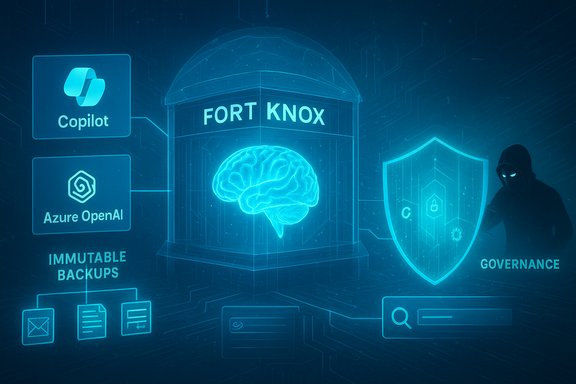
- Azure‑native deployment options for DataProtect, SmartFiles, and FortKnox (air‑gapped cloud vaulting).
- The release includes a customer case study: Bethany Children’s Health Center (Oklahoma), where Cohesity and Microsoft claim improved anomaly detection, faster ransomware recovery with AI‑scanned restore points, and better compliance workflows. Cohesity had published the BCHC case earlier in May 2025 and re‑references it in the November announcement.
Technical integrations — how the pieces fit
Cohesity Gaia + Microsoft 365 Copilot: RAG with governance
Cohesity Gaia is designed to index secondary data — snapshots, archived mailboxes, documents, file shares, and NAS exports — and expose those indexed fragments to Microsoft 365 Copilot using Retrieval‑Augmented Generation (RAG) patterns. In practice, the architecture described by Cohesity and observers looks like this: Gaia creates a versioned vector index of backup artifacts; Copilot issues an RAG query that retrieves supporting fragments; an LLM (routed to Azure OpenAI/Foundry when required) synthesizes a human‑readable answer, while role‑based access controls (RBAC), sensitivity labels and audit logs attempt to constrain exposure and provide traceability. Key defensive and governance controls called out by Cohesity and reiterated in third‑party briefings include:- RBAC enforcement and sensitivity‑label constraints to limit the data surfaced by Copilot.
- Persistent audit trails linking any generated answer back to specific snapshots and source fragments.
- Optional routing through Microsoft‑hosted inference (Azure OpenAI/Foundry) for customers that require model lineage and residency inside Microsoft’s control plane.
Sentinel, Defender and detection-to-recovery orchestration
Cohesity positions its anomaly signals and IOC scores to feed into Microsoft Sentinel for SIEM correlation, while Defender telemetry enriches backup‑time context. That enables automated Sentinel playbooks (or Logic Apps) to call Cohesity APIs to isolate snapshot sets, halt restore automation, or run malware scanning on candidate restore points — forming a detection‑to‑verified‑restore automation loop. The efficacy of those flows depends heavily on low‑latency connectors, reliable telemetry, and resilient orchestration that can handle edge cases such as false positives or network outages.FortKnox, immutable retention and AI‑scanned restore points
FortKnox is Cohesity’s isolated cloud vault offering an immutable, write‑once copy for long‑term retention. The new messaging layers AI‑scanned restore‑point verification on top of immutable retention: candidate restore points are anomaly‑scored and malware‑scanned before being allowed for automated re‑instatement. That reduces the odds of restoring compromised data but introduces additional verification time which must be accounted for in RTO planning and tabletop exercises.Real‑world example: Bethany Children’s Health Center
Cohesity’s public case study for Bethany Children’s Health Center (BCHC) describes a migration to Cohesity on Azure that led to:- AI‑powered anomaly detection to flag suspicious activity earlier.
- Faster ransomware recovery using immutable backups and AI‑scanned restore points across Microsoft 365 and Azure.
- PHI/PII classification dashboards and Microsoft 365 Copilot–driven operational workflows to improve audit readiness and compliance.
Business momentum and Marketplace economics
Cohesity’s headline go‑to‑market claims — ~200% Marketplace sales growth and >10× co‑sell engagement growth YoY — reflect how Microsoft has incentivized Marketplace transactability and co‑sell in recent partner program updates. Microsoft’s push to make Marketplace fully transactable, expand private offers, and align seller incentives with Marketplace outcomes creates an environment where qualified ISVs can register very rapid YoY increases in Marketplace revenue, especially when moving from early listings to scalable transactable offers. Several partner‑ecosystem analyses demonstrate Marketplace growth trends that make Cohesity’s numbers plausible in context. That said, those exact percentages are company‑reported and should be validated where they matter:- Sales leaders should ask for anonymized co‑sell deal counts and regional breakouts.
- Procurement should request Marketplace revenue/transaction evidence and partner‑team confirmations from Microsoft or a Microsoft account representative.
Critical analysis — strengths, practical upside
- Turning backups into active intelligence. The integration of Gaia + Copilot materially lowers the friction for legal, compliance, and security teams to find historic artifacts without full restores, which can save time and reduce operational disruption.
- Azure‑native governance path. For Azure‑centric organizations, optional routing of inference to Azure OpenAI/Foundry gives a governance and residency model that keeps model execution inside Microsoft’s control plane — appealing to regulated customers.
- End‑to‑end resilience composition. Immutable backups, FortKnox vaulting and AI‑scanned restore verification form a plausible layered defense against modern ransomware playbooks (detect, isolate, validate, recover). When properly implemented and tested, this combination can reduce recovery risk.
- Faster procurement via Marketplace. Transactable Azure Marketplace listings and co‑sell programs can shorten procurement cycles for Azure customers and accelerate pilot‑to‑production timelines if private offers and seller incentives are aligned.
Risks, limitations and governance concerns
- Company‑reported metrics need verification. The 200% and 10× figures and the “13,000 customers / ~70% Fortune Global 500” claims are publicly stated by Cohesity and echoed by trade media — they constitute vendor‑reported evidence of momentum. Buyers should request validating data (anonymized deal counts, reference lists, Microsoft co‑sell confirmations) before relying on those numbers in procurement decisions.
- RTO impact from verification windows. AI‑scanned restore points and malware scanning add time to the restore pipeline. Organizations must explicitly include verification time in Recovery‑Time Objective (RTO) calculations and run live drills to ensure acceptable recovery timelines.
- Trustworthiness of RAG outputs. RAG is only as reliable as the retrieval layer, citation model and index versioning. Generated answers must be traceable to precise backup fragments; any mis‑grounded summaries could mislead legal or security workflows. Insist on prompt logging, citation metadata, and human review for high‑impact decisions.
- Data residency, telemetry and compliance. Customers in regulated jurisdictions must verify where vector indices, prompt logs, and model telemetry are stored and who has access. Optional routing to Azure OpenAI helps, but contractual SLAs and data‑processing agreements must be explicit.
- False positives and automation safety. Automated playbooks that run restores or quarantines based on anomaly scores must be tuned to avoid fail‑closed scenarios that prevent legitimate recovery or fail‑open conditions that restore compromised snapshots. Red‑team testing and staged POCs are essential.
- Vendor concentration and operational coupling. Deep integration with Microsoft’s control plane (Copilot, Azure OpenAI, Sentinel) reduces friction but increases coupling; outages or policy changes at the platform level could have outsized operational effects if not mitigated with fallbacks.
- Cost and licensing complexity. Layered services (Cohesity subscriptions, Copilot licensing, Azure OpenAI usage, Sentinel/Defender ingestion) create a multi‑vendor cost stack that requires careful modeling during procurement. Include ongoing inference costs and Marketplace private‑offer pricing in TCO exercises.
Practical guidance for Windows and Azure‑centric IT teams
- Run a focused POC that mirrors a production incident:
- Simulate a ransomware scenario that requires verified restore and measure end‑to‑end time (detect → scan → validate → restore).
- Include Defender‑to‑Sentinel‑to‑Cohesity playbook automation and test false‑positive handling.
- Validate governance controls:
- Get an architecture and data‑flow diagram showing where indices, prompt logs, and vector stores reside.
- Confirm RBAC, sensitivity‑label enforcement, and audit trail granularity for RAG outputs.
- Negotiate SLAs for model routing and telemetry:
- If you require Azure‑hosted inference for compliance, document routing SLAs and telemetry retention periods.
- Include verification windows in RTOs and DR runbooks:
- Explicitly model scanning/verification time into RTO and perform live drills to validate assumptions.
- Ask for partner‑validated Marketplace metrics:
- Request anonymized co‑sell counts, Marketplace revenue snapshots, and a Microsoft partner contact to corroborate go‑to‑market claims.
Competitive landscape and market context
Cohesity’s recent scale shift — following its combination with Veritas’ enterprise data protection business — positioned the company as a larger player in the data protection market and helps explain claims about expanded customer coverage and market share. Public filings and press at that time cited a substantial increase in customer base and pro‑forma revenue metrics. This strategic consolidation increases Cohesity’s addressable market in enterprise backup and gives it a broader workload support footprint to pair with AI initiatives. Competitors are also moving in similar directions: other backup/resilience vendors have added AI‑driven anomaly detection, verified restore capabilities and Microsoft integrations. That competitive pressure will push rapid feature parity in areas such as Copilot connectivity, Sentinel playbooks and Marketplace transactability; buyers should evaluate not only features but maturity, false‑positive rates, SLAs, and proof points across vendors.What to ask Cohesity and Microsoft before you sign
- For Cohesity:
- Provide anonymized counts of Microsoft co‑sell deals, Marketplace transactions, and a dated regional breakdown for the claimed 200% growth.
- Demonstrate audit trails for at least three production Copilot+Gaia queries, showing source fragments, snapshot lineage and RBAC enforcement.
- Show the average additional verification latency introduced by AI‑scans on restore points and examples of RTOs achieved in production customers.
- For Microsoft / your Microsoft account team:
- Confirm co‑sell engagement counts and whether the listing is transactable globally or limited by private offers/regions.
- Describe support boundaries between Copilot, Azure OpenAI Foundry routing and Cohesity services, and escalation paths for cross‑vendor incidents.
Final assessment
Cohesity’s partnership expansion with Microsoft reflects a real market dynamic: backup data is being reimagined as an active source of security intelligence and business insight, and cloud platform economics (Marketplace + co‑sell incentives) can accelerate commercial momentum quickly. The integration story — Gaia inside Copilot, Azure OpenAI routing, Sentinel/Defender orchestration, immutable vaulting with FortKnox — is coherent and aligns with observable industry trends. Independent trade coverage and Cohesity’s prior corporate moves (including the Veritas combination) corroborate that the vendor is scaling both capability and commercial reach. However, the most critical practical caveats remain: the headline growth numbers are vendor‑reported and should be validated in procurement; RTOs will be affected by verification steps and need testing; and RAG outputs require strict governance, citation and human review in high‑risk contexts. Organizations that pilot carefully, insist on explicit SLAs and audit evidence, and incorporate verification time into recovery planning are the most likely to capture the promised benefits — faster, safer, and smarter recovery — without falling prey to automation surprises or hidden operational costs.Quick checklist for CIOs and CISOs evaluating the Cohesity + Microsoft proposition
- Confirm whether Gaia+Copilot indexing respects enterprise sensitivity labels end‑to‑end and request a demo with your own redaction rules.
- Measure verification latency (mean and peak) for AI‑scanned restore points under representative dataset sizes.
- Obtain anonymized Marketplace and co‑sell metrics tied to your region to validate go‑to‑market claims.
- Require an explicit data residency and telemetry retention schedule for vector indices and prompt logs.
- Run a cross‑vendor incident playbook with Sentinel, Defender and Cohesity to validate automation tolerances.
Cohesity’s November announcement is a meaningful signal that AI and cloud‑native platform economics are reshaping how enterprises approach data resilience: backup systems are becoming active security and knowledge platforms. The technical vision — grounded in RAG, Azure‑hosted inference, SIEM integration and immutable vaulting — is coherent and valuable, but realizing it safely at scale requires disciplined pilots, contractual rigor, and careful RTO/governance planning before wide deployment.
Source: Business Wire https://www.businesswire.com/news/h...-Data-Security-Through-Microsoft-Partnership/
