

Cognizant’s December 18, 2025 announcement of a multi‑year strategic partnership with Microsoft signals a deliberate escalation from cloud migration and managed services into the industrialization of Copilot, agentic AI, and verticalized, production‑grade AI solutions targeted at Financial Services, Healthcare & Life Sciences, Retail and Manufacturing.
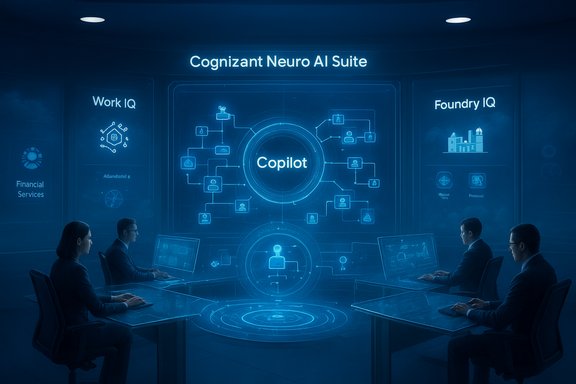
Cognizant (NASDAQ: CTSH) and Microsoft have worked together for years on cloud, application modernization and managed services, but the December 18 press release frames the new agreement as a step‑change: both companies will co‑build industry‑grade AI offerings, co‑sell globally and embed Microsoft’s Copilot and “IQ” layers — Work IQ, Foundry IQ and Fabric IQ — into mission‑critical enterprise workflows. The announcement explicitly ties Cognizant’s Neuro® AI Suite and several proprietary platforms (TriZetto, Skygrade and FlowSource™) to Microsoft cloud and AI services as accelerators for vertical solutions. This move is presented as part of Cognizant’s broader “three‑vector AI builder” strategy and Microsoft’s partner‑centric drive to turn leading systems integrators into what it calls “Frontier Firms” — organizations that embed Copilot and agentic AI deeply into operational processes to unlock measurable productivity gains and new business outcomes. The companies named license‑scale adoption and upskilling inside Cognizant as immediate priorities, with explicit commitments to scale Microsoft 365 Copilot and GitHub Copilot across delivery and consulting teams.
However, the announcement is principally a strategic framework rather than a binding operational roadmap. The real test will be the early months of execution: productized vertical offerings, demonstrable reference deployments, retention of specialist engineering talent (including those from 3Cloud), and concrete governance artifacts that address regulatory and safety concerns. Until those items appear in the market and in customer accounts, procurement and IT leaders should treat the announcement as a signal of intent and require contractable, measurable guarantees before committing to large‑scale adoption.
Cognizant and Microsoft have publicly articulated a high‑ambition plan to co‑build and co‑sell Copilot and agentic AI solutions that are embedded in industry workflows; the partnership strengthens Cognizant’s position in the Microsoft ecosystem and aligns with broader market consolidation around hyperscaler‑centric systems integrators. The value is real if the promises become measurable, repeatable offerings with hardened governance and demonstrable client outcomes. The coming quarters will show whether the relationship moves from strategic intent to industrialized delivery — and whether customers get contractable, auditable guarantees that justify enterprise‑scale adoption.
Source: AD HOC NEWS Cognizant Technology Solutions
 Background
Cognizant (NASDAQ: CTSH) and Microsoft have worked together for years on cloud, application modernization and managed services, but the December 18 press release frames the new agreement as a step‑change: both companies will co‑build industry‑grade AI offerings, co‑sell globally and embed Microsoft’s Copilot and “IQ” layers — Work IQ, Foundry IQ and Fabric IQ — into mission‑critical enterprise workflows. The announcement explicitly ties Cognizant’s Neuro® AI Suite and several proprietary platforms (TriZetto, Skygrade and FlowSource™) to Microsoft cloud and AI services as accelerators for vertical solutions. This move is presented as part of Cognizant’s broader “three‑vector AI builder” strategy and Microsoft’s partner‑centric drive to turn leading systems integrators into what it calls “Frontier Firms” — organizations that embed Copilot and agentic AI deeply into operational processes to unlock measurable productivity gains and new business outcomes. The companies named license‑scale adoption and upskilling inside Cognizant as immediate priorities, with explicit commitments to scale Microsoft 365 Copilot and GitHub Copilot across delivery and consulting teams. Key declarative commitments from the announcement
- Co‑build industry‑grade, Copilot‑driven solutions and vertical accelerators that combine Microsoft cloud and Cognizant industry platforms.
- Joint global co‑sell motions and collaboration on large‑scale deals in Financial Services, Healthcare & Life Sciences, Retail and Manufacturing.
- Embed agentic AI and Copilot into mission‑critical workflows using Microsoft’s Work IQ, Foundry IQ and Fabric IQ capabilities.
- Scale internal adoption of Microsoft 365 Copilot and GitHub Copilot at Cognizant and upskill associates on Azure and Azure AI Foundry.
Why this matters now: market context and timing
The partnership announcement arrives at a moment when hyperscaler cloud consumption and enterprise AI projects are driving demand for integrators that can deliver production‑grade outcomes — not just prototypes. Microsoft’s cloud growth through 2025 and its explicit push to scale Copilot across enterprise customers provide the commercial backdrop for this pact. Cognizant’s messaging positions the collaboration as an answer to the “last‑mile” problem many enterprises face: moving from pilot‑phase AI experiments to sustained, governed, and measurable production deployments. The timing also dovetails with Cognizant’s November 2025 acquisition of 3Cloud, an Azure‑specialist consultancy, which the company and independent reporting framed as a way to add Azure engineering depth and accelerate the ability to build and run Azure‑native AI solutions at scale. That acquisition strengthens the technical picture behind the partnership: more Azure‑certified engineers, delivery frameworks for Fabric/Databricks patterns and managed operations to run inference workloads.What’s actually new — a close reading of the commitments
Co‑build vs. co‑sell: two different bets
Cognizant and Microsoft declared both co‑build and co‑sell intentions. These are distinct but complementary commercial motions.- Co‑build: Joint R&D and productization of vertical, Copilot‑embedded solutions that combine Microsoft’s intelligence layers with Cognizant’s vertical IP. This is an investments‑heavy path that requires product engineering, platform integrations, security and regulatory packaging.
- Co‑sell: Leveraging both salesforces to pursue large deals — a go‑to‑market play that depends on partner economics, revenue‑share models, and aligned customer narratives. Co‑sell success hinges on measurable proof points and predictable deployment outcomes.
Technical focus: Copilot, agentic AI and the “IQ” layers
The deal foregrounds Microsoft 365 Copilot and GitHub Copilot adoption, but more importantly it highlights the integration of agentic AI — multi‑step agents that can act in workflows — and the “IQ” layer technologies Microsoft uses to ground models in enterprise identity, data and governance (Work IQ, Fabric IQ, Foundry IQ). These capabilities are intended to deliver identity‑aware, semantically grounded assistants that can operate in the flow of work and integrate with enterprise systems. Embedding these in regulated verticals (healthcare, financial services) raises both potential value and governance questions that will define real outcomes.Platforms and IP that matter
Cognizant pointed to its Neuro® AI Suite and vertical platforms — TriZetto for payer workflows, Skygrade for risk/compliance scoring, and FlowSource™ for engineering modernization — as the accelerators that will be married to Microsoft primitives. This is significant: the partnership is not just about deploying Copilot; it’s about packaging Copilot‑driven features into domain‑specific playbooks that customers can buy and run. The speed and repeatability of those playbooks will determine how well the partnership converts marketing rhetoric into revenue.Strategic strengths of the agreement
1. Scale and channel leverage
Combining Cognizant’s global delivery footprint with Microsoft’s cloud and platform reach creates a distribution engine that can push Copilot and agentic solutions into large accounts. The co‑sell promise is valuable because Microsoft’s partner incentives favor partners that can drive Azure consumption and license scale. Cognizant’s internal rollout of Microsoft 365 Copilot and GitHub Copilot helps operationalize best practices before pushing to clients.2. Vertical focus reduces proof‑of‑value friction
The decision to prioritize Financial Services, Healthcare & Life Sciences, Retail and Manufacturing is pragmatic: these industries have clear, measurable KPIs (claims processing, risk assessment, call‑center throughput, manufacturing downtime) that make it easier to measure ROI on AI interventions. Verticalized accelerators (TriZetto, Skygrade, FlowSource™) are natural levers to speed deployments in those sectors.3. Complementary technical capabilities
Cognizant’s recent moves — including the 3Cloud deal — inject Azure engineering depth and data‑and‑AI delivery capability into the mix. That reduces the time and technical friction required to stand up Fabric/Databricks patterns and to operationalize Azure OpenAI and MLOps pipelines. In short, the partnership pairs cloud platform primitives with enterprise delivery muscle.4. Internal upskilling and flywheel potential
Cognizant’s plan to scale Copilot internally across delivery teams is important: it creates the potential for internal engineering productivity gains and a population of practitioners who can evangelize Copilot use cases to clients. This internal competence can form a flywheel for both co‑sell efficacy and faster, safer customer deployments.Risks, caveats and open questions
Integration and delivery risk
Turning broad strategic commitments into reliable, repeatable client outcomes is hard. The press release describes intentions rather than binding guarantees. Past patterns in large SI‑hyperscaler collaborations show three persistent hazards:- Retention and cultural integration after acquisitions (3Cloud example): keeping niche engineering culture intact inside a large SI is a recurring challenge. If specialist teams are absorbed and talent leaves, capability claims can wither.
- Reproducibility: building a handful of pilot Copilot/agent solutions is different from deploying hundreds of fully governed, SLA‑backed instances that integrate with legacy systems and compliance controls. Execution discipline matters more than intent.
- Commercial alignment: co‑sell economics and accountability for license consumption and managed services must be explicit. Without tight commercial models, co‑sell can devolve into competing incentives between vendor field teams.
Data governance, privacy and regulatory exposure
Embedding Copilot and agentic AI into workflows in Financial Services and Healthcare raises thorny governance questions: data residency, model grounding and explainability, audit trails of agent actions, and the legal liability of automated decisions. The press release emphasizes responsible scaling, but the real tests will be product packaging, contractual SLAs and third‑party attestations that demonstrate compliance in regulated jurisdictions. These are not trivial and can slow adoption or force bespoke implementations that erode margins.Vendor lock‑in and architectural choices
Committing to Microsoft’s full Copilot + IQ stack and Azure technical primitives can accelerate deployments — but it concentrates risk. Customers adopting the resulting vertical solutions may face higher switching costs if they want to diversify cloud or model providers later. Enterprises sensitive to sovereign or vendor‑diversification concerns will demand clear portability and data separation guarantees.Agentic AI safety and operational unpredictability
Multi‑step agents introduce new failure modes: automation acting on incomplete or stale data, agents performing unintended actions, and the challenge of reliably testing agent behavior in complex enterprise environments. Operational resilience requires layered guards: human‑in‑the‑loop checkpoints, deterministic fallbacks, and rigorous testing frameworks that go beyond ordinary QA. The announcement signals the intent to embed agents but does not enumerate the governance guardrails or safety engineering that will be needed at scale.Financial transparency and measurable KPIs
The public release is clear on strategic intent but not on financial mechanics. Important questions remain unanswered in announced materials:- Pricing and contractual models for combined solutions (how Copilot licenses, Azure consumption and Cognizant managed services fees are bundled).
- Expected timeframes and KPIs for converting prototype projects into recurring revenue.
- How Cognizant will measure and report adoption and outcomes internally and to customers.
How enterprises should evaluate the offering
Enterprises considering Cognizant+Microsoft Copilot/agentic solutions should adopt a cautious, structured evaluation that treats the announcement as a signal, not a turnkey guarantee.Short checklist for procurement and IT leaders
- Demand contractable SLAs and auditability for any Copilot‑enabled workflow that touches regulated data.
- Require explicit data residency and processing guarantees for sensitive workloads and proof of in‑country handling where required.
- Ask for reference deployments in the same vertical that demonstrate measurable KPIs (e.g., percent reduction in claims processing time, improvements in first‑call resolution).
- Insist on runbook‑level details for agent governance: how are agent actions logged, how are rollbacks handled, and what human escalation paths exist?
- Evaluate portability: request migration scenarios and exit plans that show how to move data and workflows off a combined Cognizant‑Microsoft stack if needed.
Commercial implications for Cognizant, Microsoft and competitors
For Cognizant
The partnership reinforces Cognizant’s strategic pivot to be an “AI builder” that pairs platform engineering with vertical IP. If Cognizant can productize its Neuro® AI Suite and the named vertical platforms alongside Microsoft primitives, it stands to capture sizeable managed‑service revenues and Azure consumption economics. However, success depends on disciplined productization, retention of engineering talent (3Cloud integration will be a test) and the ability to demonstrate reproducible client outcomes.For Microsoft
This arrangement advances Microsoft’s broader Copilot industrialization strategy by pushing large SI partners to embed Copilot and agents into core enterprise work. Microsoft benefits if these partners drive license scale and Azure consumption, especially in regulated verticals where Microsoft’s investments in data‑sovereignty and commercial terms are tested. The partnership also increases Microsoft’s presence inside enterprise operating models via partner IP.For competitors and the market
Other global SIs — both hyperscaler‑aligned and independent — will respond in kind. The market is already consolidating around partners that can deliver both platform engineering and vertical IP. Smaller specialists risk being acquired or squeezed by combined offers. For customers, a proliferation of SI/hyperscaler stacks increases the need for careful vendor governance and integration discipline.Technical considerations: engineering, security and operations
Building agents that are production‑grade
Operationalizing agentic AI at scale requires engineering investments beyond model selection:- Robust identity and access integration (so agents act with correct permissions).
- Semantic grounding to trusted data sources (so agents don’t hallucinate).
- Deterministic testing frameworks for multi‑step workflows, including chaos testing for edge cases.
- Observability and traceability, with immutable logs and human audit trails.
- Runtime governance that enforces policy, rate limits and human approval thresholds.
Security posture and supply‑chain risk
Embedding third‑party agent logic into critical workflows expands the attack surface. Typical concerns include model‑poisoning vectors, API‑level vulnerabilities, and supply‑chain dependencies on both platform and integrator code. Customers should require third‑party attestation of security controls, penetration testing results, and compliance certifications for any managed service offering built from this partnership.Measuring success: how to tell if the partnership delivers
Assessing whether this partnership delivers tangible value requires watching a set of measurable indicators over the next 12–24 months:- Documented reference deployments in the named verticals with quantified KPIs (productivity uplift, cost reduction, speed to decision).
- Azure consumption growth attributable to Cognizant engagements and evidence of license scale for Microsoft 365 Copilot and GitHub Copilot.
- Retention rates and headcount metrics for specialist engineering teams (including the outcome of the 3Cloud integration).
- Published case studies that detail governance, compliance and incident response post‑deployment.
- Evidence of repeatable IP (packaged accelerators or managed services) that customers can procure with clear SLAs.
What to watch next (near‑term milestones)
- Early client announcements and reference case publications from Cognizant and Microsoft in H1 2026.
- Productized vertical offers or managed services that combine Copilot licensing, Azure consumption and Cognizant delivery in clearly priced bundles.
- Integration progress and retention metrics from the 3Cloud acquisition, which is expected to close subject to regulatory approvals and customary conditions.
- Any regulatory or customer disclosures about data residency or in‑country processing options for Copilot/agent deployments in sensitive jurisdictions.
Verdict: pragmatic optimism, conditioned on execution
The Cognizant–Microsoft partnership is a logical next step in the industrialization of enterprise AI. It pairs platform and channel scale with vertical IP and delivery capacity, and it is well aligned to the current commercial dynamics of hyperscaler‑driven AI adoption. The combination can produce meaningful outcomes for clients that need repeatable, governed AI workflows — if the engineering work, governance artifacts and commercial models are productized and executed with discipline.However, the announcement is principally a strategic framework rather than a binding operational roadmap. The real test will be the early months of execution: productized vertical offerings, demonstrable reference deployments, retention of specialist engineering talent (including those from 3Cloud), and concrete governance artifacts that address regulatory and safety concerns. Until those items appear in the market and in customer accounts, procurement and IT leaders should treat the announcement as a signal of intent and require contractable, measurable guarantees before committing to large‑scale adoption.
Practical guidance for CIOs and procurement teams evaluating vendor pitches
- Require an initial pilot that maps directly to a clear business KPI and includes a rollback plan, human‑in‑the‑loop checkpoints, and incident playbooks.
- Insist on contractual commitments for data residency, model explainability, and audit logs where regulated data is involved.
- Demand transparency about commercial economics: how Copilot licenses, Azure consumption and managed service fees are invoiced and who bears overrun risk.
- Verify provider claims using independent references and ask for running dashboards that demonstrate production stability, not just lab proofs.
- Build a multi‑sourcing strategy for critical controls: avoid single‑vendor lock‑in for core governance components by specifying modular integration points.
Cognizant and Microsoft have publicly articulated a high‑ambition plan to co‑build and co‑sell Copilot and agentic AI solutions that are embedded in industry workflows; the partnership strengthens Cognizant’s position in the Microsoft ecosystem and aligns with broader market consolidation around hyperscaler‑centric systems integrators. The value is real if the promises become measurable, repeatable offerings with hardened governance and demonstrable client outcomes. The coming quarters will show whether the relationship moves from strategic intent to industrialized delivery — and whether customers get contractable, auditable guarantees that justify enterprise‑scale adoption.
Source: AD HOC NEWS Cognizant Technology Solutions
