Cognizant and Microsoft have announced a multi‑year strategic expansion of their partnership to co‑build industry‑grade AI solutions, embed agentic AI and Microsoft Copilot capabilities into mission‑critical workflows, and jointly pursue large-scale deals across financial services, healthcare and life sciences, retail and manufacturing.
Background / Overview
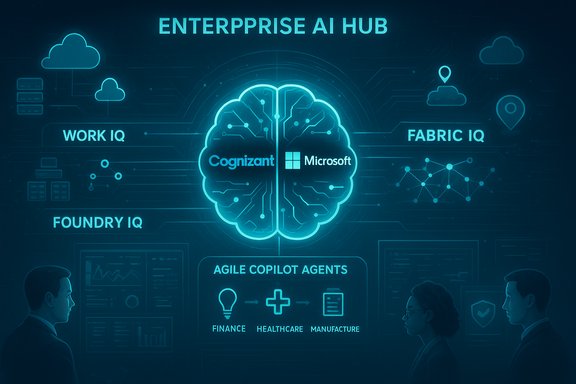
For the past several years Cognizant and Microsoft have maintained a broad cloud and services alliance; the December 18, 2025 announcement formalizes a deeper, outcome‑oriented phase of that relationship focused on moving enterprises from pilots to production‑grade, Copilot‑driven workflows. The companies say the expanded agreement centers on co‑building vertical solutions, co‑selling globally, and bringing agentic AI — multi‑step, workflow‑oriented agents — into the flow of work. This latest step is explicitly tied to Cognizant’s Neuro® AI Suite and specialized platforms (TriZetto, Skygrade, FlowSource™), and to Microsoft’s “Intelligence Layer” consisting of Work IQ, Fabric IQ and Foundry IQ — architectural pieces Microsoft describes as necessary to make Copilot and agentic systems auditable, identity‑aware and enterprise‑grade. Much of the public messaging frames this as a move to create “Frontier Firms” — enterprises that embed Copilot and agents deeply to redefine work — and to scale Copilot seat deployments at partner scale. Microsoft has contemporaneous public initiatives that amplify this aim, including a headline investment in India and coordinated Copilot commitments with several large systems integrators.What the partnership actually covers
Core commitments and scope
- Co‑development of industry‑grade AI solutions that combine Microsoft cloud, Copilot, and Azure AI Foundry capabilities with Cognizant’s vertical platforms and delivery models.
- A co‑sell motion: Cognizant and Microsoft will jointly pursue large deals, leveraging combined sales channels and customer relationships.
- Embedding agentic AI and Copilot functionality (Microsoft 365 Copilot, GitHub Copilot) into enterprise workflows to improve productivity, customer experience and operational resilience.
- Upskilling and adoption programs: Cognizant will scale Microsoft 365 Copilot and GitHub Copilot across its delivery and consulting teams and train associates on Azure, Azure AI Foundry, and associated tooling.
Where it will be applied
The announcement names four priority verticals where Cognizant and Microsoft will focus: Financial Services, Healthcare & Life Sciences, Retail, and Manufacturing. These are sectors with heavy regulation, complex legacy systems and measurable opportunity for process automation and knowledge‑work augmentation — making them natural first targets for agentic AI rollouts.Technical building blocks: what’s being integrated
Microsoft’s intelligence and Copilot stack
Microsoft’s articulation of the enterprise AI stack matters here because the partners intend to build on the same primitives:- Work IQ — the people‑ and role‑aware context layer for Copilot that retains memory and maps signals from mail, chat and files into a persistent model of the workplace.
- Fabric IQ — a semantic data layer inside Microsoft Fabric that maps operational systems and analytics into business entities (customers, orders, inventory) so models can reason using business meaning rather than raw tables.
- Foundry IQ / Azure AI Foundry — the model catalogue, routing and governance plane used to deploy, route and observe models and agent runtimes at enterprise scale.
Cognizant’s Neuro® AI Suite and vertical platforms
Cognizant positions the partnership as an extension of its Neuro® AI Suite, a collection of platforms and accelerators intended to industrialize AI across vertical processes. Named Cognizant platforms include:- TriZetto — healthcare payer platforms and claims processing assets used to automate core insurance and health‑plan workflows.
- Skygrade — a platform for risk, compliance and scoring-related workflows (company-described).
- FlowSource™ — tooling to modernize engineering and delivery capabilities for scaled software development.
Why both companies want this: strategic rationale
Why Cognizant is doubling down with Microsoft
Cognizant’s objectives are pragmatic: align with the dominant productivity and enterprise stack (Microsoft 365 + Azure), reduce friction for clients standardizing on Azure, and convert sizable internal and client seat deployments into enduring revenue streams. The 3Cloud acquisition strengthens the technical pathway for delivering Azure‑native, production‑grade AI solutions. In short, Cognizant gains deeper product roadmap access, prioritized engineering support and scaled co‑sell capacity with Microsoft.Why Microsoft needs large systems integrators like Cognizant
Microsoft’s commercial model for Copilot and Azure AI depends heavily on cloud consumption and enterprise seat adoption. Large systems integrators provide distribution, verticalization IP and implementation muscle that can convert platform capabilities into client outcomes. Partnering with Cognizant extends Microsoft’s reach into regulated industries where specialized workflow knowledge and delivery scale are critical. This in turn drives Azure consumption and co‑sell economics.Market and geopolitical context
Microsoft’s contemporaneous announcements — including a multibillion‑dollar investment into India and coordinated Copilot seat commitments with Cognizant, Infosys, TCS and Wipro — create a commercial and geopolitical backdrop that amplifies this partnership’s strategic importance. The broader initiative is framed as a route to scale agentic AI while providing in‑country processing and sovereign‑ready options for regulated workloads. These moves are aimed at reducing latency, addressing data residency concerns and accelerating adoption across large enterprise accounts.Scale claims and what’s verifiable now
Microsoft’s public briefings during December 2025 positioned four major systems integrators as “Frontier Firms,” each committing to deploy more than 50,000 Microsoft 365 Copilot licenses, producing a combined footprint Microsoft described as exceeding 200,000 Copilot seats. These license‑count figures have been repeated in Microsoft and partner statements and in press coverage; however, seat commitments and activation calendars are declarations of intent and should be distinguished from live, fully‑provisioned, measured usage. Cognizant’s own release confirms the multi‑year partnership and platform integration goals, and the 3Cloud acquisition is a disclosed, independent transaction that materially increases Cognizant’s Azure credentials — both facts that are verifiable in company filings and press releases. Flag for readers: promises of seat counts, dollarized outcomes or productivity multipliers need subsequent verification in the form of published case studies, customer activation dashboards, and third‑party usage metrics. Until those appear, these statements remain corporate commitments rather than audited results.Operational and technical considerations for enterprise buyers
Enterprises evaluating joint Cognizant‑Microsoft offers should treat the announcement as a prompt to reset procurement and governance expectations in these concrete ways:- Demand measurable activation metrics. Contracts should bind economics (discounts, success fees, consumption credits) to evidence of active seat usage, business KPIs and time‑based milestones.
- Require architecture and data‑flow transparency. Agents must be auditable, with model lineage, prompt logs, ground truth references and retention policies clearly stated. This is non‑negotiable for regulated sectors.
- Verify in‑country processing and data residency claims. If a vendor promises local Copilot processing or sovereign options, enterprises should obtain technical architecture diagrams and SLAs that specify where inference and data storage occur.
- Insist on portability and escape clauses. Large co‑sells and vendor bundles increase switching costs; contracts should include portability rights for data and models to avoid lock‑in.
- Establish human‑in‑the‑loop governance. Agentic workflows can initiate actions — enterprises must keep human oversight, approval gates and escalation paths in place.
Notable strengths of the expanded alliance
- Vertical depth meets platform scale. Cognizant’s industry platforms and delivery footprint combined with Microsoft’s Copilot and Azure primitives can shorten time to production for complex, regulated workflows.
- Stronger path to production. The 3Cloud acquisition adds Azure engineering horsepower, addressing a common “last‑mile” problem for AI projects — taking prototypes to reproducible, monitored production systems.
- Co‑sell and distribution muscle. A joint GTM motion can accelerate customer procurement cycles and provide bundled commercial models that lower procurement friction.
- Governance surface in product. Microsoft’s emphasis on Work IQ/Foundry IQ/Fabric IQ signals a productized approach to identity, grounding and observability that, if implemented consistently, reduces the ad‑hoc risk many early AI pilots experienced.
Material risks and caveats
- Vendor lock‑in and concentration. Large, platform‑centric partnerships reduce architectural diversity. Customers could face higher switching costs if they standardize on Copilot + Azure + Cognizant‑built IP without contractual portability guarantees.
- Governance and auditability gaps. Agentic AI increases the risk surface: persistent agents that perform multi‑step actions complicate evidence trails unless telemetry, decision logs and human approvals are baked in from day one. Many enterprise customers will need to insist on auditable guardrails as a condition of deployment.
- Cost and consumption volatility. Large seat counts and model‑inference consumption can produce unpredictable cloud bills. Enterprises must model consumption scenarios and require transparent pricing for inference, storage and orchestration.
- Operational maturity mismatch. While Cognizant brings vertical delivery expertise, some customers may find that organizational processes, legacy integrations and data quality issues are still the gating factors for value realization. The partnership reduces some friction but does not erase the hard work of change management.
Competitive and industry implications
Microsoft’s strategy of elevating a small set of large systems integrators as distribution engines for Copilot and agentic AI (the “Frontier Firms” play) reshapes the services landscape in several ways:- It creates a cohort of hyperscaler + integrator combinations that can offer turnkey, Azure‑centric AI solutions at global scale. This benefits enterprises seeking one‑stop vendors for compliance‑sensitive workloads.
- It increases pressure on smaller specialists and multi‑cloud integrators to either partner with major cloud vendors or build niche, cross‑platform value propositions that avoid single‑vendor lock‑in.
- It focuses competition on execution and vertical IP: the winners will be those who can demonstrate repeatable vertical outcomes, solid governance frameworks, and predictable economics.
Practical next steps for enterprise IT leaders
- Request activation case studies. Require vendors to show at least one live customer deployment per target vertical with measurable KPIs.
- Pilot with binding KPIs. Structure initial engagements as outcome‑based pilots with defined success metrics (time saved, error rate reduction, FTE reallocation).
- Audit the data flow. Obtain explicit architecture diagrams showing where data is stored, where inference occurs, and the identity model for agent actions.
- Negotiate governance and portability clauses. Include rights to logs, model artifacts and data exports that enable future migration.
- Budget for consumption. Model multiple workload scenarios and include guardrails to avoid runaway inference costs.
What to watch next
- Evidence of activation: published customer case studies, third‑party audits or dashboards showing active Copilot/agent usage will be the clearest signal that the partnership is moving from intent to impact.
- 3Cloud integration progress: whether Cognizant successfully preserves specialized Azure engineering capacity and delivers on the promised certification and talent numbers will materially affect delivery capabilities.
- Microsoft’s infrastructure rollouts and in‑country processing options tied to its India investment will determine which regulated workloads can be migrated to Copilot surfaces without violating data residency rules.
Conclusion
The Cognizant–Microsoft expansion is a logical and predictable evolution of two longstanding partners moving into the practical phase of enterprise AI adoption: platform primitives (Copilot, Azure, Foundry) plus vertical execution capability (Cognizant’s Neuro® suite and industry platforms) create a plausible path from pilots to production. The partnership’s strengths are its vertical focus, co‑sell distribution model and Microsoft‑centred technical spine; its open questions are activation, governance and the economics of scale.For enterprise decision‑makers, the announcement is an invitation to pursue practical optimism: recognize the opportunity to embed agentic AI into workflows, but insist on contractual evidence of activation, transparent governance, and architectural portability to manage the real risks that come with platform‑centric scale.
Source: Nasdaq https://www.nasdaq.com/articles/cog...-partnership-drive-enterprise-transformation/