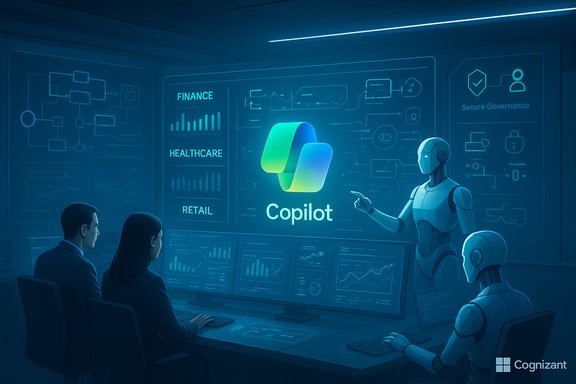
Cognizant and Microsoft have formalized a multi‑year strategic partnership to co‑build industry‑grade, Copilot‑driven AI solutions and to jointly pursue large deals that move enterprises from pilots to production‑grade, agentic AI workflows. The pact—announced December 18, 2025—ties Cognizant’s Neuro® AI Suite and vertical platforms to Microsoft’s Copilot family and its emerging “intelligence layer” (Work IQ, Fabric IQ, Foundry IQ), and it commits both firms to co‑sell, co‑innovate and scale Copilot and GitHub Copilot across delivery teams and client engagements.
Cognizant (NASDAQ: CTSH) and Microsoft have a long history of collaboration on cloud, application modernization, and managed services. The December 18, 2025 announcement marks a clear escalation: the relationship is shifting from platform and migration services toward an outcome‑oriented, AI industrialization playbook that combines product, platform and systems‑integration capabilities. The companies say the goal is to help global enterprises become “Frontier Firms”—organizations that redefine work, unlock new value, and scale innovation responsibly by embedding Copilot and agentic AI into mission‑critical workflows. The public messaging identifies four priority verticals: Financial Services, Healthcare & Life Sciences, Retail, and Manufacturing—categories where complex legacy systems, high regulation and measurable process KPIs make the potential ROI on agentic AI especially tangible. Cognizant frames the partnership as an extension of its “three‑vector AI builder strategy” and its Neuro® AI Suite, and Microsoft positions the initiative as part of a broader partner play that will scale Copilot deployments through large systems integrators.
At the same time, the announcement amplifies familiar enterprise trade‑offs: the promise of rapid scale versus risks of concentration, portability challenges, and governance gaps. Seat counts and license commitments headline the story today; the test will be measurable activation, audited governance and real customer outcomes tomorrow. Buyers should demand activation evidence, airtight governance, and contractual protections that prioritize portability and auditability—only then will the promise of “Frontier Firms” translate into reliable, long‑term value.
Source: The Fast Mode Cognizant, Microsoft Form Multi-Year Partnership to Build AI-Powered Enterprises
 Background / Overview
Cognizant (NASDAQ: CTSH) and Microsoft have a long history of collaboration on cloud, application modernization, and managed services. The December 18, 2025 announcement marks a clear escalation: the relationship is shifting from platform and migration services toward an outcome‑oriented, AI industrialization playbook that combines product, platform and systems‑integration capabilities. The companies say the goal is to help global enterprises become “Frontier Firms”—organizations that redefine work, unlock new value, and scale innovation responsibly by embedding Copilot and agentic AI into mission‑critical workflows. The public messaging identifies four priority verticals: Financial Services, Healthcare & Life Sciences, Retail, and Manufacturing—categories where complex legacy systems, high regulation and measurable process KPIs make the potential ROI on agentic AI especially tangible. Cognizant frames the partnership as an extension of its “three‑vector AI builder strategy” and its Neuro® AI Suite, and Microsoft positions the initiative as part of a broader partner play that will scale Copilot deployments through large systems integrators.What the partnership actually covers
Core commitments
- Co‑build industry‑grade AI solutions that stitch Microsoft cloud, Copilot, and Azure AI Foundry capabilities with Cognizant’s vertical IP and delivery frameworks.
- Joint go‑to‑market and co‑sell motions, targeting large enterprise deals globally in the named sectors.
- Embed agentic AI—multi‑step, workflow‑oriented agents—together with Microsoft 365 Copilot and GitHub Copilot into mission‑critical workflows to accelerate productivity, customer experience and operational resilience.
- Scale internal adoption: Cognizant will roll out Microsoft 365 Copilot and GitHub Copilot across its delivery and consulting teams and upskill associates on Azure, Azure AI Foundry and related tooling.
Named product and platform pieces
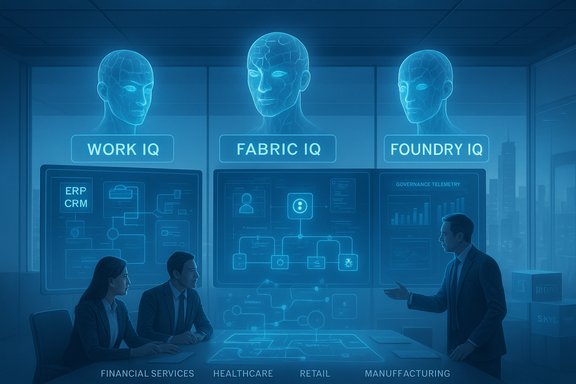
- Microsoft primitives: Work IQ, Fabric IQ, Foundry IQ (the intelligence‑layer services Microsoft uses to provide identity‑aware context, semantic data grounding and model/governance plumbing for Copilot and agents).
- Cognizant IP: Neuro® AI Suite, plus domain platforms TriZetto (healthcare/payer workflows), Skygrade (risk/compliance/scoring) and FlowSource™ (engineering/delivery modernization). These will act as accelerators and vertical templates.
Verifying the key claims
Multiple public sources corroborate the headline items included in the announcement. Cognizant’s corporate release dated December 18, 2025 confirms the partnership and the core commitments outlined above. PR Newswire and Cognizant’s investor relations site reproduce the same release, confirming the date and the language used. Several industry reports and news outlets also place the Cognizant tie‑up in the broader context of Microsoft’s partner‑led Copilot strategy and Microsoft’s regional investments—most notably the $17.5 billion India investment Microsoft announced in December 2025 to expand cloud and AI infrastructure, skilling and sovereign‑ready capabilities between 2026 and 2029. That $17.5B commitment is independently reported by Microsoft’s regional newsroom and major outlets. Caveat on numerical claims: large license counts and seat‑deployment targets frequently appear in partner messaging (for example, Microsoft’s on‑stage figure that top integrators would deploy tens of thousands of Copilot seats). Those are commercial commitments and not immediate, auditable activation metrics—they require later validation via usage dashboards, customer case studies and financial disclosures. Treat seat counts and activation timelines as contractual intent rather than instant, fully‑activated inventories.The technical spine: what Work IQ, Fabric IQ and Foundry IQ mean
For enterprise adoption of agents and Copilot to move beyond demos, three technical gaps must be closed: identity‑aware reasoning, business‑semantic grounding, and enterprise governance/observability. Microsoft’s “IQ” nomenclature maps directly to those needs:- Work IQ: a people‑ and role‑aware context layer that captures signals from mail, chat, calendar and files and provides Copilot with identity‑bound memory and situational awareness. This helps agents maintain continuity and operate with appropriate scope and permissions.
- Fabric IQ: a semantic data layer inside Microsoft Fabric that maps operational data and analytics into business entities (customers, orders, inventory), enabling models to reason on business meaning rather than raw tables. This is essential when agents need to interact with ERP, CRM or line‑of‑business systems.
- Foundry IQ / Azure AI Foundry: a model catalogue, routing and governance plane that handles model selection, routing, observability, and tenant isolation—key controls for enterprises operating in regulated sectors.
Cognizant’s playbook: Neuro® AI Suite, FlowSource™ and the 3Cloud bet
Cognizant positions this partnership as an extension of its broader AI strategy. Two operational details matter for buyers and industry watchers:- Cognizant Neuro® AI Suite: This umbrella is the company’s commercial packaging for AI services and assets that will leverage Microsoft cloud and AI services to create verticalized solutions. The December announcement states the partnership will expand on that offering.
- Strategic M&A: Cognizant’s announced acquisition of 3Cloud (definitive agreement dated November 13, 2025) strengthens its Azure bench and engineering capacity—21,000+ Azure‑certified specialists are cited in the transaction announcement—making Cognizant a larger, more credible integrator for Azure‑native AI solutions. Financial terms were not disclosed; close is expected in Q1 2026 subject to regulatory approvals.
Microsoft’s incentives and the India context
From Microsoft’s perspective, the partnership with Cognizant is one node in a deliberate partner strategy to industrialize Copilot across large enterprise installs. Microsoft has publicly elevated a set of systems integrators—Cognizant, Infosys, TCS and Wipro—as what it calls “Frontier Firms,” and it presented an aggregate target of deploying more than 200,000 Copilot seats across those firms in a coordinated program. Multiple news outlets and Microsoft’s own regional announcements back up that narrative. Microsoft’s December 2025 $17.5 billion India commitment (2026–2029) is central to this market logic: it funds hyperscale data centers, in‑country Copilot processing, and large skilling programs that reduce latency, enable data sovereignty and expand the pool of AI‑fluent engineers capable of operating Copilot and agentic systems at scale. That investment materially strengthens Microsoft’s bargaining power with large integrators while creating an ecosystem where Azure consumption and Copilot usage both grow.Commercial and competitive implications
- Faster GTM for Copilot solutions: Co‑selling with Cognizant gives Microsoft prioritized routes to enterprise customers and the vertical engineering teams required to convert pilots into production systems. For Cognizant, the arrangement promises an inside track to Microsoft product roadmaps and engineering support.
- Increased Azure consumption: As partners deploy Copilot and agentic workloads, Azure inference, storage and data services are likely to see material uplift—Microsoft’s motivation is as much consumption economics as product adoption.
- Market concentration and vendor lock‑in: The play consolidates a pattern visible across 2025–2026—hyperscale cloud providers plus a handful of global integrators become the de facto delivery vehicles for enterprise AI. This simplifies procurement for some customers but increases switching friction and concentration risk for strategic workloads.
Practical risks and governance concerns
- Activation vs. commitment: Seat counts are headlines, not proof of value. Large license portfolios can become under‑utilized if skilling, change management and workflow integration do not follow. Procurement teams should insist on KPIs, activation dashboards and economic clauses that tie payments to demonstrated usage and outcomes.
- Data residency and export controls: Connecting Copilot and agentic workflows to regulated data (health records, financial ledgers) raises questions about where inference happens, auditability of outputs, and cross‑border flows. Microsoft’s India investment includes sovereign‑ready processing, but customers must demand architecture diagrams and SLAs that specify processing locality and access controls.
- Governance, traceability and explainability: Agentic systems that take actions require richer observability—audit logs, retrievable prompts, output provenance and human‑in‑the‑loop controls. Foundry IQ-style governance is necessary but not sufficient; independent conformance testing and third‑party audits will become standard procurement asks.
- Concentration and portability: Deep verticalization around Microsoft primitives plus Cognizant’s platforms can accelerate deployment, but it also risks creating non‑portable business processes (e.g., connectors and ontologies that lock data and workflows into a single cloud + SI stack). Negotiate portability terms, data export guarantees, and code/IP ownership upfront.
- Security and supply‑chain exposure: Large integrations between enterprise systems and agentic components expand attack surface. Zero‑trust controls, short‑lived credentials for agent runtimes, and hardened registries are immediate operational requirements. Security teams must demand independent red‑team evidence before production rollout.
What enterprise buyers should demand (checklist)
- Concrete activation metrics and delivery milestones tied to commercial terms (not just license delivery).
- Architecture blueprints showing where data is stored, processed, and logged—explicitly state in‑country processing commitments where required.
- Governance and audit artifacts: prompt logs, action trails, model routing policies and retrievability of source inputs used for outputs.
- Portability and exit clauses for connectors and domain ontologies.
- Independent security and compliance attestations, including penetration testing and third‑party privacy impact assessments.
- Reskilling and human oversight plans: evidence that staff will be trained as agent supervisors, not just Copilot users.
Early architecture patterns to expect from joint solutions
- Azure‑first deployments using Azure AI Foundry for model routing, OneLake/Fabric for semantic data models, and Microsoft Entra + Purview for identity and data governance.
- Vertical accelerators that combine TriZetto connectors (payer systems) or Skygrade modules (risk scoring) with Copilot authoring in Copilot Studio; this lets domain specialists assemble agentic workflows faster.
- Hybrid processing where sensitive retrieval and grounding happen in sovereign regions (e.g., Microsoft’s India South Central region) while less sensitive orchestration or model selection may run in global control planes.
Strategic analysis: who wins, who should be cautious
- Winners: Enterprises that already run heavy Microsoft 365 + Azure footprints and prefer a fast, integrated route to production agentic AI will benefit from repeatable accelerators and co‑delivered services. Cognizant’s domain platforms and new Azure capacity from the 3Cloud acquisition materially reduce delivery risk for complex vertical projects.
- Caution required: Organizations with multi‑cloud strategies, strict data sovereignty needs outside Microsoft’s regional coverage, or those unwilling to accept deeper vendor concentration should tread carefully. Vendor lock‑in and concentrated cloud spend are real strategic downsides.
The near horizon: what to watch for next
- Activation metrics and case studies: Evidence that co‑built agents deliver measurable KPIs (time saved, error reduction, revenue uplift) in regulated sectors will be the decisive proof point. Expect the first public client case studies in 2026‑2027 if the deal execution is successful.
- Regulatory responses: As agentic systems are used in finance and healthcare, regulators will ask for auditability and model validation—look for compliance frameworks and industry‑specific attestations to appear in partner contracts.
- Product evolution: Microsoft’s investment in its model stack and moves to integrate multiple models (including non‑OpenAI models) into Copilot products will change the model‑management calculus and could reduce dependency risk for customers over time.
- Competitive reactions: Other major integrators will expand their Microsoft partnerships or accelerate multi‑cloud agent strategies—customers should evaluate competing GTM options to ensure best fit.
Conclusion
The Cognizant–Microsoft multi‑year partnership is a pragmatic recognition that enterprise AI must be delivered as an integrated stack of product, governance and delivery capabilities—not merely as model access. The alliance brings together Cognizant’s vertical platforms and delivery scale with Microsoft’s Copilot products and the intelligence‑layer primitives necessary for agentic AI to function in regulated environments. If executed well, it can speed the transition from pilot projects to production workflows and deliver measurable business outcomes.At the same time, the announcement amplifies familiar enterprise trade‑offs: the promise of rapid scale versus risks of concentration, portability challenges, and governance gaps. Seat counts and license commitments headline the story today; the test will be measurable activation, audited governance and real customer outcomes tomorrow. Buyers should demand activation evidence, airtight governance, and contractual protections that prioritize portability and auditability—only then will the promise of “Frontier Firms” translate into reliable, long‑term value.
Source: The Fast Mode Cognizant, Microsoft Form Multi-Year Partnership to Build AI-Powered Enterprises