

Microsoft published two Security customer stories on May 22, 2026, spotlighting St. Luke’s University Health Network and ManpowerGroup as examples of organizations using Microsoft Security Copilot, Microsoft Defender, Microsoft Sentinel, and Microsoft 365 E5 to prepare their security foundations for AI adoption. The company’s message is not subtle: before businesses can safely let AI reshape work, they need cleaner telemetry, stronger identity controls, and fewer disconnected security tools. That is both a product pitch and a useful warning. The AI boom is turning yesterday’s “good enough” security architecture into tomorrow’s unmanaged risk.
The most interesting thing about Microsoft’s latest security customer push is that it is not really about flashy AI at all. It is about the dull, expensive, chronically underfunded plumbing beneath AI: identity, endpoint protection, SIEM operations, data governance, alert triage, and the painful work of consolidating tools that never quite talked to each other.
That is where the company’s two examples land. St. Luke’s is presented as a healthcare organization trying to give its security operations center a unified, AI-assisted view across Microsoft Defender and Microsoft Sentinel. ManpowerGroup is framed as a global workforce company reducing tool sprawl by moving toward Microsoft 365 E5, Defender, Sentinel, Entra, and Purview as a common platform.
Microsoft calls this the foundation for “AI-powered work,” but the practical lesson is older than generative AI: complexity is where risk hides. The more consoles, agents, rules, licensing models, data stores, and manual handoffs a security team must coordinate, the more likely it is that the crucial signal arrives too late, lands in the wrong queue, or is buried under a mountain of false positives.
The company’s argument is also opportunistic. Microsoft has spent years assembling a security stack that stretches from the Windows endpoint to the cloud identity layer to the SOC console. Now it is recasting that stack as the prerequisite for agentic AI, where autonomous or semi-autonomous systems may act on business data, summarize incidents, trigger workflows, or recommend remediation.
That framing is persuasive because AI raises the cost of poor security hygiene. If organizations do not know where sensitive data lives, which identities are overprivileged, which devices are unmanaged, or which alerts deserve action, AI will not magically solve the problem. It may simply accelerate the consequences.
St. Luke’s University Health Network is described as having a visibility problem across its security tools. That is a familiar condition in mature organizations, especially those that have accumulated point solutions over time. Each tool may be defensible on its own; together, they can create a fragmented operational picture that slows detection and response.
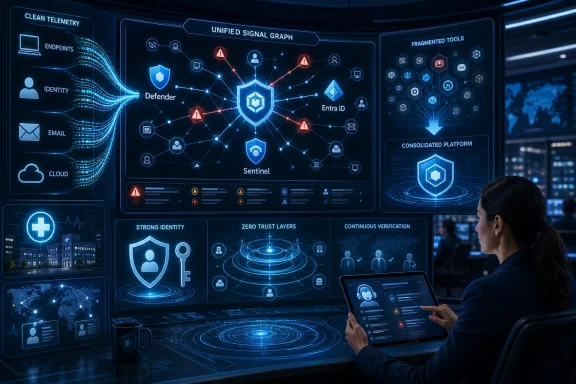
Microsoft’s answer is Security Copilot layered into workflows that already include Defender and Sentinel. In the company’s telling, St. Luke’s gains a unified view across endpoints, identity, email, and cloud workloads, allowing analysts to correlate threats faster and move from reactive response toward something closer to proactive defense. That is the dream version of the SOC: fewer swivel-chair investigations, more context at the moment of decision.
The eye-catching number is Microsoft’s claim that Security Copilot agents, including a Security Triage Agent, are saving St. Luke’s up to 200 analyst hours each month. That figure should be read carefully. It is a customer-story metric, not an independent benchmark, and the value of saved time depends on what the analysts do with it. But even with that caveat, the direction is significant: Microsoft is selling AI not as a replacement for the SOC analyst, but as a filter against the repetitive work that makes analysts less effective.
That distinction matters. The security industry has a long history of automation promises that become new maintenance burdens. If Security Copilot merely adds another layer of output that humans must verify, it risks becoming an expensive chatbot in the incident queue. If it consistently reduces low-value triage while preserving human judgment for consequential decisions, it becomes much more interesting.
This is where Microsoft has an architectural advantage over many standalone vendors. It controls Windows, Microsoft 365, Entra ID, Defender, Sentinel, Intune, Azure, and Purview-adjacent governance tooling. In Microsoft-heavy environments, that gives the company a broad surface area for detection and policy enforcement.
It also gives Microsoft a commercial advantage that customers should evaluate with clear eyes. Consolidation can reduce complexity, but it can also deepen vendor dependency. An organization that standardizes SOC workflows, identity controls, endpoint security, compliance reporting, and AI-assisted investigation around one provider may gain speed and consistency while surrendering bargaining power and some architectural diversity.
For St. Luke’s, the tradeoff appears to be framed around operational efficiency. Analysts get fewer disconnected workflows, better alert context, and automated triage for routine work. In healthcare, where security teams are often asked to defend sprawling environments with limited staffing, that kind of consolidation can be attractive.
But the hard work does not disappear. Someone still has to tune policies, validate AI recommendations, decide acceptable risk, handle exceptions, and ensure that automation does not normalize the wrong behavior. AI can accelerate judgment; it cannot replace governance.
Microsoft’s customer story describes a familiar enterprise pattern: years of expansion, regional autonomy, and accumulated best-of-breed tools created a security environment that was increasingly difficult to manage. The problem was not necessarily that any single tool failed. The problem was that the overall system became too complex.
That is an important distinction because many organizations buy security tools in response to discrete risks. A phishing problem creates one purchase. A cloud visibility gap creates another. A compliance requirement creates another. Over time, the organization owns a collection of answers but not necessarily a coherent security operating model.
ManpowerGroup’s move to Microsoft 365 E5 is presented as an effort to compress that sprawl into a unified stack. Defender covers identity, endpoint, email, and cloud protection. Sentinel provides cloud-native SIEM and SOAR. Entra ID supplies identity and access management. Purview is positioned for governance, compliance, eDiscovery, audit, and data protection.
The customer-story result is straightforward: reduced complexity, faster integration timelines, more unified global security operations, and a more AI-ready foundation. The phrase “AI-ready” can sound like marketing fog, but in this context it has a concrete meaning. AI-assisted security workflows depend on consistent telemetry, normalized controls, and data governance that is good enough to trust at scale.
That does not mean every enterprise should rip and replace its stack on an aggressive timeline. Fast migrations can fail spectacularly when dependencies are poorly mapped or regional teams are not prepared. But the underlying point is sound: security modernization projects often carry risk precisely because they linger.
For global organizations, drawn-out transitions can leave policy enforcement uneven across regions. They can create ambiguous ownership when an incident crosses systems. They can also make security reporting less reliable, because executives are asked to compare metrics from different tools and operating models.
Microsoft’s platform pitch benefits from this dynamic. If a customer can move a large portion of its security estate into one licensing and operational framework, the migration can look less like a series of integrations and more like a strategic reset. That is the appeal of E5 in particular: it bundles enough security capability to make consolidation financially and operationally plausible for organizations already committed to Microsoft 365.
The risk is that “simpler” becomes confused with “complete.” A unified platform can reduce friction, but it does not eliminate the need for independent validation, incident response planning, backup controls, red-team testing, and security expertise outside the vendor’s preferred narrative.
Traditional governance often lived in documents, committees, audits, and periodic reviews. AI systems force governance closer to runtime. If an agent can retrieve sensitive documents, summarize customer records, trigger workflow actions, or assist in incident response, then permissions, labels, logging, and policy enforcement must be operational rather than aspirational.
That is why Microsoft keeps linking AI readiness with Zero Trust, cloud posture management, data governance, and security operations. An AI assistant that inherits bad permissions will expose bad permissions faster. A security agent trained on noisy incidents may help analysts move faster in the wrong direction. A governance model that depends on humans remembering policy will not survive contact with automated workflows.
The St. Luke’s and ManpowerGroup examples point to a more pragmatic model. First, unify the signals. Then normalize the controls. Then automate the repeatable work. Only after that does AI become something more than a risk amplifier.
This is not a glamorous sequence, but it is likely the one that matters. The organizations that benefit most from AI security tools will not be the ones that simply buy Copilot first. They will be the ones that have done enough groundwork for Copilot’s recommendations to be based on trustworthy data, bounded permissions, and clear escalation paths.
For ManpowerGroup, Microsoft positions Entra ID as the identity foundation and Defender as part of the detection-and-response layer around endpoints, cloud resources, email, and identity threats. For St. Luke’s, the emphasis is on correlated visibility and analyst acceleration. In both cases, identity is not merely a login problem. It is the connective tissue of modern security.
That point is especially important for AI adoption. Many of the most dangerous AI failures will not look like science-fiction attacks. They will look like ordinary authorization failures at machine speed: an agent retrieving files it should not access, a user over-sharing regulated data into a tool, a workflow acting on stale or spoofed information, or an automated remediation step taken without enough context.
Zero Trust does not prevent all of that by itself. But it provides the right vocabulary for reducing the blast radius: least privilege, continuous verification, conditional access, device health, sensitivity labels, audit trails, and segmentation. These are not AI features in the marketing sense. They are the controls that make AI features survivable.
The danger is that vendors will use AI anxiety to sell prepackaged maturity. No platform can make an enterprise “Zero Trust” by licensing agreement alone. The hard part remains organizational: deciding what users should access, which workflows deserve automation, who can override controls, and how much risk the business is willing to accept.
That is why these customer stories matter beyond marketing. They show how Microsoft wants customers to think about the next phase of enterprise security. Not as a set of point products. Not as a SOC tool plus an identity tool plus a data loss prevention tool. But as a platform where telemetry, governance, posture management, and AI assistance reinforce each other.
This is a powerful model for Microsoft-centric organizations. If your users live in Microsoft 365, your endpoints run Windows, your identities sit in Entra ID, your email is protected by Defender, and your SOC uses Sentinel, Microsoft can plausibly argue that its AI security layer has context competitors may struggle to match.
But platform gravity cuts both ways. The more security operations depend on Microsoft’s integrated stack, the more carefully customers should plan for resilience. That includes exportable logs, third-party validation, incident response plans that do not assume the vendor console is always available, and governance processes that are intelligible outside Microsoft’s product language.
The best version of Microsoft’s pitch is not “trust us with everything.” It is “reduce unnecessary complexity so your defenders can act faster.” Those are not the same claim. Enterprises should embrace the second while interrogating the first.
A SOC that wants AI-assisted triage still needs clean Defender deployment. A company that wants AI-ready governance still needs sensitivity labels that reflect real data handling. A business that wants automated remediation still needs to decide which actions can be safely automated and which require human approval.
There is also a cultural shift hiding here. Security teams have spent years asking users to slow down in the name of safety. Microsoft’s new pitch is that security can help the business move faster by reducing friction and automating guardrails. That is a more attractive message, but it raises expectations that security teams may struggle to meet without investment.
For admins, the immediate challenge is to avoid being handed AI objectives without the foundational work funded. If leadership wants AI agents, Copilot-powered security workflows, and faster compliance reporting, then it must also pay for the boring prerequisites. Inventory, telemetry, identity cleanup, retention policies, endpoint coverage, and role design are not optional footnotes. They are the product.
The St. Luke’s and ManpowerGroup stories are useful because they make that dependency visible. AI did not arrive first. Consolidation did.
 Microsoft’s AI Security Pitch Starts With a Familiar Enterprise Problem
The most interesting thing about Microsoft’s latest security customer push is that it is not really about flashy AI at all. It is about the dull, expensive, chronically underfunded plumbing beneath AI: identity, endpoint protection, SIEM operations, data governance, alert triage, and the painful work of consolidating tools that never quite talked to each other.That is where the company’s two examples land. St. Luke’s is presented as a healthcare organization trying to give its security operations center a unified, AI-assisted view across Microsoft Defender and Microsoft Sentinel. ManpowerGroup is framed as a global workforce company reducing tool sprawl by moving toward Microsoft 365 E5, Defender, Sentinel, Entra, and Purview as a common platform.
Microsoft calls this the foundation for “AI-powered work,” but the practical lesson is older than generative AI: complexity is where risk hides. The more consoles, agents, rules, licensing models, data stores, and manual handoffs a security team must coordinate, the more likely it is that the crucial signal arrives too late, lands in the wrong queue, or is buried under a mountain of false positives.
The company’s argument is also opportunistic. Microsoft has spent years assembling a security stack that stretches from the Windows endpoint to the cloud identity layer to the SOC console. Now it is recasting that stack as the prerequisite for agentic AI, where autonomous or semi-autonomous systems may act on business data, summarize incidents, trigger workflows, or recommend remediation.
That framing is persuasive because AI raises the cost of poor security hygiene. If organizations do not know where sensitive data lives, which identities are overprivileged, which devices are unmanaged, or which alerts deserve action, AI will not magically solve the problem. It may simply accelerate the consequences.
St. Luke’s Shows Why the SOC Became Microsoft’s AI Beachhead
Healthcare is a natural venue for Microsoft’s AI security story because the stakes are obvious. Hospitals and health networks carry sensitive personal data, clinical operations that cannot easily pause, regulatory pressure, and threat actors that understand the leverage created by downtime. In that environment, security operations cannot be treated as a back-office abstraction.St. Luke’s University Health Network is described as having a visibility problem across its security tools. That is a familiar condition in mature organizations, especially those that have accumulated point solutions over time. Each tool may be defensible on its own; together, they can create a fragmented operational picture that slows detection and response.
Microsoft’s answer is Security Copilot layered into workflows that already include Defender and Sentinel. In the company’s telling, St. Luke’s gains a unified view across endpoints, identity, email, and cloud workloads, allowing analysts to correlate threats faster and move from reactive response toward something closer to proactive defense. That is the dream version of the SOC: fewer swivel-chair investigations, more context at the moment of decision.
The eye-catching number is Microsoft’s claim that Security Copilot agents, including a Security Triage Agent, are saving St. Luke’s up to 200 analyst hours each month. That figure should be read carefully. It is a customer-story metric, not an independent benchmark, and the value of saved time depends on what the analysts do with it. But even with that caveat, the direction is significant: Microsoft is selling AI not as a replacement for the SOC analyst, but as a filter against the repetitive work that makes analysts less effective.
That distinction matters. The security industry has a long history of automation promises that become new maintenance burdens. If Security Copilot merely adds another layer of output that humans must verify, it risks becoming an expensive chatbot in the incident queue. If it consistently reduces low-value triage while preserving human judgment for consequential decisions, it becomes much more interesting.
The Real Product Is Not the Copilot, It Is the Signal Graph Beneath It
Security Copilot’s usefulness depends on the quality of the telemetry beneath it. That is why Microsoft’s customer story keeps returning to Defender and Sentinel. The AI interface is the visible part; the underlying value is the consolidation of signals across endpoint, identity, email, and cloud workloads.This is where Microsoft has an architectural advantage over many standalone vendors. It controls Windows, Microsoft 365, Entra ID, Defender, Sentinel, Intune, Azure, and Purview-adjacent governance tooling. In Microsoft-heavy environments, that gives the company a broad surface area for detection and policy enforcement.
It also gives Microsoft a commercial advantage that customers should evaluate with clear eyes. Consolidation can reduce complexity, but it can also deepen vendor dependency. An organization that standardizes SOC workflows, identity controls, endpoint security, compliance reporting, and AI-assisted investigation around one provider may gain speed and consistency while surrendering bargaining power and some architectural diversity.
For St. Luke’s, the tradeoff appears to be framed around operational efficiency. Analysts get fewer disconnected workflows, better alert context, and automated triage for routine work. In healthcare, where security teams are often asked to defend sprawling environments with limited staffing, that kind of consolidation can be attractive.
But the hard work does not disappear. Someone still has to tune policies, validate AI recommendations, decide acceptable risk, handle exceptions, and ensure that automation does not normalize the wrong behavior. AI can accelerate judgment; it cannot replace governance.
ManpowerGroup Makes the Stronger Case Against Tool Sprawl
If St. Luke’s is Microsoft’s SOC productivity story, ManpowerGroup is the platform consolidation story. The company operates across more than 70 countries and territories, with a business built around people, clients, employment data, onboarding, and trust. That makes identity, data protection, and consistent global controls central to the business rather than peripheral IT concerns.Microsoft’s customer story describes a familiar enterprise pattern: years of expansion, regional autonomy, and accumulated best-of-breed tools created a security environment that was increasingly difficult to manage. The problem was not necessarily that any single tool failed. The problem was that the overall system became too complex.
That is an important distinction because many organizations buy security tools in response to discrete risks. A phishing problem creates one purchase. A cloud visibility gap creates another. A compliance requirement creates another. Over time, the organization owns a collection of answers but not necessarily a coherent security operating model.
ManpowerGroup’s move to Microsoft 365 E5 is presented as an effort to compress that sprawl into a unified stack. Defender covers identity, endpoint, email, and cloud protection. Sentinel provides cloud-native SIEM and SOAR. Entra ID supplies identity and access management. Purview is positioned for governance, compliance, eDiscovery, audit, and data protection.
The customer-story result is straightforward: reduced complexity, faster integration timelines, more unified global security operations, and a more AI-ready foundation. The phrase “AI-ready” can sound like marketing fog, but in this context it has a concrete meaning. AI-assisted security workflows depend on consistent telemetry, normalized controls, and data governance that is good enough to trust at scale.
Speed Became a Security Control
One of the more useful ideas in the ManpowerGroup story is that long transformations can create their own risk. Running old and new security stacks in parallel may look cautious, but it can expand the attack surface, duplicate operational burden, and extend the period in which teams are learning two systems at once. In that sense, migration speed becomes more than a project-management metric. It becomes a security control.That does not mean every enterprise should rip and replace its stack on an aggressive timeline. Fast migrations can fail spectacularly when dependencies are poorly mapped or regional teams are not prepared. But the underlying point is sound: security modernization projects often carry risk precisely because they linger.
For global organizations, drawn-out transitions can leave policy enforcement uneven across regions. They can create ambiguous ownership when an incident crosses systems. They can also make security reporting less reliable, because executives are asked to compare metrics from different tools and operating models.
Microsoft’s platform pitch benefits from this dynamic. If a customer can move a large portion of its security estate into one licensing and operational framework, the migration can look less like a series of integrations and more like a strategic reset. That is the appeal of E5 in particular: it bundles enough security capability to make consolidation financially and operationally plausible for organizations already committed to Microsoft 365.
The risk is that “simpler” becomes confused with “complete.” A unified platform can reduce friction, but it does not eliminate the need for independent validation, incident response planning, backup controls, red-team testing, and security expertise outside the vendor’s preferred narrative.
Agentic AI Turns Governance From Policy Theater Into Infrastructure
Microsoft’s blog uses the language of agentic AI, a term that has quickly become one of the industry’s most overloaded phrases. At its most practical, it refers to AI systems that do more than answer prompts: they can plan, invoke tools, follow workflows, and take or recommend actions with varying degrees of autonomy. That changes the security conversation.Traditional governance often lived in documents, committees, audits, and periodic reviews. AI systems force governance closer to runtime. If an agent can retrieve sensitive documents, summarize customer records, trigger workflow actions, or assist in incident response, then permissions, labels, logging, and policy enforcement must be operational rather than aspirational.
That is why Microsoft keeps linking AI readiness with Zero Trust, cloud posture management, data governance, and security operations. An AI assistant that inherits bad permissions will expose bad permissions faster. A security agent trained on noisy incidents may help analysts move faster in the wrong direction. A governance model that depends on humans remembering policy will not survive contact with automated workflows.
The St. Luke’s and ManpowerGroup examples point to a more pragmatic model. First, unify the signals. Then normalize the controls. Then automate the repeatable work. Only after that does AI become something more than a risk amplifier.
This is not a glamorous sequence, but it is likely the one that matters. The organizations that benefit most from AI security tools will not be the ones that simply buy Copilot first. They will be the ones that have done enough groundwork for Copilot’s recommendations to be based on trustworthy data, bounded permissions, and clear escalation paths.
Zero Trust Gets a Second Life as AI Risk Management
Zero Trust has been marketed so heavily that the phrase sometimes feels drained of meaning. But AI gives it renewed relevance. “Assume breach and verify continuously” is no longer just a network-security mantra; it is an operating principle for environments where human users, service accounts, applications, and AI agents may all be requesting access to sensitive systems.For ManpowerGroup, Microsoft positions Entra ID as the identity foundation and Defender as part of the detection-and-response layer around endpoints, cloud resources, email, and identity threats. For St. Luke’s, the emphasis is on correlated visibility and analyst acceleration. In both cases, identity is not merely a login problem. It is the connective tissue of modern security.
That point is especially important for AI adoption. Many of the most dangerous AI failures will not look like science-fiction attacks. They will look like ordinary authorization failures at machine speed: an agent retrieving files it should not access, a user over-sharing regulated data into a tool, a workflow acting on stale or spoofed information, or an automated remediation step taken without enough context.
Zero Trust does not prevent all of that by itself. But it provides the right vocabulary for reducing the blast radius: least privilege, continuous verification, conditional access, device health, sensitivity labels, audit trails, and segmentation. These are not AI features in the marketing sense. They are the controls that make AI features survivable.
The danger is that vendors will use AI anxiety to sell prepackaged maturity. No platform can make an enterprise “Zero Trust” by licensing agreement alone. The hard part remains organizational: deciding what users should access, which workflows deserve automation, who can override controls, and how much risk the business is willing to accept.
Microsoft Is Selling Trust, But Customers Are Buying Leverage
Microsoft’s security story is also a story about leverage. For the customer, leverage means doing more with the same security staff, reducing integration drag, and making AI adoption less reckless. For Microsoft, leverage means turning its existing footprint into the default security control plane for AI-era work.That is why these customer stories matter beyond marketing. They show how Microsoft wants customers to think about the next phase of enterprise security. Not as a set of point products. Not as a SOC tool plus an identity tool plus a data loss prevention tool. But as a platform where telemetry, governance, posture management, and AI assistance reinforce each other.
This is a powerful model for Microsoft-centric organizations. If your users live in Microsoft 365, your endpoints run Windows, your identities sit in Entra ID, your email is protected by Defender, and your SOC uses Sentinel, Microsoft can plausibly argue that its AI security layer has context competitors may struggle to match.
But platform gravity cuts both ways. The more security operations depend on Microsoft’s integrated stack, the more carefully customers should plan for resilience. That includes exportable logs, third-party validation, incident response plans that do not assume the vendor console is always available, and governance processes that are intelligible outside Microsoft’s product language.
The best version of Microsoft’s pitch is not “trust us with everything.” It is “reduce unnecessary complexity so your defenders can act faster.” Those are not the same claim. Enterprises should embrace the second while interrogating the first.
The Windows Admin’s View Is Practical, Not Philosophical
For WindowsForum readers, the lesson is less about grand AI transformation and more about the next set of tickets, policies, and operational tradeoffs headed toward IT teams. Security Copilot and agentic triage sound executive-friendly, but their success depends on configuration work that admins know well: identity hygiene, endpoint enrollment, alert tuning, data classification, and change control.A SOC that wants AI-assisted triage still needs clean Defender deployment. A company that wants AI-ready governance still needs sensitivity labels that reflect real data handling. A business that wants automated remediation still needs to decide which actions can be safely automated and which require human approval.
There is also a cultural shift hiding here. Security teams have spent years asking users to slow down in the name of safety. Microsoft’s new pitch is that security can help the business move faster by reducing friction and automating guardrails. That is a more attractive message, but it raises expectations that security teams may struggle to meet without investment.
For admins, the immediate challenge is to avoid being handed AI objectives without the foundational work funded. If leadership wants AI agents, Copilot-powered security workflows, and faster compliance reporting, then it must also pay for the boring prerequisites. Inventory, telemetry, identity cleanup, retention policies, endpoint coverage, and role design are not optional footnotes. They are the product.
The St. Luke’s and ManpowerGroup stories are useful because they make that dependency visible. AI did not arrive first. Consolidation did.
The Playbook Is Clearer Than the Marketing
Microsoft’s examples are polished, but beneath the polish is a practical enterprise pattern. Organizations that want AI-enabled security need fewer blind spots, fewer manual handoffs, and fewer places where policy exists only as a PDF. They also need to remember that automation is only as good as the operating model around it.- St. Luke’s is using Microsoft Security Copilot with Defender and Sentinel to improve SOC visibility, triage, and analyst productivity.
- Microsoft says Security Copilot agents are saving St. Luke’s up to 200 analyst hours each month by reducing repetitive triage work.
- ManpowerGroup is using Microsoft 365 E5, Defender, Sentinel, Entra, and Purview to reduce security tool sprawl across a global workforce environment.
- The strongest shared lesson is that AI security readiness begins with identity, telemetry, governance, and operational consolidation rather than with an AI assistant alone.
- Customers should treat Microsoft’s platform story as a useful simplification strategy, while still planning for validation, resilience, and the risks of deeper vendor dependency.
References
- Primary source: Microsoft
Published: Fri, 22 May 2026 16:00:00 GMT
Microsoft Security success stories: How St. Luke's and ManpowerGroup are securing AI foundations | Microsoft Security Blog
Read how Microsoft customers embed governance, identity, and cloud security to make protection an enabler of AI growth.www.microsoft.com - Official source: learn.microsoft.com
What is Microsoft Security Copilot? | Microsoft Learn
Microsoft Security Copilot is an AI-powered, natural language, security analysis solution designed to help security professionals defend against sophisticated attacks at machine speed and scale.learn.microsoft.com - Official source: adoption.microsoft.com
Microsoft Security Copilot – Microsoft Adoption
 adoption.microsoft.com
- Official source: news.microsoft.com
- Official source: microsoftpartners.microsoft.com
- Official source: azure-int.microsoft.com

- Related coverage: ips.insight.com
~ai-b47e045e-cefc-495c-9c84-76fd9ba0691b_
Hispanic Latin American couple, software engineer developer use computer, work on program coding together at home office. Programming language development technology, freelance job conceptips.insight.com
- Official source: cdn-dynmedia-1.microsoft.com
MSFT_logo_rgb_C-Wht
MSC17_dataCenter Microsoft Contact: Stephen Smith (stepsmit) Agency: Cinco Design Agency Contact: Kate Callahan ([email protected]) Photographer: Amy Sacka (http://www.amysackaphotography.com/) Shoot month: March 2017 Location: Portland, OR Business: LinkedIn Datacentercdn-dynmedia-1.microsoft.com
- Official source: microsoft.github.io
- Official source: download.microsoft.com
Security Copilot – Purchase guidance
</rdf:Alt> </dc:description> <dc:creator> <rdf:Seq> <rdf:li>Joey Caparasdownload.microsoft.com
