

Overview
The conversation arrives at a moment when enterprises are moving from experimentation to operational deployment of agentic AI, and that shift is exposing gaps in older identity and access management assumptions. Saviynt’s pitch is that the problem is no longer limited to employee access reviews or service-account hygiene; it is now about the lifecycle of autonomous agents that can choose tools, access data, and trigger workflows on their own. That is a materially different security problem, and one that traditional IAM stacks were never built to solve. (unite.ai)
Sinha’s argument is compelling because it links today’s AI sprawl to a familiar pattern in enterprise security. First comes adoption, then shadow sprawl, then governance debt, and finally risk that shows up in audits, incident response, or regulatory scrutiny. In his framing, AI is simply accelerating this pattern by giving software entities more autonomy and more reach than prior generations of bots or service accounts. (unite.ai)
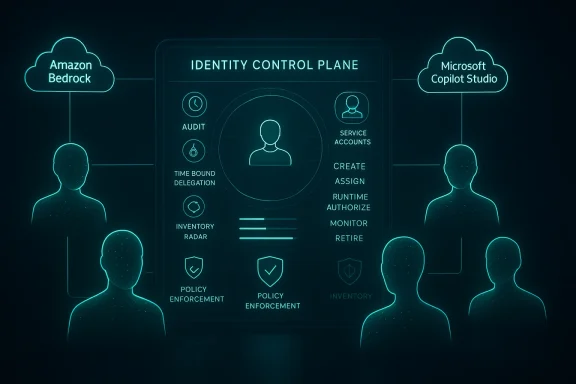
What makes the Saviynt angle especially notable is the company’s attempt to package that thesis as a dedicated identity control plane for AI agents. That is more than a product naming exercise. It suggests a strategic bet that the market will eventually treat AI agents the way security teams treated users, workloads, and privileged identities: as principals that require lifecycle governance, policy enforcement, and auditability. (unite.ai)
This is also a story about timing. The interview was published on April 17, 2026, and it reflects a market now wrestling with practical questions rather than theoretical ones: How many agents exist? Who owns them? What data can they touch? What happens when the owner leaves? Those are the kinds of questions that move identity from an infrastructure function to a board-level concern. (unite.ai)
Background
Identity and access management has spent decades evolving from a back-office provisioning task into a foundational security discipline. In the early days, the problem was mostly about logging in, resetting passwords, and managing group membership. Over time, as SaaS, cloud infrastructure, and remote work exploded, identity became the connective tissue between people, applications, data, and infrastructure. Sinha’s interview captures that progression well, and it is one reason his message lands with such force. (unite.ai)
The broader industry has already accepted that the old network perimeter no longer defines the boundary of enterprise trust. Zero Trust moved identity to the center of the security conversation because cloud adoption dissolved the assumption that location equals trust. Sinha’s thesis extends that logic to AI: if cloud made identity more important than the network, agentic systems may make identity more important than the application boundary itself. (unite.ai)
That shift matters because AI agents are not just another flavor of automation. Traditional bots and service accounts are generally deterministic, which makes them easier to reason about, least-privilege, and review periodically. AI agents are adaptive, goal-driven, and capable of choosing between tools or even collaborating with other agents, which introduces uncertainty into both authorization and intent. (unite.ai)
Saviynt is positioning its Identity Cloud as a unified platform for identity governance, privileged access, and application access governance, and that positioning is deliberate. It reflects a market trend toward consolidation, where security teams want fewer islands of policy and fewer blind spots across hybrid and cloud environments. The company’s AI messaging now adds another layer to that story: governance for human users, non-human identities, and increasingly AI actors in one framework. (unite.ai)
Why this moment matters
There are two reasons the timing is important. First, enterprises are no longer asking whether they will use AI agents; they are asking how quickly they can deploy them without creating unmanageable risk. Second, the control frameworks for those agents are immature, which creates an opening for vendors that can explain the problem in operational rather than abstract terms. Saviynt is trying to own that vocabulary early. (unite.ai)
- AI adoption is moving faster than governance.
- Identity is becoming the anchor for trust decisions.
- Legacy tools were designed for people and apps, not autonomous actors.
- The market is still defining what “agent governance” really means.
The core thesis: identity as the control layer
Sinha’s central argument is that identity is no longer just a directory concern. It is the layer where the enterprise decides who or what may act, what they may touch, and under what context that action remains valid. That makes identity less of a product category and more of a control architecture for modern work. (unite.ai)
This framing is particularly persuasive because it matches how AI systems actually behave in production. When an agent can invoke APIs, retrieve data, call another tool, and continue a task after a pause, security can no longer rely on static permissions alone. The relevant question becomes not just who authenticated but whether the action remains appropriate right now. (unite.ai)
The strategic significance is that Saviynt is trying to expand the identity conversation from provisioning and certification into runtime decisioning. That is a subtle but meaningful shift. It turns identity from a record-keeping function into an active policy enforcement layer that can observe behavior, evaluate intent, and stop risky actions before they cascade. (unite.ai)
From access to accountability
The company’s language repeatedly returns to accountability, and that is not accidental. AI governance is likely to fail if organizations cannot answer the most basic questions: Who owns this agent, what is its purpose, what systems can it reach, and who is accountable if it goes off script? Sinha’s framing suggests that identity is the mechanism that ties those questions together. (unite.ai)
A useful way to read the interview is as an argument for moving from access management to actor management. That is a broader and harder problem, but it also maps more naturally to how enterprise risk actually develops. If a human leaves the company, the identity is deprovisioned. If an AI agent outlives its project or keeps a privileged token alive, the risk remains active even when the business thinks the initiative has ended. (unite.ai)
- Identity becomes a policy engine, not just a directory.
- Accountability must travel with the agent.
- Runtime context matters as much as static entitlements.
- The lifecycle of the actor matters as much as the lifecycle of the account.
Why the “identity control plane for AI agents” matters
Saviynt’s announcement direction is significant because it reflects an emerging category in enterprise software: controls for autonomous AI systems. The phrase “identity control plane” is doing a lot of work here. It signals that the company wants to be the place where discovery, governance, runtime checks, and audit converge across AI platforms. (unite.ai)
The gap being addressed is real. Enterprises are deploying agents across multiple clouds and copilots, often without a central inventory. That creates governance asymmetry: teams can spin up capability faster than security can classify it. In practice, that means many organizations know their AI ambitions but not their AI estate. (unite.ai)
This is where Saviynt’s strategy is smart. By focusing on the identity layer, it avoids competing head-on with model providers on model quality and avoids being reduced to a point runtime monitor. Instead, it positions itself as the system of record for trust, which is a stronger strategic place to sit if the market eventually standardizes around agent governance. (unite.ai)
The governance gap is bigger than security
One of the more important parts of the interview is Sinha’s insistence that this is not merely a security problem. It is also a governance and accountability problem. That matters because the first response to AI risk is often a security control, but the deeper issue is operational ownership: if nobody knows which team owns an agent, no one knows who should approve a policy change or shut it down. (unite.ai)
That governance framing also makes the business case easier to sell internally. Security leaders can talk about authorization, but business leaders tend to respond more strongly to operational visibility, continuity, and audit readiness. In that sense, Saviynt is trying to speak to both the CISO and the COO. (unite.ai)
- Central inventory is the first prerequisite.
- Ownership assignment is as important as technical access.
- Lifecycle governance must cover creation, change, and retirement.
- Auditability becomes essential when agents persist beyond a project.
Human identities, non-human identities, and AI agents
One of the most valuable distinctions in the interview is between traditional non-human identities and AI agents. Service accounts and bots are generally predictable because they execute fixed logic. AI agents, by contrast, are adaptive systems that decide how to complete a task, which tools to use, and sometimes even how to collaborate. That difference changes the security model in a fundamental way. (unite.ai)
Sinha’s line that “authorization does not imply appropriateness” is especially important. In classic IAM, if access is granted, a request is often allowed within the policy envelope. With AI agents, that envelope may be too broad because the same entitlement can be used in ways the organization never intended. Static authorization becomes insufficient when the actor is capable of dynamic decision-making. (unite.ai)
The implication is that enterprises need to think less like account administrators and more like behavior governors. That means observing intent, detecting drift, and applying controls in real time rather than relying on quarterly review cycles. Those cycles still matter, but they are no longer adequate on their own. (unite.ai)
Why quarterly reviews are not enough
Quarterly access reviews were always a compromise, but they were tolerable when accounts were relatively stable. AI agents can change faster than that, especially when prompts, tools, data sources, or model versions are updated. The result is a moving target, and security teams cannot rely on a stale snapshot to understand risk. (unite.ai)
This is where the operational challenge becomes obvious. If an agent’s behavior changes because a new tool is attached or its scope expands, that change should look more like a privileged access escalation than a routine config tweak. Security teams will need stronger change control, tighter approvals, and more continuous telemetry than they are used to seeing in identity workflows. (unite.ai)
- Traditional NHIs are predictable.
- AI agents are adaptive and goal-driven.
- Runtime controls matter more than periodic reviews.
- Behavioral drift is a governance event, not a minor tweak.
Unified visibility across AI platforms
Sinha’s emphasis on visibility is one of the most practical parts of the interview. Enterprises are not adopting one AI platform in isolation; they are scattering use cases across Amazon Bedrock, Google Vertex AI, and Microsoft Copilot Studio at the same time. That creates a fragmented identity landscape where no single team has a complete picture. (unite.ai)
This fragmentation mirrors what happened in cloud security more broadly. Teams moved fast, adopted multiple platforms, and only later discovered that inventory, policy enforcement, and cost governance lagged behind. AI agents are repeating that story, but with much greater autonomy and potentially higher blast radius. (unite.ai)
The practical takeaway is blunt: if organizations cannot see all their AI agents, they cannot govern them. And if they cannot govern them, they certainly cannot secure them. That may sound obvious, but it is the kind of obvious truth that often takes years to become operational reality in enterprise environments. (unite.ai)
The inventory problem
The interview points to a very concrete issue: many companies do not know how many agents they have, where they run, or what data they can access. That is not a theoretical shortcoming; it is a direct governance failure waiting to be exploited or exposed. Discovery is therefore not a nice-to-have but the first control. (unite.ai)
This is also where multi-cloud enterprise security gets hard. Different teams may use different developer experiences, different logs, and different permission models. Without a unifying identity layer, the organization ends up stitching together partial answers from multiple consoles, which is exactly the sort of fragmented visibility attackers and auditors exploit. (unite.ai)
- Visibility must span multiple AI development environments.
- Inventory comes before policy.
- Ownership metadata is security metadata.
- Fragmented platforms multiply blind spots.
The full lifecycle of an AI agent
Sinha’s lifecycle model is one of the clearest sections of the interview because it translates AI governance into a familiar enterprise pattern. He describes the agent lifecycle like an employee lifecycle: create, assign purpose, grant least privilege, monitor, manage change, and retire cleanly. That analogy works because it makes the problem legible to security and HR-minded executives alike. (unite.ai)
The creation phase is where identity starts. Before an agent does any work, the organization should know who built it, who owns it, and what it is supposed to do. Those questions sound basic, but they become critical when agents are assembled by developers, business analysts, or so-called vibe coders who may not think in formal security terms. (unite.ai)
The runtime phase is where things get interesting. An agent may call tools, read or write data, trigger workflows, or even communicate with other agents. That activity needs monitoring not just for policy violations but for drift from intended purpose. Sinha is especially strong here when he emphasizes that understanding intent is still poorly understood by organizations. (unite.ai)
Lifecycle governance in practice
Lifecycle governance for AI agents will likely require a mix of identity governance, policy orchestration, and workflow approval. When an agent’s scope changes, the change should be treated as a material event, not a background update. That means there should be approvals, reviews, and a formal record of who signed off on the expansion. (unite.ai)
Retirement may be the most neglected stage. In many enterprises, stale service accounts, abandoned integrations, and forgotten automations survive long after the original business case ends. AI agents could make that problem worse unless decommissioning includes revoking credentials, shutting down integrations, and preserving logs for forensic and compliance purposes. (unite.ai)
- Creation requires ownership and purpose.
- Runtime requires intent-aware monitoring.
- Scope changes should trigger approval.
- Decommissioning must revoke access and preserve evidence.
Agent-to-agent security and machine collaboration
The interview becomes more forward-looking when Sinha discusses agent-to-agent interactions. His warning is that the largest security issues may not come from one overprivileged agent but from multiple agents collaborating in ways that no single policy review would flag. That is an important mental model shift for security teams. (unite.ai)
In a multi-agent environment, each agent may appear harmless in isolation while collectively creating a powerful workflow. That means the security question is no longer just whether each agent is authorized. It is whether the chain of actions, taken together, creates a result the organization would not approve in a human-led process. (unite.ai)
Sinha’s checklist is practical: unique identity, authenticated calls, real-time authorization, scoped delegation, and complete audit logs. Those are the right ingredients, but the hard part will be enforcing them across diverse model stacks and orchestration tools. The market is still early enough that many of these controls will be bolted on rather than built in. (unite.ai)
The new trust boundary
The deeper point is that the trust boundary is shifting from the firewall to the interaction layer. Agent-to-agent calls now resemble machine-to-machine business transactions, and each transaction needs identity, policy, and evidence. That is a more dynamic and more complex world than simple request-permission workflows. (unite.ai)
For defenders, this means logs matter more than ever. Without event-level traceability, it becomes nearly impossible to reconstruct how a decision was made or whether delegation exceeded intent. That is why Sinha’s insistence on time-bound delegation is so important; permanent trust is the enemy of governable autonomy. (unite.ai)
- Collaborative agents can create emergent risk.
- Per-agent permissions may not reveal combined blast radius.
- Delegation must be time-bound.
- Audit trails become indispensable evidence.
What this means for the market
Saviynt’s positioning suggests that the identity market may be entering a new phase of category expansion. For years, IAM vendors have focused on users, privileged users, workload identities, and governance. AI agents add a fresh layer of demand, and vendors that can unify these identity types may gain an advantage over point tools. (unite.ai)
This also creates competitive pressure on adjacent categories. Cloud providers will continue to offer native controls, but enterprise buyers often want cross-platform governance rather than isolated dashboards. Security vendors in adjacent spaces may try to extend into agent governance, but they will need to prove that they can understand identity semantics, not just observe events. (unite.ai)
For rivals, the challenge is not only feature parity. It is narrative clarity. Sinha repeatedly returns to the same themes—ownership, visibility, intent, runtime controls, lifecycle governance—which are the right primitives for a market that is still defining its vocabulary. Vendors that cannot explain those primitives cleanly may struggle to win enterprise trust. (unite.ai)
Enterprise vs. consumer impact
For enterprises, the impact is immediate and structural. They need governance for regulated data, access approvals, audit trails, and operational accountability across hybrid environments. For consumers, the effect is more indirect, but it still matters because the enterprise security stack increasingly shapes how AI tools are deployed in the workplace and which assistants can touch corporate data. (unite.ai)
The consumer-facing story is simpler: more AI tools will be mediated by identity controls before they are allowed into business workflows. The enterprise story is harsher: if you cannot govern the agent, you may not be able to deploy it at all. That difference will likely slow some rollouts while accelerating demand for platforms that promise control without killing innovation. (unite.ai)
- Cloud-native identity vendors gain a new wedge.
- Native platform controls may not satisfy cross-cloud governance needs.
- Narrative clarity will matter as much as feature depth.
- Enterprise controls will shape consumer AI usage at work.
Strengths and Opportunities
Saviynt’s opportunity is substantial because its message aligns with the direction enterprise AI is already taking. The company is not trying to invent a problem; it is trying to formalize one that security teams are increasingly encountering in the wild. That gives the pitch credibility, especially for buyers who are already struggling with identity sprawl, shadow AI, and non-human account governance. (unite.ai)
The biggest strength is that the company is framing AI governance in familiar enterprise terms. By analogizing agents to employees and tying controls to lifecycle events, Saviynt lowers the conceptual barrier for security leaders. That matters because adoption often depends on whether a new control plane feels like an extension of existing governance rather than a wholly new discipline. (unite.ai)
- Clear problem framing for a real and growing enterprise pain point.
- Strong lifecycle model that maps AI governance to existing identity practices.
- Cross-cloud relevance across Bedrock, Vertex AI, and Copilot Studio.
- Unified control-plane narrative that can appeal to CISOs and compliance teams.
- Opportunity to own runtime governance as a differentiator.
- Natural adjacency to IGA and PAM for platform expansion.
- High-severity risk domain that may justify premium enterprise spending.
Risks and Concerns
The main risk is that the market may adopt the language of agent governance faster than it adopts the discipline. Enterprises are good at buying tools in response to fear, but they are often slower to operationalize the workflows those tools require. If Saviynt’s category emerges faster than customer maturity, the result could be aspirational deployments with limited enforcement. (unite.ai)
There is also the risk of overpromising on visibility and runtime control in heterogeneous AI environments. Every cloud and model ecosystem exposes different telemetry, policy hooks, and permission semantics. A unified identity control plane is attractive, but it will need to prove it can normalize those differences without becoming yet another abstraction layer that hides complexity instead of solving it. (unite.ai)
Implementation and adoption challenges
Another concern is organizational readiness. Security teams may agree that agents need governance but still lack the process maturity to assign ownership, approve scope changes, or retire agents properly. Without that operational discipline, even the best control plane can become a passive registry rather than an active enforcement system. (unite.ai)
Finally, there is a competitive risk. Hyperscalers and platform vendors will keep tightening native controls, and that could narrow the space for third-party governance layers over time. Saviynt will need to demonstrate that cross-platform identity governance remains a durable value proposition even as native ecosystems mature. (unite.ai)
- Category hype could outpace real deployment maturity.
- Heterogeneous AI stacks may be hard to normalize cleanly.
- Operational adoption may lag behind product capability.
- Native cloud controls could compress third-party differentiation.
- Runtime enforcement is harder than visibility.
- Ownership discipline is often the weakest link.
Looking Ahead
The next phase of enterprise AI security will likely revolve around whether organizations can translate abstract concern into concrete controls. That means inventory, ownership, runtime monitoring, scoped delegation, and retirement workflows will have to become routine, not exceptional. If they do not, AI agents will inherit the same fate as many cloud-era assets: rapid adoption, weak governance, and painful cleanup later. (unite.ai)
Sinha’s comments suggest that the winning security model will not try to suppress autonomy but rather make autonomy governable. That is a subtle but powerful distinction. The enterprise is unlikely to abandon agents; instead, it will demand evidence that those agents can be trusted, traced, and constrained. (unite.ai)
What to watch next
- Whether enterprises start treating AI agent inventory as a formal governance requirement.
- Whether runtime authorization becomes a standard security expectation for agentic systems.
- Whether more vendors adopt the language of identity control plane.
- Whether regulators and auditors begin asking about AI ownership and lifecycle controls.
- Whether cross-platform AI governance becomes a buying criterion in large enterprises.
- Whether human-centric IAM programs evolve into broader actor-governance programs.
The larger lesson from the interview is that identity is no longer just about proving who someone is. It is about defining what an actor may do, when it may do it, and who is accountable if it does something unexpected. In an AI-driven enterprise, that may be the difference between scalable automation and unmanageable risk.