

Microsoft’s next-generation Xbox is reportedly being rebuilt on a Windows-derived core, designed to support multiple digital storefronts and a family of OEM devices — a strategy that would reshape Xbox from a single-purpose living-room console into a Windows-centric, cross-device gaming platform. The claim, surfaced in recent reporting and company statements, ties together three threads we've watched unfold across 2025 and early 2026: a multi-year silicon partnership with AMD, the arrival of Windows-powered Xbox-branded hardware (notably handhelds), and an explicit promise from Xbox leadership that the next platform “won’t be locked to a single store.” (theverge.com)
That announcement was followed by the ROG Xbox Ally handhelds — an Asus‑made, Xbox‑branded Windows device that boots into a full‑screen Xbox experience while running Windows under the hood. The Ally is the clearest, public example of Microsoft experimenting with a Windows‑based Xbox experience that can also access other PC storefronts.
Most recently, AMD CEO Lisa Su indicated on an earnings call that AMD’s semi‑custom SoC development for Microsoft is “progressing well to support a launch in 2027,” injecting a new timeline cue into the conversation and suggesting Microsoft’s next generation might arrive sooner than some leaked roadmaps implied. That statement was reported by major outlets on February 3, 2026. (theverge.com)
That shift has two immediate strategic benefits:
That suggests Microsoft could adopt or extend:
Microsoft will need to decide whether:
But the promise comes bundled with substantial engineering, UX, and policy questions. Microsoft must deliver the technical scaffolding — secure execution containers, consistent anti‑cheat frameworks, and low‑overhead runtime environments — while designing a user experience that retains the simplicity gamers expect from consoles. It must also make the commercial rules explicit so developers and OEMs can invest with confidence.
For now, the signals are clear but the blueprint is not: AMD’s roadmap gives the hardware timeline momentum, OEM experiments like the ROG Xbox Ally show what is possible, and Xbox leadership’s language signals intent to open the platform. The pivotal next step will be the details — Microsoft’s SDKs, certification rules, and the first generations of OEM devices. Those details, once published, will determine whether this becomes a graceful evolution toward cross‑device gaming or a messy hybrid that pleases no constituency.
In short: the next‑gen Xbox may be gearing up to become less a single box and more a shared Windows‑centric gaming ecosystem. If Microsoft gets the engineering and governance right, players and partners could benefit from the best of both PC and console worlds. If it stumbles on execution or policy, the risk is fragmentation, degraded TV experiences, and regulatory headaches — consequences that will reverberate across the industry as the platform evolves.
Source: VideoCardz.com https://videocardz.com/newz/next-ge...ore-with-multi-store-support-and-oem-devices/
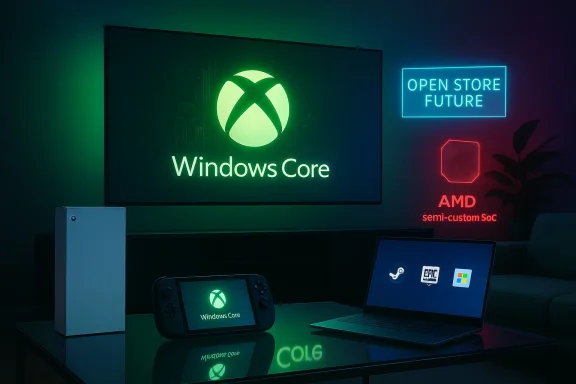 Background
Where this story came from
In June 2025 Microsoft announced a strategic, multi‑year partnership with AMD to co‑engineer silicon for a portfolio of devices that it described as “consoles in your living room and in your hands.” In follow-up messaging, Xbox leadership framed the vision as one in which Xbox experiences are available across devices and not tied to a single storefront — language that has since been amplified across the trade press and technical observers.That announcement was followed by the ROG Xbox Ally handhelds — an Asus‑made, Xbox‑branded Windows device that boots into a full‑screen Xbox experience while running Windows under the hood. The Ally is the clearest, public example of Microsoft experimenting with a Windows‑based Xbox experience that can also access other PC storefronts.
Most recently, AMD CEO Lisa Su indicated on an earnings call that AMD’s semi‑custom SoC development for Microsoft is “progressing well to support a launch in 2027,” injecting a new timeline cue into the conversation and suggesting Microsoft’s next generation might arrive sooner than some leaked roadmaps implied. That statement was reported by major outlets on February 3, 2026. (theverge.com)
What “Windows core” means in context
When journalists and analysts say “Windows core” they are not saying Xbox will run a stock desktop OS like the Windows 11 you buy for a laptop. The phrase refers to Microsoft’s long‑running engineering work to unify Windows components under shared foundations — OneCore, modular Windows Core OS experiments, and the GameCore initiative intended to let developers build once and run across Microsoft platforms. The overarching idea: reuse the same low‑level components, driver model, and services so a variety of devices can run tailored shells without rebuilding the OS stack from scratch. This is rooted in projects and concepts Microsoft has publicly discussed for years.What the reports claim — a concise summary
- The next‑gen Xbox hardware will be co‑engineered with AMD and use a semi‑custom AMD SoC; AMD has signaled readiness to support a 2027 launch window. (tomshardware.com)
- The platform will be Windows‑centric at the core, enabling a shared software foundation across consoles, handhelds, PC‑form factor devices, and cloud instances.
- Microsoft says the platform will not be locked to a single digital storefront — meaning third‑party PC stores could be supported alongside Microsoft’s own storefront.
- The company is already shipping or partnering on OEM devices (for example, the ROG Xbox Ally) that show how a Windows‑based, Xbox‑branded device might behave in practice.
Why this would be a strategic pivot for Xbox
From closed console to platform family
Historically, consoles have been walled gardens: controlled hardware, curated stores, and strict certification. Moving Xbox to a Windows‑derived core and supporting multiple stores would be a deliberate pivot toward platform openness and ubiquity. Microsoft would be explicitly treating Xbox as a brand and ecosystem — a set of experiences that can run on living‑room units, handheld OEM hardware, Windows PCs, and in the cloud.That shift has two immediate strategic benefits:
- It leverages Microsoft’s biggest asset outside gaming: Windows. Tight integration with Windows could help Xbox reach PC players more naturally and expand Game Pass and cloud offerings.
- It removes an artificial barrier to content discovery and distribution; supporting multiple storefronts could make the Xbox platform more attractive to third‑party publishers and PC‑first developers.
Silicon and the performance story
A closer hardware partnership with AMD signals that Microsoft wants high‑performance, differentiated silicon across devices. AMD’s public comments that their semi‑custom SoC development is “supporting a launch in 2027” suggests Microsoft isn’t merely rebadging PC chips — it wants bespoke silicon tuned for Xbox workloads, AI features, and cross‑device compatibility. That runway matters because building a hybrid console/PC device that’s also efficient, low‑power (for handhelds), and cost‑competitive requires deep hardware/software co‑design. (tomshardware.com)Technical implications and architectures
A shared core, multiple shells
If the next‑gen Xbox is indeed built on a Windows‑derived core, expect an architecture like:- A minimal, common kernel and runtime (the “core”) shared across device classes.
- Device‑specific shells and UIs: a TV‑optimized console shell, a fullscreen Xbox shell for handhelds, and a Windows desktop mode for PC partners.
- Compatibility layers and APIs (GameCore/WinRT variations) to let Xbox platform features like achievements, multiplayer, and access to Game Pass work everywhere.
Containerization, virtualization, and security
Multiple reports and early experiments (e.g., Windows features for app isolation) point to an approach that could use virtualization or containerization to safely run third‑party storefronts and PC titles on a console‑like platform. Running Steam or other stores on a device that’s expected to maintain console‑grade anti‑cheat and security needs isolation between store processes, kernel interfaces, and game execution.That suggests Microsoft could adopt or extend:
- Lightweight container sandboxes for third‑party storefronts.
- A hypervisor or compartmentalized runtime to ensure certified games interact with hardware and services in controlled ways.
- A new certification and compliance framework for any store that wants to integrate deeply with Xbox platform services.
Multi‑store support — benefits and friction points
What “not locked to a single store” could mean in practice
Microsoft’s public language promises that players will not be restricted to Microsoft’s storefront. In practice, this could take several forms:- Native support for third‑party storefront apps (Steam, Epic, GOG) that run on top of a trusted Xbox shell.
- Integration layers so purchases and libraries from other stores show up alongside Xbox titles in a unified launcher.
- Backend partnerships where third‑party stores are allowed to operate but must comply with Xbox certification and possibly revenue‑sharing rules.
Licensing, anti‑cheat, and DRM
Third‑party stores bring varied DRM and anti‑cheat systems. Consoles work because of a consistent, certifiable execution environment; mixing stores increases surface area for exploits and complicates anti‑cheat enforcement.Microsoft will need to decide whether:
- To mandate standard anti‑cheat/drm integrations for any store on the platform, or
- To allow stores to operate independently but require games to run inside certified containers that the platform controls.
OEM devices and the “Xbox in your hands” promise
ROG Xbox Ally: a preview
The Asus ROG Xbox Ally demonstrates one practical route: an OEM builds a Windows device tuned to ship a fullscreen Xbox shell and offers access to other PC stores. The Ally shows how Microsoft can extend its brand into OEM hardware without building every device itself. The Ally’s existence provides a real data point: players can have an Xbox experience on Windows hardware that isn’t strictly locked to Microsoft’s store.Scale and partner strategy
If Microsoft pursues a broader OEM plan, we should expect:- Tiered OEM partnerships (premium handhelds, midrange TV boxes, value set‑top devices).
- Reference hardware specifications and certification programs to ensure feature parity for Xbox services.
- Supply chain diversification to support simultaneous device families (handheld, console, cloud servers).
What this means for players and developers
Players
- Choice expands: players could theoretically run their Steam libraries, Game Pass titles, and Xbox Store purchases on the same device family.
- Experience fragmentation risk: not all titles will run identically on every device type (e.g., console‑only binaries vs. PC builds), so clear labeling and compatibility guarantees will be essential.
- Potential UI clutter: an open storefront ecosystem demands careful UX to prevent a confusing or hostile TV experience.
Developers
- Development model consolidation: GameCore and shared APIs could reduce the cost of porting between Xbox and Windows devices.
- Certification complexity: supporting console‑grade features (Quick Resume, achievements, integrated DLC) on third‑party storefronts will require additional engineering and testing.
- Commercial negotiation: developers may need to navigate different revenue splits and discoverability terms across stores on the same platform.
Risks and unanswered questions
Performance and bloat
There is a legitimate fear among console purists that a Windows‑derived platform will introduce overhead relative to a lean, console‑only OS. Microsoft will have to prove that a unified core can meet the low‑latency, high‑performance, and rapid‑boot expectations of console users while supporting the flexibility of a PC ecosystem.User experience on the living‑room TV
Windows and PC storefront paradigms are inherently mouse/keyboard and window oriented. Translating that to the 10‑foot, controller‑first TV experience is non‑trivial. Microsoft must ensure that allowing multiple storefronts does not degrade the polished, plug‑and‑play simplicity that is central to console value.Regulatory and competitive scrutiny
Opening a console to other PC stores does not automatically make the platform neutral. Microsoft will still control the system UI and potentially favor its services. Given the industry’s recent regulatory focus on platform gatekeepers and Microsoft’s own acquisitions history, this strategic pivot could attract intense regulatory attention, particularly around discoverability and default placements.Technical unknowns that matter
- How will anti‑cheat and anti‑tamper systems be standardized across third‑party stores?
- Will consoles still enforce a single certified execution environment for performance‑sensitive titles?
- What are the commercial terms for OEMs, and how will Microsoft prevent fragmentation in features like cloud saves, achievements, or Game Pass integration?
Four likely scenarios Microsoft could choose
- Controlled Openness (probable): Microsoft allows third‑party stores but requires them to run as certified apps inside a controlled runtime that enforces anti‑cheat, DRM, and platform APIs. This balances choice and security but requires engineering tightness.
- Full Native Support (less likely): Steam/Epic/GOG run natively with minimal constraints — great for users but extremely risky for security, consistency, and gating proprietary platform services.
- UI‑Level Aggregation (likely early approach): Microsoft aggregates third‑party libraries into a single launcher or library view while the third‑party store app runs separately. Lower technical risk, but discoverability debates remain.
- Tiered Device Strategy (likely): Microsoft allows OEM differentiation — premium devices offer full openness and PC‑grade features; mainstream living‑room consoles keep tighter controls for simplicity and certification.
Recommendations for stakeholders
- For players: watch compatibility labels and certification badges; early adopters of OEM devices should expect some rough edges as Microsoft and partners iterate.
- For developers: prepare for cross‑target testing (console shell, handheld, PC) and plan for anti‑cheat/DRM integration across environments.
- For OEMs: demand clear, predictable certification and update channels. The attractiveness of Xbox‑branded Windows hardware depends on smooth integration and a stable SDK.
- For regulators and industry watchers: monitor how Microsoft balances UI placement and discoverability — an “open” platform that still defaults to first‑party storefront prominence may not meet competition expectations.
Conclusion
The notion of a next‑generation Xbox built on a Windows core with multi‑store support and OEM devices is not merely incremental; it is potentially transformational. It promises an Xbox brand that is platform first — an ecosystem stitched into Windows, delivered across devices, and powered by bespoke AMD silicon. That future promises greater consumer choice, easier cross‑device portability, and deeper use of Microsoft’s platform strengths. (tomshardware.com)But the promise comes bundled with substantial engineering, UX, and policy questions. Microsoft must deliver the technical scaffolding — secure execution containers, consistent anti‑cheat frameworks, and low‑overhead runtime environments — while designing a user experience that retains the simplicity gamers expect from consoles. It must also make the commercial rules explicit so developers and OEMs can invest with confidence.
For now, the signals are clear but the blueprint is not: AMD’s roadmap gives the hardware timeline momentum, OEM experiments like the ROG Xbox Ally show what is possible, and Xbox leadership’s language signals intent to open the platform. The pivotal next step will be the details — Microsoft’s SDKs, certification rules, and the first generations of OEM devices. Those details, once published, will determine whether this becomes a graceful evolution toward cross‑device gaming or a messy hybrid that pleases no constituency.
In short: the next‑gen Xbox may be gearing up to become less a single box and more a shared Windows‑centric gaming ecosystem. If Microsoft gets the engineering and governance right, players and partners could benefit from the best of both PC and console worlds. If it stumbles on execution or policy, the risk is fragmentation, degraded TV experiences, and regulatory headaches — consequences that will reverberate across the industry as the platform evolves.
Source: VideoCardz.com https://videocardz.com/newz/next-ge...ore-with-multi-store-support-and-oem-devices/
