Epic’s store is no longer an experiment — it’s a deliberate platform play with measurable traction, a pricey acquisition engine built around free games, and an explicit interest in being where users play next: potentially on a Windows‑powered, next‑generation Xbox. m])
Epic Games started the Epic Games Store (EGS) as a disruptor to Valve’s Steam, promising better economics for developers and a more curated storefront for players. What began as a contentious, sometimes clumsy challenge has matured into a product group with measurable business outcomes and a clear strategic posture: build scale through acquisition (chiefly weekly free games), tighten relationships with developers through generous revenue terms, and expand presence across platforms — including the possibility of a presence on whatever Microsoft ships as its next Xbox.
Epic’s own 2025 Year in Review lays out the numbers: the store recorded roughly $1.16 billion in total PC purchases, with $400 million spent on third‑party PC games — a 57% year‑over‑year jump — and 2.78 billion hours logged in third‑party games. Monthly active users hit an all‑time December high at 78 million MAU, and Epic claims the Free Games Program delivered 662 million claimed titles in 2025. Those giveaways also produced a significant “halo” effect on other platforms: Epic reports an average 40% lift in Steam concurrent users while a title is free on EGS.
Those are headline figures worth parsing, because they change the narrative: Epic’s store is not merely a promotional vehicle for Fortnite virality; it’s now a functioning marketplace with third‑party revenue, developer incentives, and cross‑platform effects that matter.
Yet the nuance is important: Epic separates first‑party payment flows (Epic’s own games and in‑app purchases) from third‑party retail spending in its reporting. The rising third‑party figure shows stronger marketplace activity, but it coexists with an acquisition model that subsidizes user growth through heavy promotional spending.
Pros:
Key upcoming features Epic has highlighted or that are logical follow‑ups:
Why Epic wants in:
Microsoft’s shifts also matter. Microsoft has been evolving the Xbox PC app, aggregated libraries, and a Full Screen Experience that hints at deeper Windows‑Xbox convergence. If Microsoft opens the next console to third‑party PC storefronts, the platform competitive map changes materially — suddenly the living room becomes an extension of the PC ecosystem, rather than a closed garden. Epic clearly wants in on that future, but Microsoft's final design choices, certification rules, and anti‑cheat policies will determine how open that garden becomes in practice.
The firm’s interest in supporting a Windows‑first next Xbox is logical and likely; it’s the natural next step for a company that built a cross‑platform business around games, social features, and developer incentives. But the road to a living‑room Epic Games Store will be paved with technical, middleware, and policy challenges. Epic’s wins in 2025 are real, but execution and cooperation — from anti‑cheat vendors to Microsoft’s eventual product decisions — will determine whether the company’s momentum turns into durable platform parity with Steam, or into another chapter of episodic competition.
For now, Epic is doing the thing challengers must: iterate the product, subsidize growth to build a base, and make smart bets on where players will spend time next. The difference between a successful challenger and a failed imitator will be measured in months of improved retention, smoother launcher performance, and whether Epic can translate free‑driven attention into long‑term commercial activity for developers and stable revenue for itself.
Source: Windows Central https://www.windowscentral.com/gami...-weve-been-talking-to-the-folks-at-microsoft/
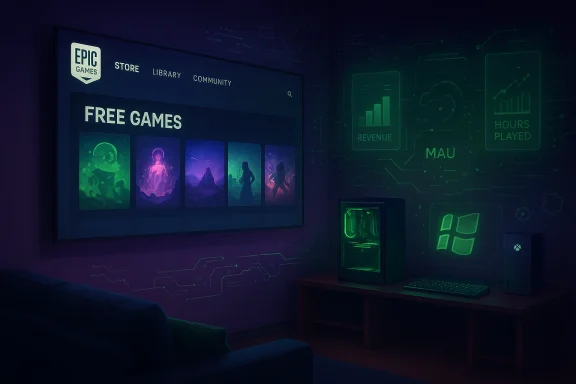 Background: where Epic was, and where it says it is now
Epic Games started the Epic Games Store (EGS) as a disruptor to Valve’s Steam, promising better economics for developers and a more curated storefront for players. What began as a contentious, sometimes clumsy challenge has matured into a product group with measurable business outcomes and a clear strategic posture: build scale through acquisition (chiefly weekly free games), tighten relationships with developers through generous revenue terms, and expand presence across platforms — including the possibility of a presence on whatever Microsoft ships as its next Xbox.Epic’s own 2025 Year in Review lays out the numbers: the store recorded roughly $1.16 billion in total PC purchases, with $400 million spent on third‑party PC games — a 57% year‑over‑year jump — and 2.78 billion hours logged in third‑party games. Monthly active users hit an all‑time December high at 78 million MAU, and Epic claims the Free Games Program delivered 662 million claimed titles in 2025. Those giveaways also produced a significant “halo” effect on other platforms: Epic reports an average 40% lift in Steam concurrent users while a title is free on EGS.
Those are headline figures worth parsing, because they change the narrative: Epic’s store is not merely a promotional vehicle for Fortnite virality; it’s now a functioning marketplace with third‑party revenue, developer incentives, and cross‑platform effects that matter.
Why the numbers matter: revenue, users, and the free‑games paradox
Third‑party revenue growth is real — and strategic
A 57% jump to $400 million in third‑party spending is not trivial. It signals that a store widely criticized for attracting players only for freebies is increasingly generating retail revenue for non‑Fortnite titles. That broader spending mix matters for developers and for Epic’s long‑term economics: paid purchases validate the store as a commercial channel rather than purely a marketing funnel. Epic’s published numbers and multiple industry reports corroborate this growth.Yet the nuance is important: Epic separates first‑party payment flows (Epic’s own games and in‑app purchases) from third‑party retail spending in its reporting. The rising third‑party figure shows stronger marketplace activity, but it coexists with an acquisition model that subsidizes user growth through heavy promotional spending.
The Free Games Program: acquisition engine or dangerous habit?
Epic’s Free Games Program is the story’s beating heart. The company reports claiming 662 million titles in 2025 and estimates it brings in roughly 7–12 million new players a year, numbers that management and analysts consistently point to when defending the program’s ROI. Epic’s own data shows that many freebies lead to sizable spikes in engagement for those games — even on other stores — which has real value for developers who want reach.Pros:
- Extremely cost‑efficient acquisition. Epic executives describe this as one of the best dollars‑per‑new‑user spends in their marketing toolkit.
- Discovery and halo effects. Titles often see peak concurrent users on Epic and measurable lifts on other platforms, increasing long‑tail visibility for developers.
- Community goodwill. For many players, the weekly freebies are a visceral reason to keep the launcher installed and to check the store.
- Conversion concerns. Not every free claimant becomes a buyer; some industry reporting suggests conversion percentages can be modest (single‑digit percentages in many cases), making the program more of a top‑of‑funnel activity than a direct revenue driver. Epic reports conversion varies widely and that the cost per new user still compares favorably to other channels.
- Perception risk. If a store becomes synonymous with “free game hunting,” it can be dismissed in public discourse as lacking a true paying customer base — a narrative Epic itself has fought.
- Developer tension. Some publishers worry about prize‑sparks that don’t translate into durable customer relationships or higher-priced purchases in follow‑on windows.
The product roadmap: cosmetics, chat, and a major architectural rebuild
Epic is explicit about building the product it needs to compete. The company has been candid that the current launcher and storefront need a usability refresh — slow launcher start times, memory use, and feature parity compared to Steam remain pain points. Epic says a fundamental rebuild of the underlying architecture is underway and targeted for public rollout soon; the company’s GM told reporters the difference was “profound” in recent demos, and Epic’s Year in Review and reporting confirm a planned revamp focused on speed, memory footprint, and platform feature parity.Key upcoming features Epic has highlighted or that are logical follow‑ups:
- Cross‑platform chat and unified social features to rival Steam and Battle.net.
- Community tooling, including forums and richer community discoverability.
- Launcher performance and memory improvements from a reworked architecture.
- Better storefront parity across PC and potentially console front‑end modes.
The Xbox angle: why Epic wants to be on the next Xbox — and what could block it
Windows Central’s reporting — and Epic’s own management comments — make one thing clear: if Microsoft ships a next‑generation Xbox that is effectively a Windows device with a TV‑optimized shell, Epic intends to be there. Steve Allison told Windows Central the company has been “talking to folks at Microsoft” and would build an app if Microsoft allows third‑party storefronts on the next Xbox. That’s a natural move: the next Xbox appears to be leaning toward a Windows‑layer model that would permit Steam, GOG, and Epic’s own launcher to be installed, and Epic is positioning itself to take advantage of any such openness.Why Epic wants in:
- Distribution and reach. Placing the Epic Games Store in a living‑room, controller‑first experience opens console audiences to PC storefront catalogues.
- Fortnite and cross‑ecosystem leverage. Epic’s Fortnite ecosystem remains a massive bridge to younger players who might be introduced to traditional PC games via Epic’s promotions.
- Competitive posture. Being absent from a major hardware platform would constrain Epic’s ability to be a true cross‑platform marketplace.
- Microsoft’s product decisions are not final. Reporting around the next Xbox running full Windows with a layered console shell remains industry reporting and strategic interpretation; Microsoft has signaled direction but has not published final specs. Any headline that claims the next Xbox will definitely install Steam and Epic natively should be treated with caution until Microsoft confirms product details.
- Anti‑cheat and DRM complexities. Many multiplayer titles rely on DRM and anti‑cheat middleware that tie into platform certification. Running native clients on console hardware — even if Windows is the base OS — requires middleware vendors and publishers to sign off on compatibility.
- UX and controller optimization. A desktop launcher doesn’t automatically translate to a comfortable TV experience. Epic would need to invest in a Full Screen Experience–optimized app for Xbox’s controller/tv UX — work Epic has acknowledged but not prioritized for immediate release.
Developers and economics: why studios are paying attention
Epic has been methodical about economic incentives:- The company offers an 88/12 revenue split, more generous than many storefronts, and in 2025 rolled out policies allowing developers to keep 100% of the first $1 million in annual net revenue per product before the standard split applies (a program introduced mid‑year). That change directly undercuts the old economics that favored incumbents and has been a powerful lure for indies and established studios alike.
- Margins: More favorable revenue splits mean studios can retain more cash to fund live ops, marketing, or future projects.
- Discovery and promotion: Epic’s Free Games Program and curated editorial picks generate bursts of attention that are valuable for long‑tail discoverability.
- Cross‑platform reach: Epic’s push to be everywhere (PC, mobile, and potentially console) makes it a more attractive partner for developers who want unified distribution.
- Exclusivity trade‑offs. Epic has used promotion and exclusives as incentives; exclusivity still buys visibility but can also fragment audiences and complicate cross‑platform live operations.
- Sustainability of the model. Developers must weigh the short‑term uplift from being featured in free promotions against the long‑term expectation of customer spend and retention.
UX, trust, and the battle for long‑term retention
Technical polish and trust are the two non‑negotiables for adoption beyond the curious or bargain hunter.- Technical polish: Launchers must be fast, unobtrusive, and reliable. Epic admits the current launcher experience is subpar compared to Steam and is undertaking a core rewrite to address loading speed and resource use. Delivering on that promise is essential if Epic wants to retain users acquired via freebies.
- Platform trust: Epic’s public image — from business fights with Apple to outspoken CEO commentary — complicates a neutral, platform‑first perception. For users and developers alike, perceived fairness, transparency in data collection/telemetry, and robust moderation/community tools matter almost as much as revenue splits.
Competitive dynamics: Steam, Microsoft, and a more open Xbox
Steam remains the category leader on PC, and Valve’s depth in commerce, community, and discovery is substantial. Epic’s strategy is realistic: it does not have to dethrone Valve to win. Steve Allison has framed Epic’s objective in measured terms — securing enough market share that developers “have to be here” on PC rather than toppling Steam outright. Multiple industry observers echo this view: Epic’s growth makes it an unavoidable commercial channel, not necessarily the dominant one.Microsoft’s shifts also matter. Microsoft has been evolving the Xbox PC app, aggregated libraries, and a Full Screen Experience that hints at deeper Windows‑Xbox convergence. If Microsoft opens the next console to third‑party PC storefronts, the platform competitive map changes materially — suddenly the living room becomes an extension of the PC ecosystem, rather than a closed garden. Epic clearly wants in on that future, but Microsoft's final design choices, certification rules, and anti‑cheat policies will determine how open that garden becomes in practice.
Risks and the unknowns that still matter
- Execution risk on the rewrite. A promised architectural rebuild must deliver measurable improvements in performance and memory usage. If it doesn’t, Epic will continue to struggle with stack‑level criticism.
- Free games sustainability. The economics of handing out hundreds of millions of game copies is expensive and depends on continued advertising returns in the form of retained users, follow‑on purchases, or cross‑product engagement. If conversion rates remain low, Epic may need to adjust cadence or scope.
- Platform policy and middleware. Anti‑cheat, DRM, and publisher certification remain potential deal breakers for any native storefront on console hardware. Epic’s plan to support the next Xbox hinges on those third parties cooperating.
- Public perception and brand risk. Epic’s polarizing public image can complicate developer and consumer trust. Clean product UX, transparent developer policies, and clear data practices will be necessary counterweights.
- Regulatory and competitive pushback. As Epic expands, it invites more scrutiny from incumbents, partners, and regulators — especially around payments, data sharing, and platform economics.
What this means for gamers, developers, and platform owners
- Gamers: more choice and potentially richer cross‑platform discovery. If Epic’s technical revamp and social tooling arrive as promised, players should get faster, more social store experiences and easier ways to find games that matter to them. The Free Games Program remains a major value proposition for casual players and deal hunters.
- Developers: a stronger alternative to the incumbent store. Epic’s economics and promotional muscle make it an attractive channel; developers will still need to weigh exclusivity deals against audience fragmentation.
- Platform owners (Microsoft and others): Epic’s posture creates both an opportunity and a challenge. If the next Xbox becomes effectively Windows in a console shell, platform openness could accelerate competition among storefronts and force clearer policies around DRM, anti‑cheat, and certification.
Practical takeaways and what to watch next
- Watch for Epic’s architectural update shipping and measurable UX metrics (launcher start time, memory usage, and user retention post‑free pickup). Epic indicated a major update in its roadmap and demos suggest meaningful improvements — follow release notes and independent performance tests when available.
- Monitor conversion metrics reported by Epic and by independent analytics firms. The ratio of free‑claimants to paying customers is the single most important long‑term determinant of the Free Games Program’s sustainability. Industry reporting suggests conversions vary, and Epic’s own commentary places cost‑per‑new‑user as a guiding KPI.
- Track Microsoft’s final product framing for the next Xbox. If Microsoft formally says the device will run a Windows layer that permits third‑party storefronts, expect Epic (and others) to move quickly to build controller‑first storefront apps; if Microsoft opts for a more closed or curated model, Epic’s path to console presence will be more constrained. Treat current Intel and reporting as directional rather than definitive.
- For developers: evaluate Epic’s economics and promotional opportunities against your game’s lifecycle needs. The platform can produce fast spikes; ensure you have plans for retention, cross‑platform live ops, and post‑promotion monetization if you participate in Epic’s programs.
Conclusion: Epic as infrastructure and as challenger
Epic Games has moved beyond “free games and headlines” into the realm of platform infrastructure. The 2025 figures show a store with real third‑party revenue, meaningful playtime in partner titles, and a deliberate strategy to be present across devices. Epic’s Free Games Program remains simultaneously its greatest growth engine and its most complicated reputation problem — it draws users, creates cross‑platform halo effects for developers, and forces Epic to continually prove the store is more than giveaways.The firm’s interest in supporting a Windows‑first next Xbox is logical and likely; it’s the natural next step for a company that built a cross‑platform business around games, social features, and developer incentives. But the road to a living‑room Epic Games Store will be paved with technical, middleware, and policy challenges. Epic’s wins in 2025 are real, but execution and cooperation — from anti‑cheat vendors to Microsoft’s eventual product decisions — will determine whether the company’s momentum turns into durable platform parity with Steam, or into another chapter of episodic competition.
For now, Epic is doing the thing challengers must: iterate the product, subsidize growth to build a base, and make smart bets on where players will spend time next. The difference between a successful challenger and a failed imitator will be measured in months of improved retention, smoother launcher performance, and whether Epic can translate free‑driven attention into long‑term commercial activity for developers and stable revenue for itself.
Source: Windows Central https://www.windowscentral.com/gami...-weve-been-talking-to-the-folks-at-microsoft/