

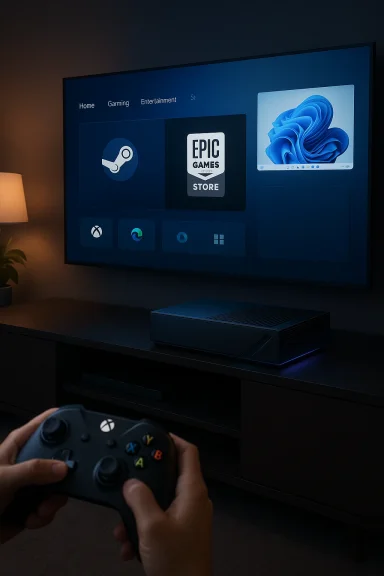
Microsoft’s next-generation Xbox is shaping up to be less like a closed console and more like a curated Windows 11 PC for the living room — a hybrid platform that promises a console-first experience by default while exposing a full Windows stack underneath, and that may ship as early as 2027 according to silicon partner timelines and recent reporting. The claim that future Xbox hardware will adopt Windows 11 PC architecture and offer native support for storefronts such as Steam and the Epic Games Store marks a potential turning point in console design: this would blur the line between PC and console, widen consumer choice, and introduce new technical, business, and regulatory complexities that deserve careful scrutiny.
Parallel industry moves have also nudged boundaries: Windows on Arm improvements, broader emulator support, and a deeper collaboration between Microsoft and AMD to co-engineer semi‑custom silicon. Those pieces set the technical and business groundwork for a next-gen device that could run a Windows 11 architecture under an Xbox shell.
At the same time, detailed hardware leaks and speculation about an AMD “Magnus” APU have circulated, suggesting large compute counts, expanded memory budgets, and on‑chip neural processing units (NPUs). Those leaked figures remain unverified engineering data until AMD or Microsoft confirms them; they provide a plausible hint about the goals for next‑gen performance but should be treated cautiously.
Regulators will likely examine:
However, the path is crowded with technical and business hazards. A Windows‑based Xbox must deliver a reliable, consumer‑friendly console experience while also respecting the complex technical demands of PC software ecosystems—most notably anti‑cheat and DRM. Price sensitivity, supply uncertainty, regulatory scrutiny, and the risk of a fractured user experience are all real and consequential.
If Microsoft and its partners can execute a tightly integrated launch—shipping hardware with adequate cooling and performance, coordinating anti‑cheat and driver signing, and offering a clear, default console UX—this could be a generational step for gaming platforms. If they misstep, the platform risks becoming a confusing hybrid that pleases neither console-first customers nor PC enthusiasts.
For now, treat the hardware leaks and ambitious specs as aspirational engineering targets, and consider the 2027 timeline as a supplier readiness signal rather than a hard launch date. Over the coming months, watch for official confirmations from Microsoft and AMD, developer tool disclosures at GDC, and early hands‑on previews that show whether Windows‑under‑Xbox can truly deliver the best of both worlds.
Source: Mix Vale Future Xbox will adopt Windows 11 PC architecture and native support for Steam and Epic in 2027
 Background
How we got here: Xbox, Windows, and a softer line between platforms
Microsoft and Xbox have been on a slow trajectory toward convergence for years. Historically, Xbox consoles ran a bespoke Xbox OS optimized for performance, latency, and DRM control. More recently, Microsoft has experimented with Windows-based devices in gaming—most visibly through collaborations like the ASUS ROG Xbox Ally handhelds that ship with Windows 11 and boot into an Xbox‑centric UI—and through the Xbox PC app on Windows, which is evolving into an aggregated launcher that can discover games across other storefronts.Parallel industry moves have also nudged boundaries: Windows on Arm improvements, broader emulator support, and a deeper collaboration between Microsoft and AMD to co-engineer semi‑custom silicon. Those pieces set the technical and business groundwork for a next-gen device that could run a Windows 11 architecture under an Xbox shell.
Recent catalyst: silicon readiness and reporting
Publicly, the most concrete timeline signal came from AMD’s investor commentary: AMD’s leadership stated that development of its semi‑custom SoC for Microsoft is “progressing well to support a launch in 2027.” That supplier readiness is meaningful: it means a critical component of the platform can be available in that window. Industry reporting from multiple outlets has elaborated on the idea that Microsoft aims to make the next‑gen platform feel like a console by default while also allowing full Windows functionality — a move described as “ambitious” and “risky” in recent coverage.At the same time, detailed hardware leaks and speculation about an AMD “Magnus” APU have circulated, suggesting large compute counts, expanded memory budgets, and on‑chip neural processing units (NPUs). Those leaked figures remain unverified engineering data until AMD or Microsoft confirms them; they provide a plausible hint about the goals for next‑gen performance but should be treated cautiously.
What “adopting Windows 11 PC architecture” would actually mean
Two operating modes: console shell and full Windows
If Microsoft ships an Xbox running Windows 11 under the hood, expect at least two operating modes:- A console-first shell (default): boots into an Xbox‑centric UI that prioritizes Game Pass, quick resume, controller-first navigation, and performance optimizations.
- A full Windows mode (optional): lets users enter a standard Windows 11 desktop, install arbitrary PC software, run third‑party launchers, and use peripherals and productivity apps.
Kernel and runtime implications
Running Windows 11 brings a different runtime model than a bespoke console OS. Windows manages processes, drivers, and userland services with different security and permission models. That opens capabilities, such as broader driver and peripheral support, richer multitasking, and native access to PC APIs. But it also raises questions around:- Background processes that might interfere with predictable performance.
- Windows update cadence and how large OS updates will be staged for a console audience.
- How Microsoft will reconcile Windows telemetry and privacy defaults with console‑style expectations.
Native Steam and Epic support: what “native” likely means
Full clients vs. aggregated discovery
There are multiple technical models for Steam and Epic presence on an Xbox running Windows 11:- Aggregation: the Xbox app acts as a unified library that discovers installed titles across Steam/Epic and launches them. The Xbox UI remains the front door while the native client handles execution where necessary.
- Native clients in shell: the full Steam client and Epic Games Store are installable and runnable inside the Windows layer — identical to how they operate on a PC.
- Hybrid orchestration: the Xbox shell provides an integrated listing and storefront experience, but actual execution may “hand off” to the native Steam/Epic client when features like kernel‑mode anti‑cheat or DRM require the native runtime.
Anti‑cheat and DRM: the hard technical constraint
Games that use kernel‑mode anti‑cheat (e.g., some titles on BattleEye or other solutions) present a critical dependency. Kernel drivers and secure launch sequences often assume a PC environment with specific driver signing and update policies. Microsoft will need to coordinate with anti‑cheat vendors and storefronts to ensure:- Drivers are signed for the device’s firmware and boot chain.
- The Windows layer on Xbox supports necessary driver models, or a secure handoff to native clients is implemented.
- Security and attestation remain strong to avoid opening vectors for cheating.
Hardware blueprint: the rumored “Magnus” APU and what it enables
Leaked/rumored specs (treat as unverified engineering data)
Leaked reports contain ambitious numbers for a semi‑custom AMD APU—commonly referenced under the codename “Magnus.” The key claimed characteristics include:- Very high RDNA 5 compute counts (tens of compute units), suggesting a substantial GPU uplift over current consoles.
- A hybrid Zen 6 CPU cluster with both performance and efficiency cores.
- A large memory pool (dozens of gigabytes of GDDR7 on a 192‑bit bus) to support multitasking, Windows processes, and high‑resolution assets.
- An on‑chip NPU capable of tens to hundreds of TOPS for AI features like dynamic upscaling, image enhancement, and system‑level acceleration.
Practical hardware tradeoffs
There are several real‑world constraints to balance:- Power and thermals. Achieving high GPU performance in a living‑room console without a large power budget requires advanced cooling and likely premium chassis designs; that has implications for cost and noise.
- Cost and supply. Larger die sizes, GDDR7 memory, and AI accelerators push BOM costs higher—an acute risk in the current market dynamic where component price volatility is a real factor.
- Form factor diversity. Microsoft’s reported strategy of allowing OEM partners to build devices means one SKU might be a premium, high‑power tower‑style console, while others could be compact or handheld variants with scaled silicon.
Benefits for gamers and the Windows ecosystem
Consumer advantages
- Choice of storefront and software: Native support for Steam and Epic means users can access broader libraries without multiple devices.
- Versatility: A Windows‑backed Xbox could double as a living‑room PC for streaming, retro‑emulation, productivity, and modding.
- Backward compatibility: Maintaining Xbox compatibility alongside PC game support would preserve the console’s legacy while adding PC flexibility.
- Unified account and play patterns: Microsoft’s crossplay, cloud saves, and Game Pass integration could be harmonized with other stores for a more seamless experience.
Developer benefits
- Easier PC ports and shared codepaths could reduce friction for developers targeting both Xbox and Windows. Developers gain access to a broader install base that includes console‑centric hardware with PC APIs.
Risks, unknowns, and real dangers
1. Price and market segmentation risk
Turning an Xbox into a Windows‑capable PC raises the device’s hardware bar—and its price. Microsoft must decide whether to accept slimmer unit sales with higher margins (more “boutique” Surface‑style approach) or subsidize low-cost units as a mass market strategy. If the premium price point is too high, mainstream consumers may stick with existing consoles or alternative PCs.2. Fragmentation and user confusion
Multiple modes (console shell vs full Windows), OEM variants, and optional third‑party stores could fracture the user experience. Less technical users might be confused by update flows, default storefronts, or how to manage installations across multiple stores.3. Anti‑cheat, DRM, and security friction
As noted, titles that rely on kernel drivers, proprietary DRM, or specialized launchers may not behave identically in console shell mode. The potential for inconsistent behavior across stores could lead to support overhead and customer frustration.4. Regulatory and antitrust optics
Ironically, opening the platform to Steam and Epic doesn’t eliminate regulatory risk; it changes its form. Regulators will scrutinize default settings, commission practices, and whether Microsoft favors its own storefront or services within the default console experience. Giving users choice could be a defense against antitrust claims, but Microsoft will still need to demonstrate nondiscriminatory treatment of rival stores.5. Quality of the default experience
A successful console experience prioritizes reliability, instant access, and low friction. The engineering challenge is to make Windows feel indistinguishable from a console for the casual user. Any instability, long update waits, or latency spikes under gaming workloads would damage the proposition.6. Ecosystem incentives and business model conflicts
Game Pass, Microsoft Store fees, and Microsoft’s first‑party revenues are strategically essential. Opening storefront choice could reduce Microsoft’s cut of platform revenue. The company will need to juggle incentives: promoting Game Pass while keeping the platform attractive to third‑party stores.How Microsoft could manage the transition (viable strategies)
- Ship a polished console‑first shell that locks down complexity by default, with an opt‑in route for power users to access full Windows.
- Create an official certification program for OEM Xbox devices and third‑party stores to guarantee performance and compatibility expectations.
- Negotiate standardized anti‑cheat and driver signing processes with vendors so that PC storefronts can run seamlessly without security regressions.
- Use tiered hardware SKUs: a baseline first‑party console optimized for price and ease, and premium OEM models that expose more Windows-level features for enthusiasts.
- Provide clear UI flows and educational experiences to reduce confusion between shell and desktop modes.
Business and regulatory implications
Opening the platform to Steam and Epic could reshape the economics of Microsoft’s gaming portfolio. If done transparently, it weakens one major antitrust critique—platform lock‑in—by letting users choose stores. But Microsoft’s commercial incentives remain: Game Pass, cloud services, and store revenue are core to its strategy.Regulators will likely examine:
- Whether default settings prioritize Microsoft services unfairly.
- Any differential treatment of rival stores in updates, platform APIs, or preinstallation arrangements.
- How Microsoft handles billing, store commissions, and user data sharing.
What this means for developers, publishers, and storefronts
- Developers may enjoy a broader single‑target platform: one hardware SKU family that runs both Xbox and PC storefronts reduces porting work and QA complexity.
- Retailers and publishers will evaluate whether a Windows‑style Xbox cannibalizes PC sales or increases overall market reach.
- Third‑party storefronts gain an opportunity for console‑like discovery; but they must adapt to TV‑first UX patterns and controller navigation.
- Anti‑cheat vendors and middleware providers will be essential partners. Their support timeline directly affects which titles can run natively at launch.
Practical timeline and what to watch next
- Silicon readiness commentary from AMD suggests 2027 is a supplier target; Microsoft’s own public commitment will be the key confirmation to watch.
- Industry events such as GDC and Microsoft’s own showcases are probable venues for developer frameworks, OS updates, and official platform briefs.
- Early OEM partners (e.g., ASUS’s Xbox Ally lineage) and preview hardware will indicate how Microsoft plans to split the market between first‑party consoles and partner devices.
- Compatibility tests, anti‑cheat vendor statements, and Xbox app updates on Windows (aggregation features) will be bellwethers for how smoothly multi‑store support will work.
Final assessment: promising, plausible, but high‑risk
The strategy to adopt Windows 11 architecture under an Xbox shell and enable native Steam and Epic support is a logical evolution of trends seen across Microsoft’s product portfolio: platform convergence, software ubiquity, and an emphasis on choice. The potential benefits are substantial: more choice for gamers, a single unified platform for developers, and a new hardware strategy that leverages OEM flexibility.However, the path is crowded with technical and business hazards. A Windows‑based Xbox must deliver a reliable, consumer‑friendly console experience while also respecting the complex technical demands of PC software ecosystems—most notably anti‑cheat and DRM. Price sensitivity, supply uncertainty, regulatory scrutiny, and the risk of a fractured user experience are all real and consequential.
If Microsoft and its partners can execute a tightly integrated launch—shipping hardware with adequate cooling and performance, coordinating anti‑cheat and driver signing, and offering a clear, default console UX—this could be a generational step for gaming platforms. If they misstep, the platform risks becoming a confusing hybrid that pleases neither console-first customers nor PC enthusiasts.
For now, treat the hardware leaks and ambitious specs as aspirational engineering targets, and consider the 2027 timeline as a supplier readiness signal rather than a hard launch date. Over the coming months, watch for official confirmations from Microsoft and AMD, developer tool disclosures at GDC, and early hands‑on previews that show whether Windows‑under‑Xbox can truly deliver the best of both worlds.
Source: Mix Vale Future Xbox will adopt Windows 11 PC architecture and native support for Steam and Epic in 2027
