

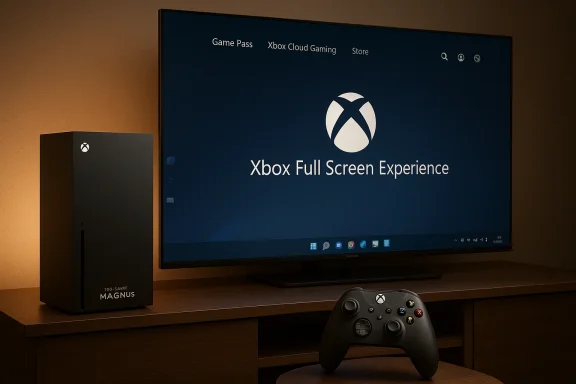
Microsoft's next Xbox, according to a fresh leak and corroborating industry signals, is not only a console upgrade — it is being positioned as a full Windows 11 PC in a console-shaped body, with a console-style TV interface layered on top by default. The result, if executed as described, would be a deliberate fusion of the console simplicity players expect and the openness and versatility of the PC ecosystem: boot into a familiar Xbox TV-first environment for living-room play, or "exit" into full Windows 11 to run PC storefronts, apps, and tools the moment you want them.
For years Microsoft has toyed with the idea of blurring the line between Xbox consoles and Windows PCs. The company’s recent partnerships, public comments from Xbox leadership, and new Windows 11 features designed for controller-first, full-screen play set the stage. The immediate catalyst for renewed attention is a detailed report from a senior gaming reporter that describes the next-gen Xbox as booting into a console-like TV experience by default while actually running a full Windows 11 installation underneath.
At the same time, silicon partners and OEM moves have reinforced the plausibility of the plan. Chip-level work reportedly codenamed Magnus is being developed with AMD as a semi-custom APU, and Microsoft has already shown the industry a testbed: Windows 11 handhelds like the ASUS ROG Xbox Ally and ROG Xbox Ally X ship with a controller-first “Xbox Full Screen Experience” layered over Windows. Those devices act as a practical demonstration that a Windows‑rooted device can be given a console‑like shell for the player-facing experience.
Taken together, these signals make the idea of a console that’s actually a Windows 11 PC by default less like a wild rumor and more like a strategic bet from Microsoft — one that trades the rigid, single-store console model for a deliberately open, multi-store ecosystem.
But execution matters far more than concept here. The leak’s promise — a console-certified experience that lives on top of a fully-featured Windows 11 stack — will only succeed if it solves the exact problems console players dislike about PCs: unpredictability, background interference, update interruptions, and complicated configuration. Achieving that while preserving Windows’ openness is a tough engineering and product-design challenge.
If Microsoft ships this product, here’s what to watch for during the rollout:
But the plan is a high‑stakes gamble. Its success hinges on delivering a true console experience on top of Windows, not a patched-together compromise. If Microsoft can deliver that — a fast, reliable, controller-first living-room interface that never feels like Windows when you don’t want it to, yet opens into a full PC when you do — the company could create the most flexible mainstream gaming platform in history. If not, the hybrid risks becoming a cautionary tale: an offering that tries to be everything and, in the eyes of many players, ends up being less than the sum of its parts.
Source: IXBT.games Next-Gen Xbox to Be a "Windows 11 PC" in a Console Body - Leak Reveals Details
 Background
For years Microsoft has toyed with the idea of blurring the line between Xbox consoles and Windows PCs. The company’s recent partnerships, public comments from Xbox leadership, and new Windows 11 features designed for controller-first, full-screen play set the stage. The immediate catalyst for renewed attention is a detailed report from a senior gaming reporter that describes the next-gen Xbox as booting into a console-like TV experience by default while actually running a full Windows 11 installation underneath.At the same time, silicon partners and OEM moves have reinforced the plausibility of the plan. Chip-level work reportedly codenamed Magnus is being developed with AMD as a semi-custom APU, and Microsoft has already shown the industry a testbed: Windows 11 handhelds like the ASUS ROG Xbox Ally and ROG Xbox Ally X ship with a controller-first “Xbox Full Screen Experience” layered over Windows. Those devices act as a practical demonstration that a Windows‑rooted device can be given a console‑like shell for the player-facing experience.
Taken together, these signals make the idea of a console that’s actually a Windows 11 PC by default less like a wild rumor and more like a strategic bet from Microsoft — one that trades the rigid, single-store console model for a deliberately open, multi-store ecosystem.
What the leak claims: the next Xbox as a Windows 11 PC
The core idea
- The device runs Windows 11 as the base operating system.
- By default it boots into a TV-first Xbox interface (a controller-optimized "Full Screen Experience") that disables or postpones non-essential Windows services to create a focused gaming environment.
- Users can exit the console layer to reach the full Windows 11 desktop — similar in spirit to how the Steam Deck lets players drop to a Linux desktop, but with Windows and PC storefronts available.
- The Xbox layer is integrated at the system level to reduce background interference and give a console-like feel while preserving PC flexibility.
Key user-facing behaviors described
- Default console mode: A curated, simplified interface optimized for TV and controllers; fast boot-to-game, system overlays tuned for controller navigation, and a focused set of system processes to preserve performance.
- Full Windows mode: One-tap or one-menu exit to the full Windows desktop, enabling installation of standard Windows apps, running desktop utilities, or launching non-Xbox storefronts like Steam or Epic.
- Backwards compatibility: Native support for Xbox One and Series X|S games is retained, so the device would function as a drop-in successor for existing Xbox libraries.
- Store openness: The console would no longer force a single-store model; Valve’s Steam, Epic, and other Windows PC stores would be accessible from the device in full Windows mode.
Hardware and timeline signals
- The new SoC — internally dubbed Magnus — is being developed with AMD as a semi-custom APU and is expected to underpin a family of devices targeted at a 2027 launch window (supplier-side readiness, not a Microsoft retail confirmation).
- Microsoft reportedly plans a portfolio approach: a Microsoft-made premium SKU, alongside multiple OEM variants (expensive and budget models, different form factors). This mirrors the current PC OEM model and echoes what ASUS already shipped with the ROG Xbox Ally.
Why this matters: the promise for players
One device, multiple identities
If Microsoft pulls this off, you get a single device that can operate in at least two high-value modes:- Console simplicity: Plug into your TV, pick up a controller, and play with a consistent, curated interface geared toward living-room gaming.
- PC openness: When you need it, the device becomes a general-purpose Windows PC — run Steam, install creative apps, use productivity tools, or mod your games.
- Players get access to both the Xbox ecosystem (Game Pass, Xbox storefront, console-first UI) and the broader Windows PC ecosystem (Steam, Epic, PC mods, desktop apps).
- Backward compatibility ensures the investment in an Xbox library still matters.
- Gamers who occasionally want to use their console as a media PC, streaming box, or creative workstation would no longer need a separate machine.
- For avid PC users who also want a living-room, controller-first experience, this removes the friction of custom setups.
Developer and ecosystem advantages
- PC-first tools and middleware can be shared across devices, reducing porting friction for studios that already target Windows.
- Smaller indie devs gain access to a console-style audience without being forced into proprietary store rules.
- Microsoft can leverage Game Pass, cloud services, and Xbox Live while remaining permissive about other storefronts — a potentially powerful hybrid business model.
The hardware picture: what we can (and cannot) verify
Industry signals point to a high-end AMD semi-custom chip surface-coded as Magnus. Details circulating in the leak pool talk about modern CPU cores and next-generation GPU microarchitectures (points discussed include Zen lineage CPUs, RDNA successor GPU elements, and large unified memory pools). However:- Precise transistor process, core counts, GPU compute units, memory bus widths, and TDP targets remain unverified. Public remarks from AMD emphasize supplier-side readiness for a 2027 window but stop short of retail specifications.
- The practical performance envelope — whether Magnus will beat or merely match current high-end PC hardware — is unclear until formal spec sheets or benchmark silicon arrives.
Software architecture — how Windows 11 might be adapted
The console-layer-over-Windows model
The proposed model is technically straightforward in principle:- Windows 11 becomes the kernel and system stack.
- On boot, a Full Screen Experience (FSE) shell launches, replacing the traditional Windows desktop with a controller-first UI.
- The FSE actively manages and minimizes background processes, defers non-critical updates, and controls resource allocations to prioritize gaming performance.
- If the user wants full Windows, they can exit FSE and return to the familiar desktop — at which point Windows services resume normal operation.
The UX challenge
- Seamless transitions: The hand-off between Xbox UI and Windows must be seamless and fast. Long waits or configuration hell will destroy the perceived benefit.
- Security model: Allowing desktop access raises questions about DRM, parental controls, and online safety on a living-room device shared by families.
- Updates and reliability: Windows updates must not break the console experience. Microsoft must guarantee that forced Windows updates won’t restart the box mid-game or change the TV-first default.
Backward compatibility and store openness: a new strategic posture
Microsoft moving to a Windows-based console essentially concedes that it will not force a single-store strategy on next-gen hardware. The leak describes:- Native support for existing Xbox One and Series X|S games.
- Access to Windows 11 storefronts, meaning Steam, Epic, and others will be runnable on the same device when in full Windows mode.
- Continued emphasis on Game Pass and Xbox Live features integrated into the FSE for a curated experience.
- Microsoft abandons an exclusive single-store mentality in favor of being the platform that hosts choice. That weakens the exclusivity lever some console makers use, but it could broaden the overall market opportunity.
- For consumers, it means less friction to use the PC storefront they prefer — but it raises new questions about how achievements, cross-platform saves, and controller tuning will be harmonized across storefronts.
- For third-party storefronts, this is a win if Microsoft keeps policies permissive; for Microsoft, it may be a bet that Game Pass and user convenience will remain compelling even without a closed store.
Form factors and OEM strategy: multiple devices, one platform
The leak envisions not a single monolithic Xbox, but a family of devices built around the same Magnus silicon:- Microsoft-branded premium console SKU(s) aimed at the living room.
- OEM variants, including more affordable boxes and experimental form factors.
- Handheld models from partners, like the ROG Xbox Ally series, which already demonstrate a Windows-with-Xbox-shell approach.
- Opportunity: Wider market coverage, better fit for different use cases (handhelds, compact living-room devices, high-end systems).
- Risk: Fragmentation — both in consumer expectations and developer testing. Games will need to be validated across multiple SKUs and configurations, which historically is a higher burden on studios than a single fixed console hardware target.
Risks and potential failure modes
Microsoft's ambition here is high, and so are the ways it can fail. Key risks include:- User experience leakage: If the Windows layer leaks problems into the console experience (unexpected updates, driver issues, background tasks consuming resources), players will see it as worse than a traditional console.
- Complexity for average users: The classic console value proposition is predictable simplicity. Adding full Windows access could confuse less technical users or create support overhead for Xbox customer service.
- Price sensitivity: High-end silicon and modular form-factor support increase BOM costs. If Microsoft prices the premium SKU too high, the device may struggle to find console-like mainstream adoption.
- Developer friction: Multiple SKUs and a broad software ecosystem can complicate QA. Studios may prefer traditional consoles with locked hardware targets unless Microsoft provides strong dev tooling and compatibility assurances.
- Market positioning: By opening the device to all PC storefronts, Microsoft must ensure Game Pass and Xbox features remain attractive enough to differentiate the offering. Otherwise, the device risks being “just another Windows PC with an Xbox badge.”
- Brand identity confusion: Long-term Xbox customers expect console-first thinking. If Microsoft does not clearly communicate what the device is and how it differs from both a PC and a console, the product could suffer from identity ambiguity.
What Microsoft must get right
- A truly locked-down FSE by default: Boot-to-game, predictable behavior, and an Xbox-grade controller UX.
- Instant, low-friction exit to Windows: For power users, that transition must be fast, reversible, and safe.
- Update and background policy guarantees: No surprise reboots; staged updates that respect active play sessions.
- Clear parental controls and profiles: Families must not be exposed to full desktop access unless explicitly allowed.
- Strong developer support: Tools, certification processes, and testing references for multiple SKUs to keep developer overhead manageable.
- Pricing tiers that make sense: A flagship premium SKU for enthusiasts, and mainstream-priced hardware for mass adoption.
- A coherent messaging strategy: Explain to consumers what the device is — and what it isn't — in plain language.
How this changes the console landscape
If Microsoft ships a polished product that delivers on the leak’s promises, the implications are broad:- Console definition shifts: The industry’s traditional console definition (single OS + curated store + tightly controlled ecosystem) would be challenged by a platform-first approach that privileges choice and flexibility.
- Competitive pressure for Sony: Rival platforms will have to explain why their approach is superior if Microsoft offers both console simplicity and PC openness.
- PC market overlap: PC OEMs and Valve's handheld efforts will suddenly face a new entrant with tight platform integration and Game Pass as a differentiator.
- Retail and marketing dynamics: Microsoft and retail partners must present multiple SKUs coherently to consumers used to one Xbox model at a time.
The consumer calculus: is this what gamers want?
The core consumer question is whether most gamers want the hybrid at all. There are three major buyer personas to consider:- The traditional console player: Values simplicity, plug-and-play behavior, and long-term stability. For them, the hybrid needs to act exactly like a console most of the time.
- The PC gamer: Values performance, modding, and storefront choice. For them, the hybrid's Windows access is a big win.
- The power user/creator: Wants a single device for gaming, streaming, and content creation. For them, the hybrid is ideal — but only at the right performance and price.
Editorial verdict and recommendations
Microsoft’s leaked plan is a bold, defensible strategic pivot that plays to the company’s strengths: deep Windows expertise, Game Pass as a platform hook, and partnerships across OEM and silicon vendors. It reflects an honest response to the fragmented modern gaming market where players use multiple stores, devices, and ecosystems.But execution matters far more than concept here. The leak’s promise — a console-certified experience that lives on top of a fully-featured Windows 11 stack — will only succeed if it solves the exact problems console players dislike about PCs: unpredictability, background interference, update interruptions, and complicated configuration. Achieving that while preserving Windows’ openness is a tough engineering and product-design challenge.
If Microsoft ships this product, here’s what to watch for during the rollout:
- Real-world boot-to-game times and the stability of the FSE during long sessions.
- The behavior of Windows updates and driver installs when the device is in TV mode.
- Pricing and SKU segmentation relative to performance and competing PC handhelds.
- Developer support materials and how studios certify games across multiple SKUs.
- How Game Pass is integrated in the FSE without penalizing users who prefer other stores.
Conclusion
The idea of a next‑gen Xbox that is essentially a Windows 11 PC under a console shell is not only plausible — it’s a logical evolution of Microsoft’s software and partner strategy. With an AMD semi‑custom APU potentially ready to support a 2027 window, and practical tests already streaming from OEM partners like ASUS, the building blocks are in place.But the plan is a high‑stakes gamble. Its success hinges on delivering a true console experience on top of Windows, not a patched-together compromise. If Microsoft can deliver that — a fast, reliable, controller-first living-room interface that never feels like Windows when you don’t want it to, yet opens into a full PC when you do — the company could create the most flexible mainstream gaming platform in history. If not, the hybrid risks becoming a cautionary tale: an offering that tries to be everything and, in the eyes of many players, ends up being less than the sum of its parts.
Source: IXBT.games Next-Gen Xbox to Be a "Windows 11 PC" in a Console Body - Leak Reveals Details
