

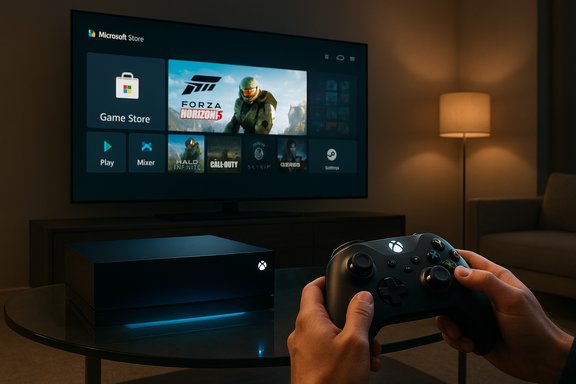
Microsoft’s next living‑room Xbox is being described by multiple reports as less a sealed console and more of a Windows-first gaming PC with a console skin — a premium, TV‑focused appliance that boots into an Xbox‑style, controller‑first experience while keeping the full Windows kernel and app model beneath it. This is not a single rumor: it’s a pattern visible in executive remarks, OEM hardware like the ROG Xbox Ally handhelds, Microsoft’s Xbox PC app updates, and reporting from outlets with sources close to platform teams.
The idea that the next Xbox might run a full Windows stack — or at least a Windows‑based session — did not appear overnight. Microsoft has been building cross‑device continuity between Xbox and Windows for years: Game Pass and Play Anywhere blurred platform lines, the Xbox PC app added an aggregated game library, and the company’s public partnership with AMD signaled a long‑term silicon strategy that spans consoles, handhelds, PCs and cloud servers. Recent OEM hardware — notably the ASUS‑branded ROG Xbox Ally and the higher‑end Ally X — shipped as Windows 11 handhelds that boot into an Xbox full‑screen interface by default, giving Microsoft a live experiment in a controller‑first Windows experience. Xbox president Sarah Bond framed the next generation as “a very premium, very high‑end, curated experience,” explicitly tying the company’s thinking to what works on Ally‑class Windows handhelds while stopping short of a full reveal. That phrasing, plus reporting that the next console “will indeed run full‑bore Windows, with a TV‑optimized, console‑style experience layered on top,” has crystallized the narrative that Microsoft is preparing a hybrid: the living‑room polish of a console plus the openness of PC gaming. Why this matters: making Windows the underlying platform could let Microsoft ship a device that supports native PC storefronts (Steam, Epic, Battle.net, GOG), run PC‑only titles, and serve as a unified endpoint for cloud play, Game Pass, and local execution — while preserving a simple, plug‑and‑play TV experience for mainstream buyers.
But leaked “Magnus” APU figures — high GDDR7 memory pools, double‑digit TOPS NPUs, and platform TDPs in the hundreds of watts — remain unverified. Engineering such a high‑TDP, high‑bandwidth chip into a quiet living‑room chassis is non‑trivial and will drive cost, cooling complexity, and acoustic tradeoffs. If Microsoft pursues a premium, PC‑class living‑room device with that silicon, expect higher retail prices and a narrower early install base compared with mass‑market consoles.
Key hardware takeaways:
But the roadmap is not without friction. Anti‑cheat and DRM constraints, the engineering cost of premium silicon in a living‑room form factor, and the business tradeoffs of a premium pricing strategy are all unresolved. Many of the boldest headlines — “the next Xbox will run full Windows” and “all storefronts will be supported out of the box” — are plausible and increasingly likely, given the signals, but they are still reports rather than product specs. Treat leaks about precise silicon specs and paywall policy changes as tentative until Microsoft confirms them.
For now, Xbox’s approach is clear: iterate publicly via OEM Windows devices and the Xbox PC app, learn from real‑world usage on Ally‑class hardware, and apply those lessons to a premium living‑room device. If Microsoft pulls it off, the result could be the most open, flexible living‑room gaming platform to date — and one that forces the rest of the industry to rethink what a “console” can be.
Source: Mashable Next Xbox console will be a full Windows gaming PC, report says
 Background / Overview
The idea that the next Xbox might run a full Windows stack — or at least a Windows‑based session — did not appear overnight. Microsoft has been building cross‑device continuity between Xbox and Windows for years: Game Pass and Play Anywhere blurred platform lines, the Xbox PC app added an aggregated game library, and the company’s public partnership with AMD signaled a long‑term silicon strategy that spans consoles, handhelds, PCs and cloud servers. Recent OEM hardware — notably the ASUS‑branded ROG Xbox Ally and the higher‑end Ally X — shipped as Windows 11 handhelds that boot into an Xbox full‑screen interface by default, giving Microsoft a live experiment in a controller‑first Windows experience. Xbox president Sarah Bond framed the next generation as “a very premium, very high‑end, curated experience,” explicitly tying the company’s thinking to what works on Ally‑class Windows handhelds while stopping short of a full reveal. That phrasing, plus reporting that the next console “will indeed run full‑bore Windows, with a TV‑optimized, console‑style experience layered on top,” has crystallized the narrative that Microsoft is preparing a hybrid: the living‑room polish of a console plus the openness of PC gaming. Why this matters: making Windows the underlying platform could let Microsoft ship a device that supports native PC storefronts (Steam, Epic, Battle.net, GOG), run PC‑only titles, and serve as a unified endpoint for cloud play, Game Pass, and local execution — while preserving a simple, plug‑and‑play TV experience for mainstream buyers.What the reports actually say (and what’s confirmed)
- The headline claim: the next Xbox will present a console‑style, controller‑first shell on top of Windows, rather than a wholly separate, bespoke console OS. This is described as a layered model — a default Xbox full‑screen experience that hides Explorer and desktop clutter but leaves Windows available if the user wants it.
- Aggregated storefront support: the device would surface an aggregated library and allow access to PC storefronts and installed titles, with the Xbox app orchestrating launches or handing off to native clients where DRM/anti‑cheat requires it. This is enabled today in Insider builds and on devices like the Ally and is being iterated.
- Hardware roadmap signals: Microsoft has a multi‑year, co‑engineering relationship with AMD and is working on high‑end silicon that could power a premium living‑room device. Leaked APU concepts and “Magnus”‑style specs circulate in rumor threads, but they are not officially confirmed. Treat specific numeric leaks (TDP, TOPS, GDDR7 capacity) as provisional.
- Paywall and policy rumors: several reports also floated a potential rethink of online multiplayer paywalls and other business model moves. These are strategic possibilities, not confirmed policy changes, and would require formal announcements to be believed.
Technical architecture: the layered Xbox shell
What “layered shell” means in practice
The model being tested is not “rip Windows out and replace it” — it’s “present a controller‑first session on top of Windows.” That session is a full‑screen Xbox front end optimized for TV posture:- Boots into a large‑tile, controller‑navigable UI.
- Suppresses Explorer, desktop wallpaper, and many background services to prioritize RAM and power for games.
- Keeps the Windows kernel, drivers, and app model underneath; switching to desktop gives full Windows functionality.
Measured resource gains — realistic expectations
Hands‑on testing on handheld hardware has shown that trimming Explorer and nonessential services can reclaim roughly 1–2 GB of RAM in favorable conditions. That’s meaningful on handhelds with tight memory budgets, but it’s not a free performance multiplier for a 4K living‑room box. For a TV‑first console, thermal design, sustained power delivery, and driver maturity become the decisive engineering problems. Reported “1–2 GB reclaimed” figures should be treated as empirical but workload‑dependent, not guaranteed.Launch orchestration vs. replacement
Practically, the Xbox front end will act as an orchestration layer that either:- Launches a discovered executable directly when safe and supported, or
- Hands off to the native storefront/client (Steam, Epic) when DRM or anti‑cheat requires it.
Storefront openness, DRM and anti‑cheat — the real blockers
Putting Windows under a console shell creates huge potential for consumer choice: players could access their PC libraries on the big screen without maintaining separate machines. But the promise of universal storefront compatibility confronts concrete third‑party technical and contractual limits.- Anti‑cheat middleware and kernel‑mode drivers used by many competitive multiplayer titles are the single largest friction point. These components may not work identically across architectures or under emulation and often require native client execution and vendor certification. The industry’s pragmatic answer so far is a mixed strategy: validate vendor compatibility where possible and fallback to cloud streaming for titles that cannot run locally.
- DRM and publisher agreements complicate the “install any storefront” promise. Some titles include launcher‑level dependencies or store‑specific DRM that won’t be abstracted away merely by running Windows underneath. Expect title‑by‑title exceptions.
- Parental controls, certification, and update predictability also matter in the living‑room. Microsoft would likely have to offer a curated “Xbox Store Mode” and a separate advanced Windows mode to preserve a console‑grade experience for mainstream buyers.
Hardware realities and the AMD partnership
Microsoft’s public multi‑year partnership with AMD is the clearest, verifiable technical signal that the company intends to own deep hardware‑software co‑design for the next generation of gaming silicon. That partnership is cited as the engineering anchor for ambitious features like on‑device AI, advanced shader delivery, and a spectrum of SKUs across handhelds, living‑room consoles and cloud nodes.But leaked “Magnus” APU figures — high GDDR7 memory pools, double‑digit TOPS NPUs, and platform TDPs in the hundreds of watts — remain unverified. Engineering such a high‑TDP, high‑bandwidth chip into a quiet living‑room chassis is non‑trivial and will drive cost, cooling complexity, and acoustic tradeoffs. If Microsoft pursues a premium, PC‑class living‑room device with that silicon, expect higher retail prices and a narrower early install base compared with mass‑market consoles.
Key hardware takeaways:
- Expect a range of SKUs: Microsoft can sell premium, halo devices while offering more affordable variants — the Ally experiment points to a portfolio approach rather than one universal SKU.
- Thermal and acoustic engineering will be decisive: higher TDP silicon requires different chassis and cooling solutions than past consoles.
- Pricing pressure will follow the premium positioning: “very premium” language strongly implies higher launch prices than the Series X|S generation.
UX: console simplicity vs. PC flexibility
The whole strategy rests on whether Microsoft can deliver a genuinely console‑grade living‑room UX on top of a flexible Windows base.- Default experience: if Microsoft ships a boot path that looks and behaves like a traditional console — fast boot to big tiles, controller navigation, integrated store, parental controls — mainstream buyers will be satisfied. The optional Windows desktop could be presented as an advanced toggle for power users.
- Tooling: Xbox PC app improvements (Aggregated Library, My apps) are already bridging discovery across multiple launchers. This software work is the UX backbone for presenting a single library while respecting native clients.
- On the Ally handhelds, reviewers found surprising preinstalled productivity apps (Teams, OneDrive) — a reminder that Windows brings baggage as well as benefits. Those elements are themselves product signals: Microsoft wants continuity across devices, but bundled productivity apps will feel odd to players who expect a lean console image.
- Default console shell for living‑room simplicity.
- Optional switch to full Windows for advanced installs, modding, and other PC use‑cases.
- Aggregated library to reduce launcher friction while deferring DRM/anti‑cheat to native clients as needed.
Developer perspective and platform tooling
A Windows‑based living‑room Xbox could reduce friction for studios that already target Windows PC, but it introduces variability that matters for optimization.- Tool consolidation is a real upside: building with a single ABI and shared GDK paths reduces porting effort across PC, handheld and console targets. Microsoft’s October GDK releases and cross‑platform runtimes are steps toward that reality.
- Certification and QA complexity may increase if Microsoft allows diverse OEM SKUs and variable hardware configurations. To avoid fragmentation, Microsoft will likely provide reference hardware and robust dev kits — but dev kit pricing and availability were flagged as concerns in industry threads.
- Anti‑cheat and DRM remain developer pain points: studios may have to treat certification and validation for a Windows‑based console as another platform target, not a drop‑in replacement for the current Xbox OS.
Business implications and competition
Shifting the Xbox brand toward a premium Windows appliance has strategic implications:- Monetization: a premium device can act as a halo to increase Game Pass engagement, on‑device Copilot integrations, and other recurring revenue streams. Microsoft’s services strategy benefits from devices that encourage sustained engagement.
- Price vs. scale tradeoff: consoles historically use aggressive hardware pricing to build install base and justify first‑party investments. A premium positioning is a deliberate tradeoff — higher per‑unit margins in exchange for a smaller early install base. That exposes Microsoft to pressure on first‑party economics.
- Competitive response: Sony and Nintendo will read these moves carefully. If Microsoft removes multiplayer paywalls or materially changes service economics, rivals may adjust pricing and policy. But such big‑ticket policy changes remain speculative without official word.
Risks and unresolved questions (what to watch for)
- Will the console default to the Xbox shell or to a Windows desktop? This choice shapes everything from updates to parental controls to consumer confusion.
- How will Microsoft reconcile storefront openness with DRM and anti‑cheat realities? Expect title‑by‑title exceptions.
- Will premium pricing limit first‑party developer incentives? A smaller install base increases the cost pressure on first‑party teams and could reshape exclusive strategy.
- Can Microsoft engineer high‑TDP silicon into a quiet living‑room chassis at a competitive price? Leaked APU numbers should be treated cautiously.
- What happens to Game Pass and multiplayer paywalls? These are strategic decisions that would have industry‑wide repercussions if implemented. Treat current reporting on paywall removal as speculative.
Practical advice for gamers and buyers
- If you value a simple, predictable living‑room experience: wait for Microsoft’s official product reveal and pay attention to what the default boot mode is. A Windows‑first device with an opt‑in Xbox shell is different from a console that simply uses Windows under the hood.
- If you already own large PC libraries and want flexibility: the Ally handhelds and Xbox PC app updates are a real proof‑of‑concept. Try the experience on Windows handhelds or Insider builds to see whether aggregated libraries and launcher handoffs meet your expectations.
- For enthusiasts who want native Steam/Epic access on the TV: expect many titles to work, but verify anti‑cheat compatibility for competitive multiplayer games on a title‑by‑title basis. Cloud streaming will remain the fallback for incompatible middleware.
Conclusion
Microsoft’s next Xbox — as described by recent reporting and corroborated by product experiments like the ROG Xbox Ally — points toward a pragmatic, hybrid future: a TV‑focused, controller‑first console shell layered on top of Windows that aims to combine the simplicity of a console with the openness of PC gaming. The strategy checks a lot of boxes: easier cross‑platform development, broader storefront choice for consumers, and the ability to showcase premium silicon and on‑device services.But the roadmap is not without friction. Anti‑cheat and DRM constraints, the engineering cost of premium silicon in a living‑room form factor, and the business tradeoffs of a premium pricing strategy are all unresolved. Many of the boldest headlines — “the next Xbox will run full Windows” and “all storefronts will be supported out of the box” — are plausible and increasingly likely, given the signals, but they are still reports rather than product specs. Treat leaks about precise silicon specs and paywall policy changes as tentative until Microsoft confirms them.
For now, Xbox’s approach is clear: iterate publicly via OEM Windows devices and the Xbox PC app, learn from real‑world usage on Ally‑class hardware, and apply those lessons to a premium living‑room device. If Microsoft pulls it off, the result could be the most open, flexible living‑room gaming platform to date — and one that forces the rest of the industry to rethink what a “console” can be.
Source: Mashable Next Xbox console will be a full Windows gaming PC, report says
