

The College of Eastern Idaho will pilot an updated English 101 that explicitly teaches generative AI literacy—how these tools work, when and how to use them, how to evaluate their output for accuracy and bias, and how to preserve personal voice and academic integrity—beginning in the Summer 2026 pilot with a full rollout planned for Fall 2026.
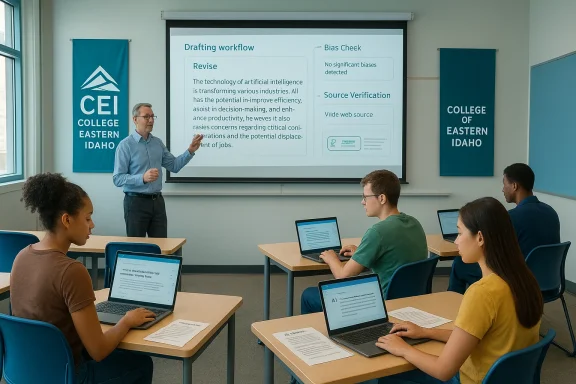
Small and regional colleges are no longer waiting for national policy to decide how to treat generative AI in classrooms. The College of Eastern Idaho (CEI) has announced a major curricular shift: English 101, a near-universal first-year composition course, will be redesigned to include hands‑on instruction in generative AI tools and responsible usage as part of its core learning outcomes. The pilot phase will run in Summer 2026 with the intention of a full launch in Fall 2026. CEI frames the effort as both a literacy and an ethical exercise: students will learn what generative AI is, how it produces text, when it is useful, and how to critique and deploy its output appropriately.
Local coverage echoed the college’s release and emphasized the practical intent: CEI will leverage Microsoft Copilot and campus training to give students guided experience with tools they’re likely to encounter in workplaces. Reporting on the announcement highlights CEI’s claim that it will be among the first Idaho institutions to embed generative AI literacy into its first‑year writing curriculum.
This pattern—vendor-provided tools paired with curricular resources—has been repeated at numerous other institutions. Some have gone further, establishing campus AI labs, institutionally-maintained learning assistants, or degree-level programs focused on applied AI. These examples demonstrate both the promise of rapid capability adoption and the governance complexities that follow.
These tactics move assessment from policing (trying to detect AI use) to pedagogy (teaching students how to use AI responsibly). The literature from other campuses shows that when institutions pair tool access with redesigned assessment and explicit instruction, they can reduce integrity incidents while raising real workplace skills.
Important limitations to stress in the classroom:
Quantitative metrics:
For parents: CEI’s approach is not a shortcut to lowering standards. The college is positioning AI literacy as part of the critical thinking toolbox graduates need for modern workplaces. The point of the course is not to teach students to outsource thinking to software, but to teach them how to supervise, edit, and verify machine-generated work.
Both groups should ask: how will data about student work be stored and protected? CEI should answer with clear policies about institutional accounts and what protections are in place for student data.
If CEI executes with those guardrails in place, the pilot could become a practical model for other small and regional institutions navigating the same challenge: how to prepare students to work with AI without surrendering academic standards, student privacy, or institutional autonomy. If CEI stumbles on governance or assessment design, the pilot could instead become a cautionary tale about vendor dependence and policy lag. The coming months—Summer 2026 pilot and the planned Fall 2026 rollout—will be decisive. Colleges watching this experiment should attend closely and, where possible, demand transparency about contracts, metrics, and pedagogical outcomes so that the sector learns collectively rather than repeating avoidable mistakes.
Source: AOL.com Local college to teach students how to live and work responsibly with AI
 Background / Overview
Small and regional colleges are no longer waiting for national policy to decide how to treat generative AI in classrooms. The College of Eastern Idaho (CEI) has announced a major curricular shift: English 101, a near-universal first-year composition course, will be redesigned to include hands‑on instruction in generative AI tools and responsible usage as part of its core learning outcomes. The pilot phase will run in Summer 2026 with the intention of a full launch in Fall 2026. CEI frames the effort as both a literacy and an ethical exercise: students will learn what generative AI is, how it produces text, when it is useful, and how to critique and deploy its output appropriately. Local coverage echoed the college’s release and emphasized the practical intent: CEI will leverage Microsoft Copilot and campus training to give students guided experience with tools they’re likely to encounter in workplaces. Reporting on the announcement highlights CEI’s claim that it will be among the first Idaho institutions to embed generative AI literacy into its first‑year writing curriculum.
Why English 101 is a strategic place to teach AI literacy
English 101 sits at a crossroads of skills every college graduate needs: clear written communication, critical reading, research practice, and iterative drafting. Embedding AI literacy into this course is strategic for several reasons.- English 101 reaches a large, diverse cohort of students—making it an efficient vehicle for campus‑wide literacy.
- Writing pedagogy already centers on drafting, revision, and source evaluation—skills that map directly onto how students should treat AI-generated text.
- Teaching tool‑use alongside rhetoric emphasizes process over product: students learn to show their work and to incorporate AI as an aid to thinking, not a replacement for it.
What CEI says students will learn (and why it matters)
CEI lists a compact set of outcomes for the redesigned English 101:- Understand the mechanics of generative AI and the limitations of large language models.
- Evaluate when AI is helpful and when it’s not.
- Analyze AI outputs for accuracy, bias, and omitted perspectives.
- Use AI to support drafting and revision while preserving the student's own voice.
- Maintain academic integrity and transparent disclosure of AI assistance.
The institutional context: vendors, partnerships, and incentives
CEI’s adoption of Microsoft Copilot and the broader Microsoft education push are not isolated events. Microsoft has been actively positioning Copilot and related educational resources to colleges and schools, including programs such as Microsoft Elevate for Educators and targeted offers for students that bundle Microsoft 365 features with Copilot capabilities. These vendor programs include training resources and educator credentials that make it easier for colleges to adopt Copilot in a pedagogicallynovernance steps to match the rollout.This pattern—vendor-provided tools paired with curricular resources—has been repeated at numerous other institutions. Some have gone further, establishing campus AI labs, institutionally-maintained learning assistants, or degree-level programs focused on applied AI. These examples demonstrate both the promise of rapid capability adoption and the governance complexities that follow.
Pedagogy in practice: how an AI‑aware English 101 should be taught
Designing an effective AI‑literate English 101 requires more than inserting demonstrations. Here are practical, classroom‑level approaches CEI and peer institutions can and should use:1. Process-first assignments
Require staged submissions: outlines, annotated drafts, revision memos, and final essays. Ask students to document how, when, and why they used an AI tool—what prompts they used, which outputs were adopted, and how they verified claims.2. Prompt‑design as rhetorical skill
Teach prompt construction as a component of clarity and audience awareness. Show students how precise prompts produce more useful drafts, and how prompt templates can be iterated and critiqued.3. Red-team and bias analysis labs
Have small groups interrogate AI outputs: identify factual errors, check source claims, surface omitted viewpoints, and annotate problematic language. These labs should emphasize methods for verification and ethical reflection.4. Oral vivas and reflective assessment
Complement written deliverables with short oral defenses or reflection exercises where students and the editorial choices they made when integrating AI output.5. Tool parity and access
Ensure all students have equitable access to the specified tools—through campus licenses or supported lab machines—and provide low‑tech alternatives for students who opt out for privacy or other reasons.These tactics move assessment from policing (trying to detect AI use) to pedagogy (teaching students how to use AI responsibly). The literature from other campuses shows that when institutions pair tool access with redesigned assessment and explicit instruction, they can reduce integrity incidents while raising real workplace skills.
Strengths of CEI’s plan
- Early, broad exposure: Using a core course guarantees reach and makes generative AI literacy a baseline skill across majors.
- Alignment with workforce expectations: Employers increasingly expect graduates to be able to use Copilot-style assistants for drafting and productivity tasks; CEI’s approach aligns classroom practice with that demand.
- Faculty‑led design: CEI’s English faculty are the drivers of the curriculum, which increases the chance the rollout will reflect pedagogical goals rather than vendor marketing.
- Pilot-driven refinement: A Summer 2026 pilot with frequent student feedback suggests an iterative approach that can fix issues before broad deployment.
Significant risks and operational challenges
No institutional adoption of generative AI is risk-free. CEI’s plan exposes several risks that must be mitigated:Vendor lock‑in and procurement traps
Relying on a single commercial platform (Microsoft Copilot) raises questions about long‑term costs, data retention, exportability, and contractual rights. Institutions that accept vendor-provisioned Copilot seats should negotiate explicit terms on data usage, non‑training clauses (preventing student data from being used to further train vendor models without consent), and exit paths. Multiple sector reviews show institutions often under‑negotiate these protections, creating multi-year dependencies.Privacy and data governa sensitive or personally identifiable information into generative AI prompts. Institutions must make clear what data may be processed by vendor systems, and provide institutional accounts with protections and settings that reduce leakage of protected data. In classroom practice, clear rules—what not to paste—are necessary and must be technical controls and pedagogical guidance.
Academic integrity and misinterpretation of detectors
Academic integrity offices are often tempted to use "AI detectors" to police misconduct. But detectors are imperfect and can produce false positives and false negatives; relying on them for disciplinary action is risky and can produce unfair outcomes. Instead, CEI should emphasize process-based assessment and corroborating evidence over tool detection scores alone. The higher‑ed sector has already seen cases where governance was insufficient and detector reliance generated appeals and reputational damage.Equity and access gaps
Students with high-end devices or paid AI subscriptions start with advantages. If a campus does not ensure parity—through institutional accounts, labs, or loaner devices—AI literacy efforts can widen existing inequities. CEI must ensure that the pilot addresses access and includes opt-out accommodations.Pedagogical dilution risk
If faculty reduce writing instruction to "how to use a tool" rather than how to think and argue in writing, the course risks becoming a skills workshop at the expense of critical thinking. The curriculum must keep rhetorical analysis, evidence evaluation, and voice central—not subordinate them to tool fluency. CEI’s stated emphasis on maintaining voice and judgment is a good sign, but the implementation details will determine success.Governance checklist for responsible adoption
To minimize the risks listed above, colleges adopting AI‑supported coursework should implement a governance checklist before scaling:- Contract safeguards: non‑training clauses, data export rights, retention limits, and audit access.
- Privacy-safe provisioning: institution-managed accounts, clear data-use notices, and default settings that minimize data sharing.
- Assessment redesign: process-based submissions, oral defenses, staged drafts, and reflective logs.
- Device and access parity: campus lab seats, institutional licenses, or vouchers to cover student access.
- Faculty development: time and credentialing for instructors to learn tool affordances and redesign rubrics.
- Transparent communication: plain‑language guidance for students on permitted uses, citation norms, and consequences.
- Incident response: a clear protocol that treats detector output as a lead, not a verdict, and preserves student due process.
Practical tech specifics: What Copilot offers and what it does not
Microsoft’s Copilot integrated into Microsoft 365 and education offerings provides a set of productivity and drafting assistants—Researcher, Analyst, Study and Learn agents, inline drafting helpers, and summarization tools. Microsoft’s 2026 education commitments include teacher training and educator credentials aimed at supporting classroom integration. These vendorp students iterate faster and restructure revision workflows, but they are not substitutes for subject-matter expertise or primary source verification. Institutions must teach students to use Copilot outputs as starting points: verify, cite, and edit.Important limitations to stress in the classroom:
- Copilot’s outputs are probabilistic and may hallucinate facts or invent citations.
- Model behavior is dependent on the data and architecture ct is not a neutral oracle.
- Vendor UIs may change frequently; classroom materials must be stable and teach principles (how to critique output) rather than rely on transient features.
Comparative snapshots: what peers are doing
CEI’s move sits in a growing landscape where institutions are choosing managed adoption—provisioning campus tools while teaching literacy—over outright bans or laissez‑faire approaches.- Seneca Polytechnic (Canada) has formalized a multi‑year partnership with Microsoft, pairing campuswide Copilot access, Microsoft Foundry for model and agent work, and an AI lab to integrate applied AI into co‑op pathways. This approach bundles platform access with curricular and experiential learning.
- University of Phoenix launched a centralized Center for AI Resources that provides students with plain-language guidance on generative AI, institutional expectations, and tool-specific prompting advice—an example of centralizing pedagogy and policy to keep guidance discoverable.
- Several regional universities have taken an incremental route—piloting Copilot or similar assistants in limited courses, instrumenting outcomes, and delaying campuswide procurement until governance and assessment practices matured. These pilots have emphasized faculty training, parity of access, and assessment redesign as prerequisites for expansion.
Recommendations for CEI and for colleges planning similar moves
The CEI pilot is an opportunity for real leadership—but the college should pair ambition with caution. Practical next steps to protect students and learning outcomes:- Publish a concise AI‑use policy specific to English 101 that includes: allowed tools, required disclosure language, and examples of acceptable vs unacceptable uses.
- Require a process log for all AI-assisted assignments: prompts, iterations, and edits. Grade process as part of the rubric.
- Offer explicit alternatives and opt‑out pathways for students with privacy or other concerns, ensuring no penalty for opting out.
- Negotiate institutional license terms that include non‑training clauses, or at minimum, transparency around data use and retention.
- Monitor and publish pilot metrics: student performance, integrity incidents, student satisfaction, and access gaps. Use those data to iterate.
- Invest in faculty development: give instructors release time or stipends to redesign materials, test rubrics, and share best practices across departments.
- Engage student representation in the design and review of policies—students are more likely to accept rules they helped create.
Measuring success: what CEI should track in the pilot
To evaluate the Summer 2026 pilot, CEI should track both qualitative and quantitative indicators.Quantitative metrics:
- Number of English 101 students who used institution-provisioned Copilot accounts vs personal accounts.
- Distribution of submission types (staged drafts, final essays) and the rate of process log compliance.
- Integrity incident rates and outcomes (resolved informally vs formal adjudication).
- Access parity indicators: lab utilization and reported device or connectivity issues.
- Student self-reported confidence in evaluating AI output.
- Faculty feedback on workload impact and rubric clarity.
- Student reflections on whether AI use improved rhetorical clarity or learning.
- Evidence of restored emphasis on critical thinking (e.g., richer revision memos, improved source triangulation).
What students and parents need to know
For students: AI-assisted drafting is a skill. When used well, Copilot-style assistants can speed up early drafts, help with structure, and propose wording. When used poorly, they can propagate inaccuracies and erode your voice. You will be graded for the thinking you demonstrate—show your process, document your prompts, and treat AI output as a draft that must be verified.For parents: CEI’s approach is not a shortcut to lowering standards. The college is positioning AI literacy as part of the critical thinking toolbox graduates need for modern workplaces. The point of the course is not to teach students to outsource thinking to software, but to teach them how to supervise, edit, and verify machine-generated work.
Both groups should ask: how will data about student work be stored and protected? CEI should answer with clear policies about institutional accounts and what protections are in place for student data.
Conclusion: a pragmatic and guarded optimism
CEI’s decision to pilot generative AI literacy in English 101 is an important example of managed adoption: acknowledging that AI tools are part of students’ present and future workflows, while attempting to teach the judgment required to use them responsibly. The strengths of the plan are clear—broad reach, faculty-led design, and an intention to pilot and iterate. But the success of the initiative will hinge on the details: contractual protections with vendors, privacy-safe provisioning, process-first assessment design, faculty training, and measures to prevent inequitable outcomes.If CEI executes with those guardrails in place, the pilot could become a practical model for other small and regional institutions navigating the same challenge: how to prepare students to work with AI without surrendering academic standards, student privacy, or institutional autonomy. If CEI stumbles on governance or assessment design, the pilot could instead become a cautionary tale about vendor dependence and policy lag. The coming months—Summer 2026 pilot and the planned Fall 2026 rollout—will be decisive. Colleges watching this experiment should attend closely and, where possible, demand transparency about contracts, metrics, and pedagogical outcomes so that the sector learns collectively rather than repeating avoidable mistakes.
Source: AOL.com Local college to teach students how to live and work responsibly with AI
