

Celebal Technologies’ announcement that it has been named a finalist in Microsoft’s 2025 Innovate with Azure AI Platform Partner of the Year program crystallizes a pattern now familiar in the enterprise AI market: specialist partners winning visibility by building platform‑native, governed agentic solutions on Azure while Microsoft simultaneously signals which partner capabilities it values most. The recognition is real — Celebal’s corporate statement and multiple press redistributions confirm the finalist placement — but the commercial meaning of the badge is nuanced, and buyers should treat it as a strong shortlist signal that still requires technical and procurement verification.
For teams moving toward agentic AI on Azure, the practical path forward is clear: leverage platform primitives (Foundry, Copilot Studio, Fabric) to shorten engineering cycles, demand auditable governance around safety and identity, and insist on pilot KPIs and exportable artifacts before full production. Partners that can back awards with operational evidence will win the contracts — and that remains the ultimate test of the promise the 2025 Partner of the Year program seeks to celebrate.
Source: WIVB News 4 https://www.wivb.com/business/press...e-with-azure-ai-platform-partner-of-the-year/
 Background
What Microsoft’s Partner of the Year awards are
Microsoft’s Partner of the Year Awards are an annual program that spotlights partner projects the company regards as exemplary across cloud, AI, industry, and other domains. This year’s cycle — announced ahead of Microsoft Ignite — included hundreds of category winners and finalists selected from thousands of nominations. That global scale is widely reported in partner press releases and corroborated by Microsoft’s partner communications. The awards are intentionally both a recognition program and a go‑to‑market mechanism: winners and finalists typically receive promotional amplification, field introductions, and prioritized co‑sell attention from Microsoft.The Innovate with Azure AI Platform category
The Innovate with Azure AI Platform award specifically recognizes partners that demonstrate measurable customer outcomes by building on Azure AI tooling — in 2025 that emphasis was especially on Azure AI Foundry, multi‑agent (agentic) architectures, model lifecycle practices, and enterprise safety/observability patterns. The category rewarded solutions that move beyond experiment to production: governed retrieval‑augmented generation (RAG), model fine‑tuning, identity and security integration, and operational observability are common evaluation points. EPAM was named the category winner for a production GenAI platform delivered to a major retailer, while several partners — including Celebal Technologies — were named finalists.What the announcement says — a concise summary
- Celebal Technologies stated on November 12, 2025 that it was named a finalist in the Innovate with Azure AI Platform Partner of the Year category. The company framed the work as an Agentic AI deployment built on Azure AI Foundry, targeting manufacturing and SAP‑adjacent workflows and emphasizing multi‑modal models, fine‑tuning, and content safety controls.
- The release includes executive quotes from CEO Anirudh Kala and Co‑founder Anupam Gupta positioning this recognition as part of a multi‑year Microsoft relationship and a string of prior partner awards, and highlights the company’s “day‑to‑day productivity agent” for manufacturing as the entry’s exemplar.
- Microsoft’s 2025 awards cycle reportedly drew thousands of nominations (commonly reported as more than 4,600 nominations across 100+ countries), a figure echoed across partner press materials during the announcement window. This underscores the competitiveness of finalist selections.
Why the finalist badge matters — commercial and technical implications
Platform alignment and co‑sell signals
Being a Microsoft finalist is a meaningful market signal. It typically:- Increases the partner’s visibility within Microsoft field and partner teams.
- Creates marketing momentum and third‑party validation that can accelerate shortlisting by procurement teams.
- Often unlocks more prominent co‑sell, joint marketing, and field access opportunities for the partner.
What “Agentic AI on Azure AI Foundry” implies technically
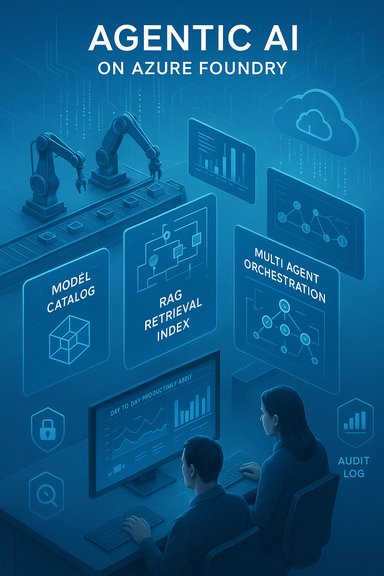
When vendors say they built an “Agentic AI” solution on Azure AI Foundry, that claim typically maps to a recognizable architecture that includes:- A model catalog and evaluation pipeline for selecting foundation, third‑party, or fine‑tuned models.
- Retrieval‑augmented generation (RAG): vector stores, indexing of enterprise knowledge (including SAP data or operational telemetry), and retrieval pipelines.
- Multi‑agent orchestration: systems that decompose complex tasks into coordinated agent actions which call backend APIs and systems.
- Observability and safety tooling: continuous evaluation, content safety filters, audit logs, and model‑level telemetry.
- Identity and security integration: Entra/Azure AD for agent identities, managed identities for backend connectors, and private network options for controlling data egress.
- Cost and deployment controls: throttling, quotas, tagging, and FinOps dashboards for token/GPU spend.
Strengths in Celebal’s finalist narrative
Vertical depth: Manufacturing + SAP
Celebal emphasizes manufacturing and SAP modernization as its domain strengths. In practice, domain focus matters: manufacturing environments generate structured operational data, have deterministic workflows (for instance, work orders, inventory reconciliation), and often benefit from agentic automation that integrates ERP systems, shop‑floor telemetry, and human workflows.- Domain expertise reduces time to build domain‑appropriate retrieval indices, intent models, and connectors for systems like SAP.
- Partners that combine SAP knowledge with Azure data/AI stacks can move faster from pilot to production in the manufacturing vertical.
Platform‑native engineering and prior awards
Celebal has a documented history of Microsoft and partner recognitions in data and AI across regions and years. Industry recognition is not conclusive evidence of production robustness, but it is a useful signal of sustained partnership investment — both in people and in platform expertise. Microsoft’s award criteria favor demonstrable outcomes and platform alignment; recurring partner recognition suggests the company has repeatedly positioned production work that matches Microsoft’s evaluation rubrics.Risks, caveats, and what to verify before procurement
Vendor claims vs. audited evidence
Press releases and awards are marketing artifacts. The most load‑bearing technical and business claims that vendors make in these announcements are frequently vendor‑supplied and require independent verification:- “Measurable productivity gains” and percentage improvement claims should be backed by named customer references, pre/post telemetry extracts, and agreed metrics.
- Security posture claims (private endpoint usage, encryption at rest/in transit, red‑team results, penetration test outcomes) should be validated by SOC 2 reports, pen test reports, or independent security attestations.
- Operational readiness claims (99.x% SLAs, capacity to handle X concurrent users, cost per seat estimates) must be written into procurement SOWs and supported by runbooks and telemetry dashboards.
Hallucination, scope creep, and governance
Agentic systems that can act on behalf of users create new failure modes compared with single‑query LLM assistants. Common operational risks include hallucination (incorrect or fabricated responses), inappropriate automated actions (agents triggering real‑world operations), and data leakage.- Require red‑team / safety testing evidence and continuous evaluation metrics that show false positive/negative rates for critical tasks.
- Insist on traceability for agent decisions: audit logs mapping agent actions back to model inputs, retrieval contexts, and human approvals.
- Define precise scope and guardrails in the SOW so agents never operate beyond approved actions without explicit human intervention.
Cost unpredictability and FinOps
LLM and GPU workloads are volatile: token usage, fine‑tuning cycles, and multi‑agent orchestration can quickly increase consumption. Before scaling, ensure:- Cost modeling and per‑user/per‑agent estimates are provided and stress‑tested for peak scenarios.
- Tagging, budgets, and automated throttling are in place to prevent runaway spend.
- Clear billing and migration terms exist in contracts, because agent workloads often create sticky platform dependencies.
Practical checklist for IT leaders evaluating Celebal or similar finalist partners
- Confirm finalist status on Microsoft’s official winners/finalists list and request the partner nomination artifact that was submitted to Microsoft. Public announcements reference the Microsoft list for verification.
- Ask for named references and request permission to view anonymized telemetry during vendor‑led pilot phases. References should be in the same industry and at a similar scale.
- Validate security: request SOC 2 (or equivalent), third‑party penetration testing reports, and architecture diagrams showing network isolation, private endpoints, and data flow controls.
- Require a red‑team / safety assessment and a published remediation plan for hallucination or content safety incidents. Confirm who is responsible for incident response and for retraining or model patching.
- Insist on FinOps artifacts: projected monthly costs per 1,000 active users, budget alerts, tagging strategies, and cost‑containment runbooks.
- Define a minimum viable production acceptance test (PAT) with agreed KPIs (latency, error rates, successful task completions) and acceptance criteria before moving to full rollout.
- Confirm data portability and exit terms: ensure critical indexes, vector stores, and logs can be exported in a usable, documented format if the relationship ends.
The broader market signal — why finalists like Celebal matter to enterprise IT
The 2025 awards cycle highlights two broader market trends that WindowsForum readers — many of whom manage Azure, identities, and Windows endpoints — should note:- Platform‑native agent engineering is maturing. Microsoft’s product surface (Azure AI Foundry, Copilot Studio, Azure OpenAI, Microsoft Fabric) now provides the cataloging, observability, and identity plumbing necessary to move agentic projects to production with more predictable governance. Partners that align to these platform primitives are able to deliver repeatable outcomes more quickly.
- Specialist partners can differentiate through vertical IP. Firms that pair deep ERP (SAP) skills with Azure data and AI technology create faster time‑to‑value in complex industries like manufacturing and supply chain. Finalist recognition is often awarded to those who can show actual production implementations in well‑defined vertical contexts.
- Awards accelerate the partner discovery process, but they increase the buyer’s responsibility to perform operational due diligence. Procurement teams should treat finalist lists as a curated starting point rather than a definitive stamp of production readiness.
Quick verification notes and sources of truth
For readers who want to confirm the headline facts independently:- Celebal Technologies’ official press announcement of the finalist placement is available on the company’s newsroom and mirrors the distributed press release text.
- Multiple partner and press releases from this awards window (including category winners such as EPAM) document the Innovate with Azure AI Platform award and the list of winners and finalists announced by Microsoft. EPAM’s category win is widely reported in its own press release.
- Microsoft’s partner communications and the consolidated winners/finalists list (announced around Microsoft Ignite) are the canonical references for final validation of any partner’s finalist or winner status; partner press releases commonly link to Microsoft’s official compilation. Readers and procurement teams should confirm entries there when required.
- Industry presswire redistributions (for example, EINPresswire and BusinessWire syndications) reproduce vendor announcements and provide additional circulation for partner claims; they are useful for cross‑checking public messaging but do not substitute for Microsoft’s official winners list or customer references.
Conclusion
Celebal Technologies’ recognition as a finalist in Microsoft’s 2025 Innovate with Azure AI Platform Partner of the Year awards is a verified and meaningful market signal: it confirms the company’s strategic alignment with Azure AI Foundry and its focus on agentic AI for manufacturing and SAP modernization. The finalist badge increases Celebal’s visibility and co‑sell potential and validates a platform‑native engineering approach that many enterprise IT buyers now prefer. That said, the recognition is the beginning — not the end — of a procurement process. Windows administrators and IT leaders should convert awards‑led shortlisting into rigorous technical and commercial validation: named references, audited security attestations, red‑team safety results, FinOps planning, and a measurable pilot acceptance plan. Finalist status should make partners like Celebal easier to evaluate; it does not replace the need for transaction‑level proof that large, agentic AI systems will behave safely, scale predictably, and remain cost‑manageable in the long run.For teams moving toward agentic AI on Azure, the practical path forward is clear: leverage platform primitives (Foundry, Copilot Studio, Fabric) to shorten engineering cycles, demand auditable governance around safety and identity, and insist on pilot KPIs and exportable artifacts before full production. Partners that can back awards with operational evidence will win the contracts — and that remains the ultimate test of the promise the 2025 Partner of the Year program seeks to celebrate.
Source: WIVB News 4 https://www.wivb.com/business/press...e-with-azure-ai-platform-partner-of-the-year/
