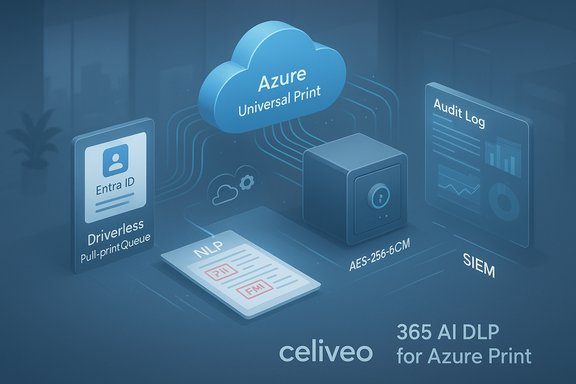
Celiveo’s claim that Celiveo 365 AI‑DLP brings enterprise-grade, Azure‑native secure cloud print with built‑in AI data‑loss prevention to customers subject to HIPAA, GDPR and CCPA must be read as a pragmatic vendor proposition rather than a regulatory waiver — but if the product’s published architecture and controls are implemented and contractually backed (BAA/DPA, key management, auditable logs), Celiveo 365 can close important gaps that organizations face when moving print and scan workflows into Microsoft Azure and Microsoft Universal Print.
Celiveo 365 is presented as a cloud-native print and document management suite built on Microsoft Azure that layers AI‑driven Data Loss Prevention (AI‑DLP), pull‑print authentication, and an enterprise document knowledge base on top of Microsoft Universal Print and Entra ID. The vendor materials state the platform inspects print and scan content in real time, detects PII and PHI using natural language processing across dozens of languages, blocks or quarantines risky jobs, and stores documents in a tenant‑controlled Azure vault with AES‑256‑GCM encryption. Celiveo also positions its solution for Microsoft CSP billing and Azure Marketplace distribution. Those product claims intersect directly with three compliance regimes most commonly cited by enterprises that handle regulated personal data: HIPAA for U.S. protected health information, GDPR for European personal data, and CCPA/CPRA for California consumer personal information. Each regime focuses less on product feature checklists and more on lawful roles, contractual arrangements, technical and organisational safeguards, and auditability — i.e., whether you can demonstrate who did what, where, and why. The federal HIPAA guidance and EU data‑protection guidance make this explicit: using a cloud vendor does not remove the covered entity’s or controller’s obligations.
Celiveo 365 is an example of a new generation of print‑centric products that recognize printing is still a valuable attack surface for data leakage — and that policy needs to follow data capture, not just storage. With correct contractual protections, validated telemetry and careful rollout, the solution can reduce risk and modernize print workflows in Microsoft‑centric enterprises. Without those controls, the same cloud‑native convenience can create new blind spots: the difference between a compliant deployment and an exposure is rarely a product feature — it’s the contract, the configuration, and the evidence.
Source: KHON2 https://www.khon2.com/business/pres...ce-for-secure-cloud-print-on-microsoft-azure/
 Background / Overview
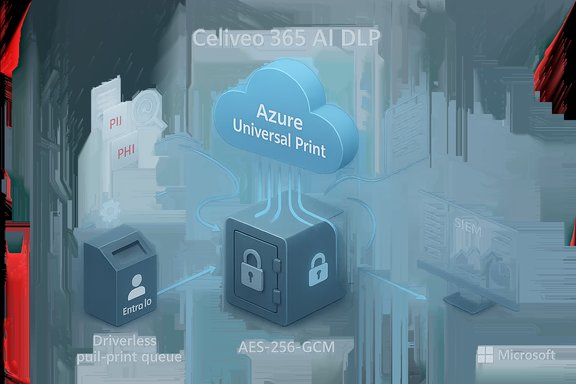
Celiveo 365 is presented as a cloud-native print and document management suite built on Microsoft Azure that layers AI‑driven Data Loss Prevention (AI‑DLP), pull‑print authentication, and an enterprise document knowledge base on top of Microsoft Universal Print and Entra ID. The vendor materials state the platform inspects print and scan content in real time, detects PII and PHI using natural language processing across dozens of languages, blocks or quarantines risky jobs, and stores documents in a tenant‑controlled Azure vault with AES‑256‑GCM encryption. Celiveo also positions its solution for Microsoft CSP billing and Azure Marketplace distribution. Those product claims intersect directly with three compliance regimes most commonly cited by enterprises that handle regulated personal data: HIPAA for U.S. protected health information, GDPR for European personal data, and CCPA/CPRA for California consumer personal information. Each regime focuses less on product feature checklists and more on lawful roles, contractual arrangements, technical and organisational safeguards, and auditability — i.e., whether you can demonstrate who did what, where, and why. The federal HIPAA guidance and EU data‑protection guidance make this explicit: using a cloud vendor does not remove the covered entity’s or controller’s obligations. What the announcement and vendor materials actually say
Key points Celiveo advertises
- AI‑DLP scanning of print/scan pages in real time that identifies PII/PHI across 79 languages and prevents unauthorized storage or printing.
- Native Microsoft Universal Print integration and support for Entra ID authentication, enabling driverless, agentless print and pull‑print workflows.
- Tenant‑aligned storage and encryption: double AES‑256‑GCM encryption and “your vault in Azure” language that implies tenant control and encryption at rest / in transit.
- Marketplace/CSP billing and rapid deployment (one‑day setup and per‑user pricing) aimed at Microsoft channels.
Technical elements emphasized by Celiveo
- Natural Language Processing (NLP) rather than rules/regex for classification (vendor argues this reduces false positives/negatives).
- Controls for blocking, quarantining, redaction or override workflows when sensitive content is detected before indexing or printing.
- No client drivers or server software required on endpoints — a serverless SaaS/PaaS model using Azure.
Verifying the vendor claims — what checks the documentation supports
Several vendor statements are testable against public documentation and standard cloud controls:- Integration with Microsoft Universal Print and Entra ID is demonstrably consistent with Microsoft’s modern print stack and the Azure Marketplace listing for Celiveo 365. Microsoft’s Universal Print documentation confirms the architecture for driverless cloud printing and centralized management; many third‑party print vendors extend it with pull‑print and secure release.
- The encryption claims (AES‑256‑GCM) and tenant storage assertions appear in Celiveo product pages and the Azure Marketplace listing; these are verifiable in the vendor’s technical documentation and the marketplace listing, but customers should require explicit detail in contract and deployment runbooks about where keys are stored, who can access them, and whether key‑management uses customer‑managed keys (CMK) or vendor keys. The marketing phrase “your Azure tenant vault” is promising, but operational fidelity depends on how keys, telemetry, and logs are handled.
- The HIPAA angle: the HHS OCR guidance on cloud computing makes clear that any cloud service provider that creates, receives, maintains or transmits ePHI is a business associate, and that a Business Associate Agreement (BAA) is a legal necessity. Celiveo’s HIPAA compliance claim is only meaningful if the vendor signs an appropriate BAA and the technical design prevents unauthorized exposure of ePHI. Customers should verify BAA availability, the scope of obligations, and breach notification timelines.
- GDPR and CCPA responsibilities are contractual and process‑oriented: the European Data Protection Board and GDPR Article 28 emphasize that processors must act on documented instructions and provide sufficient guarantees, while CCPA/CPRA distinguishes “service providers” and places contractual limits on use and retention. Celiveo’s marketing that it is “GDPR/CCPA compliant” must be validated by a Data Processing Addendum (DPA) and operational evidence (records of processing, DPIA support, sub‑processor lists, cross‑border transfer mechanisms).
- The AI training and telemetry claim — that customer documents are not used to train public models — is a frequent vendor assertion. This is an operational commitment that must be contractually enforced; customers should request specifics (no telemetry outside tenant, no model training, retention windows, and audit logs). Independently verifying “not used for training” requires contractual, technical and forensic controls; on‑site or third‑party audits are the usual route. This sort of claim is verifiable in practice only with documentation and controls, not by marketing copy alone.
Market context: why AI‑DLP for printing matters now
- Modernization of print in the Microsoft ecosystem. Microsoft’s Universal Print and the emerging Windows Protected Print (WPP) roadmap accelerate a shift toward driverless, cloud‑hosted printing. Vendors that extend Universal Print with secure release/pull print and DLP plug real gaps as driver models and print servers are phased out. Celiveo explicitly targets this gap.
- GenAI and unstructured data exposure. The rapid adoption of generative AI creates a new exfiltration vector: users copying sensitive content into chat interfaces or pasting documents into LLM prompts. Organizations need controls that detect and block sensitive content before it exits managed channels. AI‑enabled DLP at the point of capture or print can reduce that risk. Vendor solutions vary in detection efficacy; semantic approaches promise better context handling than regex lists, but accuracy metrics must be validated in pilot tests.
- Regulatory focus on roles and contractual commitments. Regulators do not certify products as “GDPR‑compliant” or “HIPAA‑approved”; they require entities to demonstrate lawful processing, contractual safeguards, and technical measures. That means a product can be deployed in a compliant way — but only if contracts (BAA/DPA), configuration, and auditing match the promises. Official guidance from HHS and EDPB underscores the need for due diligence.
Strengths: where Celiveo 365 appears to deliver real benefits
- Native Azure/Universal Print alignment: Being available on Azure Marketplace and designed to operate with Universal Print and Entra ID simplifies procurement and integration for Microsoft‑centric tenants, reducing deployment complexity compared with gateway/agent models. This is important operationally as Microsoft phases in the Modern Print Platform and Windows Protected Print.
- Agentless driverless architecture: Removing on‑prem print servers and endpoint agent installs reduces attack surface and simplifies patching, particularly attractive for distributed and hybrid workplaces. This aligns with Microsoft’s driverless direction and with vendor claims of rapid deployment.
- AI semantic DLP approach: Semantic NLP‑based classification can materially reduce false positives/negatives compared to simple pattern matching — especially for complex PHI/PII in documents with varied formats. In practice this improves usability (fewer blocked legitimate prints) and improves detection where contextual cues matter. However, the business value depends on precision/recall on representative corpora.
- Pull‑print security and audit trails: Pull printing prevents documents from sitting unclaimed in output trays, and when combined with centralized logs and tamper‑proof archives it strengthens auditability for compliance and forensics. This is a mature control in managed print environments and Celiveo bundles it with cloud DLP and an AI index for search.
Risks, caveats and what buyers must verify
- Legal role & contract (BAA/DPA/sub‑processor list): For HIPAA, Celiveo or any CSP is a business associate if it handles ePHI. The HHS OCR guidance requires a BAA; for GDPR/CCPA the customer must have a DPA and visibility of sub‑processors. A vendor claim of “compliance” is not a contractual guarantee. Buyers must obtain and review these agreements and insist on written commitments regarding data flows, sub‑processor onboarding, and breach notification timelines.
- Key management and encryption control: Marketing statements about AES‑256‑GCM are a baseline, but critical questions remain: who manages the keys, are customer‑managed keys (CMKs) supported, and can keys be revoked independently of the vendor? If keys are vendor‑managed, the tenant’s “control” is limited in practice; for the highest‑sensitivity use cases customers should insist on CMK with HSM backing and contractual limits on vendor access.
- Telemetry, model training and privacy of content: Vendor statements that the platform “does not train public models on customer data” must be proven by contractual commitments, technical architecture diagrams, and ideally third‑party audits. Telemetry sent to vendor control planes (metadata about detections, content hashes, snippet excerpts) can still pose a compliance risk if not tightly scoped and contractually limited. Require a telemetry matrix and an explicit “no training” clause.
- False positives/negatives and operational impact: No DLP system is perfect; semantic models may still miss edge cases (e.g., scanned handwritten PHI, images containing PHI, or unusual document layouts). False positives impact user productivity; false negatives create compliance risk. Buyers must run pilots with representative datasets and request precision/recall metrics before wide deployment. Independent benchmarks or pilot results must be part of procurement.
- Windows Protected Print compatibility and hardware constraints: Microsoft’s WPP and Universal Print roadmaps change the driver and device landscape. Some legacy printers and vendors may not fully support WPP or Mopria‑certified IPP; customers must inventory fleet compatibility and confirm Celiveo’s interoperability with the installed MFPs and card readers. UniFLOW and Pharos examples show vendors are updating to support WPP, but the path is not automatic for every site.
- Auditability and regulatory evidence: Regulators want proof: logs, retention, eDiscovery support, and the ability to demonstrate that sensitive documents were not exposed. Ask for explicit log formats, exportability to SIEM/eDiscovery, and an audit policy. Marketing pages cannot substitute for an audit report or SOC/ISO certification scope that includes print capture and DLP operations.
Practical deployment checklist — what to demand before buying or piloting
- Insist on a signed, jurisdiction‑appropriate Business Associate Agreement (BAA) for any ePHI use case, and a Data Processing Addendum (DPA) that lists sub‑processors and cross‑border transfer mechanisms for GDPR. Provide copies for legal review.
- Request technical architecture diagrams showing exactly where content is captured, where it is processed, whether any metadata leaves the tenant, and where keys are stored. Confirm whether Celiveo supports customer‑managed keys (CMK) in Azure Key Vault and HSM binding.
- Run a scoped pilot with a representative dataset (including PHI/PII examples) and measure precision/recall for the AI‑DLP engine. Capture false positive rates and operational impact (override workflows, helpdesk burden). Document remediation SLAs.
- Validate interoperability: confirm Universal Print integration, Entra ID SSO behavior, pull‑print card reader workflows, and Windows Protected Print compatibility for the model of MFPs in use. Test behavior with macOS, iOS and Android endpoints if your organization uses them.
- Require exportable, machine‑readable logs (prompt, detection, user ID, timestamp, action taken) that integrate with SIEM/eDiscovery and meet legal hold requirements. Confirm retention windows and the vendor’s policy for preservation in breaches or litigation.
- Obtain security and compliance artifacts: SOC 2 / ISO 27001 reports, penetration test summaries, vulnerability management cadence, and a list of security controls mapped to HIPAA/GDPR/CCPA obligations. For HIPAA, confirm the BAA includes breach notification timing and the right to audit.
- Clarify telemetry and training: ask for a written, auditable policy that specifies that customer documents are not used to train public models, and request proof (logs, code paths, or audit evidence) that the model training pipelines are segregated. If the vendor uses third‑party models (OpenAI/Azure OpenAI), ensure contractual limits on prompt/response retention and processing.
Comparative perspective and alternatives
Third‑party print management vendors (uniFLOW, Pharos, PaperCut and others) have evolved similar features: secure release, Universal Print integration and cloud options. Recent vendor updates show the ecosystem is converging around Universal Print and Windows Protected Print support. Customers should assess Celiveo against incumbents on the basis of:- Actual accuracy of DLP detection for invoice, clinical, legal and mixed documents.
- Operational model: agentless vs agent‑based and how it affects VDI, Citrix or legacy print routing.
- Channel and support: CSP billing, local reseller SLAs, and global support windows.
- Audit evidence: SOC/ISO coverage and third‑party attestations for DLP and AI processing.
Policy & legal cross‑checks (verified claims)
- HIPAA: A cloud service provider that creates, receives, maintains, or transmits ePHI is a business associate and must sign a BAA; encryption alone does not remove that status. This is HHS OCR guidance and widely echoed by legal commentators. Buyers needing HIPAA compliance must obtain a signed BAA and proof of technical controls.
- GDPR: Entities must distinguish controller/processor roles and ensure processors provide “sufficient guarantees” and DPAs that meet Article 28 requirements (instructions, sub‑processor controls, audits, deletion/return of data). Marketing claims are not a substitute for a DPA that specifies processing scope.
- CCPA/CPRA: Under California law cloud service providers can be “service providers” with contractual restrictions; the customer must ensure contractual limits on retention/use and appropriate assistance for data subject requests. For organizations regulated by the CCPA/CPRA, a DPA with explicit constraints is required.
Final assessment — pragmatic recommendation for IT and compliance teams
Celiveo 365’s approach—combining Azure‑native cloud print, Universal Print integration, pull‑print authentication and an AI‑driven DLP layer—targets a clear market need: secure, auditable handling of unstructured documents at capture and print time as enterprises move away from on‑prem print servers. The vendor aligns with Microsoft’s Universal Print and Windows Protected Print direction and offers promising features that can materially reduce leakage and simplify governance. However, the marketing assertions must be validated contractually and technically. “Compliance” claims (HIPAA, GDPR, CCPA) are meaningful only when backed by:- a signed BAA and DPA with clear sub‑processor lists and audit rights;
- demonstrable key‑management and tenant‑segregation (preferably CMK/HSM);
- pilot validated AI‑DLP accuracy on representative documents and a remediation playbook for false positives; and
- exportable, machine‑readable logs and SOC/ISO evidence covering the specific print/DLP processing pipelines.
Quick checklist for immediate next steps (executive summary)
- Obtain Celiveo’s BAA and DPA and review sub‑processor lists.
- Request architecture and key‑management details (CMK/HSM support).
- Run a representative pilot measuring AI‑DLP precision/recall and operational overhead.
- Confirm Universal Print and Windows Protected Print compatibility with your fleet and card readers.
- Demand exportable, machine‑readable audit logs for SIEM/eDiscovery and request SOC/ISO reports covering the specific functions.
Celiveo 365 is an example of a new generation of print‑centric products that recognize printing is still a valuable attack surface for data leakage — and that policy needs to follow data capture, not just storage. With correct contractual protections, validated telemetry and careful rollout, the solution can reduce risk and modernize print workflows in Microsoft‑centric enterprises. Without those controls, the same cloud‑native convenience can create new blind spots: the difference between a compliant deployment and an exposure is rarely a product feature — it’s the contract, the configuration, and the evidence.
Source: KHON2 https://www.khon2.com/business/pres...ce-for-secure-cloud-print-on-microsoft-azure/