
Centrica is expanding its Microsoft Power Platform program across the United Kingdom energy business, using Managed Environments, a custom Center of Excellence intake process, and Copilot Studio to govern more than 1,100 internal apps built by over 430 makers. The story is not simply that another large enterprise has embraced low code. It is that Centrica has reached the point where low code stops being a productivity experiment and becomes part of the operating model. That shift is where Microsoft wants every Power Platform customer to land, and it is also where governance either becomes a product feature or a business risk.
The first phase of low code is almost always charming. A finance analyst replaces a spreadsheet-and-email ritual with an app. A field team stops waiting for an overloaded central IT queue. A business unit finds that the person who understands the process can now help build the tool.
Centrica’s early example fits the pattern neatly: a tax timetable app built by the finance team to coordinate returns across three tax regimes. What had been a messy, email-driven workflow became a system of automated reminders designed to reduce missed filings, fines, and operational risk. That is the canonical Power Platform success story because it is small enough to build quickly and important enough to matter.
But the charm fades when the app count climbs. Centrica now reports more than 13,000 active Power Platform users, over 430 makers, and more than 1,100 apps. At that scale, the interesting question is no longer whether low code can produce value. The question is whether the organization can see, classify, secure, support, and retire what its users have created.
That is why Centrica’s latest Power Platform chapter matters. It is less a celebration of citizen development than a case study in how enterprises are trying to domesticate it. Microsoft’s pitch is that Managed Environments, the Power Platform admin center, and Copilot Studio can let companies keep the speed while adding adult supervision.
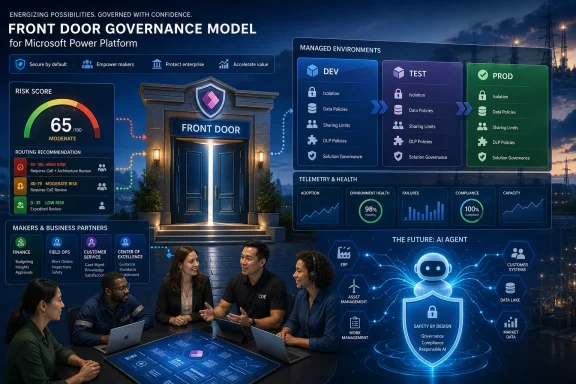
The questions Centrica asks are revealing. Makers must describe business objectives, stakeholders, the business unit involved, expected user numbers, and potential financial, regulatory, or operational risk. That information feeds an automated risk score, which determines whether the project can proceed as a lightweight solution or needs review by Power Platform leadership.
This is a quiet but important reversal of the old enterprise software model. Instead of forcing every idea through centralized IT before anyone can experiment, Centrica appears to let makers start, then intercepts the work early enough to classify it. That keeps the low-code promise alive while preventing the platform from becoming a shadow IT factory.
The review process also addresses a problem every large organization eventually discovers: duplication. If one team builds an app to solve a problem, another team may be quietly building something similar three floors away or three regions over. Centrica’s leadership team checks whether an existing solution can be reused before approving new work, which is a governance move with both technical and cultural implications.
Reuse is not glamorous, but it is where low code either compounds or fragments. A company with 1,100 apps does not just need more makers. It needs memory.
For Centrica, the key move is not merely enabling a setting. It is combining Managed Environments with an intake model that routes makers into dev-test-prod environments after approval. That matters because many low-code programs start in the default environment and stay there too long. The default environment is convenient, but convenience is rarely a compliance strategy.
Dev-test-prod sounds boring only until a business-critical app breaks in front of thousands of users. The discipline of separating development from testing and production is one of the ways citizen development starts to look less like an experiment and more like software engineering. Centrica’s model suggests that the company is not trying to turn every maker into a professional developer, but it is trying to surround makers with enough structure to prevent predictable failures.
Managed Environments also fit Microsoft’s broader strategy. The company has spent years arguing that low code is not the opposite of professional development but a tier in a larger software supply chain. That argument only works if enterprise customers believe they can apply policy, lifecycle management, auditing, and security to assets created by nontraditional developers.
That distribution is the source of Power Platform’s appeal. The finance team knows the tax timetable problem better than a generic development queue does. Field operations teams understand where engineers lose time. Call center staff can identify recurring friction long before a quarterly transformation review gets around to it.
The risk is that every one of those teams can also encode bad process, mishandle data, or create fragile dependencies. Low code does not eliminate software risk; it democratizes it. A badly governed maker program can produce the same problems as traditional software development, only faster and with less visibility.
Centrica’s support model is therefore as important as its control model. Makers get self-help materials, best practices, access to training, and the ability to book time with the Center of Excellence team. They also use the Power Apps Code Review Tool to inspect apps for efficiency and improvement opportunities.
That combination hints at the real job of a modern Center of Excellence. It is not just a gatekeeper. It is a teaching institution, a pattern library, a compliance checkpoint, and a translation layer between business users and professional IT.
That distinction matters. A canvas app can still be badly designed, but its buttons, forms, and data connections are visible. An AI agent introduces prompts, knowledge sources, generative responses, and action orchestration. The failure modes shift from “the app does not work” to “the system confidently did the wrong thing,” “the answer was plausible but incomplete,” or “the agent surfaced information in a context where it should not have.”
Microsoft knows this, which is why Copilot Studio has become tied closely to Power Platform governance. Agents live in the same administrative universe that already handles environments, connectors, data policies, and lifecycle controls. For organizations like Centrica, that is both a selling point and a warning. The existing governance foundation becomes more valuable precisely because the new tools are more powerful.
The temptation in 2026 will be to treat agent building as the new citizen-developer frontier. That may be true, but only if companies resist the urge to treat agents as glorified chatbots. A custom copilot connected to business processes is software, even if it begins with a natural-language description.
That factory needs guardrails. Without them, enterprises will either block experimentation or drown in unmanaged agents. Microsoft’s answer is to make the administrative plane the product: Managed Environments, the Power Platform admin center, environment groups, sharing limits, DLP policies, analytics, and lifecycle tooling.
This is a pragmatic strategy. CIOs are not short on AI demos. They are short on ways to let business units experiment without creating compliance nightmares. A platform that says “yes, but inside these boundaries” is more useful than one that says either “anything goes” or “open a ticket and wait six months.”
Centrica’s implementation shows why the governance story lands. The company is in a regulated, operationally complex sector, serving millions of customers through brands including British Gas, Bord Gáis Energy, and Centrica Business Solutions. In that context, internal efficiency is not just a back-office nicety. A poorly governed tool can affect customer service, engineering workflows, financial controls, and regulatory obligations.
That makes Power Platform attractive. It can shorten the distance between process pain and software response. It can also let a company build small tools that would never survive the business case process for traditional development but still save real time when multiplied across thousands of employees.
The danger is that “small” can become misleading. A small app used by a few people may be harmless. A small app that becomes embedded in compliance, field scheduling, customer communication, or finance can become mission critical before anyone formally names it as such.
Centrica’s risk scoring process is designed to catch that transition. By asking about users, stakeholders, business objectives, and risk categories at the beginning, the company is trying to identify which solutions can remain lightweight and which need more formal treatment. That is a mature distinction, and it is one many organizations only learn after a fragile automation becomes indispensable.
Centrica’s model implicitly accepts that reality. The company is not trying to suppress maker activity. It is trying to bring it into daylight. The “Front Door” system is aptly named because it gives makers an official entrance rather than forcing them through a side door.
This is the right argument for enterprise low code in 2026. The question is not whether business users will automate work. They already do. The question is whether the organization will provide sanctioned tools, common patterns, risk review, and administrative telemetry—or pretend that informal systems do not exist.
Microsoft’s advantage is that Power Platform sits inside many organizations’ existing Microsoft estate. Identity, Microsoft 365, Dataverse, Power BI, Teams, and Azure adjacency all make the platform feel familiar to administrators. But familiarity should not be mistaken for automatic safety. A Microsoft stack can still be misconfigured, over-shared, under-reviewed, or poorly documented.
Centrica’s governance model recognizes that difference through risk scoring and escalation. Low-risk productivity apps can move quickly. Advanced or high-risk projects trigger review with technical and business stakeholders. That is not anti-innovation bureaucracy; it is triage.
The hard part is keeping the triage honest. If every app is treated as high risk, the platform loses its speed. If too many apps are waved through, the organization loses control. The Center of Excellence must constantly tune the line between empowerment and oversight.
This is where metrics matter. App counts and maker counts are useful, but they can become vanity numbers. The better measures are reuse, retirement, avoided duplication, incident rates, supportability, and whether business-critical tools have clear owners. Centrica’s ability to keep expanding Power Platform will depend less on how many apps it can create than on how many it can sustain.
Companies will need to ask new questions. What knowledge sources can an agent use? Which actions can it trigger? How are responses monitored? What happens when an answer is wrong? Who owns the agent’s behavior after the original maker moves roles?
The old governance artifacts still matter: environments, DLP policies, lifecycle management, testing, sharing controls, and auditing. But AI adds another layer of judgment. The safest organizations will not simply approve or reject agents; they will classify them by the sensitivity of their data, the consequences of their actions, and the degree of human oversight required.
Centrica’s existing intake model gives it a head start because it already asks about risk before a solution becomes widely adopted. The challenge will be adapting that model to agents, where risk may emerge not only from what a tool is designed to do but from what users ask it to do.
Sysadmins and Microsoft 365 administrators should not treat Power Platform as someone else’s SaaS toy. The platform touches identity, connectors, data movement, sharing, licensing, and compliance. It also increasingly touches AI agent creation, which means the blast radius of a bad policy can expand quickly.
The good news is that Microsoft is building more governance into the product. The bad news is that features do not configure themselves, and governance still requires institutional judgment. A tenant with Managed Environments available but no coherent environment strategy is not governed in any meaningful sense.
Centrica’s example points to the operating model administrators should expect: central visibility, distributed makers, environment routing, formal review for high-risk work, training resources, reusable patterns, and escalating controls as solutions become more important. That model will feel familiar to anyone who has watched endpoint management mature from ad hoc imaging to policy-driven fleet operations.
That is why Centrica’s timeline matters. The company began working with Power Platform in 2018. The early wins were straightforward, but the estate now includes over a thousand apps and a large community of makers. Governance did not become relevant after the platform matured; governance is what allowed the platform to mature.
Organizations that wait until they have a sprawl problem will find that cleanup is harder than prevention. Makers resent retroactive bureaucracy, business units resist losing tools they depend on, and administrators inherit assets with unclear ownership. Centrica’s “Front Door” approach is an attempt to avoid that trap by making registration and review part of the normal maker journey.
There is a broader lesson here for Copilot Studio as well. If companies let agent creation bloom without intake, ownership, testing, and monitoring, they will recreate the first wave of low-code sprawl with more complex failure modes. The time to design agent governance is before the agent count becomes impressive.
Still, the substance is meaningful. Centrica’s implementation includes enough operational detail to be more than marketing gloss. Automated detection of maker activity, registration questions, risk scoring, review calls, dev-test-prod environments, code review tooling, and maker support all describe a real governance architecture.
The most interesting part is that Centrica does not appear to be choosing between innovation and control. It is trying to make control the mechanism by which innovation can scale. That is the mature version of the low-code argument, and it is the only version likely to survive in regulated enterprises.
Microsoft will point to Centrica as evidence that Power Platform can support large-scale, business-led development. IT leaders should read it as evidence that success requires more than licensing the platform. The toolset helps, but the operating model is the product.
A front door changes the social contract. Makers are not treated as rogues. They are welcomed, asked for context, assessed for risk, and routed toward the right level of support. In return, the organization gets visibility before a tool becomes too entrenched to govern.
That model is more scalable than trying to inspect every app after the fact. It also respects the reason low code works in the first place: the people closest to the process often have the clearest sense of what needs fixing. The Center of Excellence does not need to own every solution. It needs to make sure every significant solution has an owner.
This is where many enterprises stumble. They buy the platform, celebrate the first wave of apps, and then discover that enthusiasm is not an operating model. Centrica’s approach suggests a better path: keep the enthusiasm, but wrap it in intake, education, architecture, and lifecycle discipline.
That distinction will become more important as Copilot Studio spreads. A thousand simple apps are one kind of estate. A thousand agents that can answer questions, invoke flows, and use enterprise knowledge are another. The governance muscle Centrica has built for Power Platform is likely to be tested harder by AI than it ever was by canvas apps.
For Microsoft, the case study reinforces a strategic claim: the future of enterprise AI will be built not only in specialist developer tools but also in governed low-code platforms. For customers, the lesson is more sober. AI does not reduce the need for governance. It raises the cost of not having it.
The Centrica story is optimistic, but it is not carefree. It shows that the next wave of Power Platform innovation belongs to organizations that can make experimentation visible, classify risk early, and give makers a path from prototype to production without pretending every maker is a software engineer.
 Centrica Shows What Happens After the Low-Code Honeymoon
The first phase of low code is almost always charming. A finance analyst replaces a spreadsheet-and-email ritual with an app. A field team stops waiting for an overloaded central IT queue. A business unit finds that the person who understands the process can now help build the tool.Centrica’s early example fits the pattern neatly: a tax timetable app built by the finance team to coordinate returns across three tax regimes. What had been a messy, email-driven workflow became a system of automated reminders designed to reduce missed filings, fines, and operational risk. That is the canonical Power Platform success story because it is small enough to build quickly and important enough to matter.
But the charm fades when the app count climbs. Centrica now reports more than 13,000 active Power Platform users, over 430 makers, and more than 1,100 apps. At that scale, the interesting question is no longer whether low code can produce value. The question is whether the organization can see, classify, secure, support, and retire what its users have created.
That is why Centrica’s latest Power Platform chapter matters. It is less a celebration of citizen development than a case study in how enterprises are trying to domesticate it. Microsoft’s pitch is that Managed Environments, the Power Platform admin center, and Copilot Studio can let companies keep the speed while adding adult supervision.
The Center of Excellence Becomes the New Service Desk
Centrica’s answer to low-code sprawl is its Center of Excellence, built around Microsoft’s Power Platform Center of Excellence Starter Kit and extended into a customized “Front Door” process. The idea is simple: the moment a maker starts building an app or flow, Centrica’s system detects the activity and asks the maker to register the solution. Registration is not paperwork for its own sake; it is the point where a casual automation becomes an accountable business asset.The questions Centrica asks are revealing. Makers must describe business objectives, stakeholders, the business unit involved, expected user numbers, and potential financial, regulatory, or operational risk. That information feeds an automated risk score, which determines whether the project can proceed as a lightweight solution or needs review by Power Platform leadership.
This is a quiet but important reversal of the old enterprise software model. Instead of forcing every idea through centralized IT before anyone can experiment, Centrica appears to let makers start, then intercepts the work early enough to classify it. That keeps the low-code promise alive while preventing the platform from becoming a shadow IT factory.
The review process also addresses a problem every large organization eventually discovers: duplication. If one team builds an app to solve a problem, another team may be quietly building something similar three floors away or three regions over. Centrica’s leadership team checks whether an existing solution can be reused before approving new work, which is a governance move with both technical and cultural implications.
Reuse is not glamorous, but it is where low code either compounds or fragments. A company with 1,100 apps does not just need more makers. It needs memory.
Managed Environments Turn Governance Into a Platform Feature
Microsoft’s Managed Environments are central to this story because they represent a product-level attempt to solve the problems that early Power Platform adopters used to solve with scripts, spreadsheets, and heroic administrators. Managed Environments add controls such as sharing limits, usage insights, data policies, pipelines, maker welcome content, solution checking, IP restrictions, customer-managed keys, lockbox capabilities, backup options, and other administrative features. In plainer terms, they are Microsoft’s way of telling enterprises that Power Platform can be governed without killing it.For Centrica, the key move is not merely enabling a setting. It is combining Managed Environments with an intake model that routes makers into dev-test-prod environments after approval. That matters because many low-code programs start in the default environment and stay there too long. The default environment is convenient, but convenience is rarely a compliance strategy.
Dev-test-prod sounds boring only until a business-critical app breaks in front of thousands of users. The discipline of separating development from testing and production is one of the ways citizen development starts to look less like an experiment and more like software engineering. Centrica’s model suggests that the company is not trying to turn every maker into a professional developer, but it is trying to surround makers with enough structure to prevent predictable failures.
Managed Environments also fit Microsoft’s broader strategy. The company has spent years arguing that low code is not the opposite of professional development but a tier in a larger software supply chain. That argument only works if enterprise customers believe they can apply policy, lifecycle management, auditing, and security to assets created by nontraditional developers.
The Maker Community Is Now an Enterprise Asset
Centrica’s numbers are striking because they show a maker community that has moved beyond novelty. More than 430 makers is not a hackathon. It is a distributed development capability embedded across the business.That distribution is the source of Power Platform’s appeal. The finance team knows the tax timetable problem better than a generic development queue does. Field operations teams understand where engineers lose time. Call center staff can identify recurring friction long before a quarterly transformation review gets around to it.
The risk is that every one of those teams can also encode bad process, mishandle data, or create fragile dependencies. Low code does not eliminate software risk; it democratizes it. A badly governed maker program can produce the same problems as traditional software development, only faster and with less visibility.
Centrica’s support model is therefore as important as its control model. Makers get self-help materials, best practices, access to training, and the ability to book time with the Center of Excellence team. They also use the Power Apps Code Review Tool to inspect apps for efficiency and improvement opportunities.
That combination hints at the real job of a modern Center of Excellence. It is not just a gatekeeper. It is a teaching institution, a pattern library, a compliance checkpoint, and a translation layer between business users and professional IT.
Copilot Studio Raises the Stakes From Apps to Agents
If Power Apps and Power Automate made it possible for business users to build workflow software, Copilot Studio pushes the model into a more sensitive domain: conversational and agentic systems that can answer questions, trigger actions, and connect to enterprise data. Centrica’s exploration of Copilot Studio therefore changes the risk profile. An app usually exposes a defined interface. An agent invites users to ask for outcomes.That distinction matters. A canvas app can still be badly designed, but its buttons, forms, and data connections are visible. An AI agent introduces prompts, knowledge sources, generative responses, and action orchestration. The failure modes shift from “the app does not work” to “the system confidently did the wrong thing,” “the answer was plausible but incomplete,” or “the agent surfaced information in a context where it should not have.”
Microsoft knows this, which is why Copilot Studio has become tied closely to Power Platform governance. Agents live in the same administrative universe that already handles environments, connectors, data policies, and lifecycle controls. For organizations like Centrica, that is both a selling point and a warning. The existing governance foundation becomes more valuable precisely because the new tools are more powerful.
The temptation in 2026 will be to treat agent building as the new citizen-developer frontier. That may be true, but only if companies resist the urge to treat agents as glorified chatbots. A custom copilot connected to business processes is software, even if it begins with a natural-language description.
Microsoft’s Quiet Bet Is That Governance Sells AI
The most commercially interesting part of Centrica’s story is not the app count. It is the way Microsoft is positioning governance as the bridge between low code and AI adoption. Power Platform began as a way to let organizations build apps and automations quickly. Copilot Studio turns that same estate into a potential agent factory.That factory needs guardrails. Without them, enterprises will either block experimentation or drown in unmanaged agents. Microsoft’s answer is to make the administrative plane the product: Managed Environments, the Power Platform admin center, environment groups, sharing limits, DLP policies, analytics, and lifecycle tooling.
This is a pragmatic strategy. CIOs are not short on AI demos. They are short on ways to let business units experiment without creating compliance nightmares. A platform that says “yes, but inside these boundaries” is more useful than one that says either “anything goes” or “open a ticket and wait six months.”
Centrica’s implementation shows why the governance story lands. The company is in a regulated, operationally complex sector, serving millions of customers through brands including British Gas, Bord Gáis Energy, and Centrica Business Solutions. In that context, internal efficiency is not just a back-office nicety. A poorly governed tool can affect customer service, engineering workflows, financial controls, and regulatory obligations.
The Energy Sector Makes the Stakes Less Abstract
Centrica’s net-zero ambitions give the digital transformation story a wider frame, but the operational realities are more concrete. Energy companies deal with field work, billing, customer service, infrastructure, compliance, forecasting, and reporting. These are exactly the kinds of domains where business teams often know the inefficiencies intimately but lack the tools to fix them quickly.That makes Power Platform attractive. It can shorten the distance between process pain and software response. It can also let a company build small tools that would never survive the business case process for traditional development but still save real time when multiplied across thousands of employees.
The danger is that “small” can become misleading. A small app used by a few people may be harmless. A small app that becomes embedded in compliance, field scheduling, customer communication, or finance can become mission critical before anyone formally names it as such.
Centrica’s risk scoring process is designed to catch that transition. By asking about users, stakeholders, business objectives, and risk categories at the beginning, the company is trying to identify which solutions can remain lightweight and which need more formal treatment. That is a mature distinction, and it is one many organizations only learn after a fragile automation becomes indispensable.
The Old Shadow IT Argument Is No Longer Enough
For years, IT departments reacted to citizen development with a familiar objection: it creates shadow IT. The objection was not wrong, but it became incomplete. Business users kept building workarounds because centralized systems did not move fast enough, and the alternative to citizen development was often not professional development but unmanaged spreadsheets, email chains, and personal databases.Centrica’s model implicitly accepts that reality. The company is not trying to suppress maker activity. It is trying to bring it into daylight. The “Front Door” system is aptly named because it gives makers an official entrance rather than forcing them through a side door.
This is the right argument for enterprise low code in 2026. The question is not whether business users will automate work. They already do. The question is whether the organization will provide sanctioned tools, common patterns, risk review, and administrative telemetry—or pretend that informal systems do not exist.
Microsoft’s advantage is that Power Platform sits inside many organizations’ existing Microsoft estate. Identity, Microsoft 365, Dataverse, Power BI, Teams, and Azure adjacency all make the platform feel familiar to administrators. But familiarity should not be mistaken for automatic safety. A Microsoft stack can still be misconfigured, over-shared, under-reviewed, or poorly documented.
The Maker Is Not Replacing IT, but the Boundary Is Moving
One lazy reading of Centrica’s story would be that citizen developers are replacing professional developers. The more accurate reading is that the boundary between business operations and software delivery is moving. Some problems no longer need a full traditional development cycle. Others absolutely still do.Centrica’s governance model recognizes that difference through risk scoring and escalation. Low-risk productivity apps can move quickly. Advanced or high-risk projects trigger review with technical and business stakeholders. That is not anti-innovation bureaucracy; it is triage.
The hard part is keeping the triage honest. If every app is treated as high risk, the platform loses its speed. If too many apps are waved through, the organization loses control. The Center of Excellence must constantly tune the line between empowerment and oversight.
This is where metrics matter. App counts and maker counts are useful, but they can become vanity numbers. The better measures are reuse, retirement, avoided duplication, incident rates, supportability, and whether business-critical tools have clear owners. Centrica’s ability to keep expanding Power Platform will depend less on how many apps it can create than on how many it can sustain.
The AI Layer Will Test Every Governance Assumption
Copilot Studio introduces a governance challenge that is qualitatively different from ordinary low-code apps. An app generally does what its maker designed it to do. An agent may interpret, summarize, retrieve, generate, and act across systems. That makes it powerful, but it also makes it harder to reason about.Companies will need to ask new questions. What knowledge sources can an agent use? Which actions can it trigger? How are responses monitored? What happens when an answer is wrong? Who owns the agent’s behavior after the original maker moves roles?
The old governance artifacts still matter: environments, DLP policies, lifecycle management, testing, sharing controls, and auditing. But AI adds another layer of judgment. The safest organizations will not simply approve or reject agents; they will classify them by the sensitivity of their data, the consequences of their actions, and the degree of human oversight required.
Centrica’s existing intake model gives it a head start because it already asks about risk before a solution becomes widely adopted. The challenge will be adapting that model to agents, where risk may emerge not only from what a tool is designed to do but from what users ask it to do.
Windows Shops Should Read This as a Platform Story
For WindowsForum.com readers, the Centrica case is not just a business-apps story. It is a Microsoft ecosystem story. Power Platform is increasingly becoming the connective tissue between Microsoft 365, Teams, Azure, Dataverse, Dynamics, Power BI, and now Copilot. That means decisions made in the Power Platform admin center can affect the practical shape of work across a Windows-heavy enterprise.Sysadmins and Microsoft 365 administrators should not treat Power Platform as someone else’s SaaS toy. The platform touches identity, connectors, data movement, sharing, licensing, and compliance. It also increasingly touches AI agent creation, which means the blast radius of a bad policy can expand quickly.
The good news is that Microsoft is building more governance into the product. The bad news is that features do not configure themselves, and governance still requires institutional judgment. A tenant with Managed Environments available but no coherent environment strategy is not governed in any meaningful sense.
Centrica’s example points to the operating model administrators should expect: central visibility, distributed makers, environment routing, formal review for high-risk work, training resources, reusable patterns, and escalating controls as solutions become more important. That model will feel familiar to anyone who has watched endpoint management mature from ad hoc imaging to policy-driven fleet operations.
The Practical Lesson Is That Scale Arrives Before You Think
Low-code programs do not always announce when they become critical infrastructure. They grow through convenience. One app becomes ten, ten become a few hundred, and suddenly a platform that began as a productivity aid is part of finance, operations, customer service, and engineering.That is why Centrica’s timeline matters. The company began working with Power Platform in 2018. The early wins were straightforward, but the estate now includes over a thousand apps and a large community of makers. Governance did not become relevant after the platform matured; governance is what allowed the platform to mature.
Organizations that wait until they have a sprawl problem will find that cleanup is harder than prevention. Makers resent retroactive bureaucracy, business units resist losing tools they depend on, and administrators inherit assets with unclear ownership. Centrica’s “Front Door” approach is an attempt to avoid that trap by making registration and review part of the normal maker journey.
There is a broader lesson here for Copilot Studio as well. If companies let agent creation bloom without intake, ownership, testing, and monitoring, they will recreate the first wave of low-code sprawl with more complex failure modes. The time to design agent governance is before the agent count becomes impressive.
Centrica’s Model Gives Microsoft the Case Study It Needed
Microsoft’s customer stories naturally present the vendor’s preferred framing, and Centrica’s story is no exception. The narrative is tidy: an energy company embraces low code, builds a thriving maker community, uses a Center of Excellence for governance, and now explores AI-driven innovation through Copilot Studio. It is exactly the kind of proof point Microsoft needs as it sells Power Platform as both a productivity engine and an AI platform.Still, the substance is meaningful. Centrica’s implementation includes enough operational detail to be more than marketing gloss. Automated detection of maker activity, registration questions, risk scoring, review calls, dev-test-prod environments, code review tooling, and maker support all describe a real governance architecture.
The most interesting part is that Centrica does not appear to be choosing between innovation and control. It is trying to make control the mechanism by which innovation can scale. That is the mature version of the low-code argument, and it is the only version likely to survive in regulated enterprises.
Microsoft will point to Centrica as evidence that Power Platform can support large-scale, business-led development. IT leaders should read it as evidence that success requires more than licensing the platform. The toolset helps, but the operating model is the product.
The Front Door Is the Real Innovation
The Centrica story has plenty of fashionable nouns: Managed Environments, Copilot Studio, Power Platform, low code, AI, makers. But the most important phrase may be the least glamorous one: Front Door. That is the mechanism that turns an invisible act of building into a visible act of ownership.A front door changes the social contract. Makers are not treated as rogues. They are welcomed, asked for context, assessed for risk, and routed toward the right level of support. In return, the organization gets visibility before a tool becomes too entrenched to govern.
That model is more scalable than trying to inspect every app after the fact. It also respects the reason low code works in the first place: the people closest to the process often have the clearest sense of what needs fixing. The Center of Excellence does not need to own every solution. It needs to make sure every significant solution has an owner.
This is where many enterprises stumble. They buy the platform, celebrate the first wave of apps, and then discover that enthusiasm is not an operating model. Centrica’s approach suggests a better path: keep the enthusiasm, but wrap it in intake, education, architecture, and lifecycle discipline.
The Numbers Are Impressive, but the Governance Pattern Is the Point
Centrica’s Power Platform estate is now large enough that raw adoption figures tell only part of the story. More than 13,000 active users and 1,100 apps would be a warning sign without governance; with governance, they become evidence of institutional capacity. The difference is not the number. The difference is whether the company knows what those apps are, who owns them, and what risk they carry.That distinction will become more important as Copilot Studio spreads. A thousand simple apps are one kind of estate. A thousand agents that can answer questions, invoke flows, and use enterprise knowledge are another. The governance muscle Centrica has built for Power Platform is likely to be tested harder by AI than it ever was by canvas apps.
For Microsoft, the case study reinforces a strategic claim: the future of enterprise AI will be built not only in specialist developer tools but also in governed low-code platforms. For customers, the lesson is more sober. AI does not reduce the need for governance. It raises the cost of not having it.
The Centrica story is optimistic, but it is not carefree. It shows that the next wave of Power Platform innovation belongs to organizations that can make experimentation visible, classify risk early, and give makers a path from prototype to production without pretending every maker is a software engineer.
The Governance Dividend Centrica Is Trying to Bank
Centrica’s Power Platform expansion offers a practical template for companies that have moved beyond pilot projects but are not yet comfortable calling low code a core delivery model. The point is not to copy every mechanism exactly. The point is to recognize that scale changes the job.- Centrica’s low-code program has grown from early productivity apps into an estate of more than 1,100 apps used across a major UK energy business.
- The company’s Center of Excellence uses a custom intake process to register new apps and flows as soon as makers begin development.
- Automated risk scoring helps separate lightweight productivity work from advanced or high-risk projects that need formal review.
- Managed Environments and dev-test-prod practices give Centrica a more disciplined path for moving approved solutions toward production.
- Copilot Studio will make this governance foundation more important because agents can interact with data, users, and business processes in less predictable ways.
- The broader lesson for Microsoft shops is that Power Platform governance is no longer optional plumbing; it is part of the enterprise AI control plane.
References
- Primary source: Microsoft
Published: 2026-06-20T00:42:07.828549
Loading…
www.microsoft.com - Official source: learn.microsoft.com
Loading…
learn.microsoft.com - Related coverage: cdn-16.crownsresorts.com
Loading…
cdn-16.crownsresorts.com - Official source: cdn-dynmedia-1.microsoft.com
- Related coverage: cdn.featuredcustomers.com
Loading…
cdn.featuredcustomers.com - Official source: adoption.microsoft.com
Loading…
adoption.microsoft.com
- Related coverage: powerplatformsweden.se
Loading…
powerplatformsweden.se