

Centrilogic’s newly announced Data Analytics on Microsoft Azure Specialization is more than a badge for the Toronto-based services firm; it is a market signal. In a year when enterprises are trying to reconcile sprawling data estates, governance pressure, and rapid AI adoption, Microsoft’s specialization programs are increasingly being used as a shorthand for delivery maturity. Centrilogic says the recognition validates its ability to design, implement, optimize, and support analytics environments on Azure, and that matters because buyers are looking for proof that a partner can do the unglamorous work behind modern data platforms, not just sell the vision.
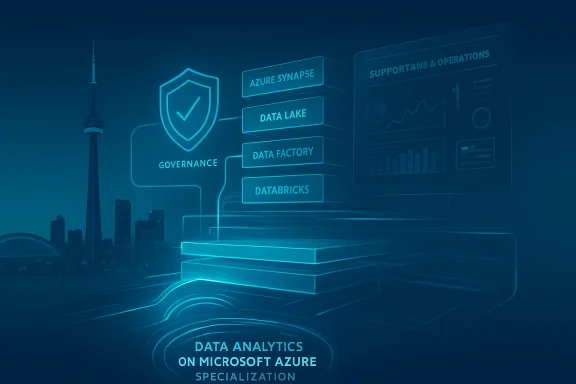
The announcement lands at an important moment for the Microsoft ecosystem. Microsoft’s partner model now places a premium on differentiated expertise, with specializations designed to validate narrowly defined skills across cloud, data, security, and application modernization. According to Microsoft’s Partner Center guidance, the Analytics on Microsoft Azure specialization is tied to a partner’s ability to deliver analytics solutions using services such as Azure Synapse Analytics, Azure Data Lake, Azure Data Factory, Azure Databricks, and now increasingly Fabric-related capabilities in the broader data stack.
Centrilogic framed the achievement as confirmation of a 15-year partnership with Microsoft and as evidence that its team can help organizations move from data sprawl to actionable insights. That language is familiar in the channel, but it is also revealing. The companies that earn these specializations are not merely proving certifications; they are showing that they can survive an audit process, assemble referenceable customer outcomes, and demonstrate mature operating practices around governance, security, and support.
The broader significance is that Microsoft’s analytics story is no longer about a single product. It now spans legacy enterprise data warehouse patterns, lakehouse architectures, AI-assisted analytics, and managed services that sit above the platform. That means specialization holders like Centrilogic are being asked to prove fluency across architecture, implementation, and lifecycle management, which is exactly where mid-market and enterprise buyers tend to struggle most.
The timing is also notable because Microsoft has spent the past year adjusting partner skilling requirements and streamlining portions of the qualification process. In other words, this is not a static program with fixed gates; it is a moving target that reflects the evolution of Azure data services and Microsoft Fabric. That makes the specialization more meaningful, not less, because it suggests the partner has kept pace with a changing platform rather than resting on older credentials.
That distinction matters because analytics projects are notoriously easy to oversell and hard to execute. A partner can talk fluently about dashboards and AI insights, yet still struggle with data quality, source-system integration, role-based access controls, workload costs, and lifecycle operations. Microsoft’s specialization criteria are intended to force a more rigorous conversation: can the partner actually design secure, scalable systems, and can it support them after go-live?
The Azure analytics stack itself has changed significantly over the past few years. Synapse once represented the flagship enterprise analytics story, while Data Factory, Databricks, and Data Lake formed the backbone of many architectures. Today, Microsoft Fabric is influencing how customers think about integration, analytics engineering, and unified data experiences, even as many enterprise deployments remain hybrid and deeply rooted in existing Azure data services.
That transition explains why partner specializations still matter. Organizations do not want to rebuild their analytics estate every time the platform evolves; they want advisers who can bridge the old and the new. A partner that can work across data warehousing, modern data platforms, and AI-driven insights is better positioned to guide incremental modernization than a firm that only understands one layer of the stack.
For Centrilogic, the recognition is likely valuable in sales cycles where procurement teams want a concrete reason to prefer one Azure partner over another. The credential does not guarantee success, but it can reduce perceived risk. In that sense, the award functions as both a technical signal and a commercial differentiator.
The services most associated with the analytics specialization remain the workhorses of enterprise data engineering. Microsoft’s documentation and training materials point to Azure Data Factory, Azure Data Lake, Azure Synapse Analytics, and Azure Databricks as core building blocks, while Microsoft also highlights modern analytics patterns and data integration approaches. Those are not glamorous technologies, but they are the foundation of scalable analytics.
What makes this important is that analytics success is often measured in trust, reliability, and operational discipline rather than feature demos. Microsoft’s partner audits are designed to capture exactly that. They reward partners that can show governance controls, secure implementation practices, and customer success evidence, which is why the designation can become an important procurement artifact for buyers.
For mid-market organizations, the promise is speed and clarity. They usually lack large internal data engineering teams and need a partner that can avoid overcomplication while still building a platform that won’t collapse under growth. For enterprises, the appeal is more about confidence that the partner can navigate existing governance requirements and legacy dependencies without creating additional risk.
The company also said it has senior Microsoft-certified experts across application modernization, cloud engineering, data & AI, security, DevOps, and managed services. That breadth matters because analytics projects do not live in isolation. They touch identity, infrastructure, pipeline automation, deployment practices, and security operations, which means a narrow specialist can sometimes become a bottleneck.
Centrilogic’s previous Microsoft-related recognition suggests a pattern rather than an isolated win. The company and its ObjectSharp arm previously received a Microsoft Azure migration specialization, which hints at a broader strategy of building repeatable technical credentials inside the Microsoft partner ecosystem. That kind of portfolio can help a services firm sell integrated transformation work rather than one-off projects.
This also matters in account planning. Partners with a deep Microsoft relationship can potentially align solutioning, skilling, and customer references in a way that lowers friction during proposal cycles. That is especially helpful when customers are comparing Azure native approaches against alternative data platforms.
Microsoft’s own documentation reflects this evolution. Azure Synapse Analytics is described as a service for gaining insights across data warehouses, data lakes, operational databases, and big data systems, while Azure Databricks training emphasizes scalable analytics and transformation workloads. Those are the building blocks for both classic BI and modern AI-enabled decision-making.
That shift helps explain why Microsoft keeps refining skilling and specialization criteria. In the past, a partner might have been assessed mainly on traditional warehouse competencies. Now, the same partner is expected to understand data engineering, governance, platform optimization, and the practical implications of AI workloads. That is a much higher bar and, in theory, a better one.
This is where partners like Centrilogic can differentiate themselves if they can move beyond generic AI messaging. The winners will be the firms that can show clients how to establish trusted foundations first, then layer machine learning, Copilot-style experiences, or advanced analytics on top. Anything less risks building impressive demos on unstable data plumbing.
There is also a practical competitive implication inside Microsoft’s own ecosystem. Partners that earn specializations often become better aligned with Microsoft field teams and customer opportunities. That can translate into more visibility in enterprise deals, especially when the customer is looking for a partner to support a broader Microsoft-centric transformation.
At the same time, the market is becoming more crowded. Many firms are chasing the same Azure data and AI opportunities, and Microsoft’s evolving program design means that credentials can age quickly if a partner doesn’t continue investing in skilling. So while Centrilogic’s achievement is meaningful, it also raises the bar for the company to keep proving that the designation reflects present-day capability rather than historical momentum.
In other words, the competitive battle is moving away from “Can you build a data platform?” to “Can you make it survive contact with the business?” That is a more demanding question, and it favors firms with process discipline, customer references, and cross-functional engineering depth. Centrilogic’s news suggests it wants to be in that category.
This emphasis also reflects the reality that analytics architectures are only as useful as their operational controls. When data pipelines break, access policies drift, or platform costs escalate, the organization quickly loses faith in the entire program. Microsoft’s specialization criteria appear designed to reward partners that can keep those issues under control in production, not just in a lab.
That matters for boards and business leaders as much as it does for IT teams. The conversation has moved from “Can we build a data lake?” to “Can we use it safely, reliably, and repeatedly?” A specialization that explicitly recognizes support maturity gives decision-makers a shorthand for evaluating that question.
That is why the strongest partner narratives usually sound less like product brochures and more like operating manuals. Enterprises want to know how a partner handles lineage, access, recovery, and change management. They also want confidence that the partner can keep pace with Microsoft’s rapid platform changes without rebuilding the stack every quarter.
Microsoft has been pushing partners toward more integrated data and AI motions, and the specialization supports that direction. By proving competence in analytics delivery, a partner can more credibly support the transition from reporting and dashboarding to predictive modeling, operational intelligence, and AI-enabled business processes. The specialization does not automatically make a firm an AI leader, but it strengthens the foundation on which AI services are built.
That is especially relevant for customers that are still early in their AI journey. Many companies want AI outcomes before they have completed the less glamorous work of data normalization, quality management, or platform rationalization. A specialized partner can help sequence the work properly, which may be the difference between a successful AI program and a short-lived pilot.
Centrilogic’s specialization win suggests it wants to be part of that shift. If it can combine governance, support, and Azure-native engineering into a coherent offering, it may have a stronger story than firms that lead only with generic AI promises. That is especially true in mid-market accounts where the buyer needs a practical path forward rather than a moonshot.
The broader Microsoft market will also be worth watching. As Fabric, Synapse, Databricks, and Data Factory continue to intersect in enterprise architectures, partners will need to show that they understand not just the products but the migration paths between them. The firms that win will likely be those that can explain why a given architecture belongs in a specific customer context, rather than trying to force every data problem into the same pattern.
Source: The Manila Times Centrilogic Achieves the Data Analytics on Microsoft Azure Specialization
 Overview
The announcement lands at an important moment for the Microsoft ecosystem. Microsoft’s partner model now places a premium on differentiated expertise, with specializations designed to validate narrowly defined skills across cloud, data, security, and application modernization. According to Microsoft’s Partner Center guidance, the Analytics on Microsoft Azure specialization is tied to a partner’s ability to deliver analytics solutions using services such as Azure Synapse Analytics, Azure Data Lake, Azure Data Factory, Azure Databricks, and now increasingly Fabric-related capabilities in the broader data stack.Centrilogic framed the achievement as confirmation of a 15-year partnership with Microsoft and as evidence that its team can help organizations move from data sprawl to actionable insights. That language is familiar in the channel, but it is also revealing. The companies that earn these specializations are not merely proving certifications; they are showing that they can survive an audit process, assemble referenceable customer outcomes, and demonstrate mature operating practices around governance, security, and support.
The broader significance is that Microsoft’s analytics story is no longer about a single product. It now spans legacy enterprise data warehouse patterns, lakehouse architectures, AI-assisted analytics, and managed services that sit above the platform. That means specialization holders like Centrilogic are being asked to prove fluency across architecture, implementation, and lifecycle management, which is exactly where mid-market and enterprise buyers tend to struggle most.
The timing is also notable because Microsoft has spent the past year adjusting partner skilling requirements and streamlining portions of the qualification process. In other words, this is not a static program with fixed gates; it is a moving target that reflects the evolution of Azure data services and Microsoft Fabric. That makes the specialization more meaningful, not less, because it suggests the partner has kept pace with a changing platform rather than resting on older credentials.
Background
Microsoft’s specialization framework exists to separate ordinary channel participation from proven technical delivery. The company positions specializations as an upper tier of validation inside the Microsoft AI Cloud Partner Program, designed to show deep expertise in specific workloads rather than general cloud competence. For analytics partners, the bar includes both technical proof points and business proof points, which is why the label carries weight with enterprise customers evaluating shortlist vendors.That distinction matters because analytics projects are notoriously easy to oversell and hard to execute. A partner can talk fluently about dashboards and AI insights, yet still struggle with data quality, source-system integration, role-based access controls, workload costs, and lifecycle operations. Microsoft’s specialization criteria are intended to force a more rigorous conversation: can the partner actually design secure, scalable systems, and can it support them after go-live?
The Azure analytics stack itself has changed significantly over the past few years. Synapse once represented the flagship enterprise analytics story, while Data Factory, Databricks, and Data Lake formed the backbone of many architectures. Today, Microsoft Fabric is influencing how customers think about integration, analytics engineering, and unified data experiences, even as many enterprise deployments remain hybrid and deeply rooted in existing Azure data services.
That transition explains why partner specializations still matter. Organizations do not want to rebuild their analytics estate every time the platform evolves; they want advisers who can bridge the old and the new. A partner that can work across data warehousing, modern data platforms, and AI-driven insights is better positioned to guide incremental modernization than a firm that only understands one layer of the stack.
Why this specialization matters now
The analytics market is crowded, but the real competition is not just among vendors. It is among implementation partners trying to prove that they can translate Microsoft’s platform ambitions into business outcomes. Specialization status acts as a trust shortcut, especially when buyers need confidence that a partner has done the hard, repetitive work required to make analytics dependable.For Centrilogic, the recognition is likely valuable in sales cycles where procurement teams want a concrete reason to prefer one Azure partner over another. The credential does not guarantee success, but it can reduce perceived risk. In that sense, the award functions as both a technical signal and a commercial differentiator.
- Validation of technical delivery, not just marketing claims.
- Differentiation in a crowded Microsoft services channel.
- Trust for enterprises with complex data estates.
- Relevance as Azure analytics and Fabric continue to converge.
- Proof that the partner can handle governance and operations, not only deployment.
What Microsoft is actually validating
Microsoft’s specialization process is deliberately broad, which is important. The company is not only checking whether a partner can install a tool or build a sample workload. It is evaluating whether the partner can support an end-to-end analytics lifecycle, including architecture, implementation, optimization, and ongoing support. That is a much tougher test than a simple certification count.The services most associated with the analytics specialization remain the workhorses of enterprise data engineering. Microsoft’s documentation and training materials point to Azure Data Factory, Azure Data Lake, Azure Synapse Analytics, and Azure Databricks as core building blocks, while Microsoft also highlights modern analytics patterns and data integration approaches. Those are not glamorous technologies, but they are the foundation of scalable analytics.
What makes this important is that analytics success is often measured in trust, reliability, and operational discipline rather than feature demos. Microsoft’s partner audits are designed to capture exactly that. They reward partners that can show governance controls, secure implementation practices, and customer success evidence, which is why the designation can become an important procurement artifact for buyers.
Enterprise vs. mid-market value
Centrilogic specifically said the specialization helps it support mid-market and enterprise customers, and that distinction is worth pausing on. Mid-market buyers often need a partner that can supply strategy, implementation, and managed support in one package. Enterprise buyers, by contrast, are more likely to demand process maturity, security rigor, and integration with broader operating models.For mid-market organizations, the promise is speed and clarity. They usually lack large internal data engineering teams and need a partner that can avoid overcomplication while still building a platform that won’t collapse under growth. For enterprises, the appeal is more about confidence that the partner can navigate existing governance requirements and legacy dependencies without creating additional risk.
- Mid-market buyers want speed, packaging, and predictable support.
- Enterprise buyers want architecture rigor, compliance, and scale.
- Both groups benefit when the partner can bridge legacy and modern data estates.
- Both groups increasingly expect AI-ready analytics foundations.
- Both groups are sensitive to cost overruns if governance is weak.
Centrilogic’s Microsoft relationship
Centrilogic said its Microsoft partnership spans more than 15 years, and that track record gives the announcement credibility beyond the usual press-release boilerplate. Long partner relationships often indicate a business that has moved through multiple technology cycles, from virtualization and migration to cloud modernization and now AI-enabled analytics. That continuity can be a meaningful advantage when customers want a partner that understands both old workloads and emerging platforms.The company also said it has senior Microsoft-certified experts across application modernization, cloud engineering, data & AI, security, DevOps, and managed services. That breadth matters because analytics projects do not live in isolation. They touch identity, infrastructure, pipeline automation, deployment practices, and security operations, which means a narrow specialist can sometimes become a bottleneck.
Centrilogic’s previous Microsoft-related recognition suggests a pattern rather than an isolated win. The company and its ObjectSharp arm previously received a Microsoft Azure migration specialization, which hints at a broader strategy of building repeatable technical credentials inside the Microsoft partner ecosystem. That kind of portfolio can help a services firm sell integrated transformation work rather than one-off projects.
The strategic value of a long Microsoft partnership
A long Microsoft relationship is not just a badge of loyalty; it is often a competitive advantage in how the partner reads the platform roadmap. Microsoft changes product naming, certification paths, and program requirements frequently enough that partners with sustained ecosystem investment tend to adapt faster than occasional participants. The result is a lower-risk partner experience for customers.This also matters in account planning. Partners with a deep Microsoft relationship can potentially align solutioning, skilling, and customer references in a way that lowers friction during proposal cycles. That is especially helpful when customers are comparing Azure native approaches against alternative data platforms.
- Long-running partnerships often signal platform fluency.
- Multiple specializations suggest a repeatable operating model.
- Microsoft alignment can speed up customer confidence.
- Cross-discipline expertise reduces handoff risk.
- Historical credentials can strengthen future cloud and AI pursuits.
Why analytics partners are suddenly more important
The rise of AI has pushed analytics from a back-office function to a strategic enabler. Organizations now recognize that their AI ambitions depend on the quality, accessibility, and governance of the underlying data estate. That has made data analytics partners more central to digital transformation, because they are the people who must connect raw data to reliable business outcomes.Microsoft’s own documentation reflects this evolution. Azure Synapse Analytics is described as a service for gaining insights across data warehouses, data lakes, operational databases, and big data systems, while Azure Databricks training emphasizes scalable analytics and transformation workloads. Those are the building blocks for both classic BI and modern AI-enabled decision-making.
That shift helps explain why Microsoft keeps refining skilling and specialization criteria. In the past, a partner might have been assessed mainly on traditional warehouse competencies. Now, the same partner is expected to understand data engineering, governance, platform optimization, and the practical implications of AI workloads. That is a much higher bar and, in theory, a better one.
AI is raising the floor
The phrase “AI-driven insights” is now ubiquitous in partner announcements, but the deeper point is that analytics and AI are converging operationally. You cannot do useful AI on top of inconsistent pipelines, inaccessible governed data, or fragile integrations. A specialization that recognizes analytics delivery maturity therefore becomes indirectly relevant to AI readiness as well.This is where partners like Centrilogic can differentiate themselves if they can move beyond generic AI messaging. The winners will be the firms that can show clients how to establish trusted foundations first, then layer machine learning, Copilot-style experiences, or advanced analytics on top. Anything less risks building impressive demos on unstable data plumbing.
- AI depends on data quality.
- Governance is now a prerequisite rather than an afterthought.
- Modern analytics is cross-functional, touching infrastructure and security.
- Microsoft’s partner model rewards maturity, not just experimentation.
- Trusted foundations are becoming a sales advantage.
Competitive implications for the channel
Centrilogic’s announcement will be noticed by other Microsoft partners because specializations are increasingly part of competitive positioning. In channel markets, these recognitions can influence who gets invited into a shortlist, who is trusted for advisory engagements, and who is perceived as capable of handling regulated or large-scale environments. The label can be modest in isolation but powerful in aggregate.There is also a practical competitive implication inside Microsoft’s own ecosystem. Partners that earn specializations often become better aligned with Microsoft field teams and customer opportunities. That can translate into more visibility in enterprise deals, especially when the customer is looking for a partner to support a broader Microsoft-centric transformation.
At the same time, the market is becoming more crowded. Many firms are chasing the same Azure data and AI opportunities, and Microsoft’s evolving program design means that credentials can age quickly if a partner doesn’t continue investing in skilling. So while Centrilogic’s achievement is meaningful, it also raises the bar for the company to keep proving that the designation reflects present-day capability rather than historical momentum.
How rivals may respond
Competitors have several obvious responses. They can pursue their own specializations, deepen Fabric and Databricks capabilities, or position around industry-specific analytics outcomes rather than generic platform delivery. They can also lean harder into managed services and governance as a differentiator, because that is where many customers still feel pain after a successful pilot.In other words, the competitive battle is moving away from “Can you build a data platform?” to “Can you make it survive contact with the business?” That is a more demanding question, and it favors firms with process discipline, customer references, and cross-functional engineering depth. Centrilogic’s news suggests it wants to be in that category.
- Credentials can influence shortlists.
- Partner-field alignment can affect deal flow.
- Managed services may become a stronger differentiator than architecture alone.
- Industry specialization can be a response to platform commoditization.
- Continuous skilling is now a competitive necessity.
Governance, security, and support as differentiators
One of the most important parts of the announcement is not analytics itself but the emphasis on governance, security, and support. Those are the areas where analytics initiatives most often stall, and they are also where customers have the least patience for improvisation. A partner that can demonstrate maturity in those areas has a better chance of winning long-term trust.This emphasis also reflects the reality that analytics architectures are only as useful as their operational controls. When data pipelines break, access policies drift, or platform costs escalate, the organization quickly loses faith in the entire program. Microsoft’s specialization criteria appear designed to reward partners that can keep those issues under control in production, not just in a lab.
That matters for boards and business leaders as much as it does for IT teams. The conversation has moved from “Can we build a data lake?” to “Can we use it safely, reliably, and repeatedly?” A specialization that explicitly recognizes support maturity gives decision-makers a shorthand for evaluating that question.
The hidden complexity behind “advanced analytics”
The phrase advanced analytics can hide a great deal of complexity. It can mean data modeling, semantic layers, orchestration, real-time ingestion, machine learning, governance enforcement, or all of the above. The best partners know that success is not one giant design choice but a sequence of small, disciplined decisions.That is why the strongest partner narratives usually sound less like product brochures and more like operating manuals. Enterprises want to know how a partner handles lineage, access, recovery, and change management. They also want confidence that the partner can keep pace with Microsoft’s rapid platform changes without rebuilding the stack every quarter.
- Governance reduces business risk.
- Security is essential in regulated environments.
- Support determines whether analytics is sustainable.
- Operational maturity often matters more than flashy demos.
- Change management is a major hidden cost in analytics programs.
Why this matters for AI transformation
The company’s messaging repeatedly ties the specialization to AI, and that connection is not accidental. AI transformation projects almost always depend on more disciplined data engineering than organizations initially expect. If the analytics layer is not trusted, AI outputs will not be trusted either.Microsoft has been pushing partners toward more integrated data and AI motions, and the specialization supports that direction. By proving competence in analytics delivery, a partner can more credibly support the transition from reporting and dashboarding to predictive modeling, operational intelligence, and AI-enabled business processes. The specialization does not automatically make a firm an AI leader, but it strengthens the foundation on which AI services are built.
That is especially relevant for customers that are still early in their AI journey. Many companies want AI outcomes before they have completed the less glamorous work of data normalization, quality management, or platform rationalization. A specialized partner can help sequence the work properly, which may be the difference between a successful AI program and a short-lived pilot.
From dashboards to decision systems
The best analytics programs no longer stop at reporting. They evolve into decision systems that feed actions back into operations, whether that is in finance, supply chain, customer service, or internal planning. That shift requires data pipelines that are reliable enough to support enterprise decision velocity.Centrilogic’s specialization win suggests it wants to be part of that shift. If it can combine governance, support, and Azure-native engineering into a coherent offering, it may have a stronger story than firms that lead only with generic AI promises. That is especially true in mid-market accounts where the buyer needs a practical path forward rather than a moonshot.
- AI programs need trustworthy data.
- Analytics maturity is a prerequisite for operational AI.
- Sequencing matters more than hype.
- Decision systems are the next step beyond dashboards.
- Practical execution will beat aspiration in most buyer evaluations.
Strengths and Opportunities
The strongest aspect of this announcement is that it gives Centrilogic a credible, externally validated signal in one of the most competitive parts of the Microsoft ecosystem. It also supports a broader narrative that the company can help customers modernize data estates while preparing for AI adoption. That combination should resonate with buyers who want both strategic guidance and hands-on execution.- Microsoft validation improves market trust.
- Azure analytics expertise supports enterprise transformation.
- AI-readiness messaging broadens the sales narrative.
- Long partner history adds credibility.
- Cross-service capabilities create upsell potential.
- Mid-market appeal is strong where internal data teams are thin.
- Managed services can extend customer lifetime value.
Risks and Concerns
The main risk is that specializations can be over-read as proof of broad excellence when they really confirm a specific scope of capability. Customers should still evaluate the actual team, reference projects, and delivery model, because a badge is not the same thing as a guaranteed outcome. There is also the broader risk that Microsoft’s rapidly evolving platform and skilling requirements can make partner credentials feel transient if they are not continuously maintained.- Credential inflation can create unrealistic buyer expectations.
- Platform change can erode the relevance of static claims.
- Execution risk remains even with a specialization.
- Customer fit may vary by industry and data maturity.
- Vendor lock-in concerns can persist in Azure-heavy strategies.
- Complex migrations can still run over budget or schedule.
- AI hype may distract from foundational data work.
Looking Ahead
The next thing to watch is whether Centrilogic turns this specialization into a sharper go-to-market motion around analytics modernization and AI foundations. If the company uses the credential to open more enterprise conversations, deepen its Microsoft alignment, and publish clearer customer outcomes, the recognition could become a meaningful growth lever rather than a one-day press release. If not, it will remain a respectable but fairly routine channel milestone.The broader Microsoft market will also be worth watching. As Fabric, Synapse, Databricks, and Data Factory continue to intersect in enterprise architectures, partners will need to show that they understand not just the products but the migration paths between them. The firms that win will likely be those that can explain why a given architecture belongs in a specific customer context, rather than trying to force every data problem into the same pattern.
- More partner announcements around analytics and AI are likely.
- Fabric-related skilling will continue to influence partner strategy.
- Customer references will matter as much as technical certification.
- Governance and cost control will remain major differentiators.
- Hybrid and legacy integration will stay central for enterprise buyers.
Source: The Manila Times Centrilogic Achieves the Data Analytics on Microsoft Azure Specialization
