

Centrilogic’s newly announced Data Analytics on Microsoft Azure Specialization is more than a partner-program badge. It is a formal signal that the company has met Microsoft’s current bar for delivering analytics solutions on Azure, a bar that now spans architecture, governance, security, performance, and customer outcomes. In a market where every systems integrator claims cloud expertise, this kind of specialization is meant to separate credible operating depth from broad but shallow capability.
The timing matters. The April 8, 2026 announcement lands at a moment when enterprises are pushing harder on data modernization, AI readiness, and platform consolidation, while Microsoft is continuing to use the partner ecosystem as a channel for moving customers toward Azure-native analytics services. For Centrilogic, the recognition adds another layer to a Microsoft relationship that the company says stretches back more than 15 years and already includes other Microsoft-focused designations and awards. For customers, especially in the mid-market, the message is simple: the firm wants to be seen not just as a cloud services provider, but as a trusted Azure analytics execution partner.
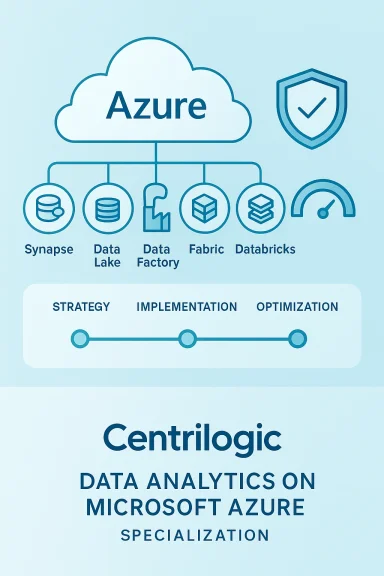
Centrilogic’s announcement fits a broader Microsoft strategy that has become increasingly important over the past few years: use specializations to identify partners with proven, repeatable delivery capability in high-demand technical areas. The Analytics on Microsoft Azure specialization is not a generic partner label; it is designed to validate a partner’s ability to plan and deliver advanced data and analytics solutions across Azure services such as Azure Synapse Analytics, Azure Data Lake, Azure Data Factory, Microsoft Fabric, and Azure Databricks. Microsoft’s documentation says the specialization requires an active Data & AI solution designation, performance thresholds, skilling requirements, and a third-party audit.
That makes the recognition materially different from a marketing award. Microsoft also frames specializations as a mechanism for customer confidence and go-to-market advantage, including customer-facing labeling and prioritization in customer searches. In practice, the specialization becomes part of a partner’s proof stack when competing for modernization work, advisory engagements, or managed data-platform contracts. For a services firm, especially one serving mid-market customers where buying decisions are often risk-sensitive, that signaling has real commercial value.
The underlying market context is also important. Azure analytics is no longer just about warehouse migration or dashboarding. Microsoft’s own product messaging increasingly ties analytics to AI, governed data access, and cross-product interoperability with Fabric, Power BI, and Databricks. Azure Databricks, for example, is positioned as a unified, governed platform for data and AI that can support real-time dashboards, predictive modeling, machine learning, and business intelligence. That makes analytics specialization increasingly relevant to broader AI transformation projects, not just classic BI programs.
For Centrilogic, then, this is less about a single certificate and more about positioning. The company is telling the market that it has the operational maturity to work across the full lifecycle of analytics modernization: strategy, design, implementation, optimization, and support. That is the kind of message that resonates in procurement cycles where customers want fewer handoffs, more accountability, and a vendor that can bridge data engineering with business outcomes.
For analytics specifically, the requirements have grown more nuanced as Microsoft’s stack has shifted. Microsoft Learn notes that the current specialization covers workloads like Azure Synapse Analytics, Azure Data Lake, Azure Data Factory, Microsoft Fabric, and Azure Databricks. It also notes that partners need eligible association types, a qualifying amount of Azure consumption revenue, and certifications held by multiple individuals in the organization. In other words, the specialization is designed to measure both sales traction and delivery competence, not one or the other.
That matters because the analytics market has become a battleground for platform convergence. Microsoft Fabric is increasingly presented as an end-to-end analytics experience that folds together data movement, warehousing, integration, and BI-style consumption. Azure Databricks, meanwhile, remains a strong choice for governed lakehouse architectures and machine-learning-heavy workloads. A partner that can credibly work across both ecosystems is better positioned to meet customers where they are, rather than forcing a one-size-fits-all architecture.
Centrilogic appears to be leaning into exactly that broad-based posture. The company’s own materials describe it as a global provider of IT transformation solutions spanning multicloud management, application innovation, data and AI, security, DevOps, and managed services. It also says it has a sizable base of Microsoft-certified experts and long-term customer experience in data and analytics. Those claims help explain why a specialization announcement like this can be strategically useful: it converts broad capability into a more legible market signal.
Historically, partner specializations have become more important as Microsoft has refined the commercial value of its ecosystem. The company has repeatedly updated requirements, skilling paths, and benefit structures to keep the program aligned with current cloud and AI priorities. That evolution has made these badges more than symbolic; they are part of Microsoft’s mechanism for steering enterprise buyers toward partners who can actually deliver in the newest technology layers.
That creates a stronger validation signal than a simple certification count. Certifications prove individuals have studied the platform; a specialization suggests the organization has also demonstrated delivery discipline, customer adoption, and operational consistency. For buyers, that distinction matters because analytics projects fail less from lack of ideas than from weak governance, poor data modeling, underpowered deployment practices, and insufficient change management.
Centrilogic’s press release leans heavily on that theme, emphasizing secure, scalable, enterprise-grade analytics platforms and AI-driven insights. That language is not accidental. It aligns closely with Microsoft’s preferred story: analytics as a governed foundation for AI rather than a disconnected reporting layer.
A few practical takeaways emerge from the structure of the specialization:
That history matters because specialization only carries weight if the market already has some reason to believe the firm can execute. Centrilogic’s past work in data and analytics gives it a credible foundation here. The company has publicly referenced customer work involving real-time data, cloud strategy, and modernization outcomes, which helps support the narrative that this is an operational capability story rather than a purely promotional one.
The company also benefits from its broader positioning as a transformation partner rather than a single-service shop. That matters because analytics projects rarely end at the dashboard layer. They often touch application modernization, identity, security, infrastructure, observability, and managed operations, all of which can influence whether an analytics platform becomes durable or simply expensive.
The company’s client-facing portfolio also helps explain the strategic fit. Centrilogic says it spans data and AI, cloud engineering, security, DevOps, and managed services. That breadth gives it multiple entry points into customer accounts and lets it pursue analytics as part of a wider modernization program instead of as a standalone project.
The result is a stronger commercial narrative:
That shift changes the role of the partner too. A partner is no longer just a deployment labor provider. It is expected to help define the data estate, enforce security and access patterns, orchestrate pipelines, and guide the customer toward a platform that can support both analytics and AI workloads. In that environment, specialization serves as shorthand for platform maturity.
For mid-market customers, the priorities are often different. They want faster time to value, lower implementation risk, and an easier path to platform modernization. A partner like Centrilogic can use the specialization to argue that it understands both the technical and organizational constraints of that segment, especially when analytics modernization must happen without a huge internal data engineering staff.
This is where the specialization becomes commercially potent. It is a trust accelerator in both markets, but for different reasons:
That strategy makes sense in an AI-driven market. As Microsoft pushes Fabric, Azure Databricks integrations, Copilot-adjacent workflows, and cloud-native analytics, it needs a partner ecosystem capable of carrying implementation load. Microsoft cannot sell AI transformation at scale if customers struggle to find people who can build secure data foundations underneath it.
For partners, the trade-off is obvious. The bar is higher, but the commercial upside is stronger. A specialization can increase discoverability, signal differentiation, and support eligibility for certain opportunities and benefits. Microsoft’s own materials frame these benefits as part of a broader effort to help partners grow by proving capability in high-demand scenarios.
In that context, Centrilogic’s announcement is not just about Centrilogic. It is also evidence that Microsoft continues to refine a partner ecosystem built around earned credibility. Companies that can meet the bar get to wear the badge; those that cannot are left competing on less reliable signals.
Centrilogic’s specialization may be especially useful against competitors that have strong general Azure practices but less visible analytics depth. The company can now market itself as validated for a subset of Azure work that is closely linked to strategic business outcomes. Since analytics is increasingly the front door to AI adoption, this could influence how buyers rank vendors in both modernization and AI-readiness conversations.
This also matters for smaller regional firms that rely on personal relationships rather than formal credentials. In many buying cycles, specialization can become the tie-breaker when several vendors look technically similar. The firm with the badge often gets the benefit of the doubt, particularly when the customer is under pressure to move quickly and cannot afford a long technical due diligence cycle.
A second competitive effect is subtler. If a firm like Centrilogic pairs analytics specialization with broader transformation services, it can attach itself earlier in the sales cycle. Instead of being called in only for BI implementation, it can show up in architecture planning, data strategy, and AI enablement discussions. That can widen wallet share and reduce the chance that competitors pick off narrower workstreams.
The company can also use the recognition to reinforce customer confidence in renewal conversations. For existing clients, especially those already relying on Centrilogic for cloud or managed services, the specialization may help justify expansion into data modernization or AI readiness work. That makes it both a sales tool and a retention tool, which is a strong combination.
There is a customer-side concern as well. Buyers increasingly want partners that can support open, interoperable data architectures rather than locking them too tightly to a single vendor stack. Centrilogic’s challenge will be to show that its Azure depth improves flexibility and governance without creating strategic dependence on a single platform.
The other concern is simply credibility management. If the company uses the specialization as a substitute for demonstrable outcomes, the market will notice. The most effective use of the badge is as reinforcement for real project evidence, not as a replacement for it.
Over time, the more interesting question is whether this recognition becomes a bridge into broader Microsoft Fabric, Databricks, and AI-led modernization deals. Microsoft’s current direction suggests that analytics, data governance, and AI readiness will increasingly converge, and partners that can operate across that continuum will be better positioned. Centrilogic now has a more credible way to claim that it belongs in those conversations.
The key things to watch next are:
For customers, that is the real value of the announcement. It is not that Centrilogic suddenly became capable on April 8, 2026. It is that Microsoft has publicly validated a capability the company has been building for years, and in a data market where trust, governance, and execution matter more than ever, that validation may prove to be one of the most useful signals available.
Source: GlobeNewswire Centrilogic Achieves the Data Analytics on Microsoft Azure Specialization
The timing matters. The April 8, 2026 announcement lands at a moment when enterprises are pushing harder on data modernization, AI readiness, and platform consolidation, while Microsoft is continuing to use the partner ecosystem as a channel for moving customers toward Azure-native analytics services. For Centrilogic, the recognition adds another layer to a Microsoft relationship that the company says stretches back more than 15 years and already includes other Microsoft-focused designations and awards. For customers, especially in the mid-market, the message is simple: the firm wants to be seen not just as a cloud services provider, but as a trusted Azure analytics execution partner.
 Overview
Centrilogic’s announcement fits a broader Microsoft strategy that has become increasingly important over the past few years: use specializations to identify partners with proven, repeatable delivery capability in high-demand technical areas. The Analytics on Microsoft Azure specialization is not a generic partner label; it is designed to validate a partner’s ability to plan and deliver advanced data and analytics solutions across Azure services such as Azure Synapse Analytics, Azure Data Lake, Azure Data Factory, Microsoft Fabric, and Azure Databricks. Microsoft’s documentation says the specialization requires an active Data & AI solution designation, performance thresholds, skilling requirements, and a third-party audit.That makes the recognition materially different from a marketing award. Microsoft also frames specializations as a mechanism for customer confidence and go-to-market advantage, including customer-facing labeling and prioritization in customer searches. In practice, the specialization becomes part of a partner’s proof stack when competing for modernization work, advisory engagements, or managed data-platform contracts. For a services firm, especially one serving mid-market customers where buying decisions are often risk-sensitive, that signaling has real commercial value.
The underlying market context is also important. Azure analytics is no longer just about warehouse migration or dashboarding. Microsoft’s own product messaging increasingly ties analytics to AI, governed data access, and cross-product interoperability with Fabric, Power BI, and Databricks. Azure Databricks, for example, is positioned as a unified, governed platform for data and AI that can support real-time dashboards, predictive modeling, machine learning, and business intelligence. That makes analytics specialization increasingly relevant to broader AI transformation projects, not just classic BI programs.
For Centrilogic, then, this is less about a single certificate and more about positioning. The company is telling the market that it has the operational maturity to work across the full lifecycle of analytics modernization: strategy, design, implementation, optimization, and support. That is the kind of message that resonates in procurement cycles where customers want fewer handoffs, more accountability, and a vendor that can bridge data engineering with business outcomes.
Background
Microsoft’s specialization framework has evolved into one of the clearest ways for partners to differentiate within the Microsoft AI Cloud Partner Program. The framework is intentionally selective. Partners must satisfy prerequisites tied to solution areas, performance, and skills, and some specializations require audits or customer references. Microsoft says this is meant to increase customer confidence and improve discoverability for high-demand scenarios.For analytics specifically, the requirements have grown more nuanced as Microsoft’s stack has shifted. Microsoft Learn notes that the current specialization covers workloads like Azure Synapse Analytics, Azure Data Lake, Azure Data Factory, Microsoft Fabric, and Azure Databricks. It also notes that partners need eligible association types, a qualifying amount of Azure consumption revenue, and certifications held by multiple individuals in the organization. In other words, the specialization is designed to measure both sales traction and delivery competence, not one or the other.
That matters because the analytics market has become a battleground for platform convergence. Microsoft Fabric is increasingly presented as an end-to-end analytics experience that folds together data movement, warehousing, integration, and BI-style consumption. Azure Databricks, meanwhile, remains a strong choice for governed lakehouse architectures and machine-learning-heavy workloads. A partner that can credibly work across both ecosystems is better positioned to meet customers where they are, rather than forcing a one-size-fits-all architecture.
Centrilogic appears to be leaning into exactly that broad-based posture. The company’s own materials describe it as a global provider of IT transformation solutions spanning multicloud management, application innovation, data and AI, security, DevOps, and managed services. It also says it has a sizable base of Microsoft-certified experts and long-term customer experience in data and analytics. Those claims help explain why a specialization announcement like this can be strategically useful: it converts broad capability into a more legible market signal.
Historically, partner specializations have become more important as Microsoft has refined the commercial value of its ecosystem. The company has repeatedly updated requirements, skilling paths, and benefit structures to keep the program aligned with current cloud and AI priorities. That evolution has made these badges more than symbolic; they are part of Microsoft’s mechanism for steering enterprise buyers toward partners who can actually deliver in the newest technology layers.
What the Specialization Actually Proves
The most important thing to understand is that Analytics on Microsoft Azure is not a surface-level endorsement. Microsoft’s own partner documentation shows that the specialization is tied to a combination of eligibility, revenue, skill, and audit requirements. The partner must hold an active Solutions Partner designation in Data & AI, meet a three-month ACR threshold from eligible workloads, and maintain trained personnel aligned to Microsoft’s current data-engineering expectations.That creates a stronger validation signal than a simple certification count. Certifications prove individuals have studied the platform; a specialization suggests the organization has also demonstrated delivery discipline, customer adoption, and operational consistency. For buyers, that distinction matters because analytics projects fail less from lack of ideas than from weak governance, poor data modeling, underpowered deployment practices, and insufficient change management.
Why buyers care
The specialization is designed to reassure buyers that a partner can do more than stand up a sandbox. It suggests the firm can handle secure data flows, platform design, and ongoing optimization in production environments. That is especially relevant for organizations moving from pilot projects to enterprise-scale analytics estates, where latency, access controls, lineage, and support matter as much as visualization quality.Centrilogic’s press release leans heavily on that theme, emphasizing secure, scalable, enterprise-grade analytics platforms and AI-driven insights. That language is not accidental. It aligns closely with Microsoft’s preferred story: analytics as a governed foundation for AI rather than a disconnected reporting layer.
A few practical takeaways emerge from the structure of the specialization:
- It validates end-to-end delivery, not just advisory services.
- It emphasizes governance and security, which are central to enterprise adoption.
- It rewards proven customer success, not just lab competence.
- It supports work across modern Azure data services, including Fabric and Databricks.
- It gives partners a sharper market signal in crowded competitive bids.
- It can help shorten buyer diligence cycles when procurement teams need a trusted shortlist.
Centrilogic’s Microsoft Story
Centrilogic is not entering Microsoft analytics from scratch. The company has spent years building a public Microsoft narrative around cloud transformation, and the new specialization appears to be one more step in that progression. Its materials describe a long-running partnership with Microsoft and a substantial bench of certified staff, while earlier company announcements highlighted recognition such as finalist status for the Microsoft Analytics Partner of the Year Award.That history matters because specialization only carries weight if the market already has some reason to believe the firm can execute. Centrilogic’s past work in data and analytics gives it a credible foundation here. The company has publicly referenced customer work involving real-time data, cloud strategy, and modernization outcomes, which helps support the narrative that this is an operational capability story rather than a purely promotional one.
The company also benefits from its broader positioning as a transformation partner rather than a single-service shop. That matters because analytics projects rarely end at the dashboard layer. They often touch application modernization, identity, security, infrastructure, observability, and managed operations, all of which can influence whether an analytics platform becomes durable or simply expensive.
From capability to credibility
Centrilogic’s messaging is now moving from “we can do this” to “Microsoft has validated that we do this well.” That distinction can be valuable in mid-market sales, where decision-makers often seek a lower-risk vendor with enough breadth to absorb complexity without requiring a patchwork of subcontractors. It is especially useful when analytics work is bundled with cloud migration, AI enablement, or managed services.The company’s client-facing portfolio also helps explain the strategic fit. Centrilogic says it spans data and AI, cloud engineering, security, DevOps, and managed services. That breadth gives it multiple entry points into customer accounts and lets it pursue analytics as part of a wider modernization program instead of as a standalone project.
The result is a stronger commercial narrative:
- Microsoft validates the delivery model.
- Centrilogic packages the capability with broader transformation services.
- Customers get a single partner across planning, implementation, and operations.
Why Azure Analytics Specialization Matters in 2026
The analytics stack has changed dramatically. A few years ago, partner conversations were dominated by lift-and-shift data warehouses, ETL modernization, and Power BI deployment. In 2026, those conversations increasingly include AI readiness, semantic data models, data governance, lakehouse architectures, and the role of Fabric in unifying analytics experiences. Microsoft’s own product pages now frame services like Azure Databricks around unified data and AI workflows, which makes the analytics-specialist category more strategically relevant than ever.That shift changes the role of the partner too. A partner is no longer just a deployment labor provider. It is expected to help define the data estate, enforce security and access patterns, orchestrate pipelines, and guide the customer toward a platform that can support both analytics and AI workloads. In that environment, specialization serves as shorthand for platform maturity.
Enterprise versus mid-market needs
For enterprise customers, the emphasis tends to be on governance, operating model, and scale. Large organizations are more likely to care about data domains, compliance, observability, and hybrid integration patterns. They may also require a partner that can work across multiple business units and multiple cloud or data platforms without forcing a premature standardization decision.For mid-market customers, the priorities are often different. They want faster time to value, lower implementation risk, and an easier path to platform modernization. A partner like Centrilogic can use the specialization to argue that it understands both the technical and organizational constraints of that segment, especially when analytics modernization must happen without a huge internal data engineering staff.
This is where the specialization becomes commercially potent. It is a trust accelerator in both markets, but for different reasons:
- Enterprises use it to reduce delivery risk.
- Mid-market buyers use it to reduce selection risk.
- Both use it to validate that a partner can manage real production complexity.
Microsoft’s Partner Strategy in the AI Era
Microsoft has spent the last several years tightening the way it differentiates partners, and the logic is clear: the company wants customers to find partners who can deliver in the most commercially important and technically demanding workloads. Its partner-benefits materials say specializations create a customer-facing badge, improve marketplace prioritization, and unlock go-to-market resources. Microsoft’s Partner Center guidance also shows that these programs are not static; they are updated as product and demand patterns change.That strategy makes sense in an AI-driven market. As Microsoft pushes Fabric, Azure Databricks integrations, Copilot-adjacent workflows, and cloud-native analytics, it needs a partner ecosystem capable of carrying implementation load. Microsoft cannot sell AI transformation at scale if customers struggle to find people who can build secure data foundations underneath it.
Specialization as market shaping
In a practical sense, specialization helps Microsoft shape buyer behavior. It encourages customers to shortlist validated firms, while giving partners an incentive to invest in skills, audits, and customer success. That tends to raise the floor of delivery quality across the ecosystem, even if it does not guarantee excellence in every engagement.For partners, the trade-off is obvious. The bar is higher, but the commercial upside is stronger. A specialization can increase discoverability, signal differentiation, and support eligibility for certain opportunities and benefits. Microsoft’s own materials frame these benefits as part of a broader effort to help partners grow by proving capability in high-demand scenarios.
In that context, Centrilogic’s announcement is not just about Centrilogic. It is also evidence that Microsoft continues to refine a partner ecosystem built around earned credibility. Companies that can meet the bar get to wear the badge; those that cannot are left competing on less reliable signals.
Competitive Implications
In the crowded Azure services market, recognition matters because differentiation is hard. Many firms can claim Azure experience, but fewer can point to current specialization in analytics. That can become a meaningful edge in competitive proposals, especially when customers compare multiple managed services firms, systems integrators, and regional cloud consultancies.Centrilogic’s specialization may be especially useful against competitors that have strong general Azure practices but less visible analytics depth. The company can now market itself as validated for a subset of Azure work that is closely linked to strategic business outcomes. Since analytics is increasingly the front door to AI adoption, this could influence how buyers rank vendors in both modernization and AI-readiness conversations.
What rivals will have to answer
Competitors will likely need to respond in one of three ways. They can either match Centrilogic’s credentialing with their own specializations, lead with niche vertical expertise, or emphasize proprietary accelerators and managed-service wrappers around Azure analytics. None of those paths is easy, and all of them require a convincing story about why a buyer should choose them over a Microsoft-validated specialist.This also matters for smaller regional firms that rely on personal relationships rather than formal credentials. In many buying cycles, specialization can become the tie-breaker when several vendors look technically similar. The firm with the badge often gets the benefit of the doubt, particularly when the customer is under pressure to move quickly and cannot afford a long technical due diligence cycle.
A second competitive effect is subtler. If a firm like Centrilogic pairs analytics specialization with broader transformation services, it can attach itself earlier in the sales cycle. Instead of being called in only for BI implementation, it can show up in architecture planning, data strategy, and AI enablement discussions. That can widen wallet share and reduce the chance that competitors pick off narrower workstreams.
Strengths and Opportunities
Centrilogic’s announcement has several obvious strengths, and the most important one is that it converts experience into an externally validated credential. In a market that often rewards marketing polish over delivery depth, that kind of recognition can be genuinely useful for customers trying to separate signal from noise. It also helps Centrilogic broaden the conversation from “analytics project” to “platform transformation,” which is usually where higher-value engagements live.- Stronger credibility with buyers evaluating Azure analytics partners.
- Better alignment with Microsoft’s AI and Fabric direction.
- Improved differentiation in crowded partner shortlists.
- Higher win potential for modernization programs that include analytics.
- Cross-sell opportunities into security, cloud engineering, and managed services.
- More trust for mid-market customers that want a single accountable partner.
- A stronger narrative around secure, governed, enterprise-grade data platforms.
The opportunity curve
The biggest opportunity is not just more Azure analytics work. It is the chance to use the specialization as a launchpad into larger transformation programs where analytics is the foundation for AI, automation, and operational decision-making. That is where the market is headed, and Centrilogic now has a better credential to support that move.The company can also use the recognition to reinforce customer confidence in renewal conversations. For existing clients, especially those already relying on Centrilogic for cloud or managed services, the specialization may help justify expansion into data modernization or AI readiness work. That makes it both a sales tool and a retention tool, which is a strong combination.
Risks and Concerns
The biggest risk in any specialization announcement is over-reading it. A Microsoft badge is meaningful, but it is not a guarantee of project success, and it certainly does not eliminate delivery risk. Customers still need to evaluate team composition, project governance, pricing discipline, and long-term support quality before signing anything.- Badge inflation can dilute the impact if the market sees too many similar announcements.
- Execution risk remains if delivery teams are stretched or poorly aligned.
- Customer expectations may rise faster than operational capacity.
- Platform dependence on Microsoft can limit flexibility in mixed-stack environments.
- Certification drift can become a problem if skilling is not maintained.
- Market skepticism may persist if the firm cannot show fresh case studies.
- Competitive response could quickly neutralize the short-term marketing advantage.
The hidden operational burden
There is also an internal cost to maintain the specialization over time. Skilling requirements, audit obligations, and revenue thresholds can all become burdens if sales momentum slows or technical staffing changes. In that sense, the award is not a finish line but a maintenance commitment.There is a customer-side concern as well. Buyers increasingly want partners that can support open, interoperable data architectures rather than locking them too tightly to a single vendor stack. Centrilogic’s challenge will be to show that its Azure depth improves flexibility and governance without creating strategic dependence on a single platform.
The other concern is simply credibility management. If the company uses the specialization as a substitute for demonstrable outcomes, the market will notice. The most effective use of the badge is as reinforcement for real project evidence, not as a replacement for it.
Looking Ahead
The most likely near-term effect of this announcement is commercial rather than technical. Centrilogic will probably use the specialization in proposals, partner listings, and customer conversations to strengthen its position in Azure analytics and AI-related transformation work. That will be especially useful where buyers are comparing several “cloud transformation” firms that all sound similar on paper but differ in depth and proof.Over time, the more interesting question is whether this recognition becomes a bridge into broader Microsoft Fabric, Databricks, and AI-led modernization deals. Microsoft’s current direction suggests that analytics, data governance, and AI readiness will increasingly converge, and partners that can operate across that continuum will be better positioned. Centrilogic now has a more credible way to claim that it belongs in those conversations.
The key things to watch next are:
- New customer case studies that show measurable analytics outcomes.
- Whether Centrilogic expands its Microsoft story into Fabric-led modernization.
- Any follow-on Microsoft recognition that broadens its partner profile.
- Evidence that the firm is winning more mid-market analytics deals.
- Signs that it is bundling analytics specialization with AI and managed services.
For customers, that is the real value of the announcement. It is not that Centrilogic suddenly became capable on April 8, 2026. It is that Microsoft has publicly validated a capability the company has been building for years, and in a data market where trust, governance, and execution matter more than ever, that validation may prove to be one of the most useful signals available.
Source: GlobeNewswire Centrilogic Achieves the Data Analytics on Microsoft Azure Specialization
