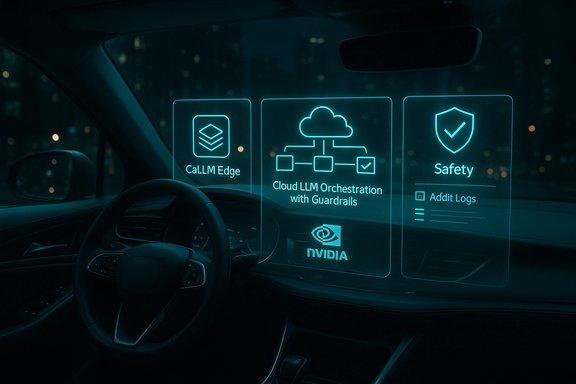
Cerence’s xUI platform is gaining real momentum: the hybrid, agentic in‑car assistant now ships with production integrations that lean on NVIDIA AI Enterprise for model performance and optimizations and on Microsoft Azure for cloud-hosted services and distribution — a stack that Cerence says is already attracting several global automakers for live programs and production rollouts.
Cerence xUI is the company’s next‑generation, hybrid “agentic” vehicle assistant: a platform design that deliberately mixes on‑device, embedded models (small language models, or SLMs) with larger cloud LLMs and orchestration layers so automakers can deliver conversational, multi‑step user experiences inside the cabin while preserving safety, latency, and privacy constraints. The company markets xUI as an OEM‑friendly, technology‑agnostic stack that integrates Cerence’s CaLLM family of models with third‑party engines and vendor runtimes. Two anchor technical claims form the core of Cerence’s messaging:
Cerence xUI is not a speculative demo; it is an engineered hybrid stack that reflects the industry’s pragmatic movement toward production agentic assistants in cars. The next phase will separate marketing from operational reality as OEM pilots expose the real metrics—latency, reliability, governance traceability and, ultimately, the total cost of ownership—needed to make LLMs a trusted part of the driving experience.
Source: The Manila Times Cerence xUI, Leveraging NVIDIA AI Enterprise and Running on Microsoft Azure, Drives Strong Traction with Automakers
Source: The Globe and Mail Cerence xUI, Leveraging NVIDIA AI Enterprise and Running on Microsoft Azure, Drives Strong Traction with Automakers
 Background / Overview
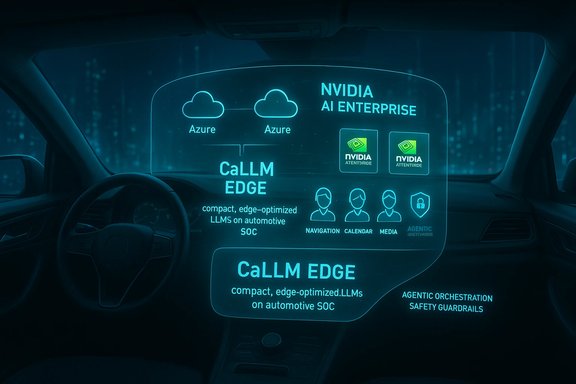
Cerence xUI is the company’s next‑generation, hybrid “agentic” vehicle assistant: a platform design that deliberately mixes on‑device, embedded models (small language models, or SLMs) with larger cloud LLMs and orchestration layers so automakers can deliver conversational, multi‑step user experiences inside the cabin while preserving safety, latency, and privacy constraints. The company markets xUI as an OEM‑friendly, technology‑agnostic stack that integrates Cerence’s CaLLM family of models with third‑party engines and vendor runtimes. Two anchor technical claims form the core of Cerence’s messaging:- CaLLM and CaLLM Edge are optimized with NVIDIA AI Enterprise toolchains (TensorRT‑LLM, NeMo, and NeMo Guardrails) for faster inference and automotive‑grade safety controls.
- Cloud components, distribution, and enterprise integrations — including Azure OpenAI and other Azure AI services — are used to host, orchestrate, and distribute models and capabilities to OEM fleets.
What Cerence xUI actually does — technical anatomy
Cerence positions xUI as a modular, hybrid execution framework built to support automotive constraints and features:- Edge SLMs (CaLLM Edge): compact, finetuned SLMs for low‑latency, offline conversational duties. These models are tuned on Cerence’s automotive dataset and are designed to run on automotive SoCs and DRIVE‑class platforms. Cerence states CaLLM Edge is available in the Azure AI model catalog.
- Cloud LLMs (CaLLM and third‑party models): larger models for knowledge‑heavy or multimodal tasks where latency and connectivity allow cloud execution. Cerence can route requests to cloud LLMs and combine them with vehicle context, user profiles, and third‑party data (maps, music, news).
- Agentic orchestration: xUI’s runtime coordinates multi‑step conversations and agents that can perform actions (calendar checks, navigation changes, dealer interactions), manage policy and guardrails, and enforce human‑in‑the‑loop gating for safety‑critical flows. The idea is to treat the in‑car assistant as a team of small, specialist agents rather than a single monolithic LLM.
- Vendor runtime & optimization layer: Cerence explicitly relies on NVIDIA AI Enterprise (TensorRT‑LLM, NeMo) to accelerate inference and to implement guardrails; on Microsoft Azure for cloud hosting, security, identity and distribution; and on partner silicon (MediaTek, SiMa.ai) and DRIVE AGX hardware for edge deployment.
How the NVIDIA and Microsoft claims check out
Independent verification of the most consequential technical claims is possible by cross‑referencing vendor materials and Cerence’s public statements.- NVIDIA AI Enterprise claim: Cerence’s press materials and follow‑ups specifically state they are leveraging NVIDIA AI Enterprise (TensorRT‑LLM and NeMo) to fine‑tune and optimize CaLLM for production inference and guardrails. NVIDIA and Cerence materials corroborate that TensorRT‑LLM and NeMo are widely used for LLM inference optimization in enterprise contexts — a sensible engineering choice when delivering low‑latency inference pipelines.
- Microsoft / Azure claim: Cerence’s collaborations with Microsoft date back to early 2024 and include Azure OpenAI integrations, Azure AI model catalog listings for CaLLM Edge, and joint GTM work that positions Azure as the distribution and governance layer for cloud models and enterprise integrations. Microsoft’s own mobility materials discuss integration patterns for in‑car assistants and Azure OpenAI usage, which aligns with Cerence’s public statements.
Why automakers are taking notice (and why traction matters)
Automakers have three, interrelated mandates driving interest in platforms like xUI:- Deliver meaningful differentiation in the digital cockpit while keeping the brand and UX under OEM control.
- Maintain safety and regulatory compliance (driver distraction, privacy, data residency) while adding generative AI features.
- Reduce the cost and complexity of model updates: move from one‑time factory firmware to continuous feature updates via cloud and OTA flows.
- Faster time‑to‑feature for vehicle models across global markets.
- Lower barrier to entry for differentiated voice agents without locking into a single public LLM provider.
- A potential new revenue/loyalty vector: upgraded in‑car features after purchase.
Strengths: what Cerence is doing well
- Automotive DNA and dataset advantage: Cerence’s decades of in‑vehicle voice and audio work give it a rich, proprietary dataset and hard‑won OEM relationships — important currency when delivering safety‑sensitive voice services.
- Pragmatic hybrid model: Mixing SLMs at the edge with cloud LLMs reduces both latency and data‑flow risk while enabling higher‑order functionality where connectivity permits. This is the right architectural posture for cars.
- Vendor ecosystem alignment: By validating both NVIDIA runtimes and Microsoft Azure integrations, Cerence reduces friction for OEMs who already use those platforms for telematics, maps and enterprise services. That makes procurement and integration easier.
- Production mindset: Cerence emphasizes production‑grade tooling (guardrails, policy, audit trails) and is pushing for Azure model catalog availability and GPU-optimized deployments — a necessary step beyond research demos.
Risks, operational caveats and hidden costs
Despite the strengths, the stack exposes several real risks and operational burdens that OEMs must manage deliberately.- Vendor concentration & lock‑in: Deep reliance on NVIDIA‑specific runtimes and Microsoft Azure services can create migration cost and negotiation leverage for those vendors. While combining multiple providers lowers single‑vendor dependency in theory, in practice tight runtime optimizations and model artifacts cause lock‑in over time. Enterprises must demand portability contracts or multi‑cloud fallbacks.
- Supply and capex for edge hardware: Deploying higher‑performance in‑car SoCs or DRIVE‑class modules increases per‑vehicle bill‑of‑materials, power/thermal design complexity, and long‑tail software maintenance. Edge AI hardware lifecycles differ from traditional automotive ECUs, introducing refresh, warranty and long‑term support complexities.
- Safety, certification and regulatory complexity: Agentic behaviors (automated actions that can change vehicle state or forward content) raise new safety certification questions. OEMs must validate the policy envelope — when an agent can act autonomously versus when human consent is required — and prove auditing and rollback mechanisms. This is non‑trivial in regulated markets.
- Operational TCO and cloud consumption: Cloud inference costs and bandwidth for fleets can be large. Vendor statements about “performance improvements” or “cost efficiencies” from optimized runtimes should be verified in pilot environments with representative traffic — published vendor improvements often depend on specific model sizes and batch patterns. Independent verification is required before procurement sign‑offs.
- Data governance and privacy: Vehicle data is highly sensitive and often subject to local residency laws. Using cloud LLMs and third‑party model catalogs requires careful contractual guardrails and data‑handling proof points that meet EU, China and other regulatory expectations. Cerence points to Azure and partner tooling, but buyers must validate the precise guarantees in writing.
Practical verification: what to validate in a pilot
For IT and engineering teams evaluating Cerence xUI, a short, structured validation plan reduces procurement risk and speeds decision‑making:- Start with a 60‑day technical pilot that exercises:
- Edge SLM latency on the intended SoC and thermal profile.
- Cloud routing and failover (connectivity loss behavior).
- Guardrail efficacy for safety‑sensitive prompts and multimodal inputs.
- Run a 90‑day TCO and scale test:
- Measure per‑session cloud inference cost under day/night, city/highway patterns.
- Benchmark GPU utilization with the vendor‑recommended runtimes (TensorRT‑LLM, NeMo).
- Test OTA update latency and rollback procedures.
- Complete a governance and compliance proof:
- Validate Azure contract terms for data residency and telemetry.
- Confirm logging, forensics, and human‑in‑the‑loop intervention controls.
- Obtain third‑party security and privacy assessments.
How the broader platform strategy changes the automotive AI landscape
Cerence’s approach is instructive because it represents a wider industry pattern: the combination of specialized vendors who own domain expertise (voice and in‑car UX) with hyperscaler model and infrastructure ecosystems (NVIDIA runtimes, Azure AI Foundry/OpenAI, and partner SoCs). This multi‑party stack accelerates productization — but also concentrates technical and commercial power across a few players.- Hyperscaler + silicon + application vendor combinations can deliver production speed and validated stacks, reducing integration risk for OEMs.
- That same alignment increases vendor leverage and raises the strategic importance of contractual visibility into pricing and compute commitments.
- Enterprise buyers must balance the short‑term benefits of validated integrations against the long‑term cost of platform dependence.
SEO‑friendly summary of the concrete facts (verified)
- Cerence xUI is a hybrid, agentic automotive assistant platform combining edge SLMs (CaLLM Edge) and cloud LLM orchestration (CaLLM), optimized with NVIDIA AI Enterprise runtimes and integrated with Microsoft Azure services for distribution and governance.
- CaLLM Edge is listed for enterprise use and referenced in the Azure AI model catalog; Cerence has public OEM collaborations and demonstrations (GWM, Renault, JLR, Geely), and announced a planned Geely deployment tied to CES 2026.
- NVIDIA collaborations include training and deployment support (DGX, DRIVE AGX Orin), use of TensorRT‑LLM and NeMo toolchains, and the application of guardrail frameworks tailored for the automotive domain.
- Cerence’s Azure relationship covers Azure OpenAI access, model catalog listing and Microsoft‑side product integrations such as Microsoft 365 Copilot for in‑car productivity agents. The Microsoft partnership has been public since at least early 2024.
Final assessment — practical takeaways for automakers and technical buyers
Cerence xUI presents a pragmatic, well‑scaffolded path for OEMs that want to add LLM‑grade conversational features to vehicles while keeping a handle on safety and brand control.- For automakers seeking rapid differentiation with controlled risk, xUI’s hybrid architecture and the Cerence dataset are compelling advantages.
- For procurement and platform teams, the crucial next steps are contractual: insist on measurable SLAs for latency and cost, documented portability options (model artifacts, exportable finetuning pipelines), and robust data‑sovereignty guarantees.
- For engineers and product teams, insist on real‑world pilots that measure inference cost and guardrail efficacy under representative conditions, and insist on a documented security and incident‑response playbook.
Cerence xUI is not a speculative demo; it is an engineered hybrid stack that reflects the industry’s pragmatic movement toward production agentic assistants in cars. The next phase will separate marketing from operational reality as OEM pilots expose the real metrics—latency, reliability, governance traceability and, ultimately, the total cost of ownership—needed to make LLMs a trusted part of the driving experience.
Source: The Manila Times Cerence xUI, Leveraging NVIDIA AI Enterprise and Running on Microsoft Azure, Drives Strong Traction with Automakers
Source: The Globe and Mail Cerence xUI, Leveraging NVIDIA AI Enterprise and Running on Microsoft Azure, Drives Strong Traction with Automakers