

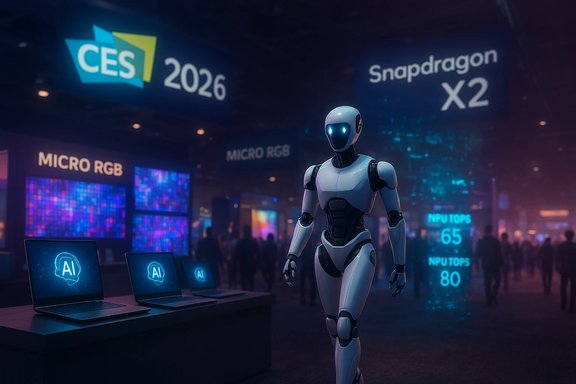
Now that the confetti has settled on the holidays, CES 2026 is ready to prove an argument that felt half-theoretical a year ago: AI is no longer a single feature on a product spec sheet — it’s the new substrate of consumer electronics, from the silicon inside laptops to the LEDs behind your living‑room TV and the actuators on a humanoid robot shown walking down the Vegas aisles.
CES 2026 (January 6–9) arrives with a clear throughline: vendors are stitching AI into hardware and user experiences at every layer. That shift is visible in company roadmaps and pre-show press — chipmakers are promoting NPUs (neural processing units) and TOPS (trillions of operations per second) as primary marketing specs; TV makers are pivoting to RGB / Micro‑RGB backlighting plus on‑device AI image engines; and robot companies are trading proof‑of‑concept demos for field‑testable humanoids and service robots. Much of this narrative is summarized in pre‑CES previews and the briefing material circulating in the trade press and vendor releases.
This article synthesizes those vendor claims, verifies the most consequential technical assertions against independent reporting where possible, highlights what Windows and PC users should care about, and flags unverified or high‑risk claims that deserve caution. Where the record is tentative, the article calls that out and points to the concrete signals to watch on the show floor.
Independent coverage and vendor material show these common themes:
On‑the‑ground verification at CES — lab measurements for TV claims, hands‑on tests of Panther Lake and Snapdragon X2 laptop behaviors, live robotics demos audited for real autonomy and safety — will determine whether 2026 is the year AI features graduate from aspiration to durable value. The signals are strong; the work ahead is turning them into measured outcomes.
Source: AI: Reset to Zero AI: Getting ready for another AI Powered CES 2026. RTZ #956
 Background / Overview
CES 2026 (January 6–9) arrives with a clear throughline: vendors are stitching AI into hardware and user experiences at every layer. That shift is visible in company roadmaps and pre-show press — chipmakers are promoting NPUs (neural processing units) and TOPS (trillions of operations per second) as primary marketing specs; TV makers are pivoting to RGB / Micro‑RGB backlighting plus on‑device AI image engines; and robot companies are trading proof‑of‑concept demos for field‑testable humanoids and service robots. Much of this narrative is summarized in pre‑CES previews and the briefing material circulating in the trade press and vendor releases.This article synthesizes those vendor claims, verifies the most consequential technical assertions against independent reporting where possible, highlights what Windows and PC users should care about, and flags unverified or high‑risk claims that deserve caution. Where the record is tentative, the article calls that out and points to the concrete signals to watch on the show floor.
The silicon battleground: AI inside laptops and PCs
What vendors are promising now
Chipmakers have reoriented product messaging around on‑device AI. The three names dominating the pre‑CES conversation are Intel Panther Lake, Qualcomm Snapdragon X2 (X2 Elite family), and AMD’s incremental “Gorgon Point” APUs for laptops. Each is being positioned to deliver sustained local inference for Copilot+ style features, lower cloud dependence, and improved battery life — a trio of promises that underpin the “AI PC” thesis.Independent coverage and vendor material show these common themes:
- Larger, faster NPUs integrated into SoCs to facilitate local LLM inference and multimodal tasks.
- Efficiency claims (longer battery life under continuous inference) framed as a major differentiator.
- OEM designs tuned for Copilot / Copilot+ experiences (Windows AI integrations), often with marketing around “Copilot‑ready” hardware.
Panther Lake — Intel’s play
Intel’s Panther Lake/Core Ultra Series 3 is being marketed as a landmark refresh: built on Intel’s 18A process and bridging power efficiency with larger integrated graphics and stronger NPU support. Early company demos and trade reporting show working Panther Lake systems in OEM laptops and dev kits; Intel has promised ramping availability into the CES timeframe. Those materials indicate improved Xe3 graphics and platform TOPS figures that are meant to support local AI workloads. Independent previews corroborate the demo hardware but also caution that full platform availability will stretch beyond initial show SKUs. Caveat: vendor TOPS and “platform TOPS” figures are meaningful as direction indicators but are rarely measured under consistent, third‑party test conditions. Treat claimed TOPS as an engineering target rather than an apples‑to‑apples performance metric without lab confirmation.Qualcomm Snapdragon X2 — Arm cores meet Copilot
Qualcomm’s follow‑on to the X Elite line, the Snapdragon X2 family (X2 Elite / X2 Elite Extreme), is pushing high NPU counts (public materials and reputable outlets cite figures in the ~80 TOPS range for the top SKUs) and an updated Oryon CPU core design for better performance per watt. OEMs (Lenovo among them) are expected to show Snapdragon X2‑powered Copilot+ Windows devices at CES, signaling the continuing investment in Windows on Arm for thin‑and‑light designs. Early reporting lists features such as Wi‑Fi 7, Hexagon/Adreno GPU upgrades, and very long battery life claims on some reference designs. Verification note: Qualcomm’s 80 TOPS claim appears in multiple vendor‑facing documents and trade coverage; independent benchmarks for whole‑system behaviors (latency for local LLM inference, sustained power draw) will be needed to validate real‑world parity with cloud‑based models.AMD’s Gorgon Point — evolution, not revolution
What’s being described publicly as Gorgon Point looks like a Strix Point refresh: Zen 5 CPU cores, RDNA 3.5‑class integrated graphics, and modest NPU increases. Early leaked slides and hardware teardowns suggest iterative uplift rather than a generational leap — but that’s a strategic play: AMD focuses on stronger integrated graphics in some segments and Ryzen AI branding where it matters for OEM positioning. Tom’s Hardware and other outlets have documented the line as aiming for 2026 product windows.Why this matters for WindowsForum readers
- For buyers: expect more laptops that can run local inference (summaries, translation, camera‑based features) without nonstop cloud calls. But buyer caution: features are highly platform‑dependent; the marketing name “Copilot+” doesn’t guarantee an offline experience across locales.
- For IT/pros: negotiate procurement terms that specify which AI workloads are supported on device vs. the cloud. Validate firmware update policies and thermal management for sustained inference.
- For gamers and content creators: integrated graphics and NPU claims matter less for raw frame rates and more for background tasks (codec acceleration, live content generation) that can reduce editing latency.
Displays and the Micro RGB moment
The hardware shift: Micro RGB backlights
The most visible hardware narrative at CES is the race to deploy RGB / Micro‑RGB backlighting in mainstream TV sizes. Unlike Mini‑LED (white backlight + quantum dot filters), Micro‑RGB embeds microscopic red, green and blue emitters into the backlight plane, enabling much finer control of colour and brightness on a near‑subpixel level. That shift promises higher peak brightness, wider color volume, and more precise local contrast — core attributes for HDR fidelity. LG’s Micro RGB evo and Samsung’s expanded Micro RGB family are flagship examples of this trend.- LG’s Micro RGB evo (α11 AI Processor Gen 3) is positioned as a 75/86/100‑inch family with Intertek‑verified claims around color coverage (100% BT.2020 / DCI‑P3 / Adobe RGB) and thousands of local dimming zones. The company says the TV uses OLED‑grade driving logic to handle Micro‑RGB control. These assertions are confirmed in LG’s press materials and early trade coverage, but the precise LED pitch and addressing architecture are not fully disclosed — those are the crucial engineering details that determine real‑world results.
- Samsung’s Micro RGB lineup expands availability from 115‑inch concept sets into more practical sizes (55–100 inches in 2026 announcements) and layers on an AI engine (Vision AI Companion) that integrates LLM‑style conversational features with image processing. Samsung’s materials claim sub‑100‑micrometer RGB emitters and AI image engines to tune color, motion and HDR behavior. Preliminary reporting and vendor statements confirm the product families and the timeline, but pricing and availability remain to be announced on many SKUs.
Pricing reality and availability
High‑end Micro RGB devices already pushed six‑figure scale for large reference models in 2025. Hisense’s 116‑inch RGB Mini‑LED TV (116UX) tested at about $29,999 in market reports; Samsung and LG say they will offer smaller sizes in 2026 that are more suitable for living rooms, but pricing will determine how fast adoption goes beyond wealthy early adopters. Expect MSRP signals during CES and pre‑orders to indicate whether Micro RGB crosses the mainstream price threshold this year.What to watch on the floor
- Independent lab measurements of gamut coverage and certified claims (Intertek/VDE notes are meaningful).
- Hands‑on demos of halo control and tone mapping under real‑world scenes (sports, night scenes).
- Vendor disclosure around LED pitch, per‑inch backlight density, and the number of addressable zones. Until those appear, vendor statements remain directional.
Robots, “physical AI,” and the Limits of the Demo
Humanoids and service robots go from experiment to product positioning
CES 2026 is more humanoid than any recent show: dozens of exhibitors (a large share from China) will present humanoid platforms for household assistance, retail, and logistics. The evidence is straightforward: exhibitor lists and trade coverage show many new entrants (Unitree, AgiBot, UBTech, and more) and established companies (LG with its CLOiD robot) aiming to scale output and practical demonstrations. Nvidia’s framing of “physical AI” — open‑sourced robotic foundational models and GPU‑accelerated pipelines — is fuelling the narrative that robotics is moving from lab demos to fieldable systems.Practical progress versus hype
- What’s real: improved computer vision stacks, cheaper sensors, and bigger GPU/AI toolchains (e.g., NVIDIA Isaac) reduce training friction for manipulation and navigation. Production players in Asia are moving to volume manufacturing and have reported multi‑thousand unit ambitions.
- What’s not yet universal: reliable, general‑purpose home humanoids that safely do laundry, load dishwashers, or perform complex, unscripted tasks. Most demos remain constrained to structured or supervised tasks; companies are honest about pilot programs and phased rollouts.
Safety, regulation and workforce risks
The scale‑up of humanoid robotics raises practical questions:- Safety standards and field verification protocols need to catch up. A CES demo is not a regulatory approval.
- Workforce transition: pilots in warehouses and service sectors can displace jobs rapidly — policymakers and procurement teams must weigh retraining and staged adoption.
- Security: robots with cameras and persistent logs increase attack surface for privacy breaches; on‑device processing vs. cloud‑based control architectures will be a critical differentiator for adopters.
Smart homes, cameras, and access control: Aliro, Matter, and UWB
Smart locks, Aliro and UWB: the access control moment
Smart locks and digital keys are getting a standards push with the Aliro initiative (Connectivity Standards Alliance / CSA) and UWB enhancements from FiRa Consortium. Aliro aims to standardize the device‑to‑reader interaction for digital keys and wearables; FiRa 4.0 adds Aliro‑focused UWB certification capabilities. Expect announcements at CES about new smart locks supporting UWB, palm/facial unlocking, and Aliro interop, but note that the timeline for full, cross‑vendor interoperability remains multi‑quarter.Cameras as automation sensors
Security cameras are being reframed as contextual automation sensors — not just surveillance. Vendors tout on‑device perception (people identification, fall detection, package recognition) that integrates with home automations (lighting, HVAC). The practical risks are data governance, false positives, and how on‑device inference is balanced against cloud features for continuous learning. Matter integration for cameras remains spotty, even as some vendors stress Matter and Aliro as the long‑term interoperability path.Privacy tradeoffs
- On‑device inference reduces cloud exposure; however, feature rollouts often use mixed architectures with cloud fallbacks or optional backups.
- Buyers should expect fine‑grained controls and opt‑out pathways; procurement teams should verify retention policies and encryption practices before deploying new devices at scale.
Gaming and handhelds: Linux/SteamOS vs Windows devices
The handheld and console landscape continues to fragment. Valve’s posture on a Steam Deck 2 remains conservative — the company insists on a meaningful performance leap (not just an incremental refresh) before shipping a successor — pushing pressure onto silicon vendors to deliver new low‑power, high‑efficiency APUs. Meanwhile, third‑party handhelds (Lenovo Legion Go S, Asus ROG Ally variations) and SteamOS‑compatible devices are evolving fast, and smaller Linux‑based gaming machines continue to challenge the Windows gaming laptop hegemony for portable play. Expect CES demos of new handhelds and SteamOS‑friendly devices; but a Valve‑branded “Deck 2” is not a lock for 2026.Wearables, XR and the “AI pen” rumor
Wearables are shifting beyond health trackers into XR/AI accessory territory. Smart glasses, headsets and mixed‑reality solutions are prominent at CES. Separately, multiple outlets have reported that OpenAI — in collaboration with designer Jony Ive — has prototyped a consumer gizmo reportedly codenamed Gumdrop, with leaks suggesting an AI‑enabled pen among possible concepts. Manufacturing partners and supply chain shifts (Luxshare → Foxconn reporting) also appear in the rumor mill. These reports should be treated as credible leaks but not confirmed product launches; CES may not be the place for a surprise OpenAI hardware unveiling. Verification: until an official OpenAI product announcement, treat device format and capabilities as speculative.The five most load‑bearing claims to verify at CES
- LG’s Micro RGB evo real‑world performance and Intertek verification claims (color volume, dimming zones).
- Samsung’s availability and pricing plans for Micro RGB in 55–100‑inch sizes and the practical behavior of Vision AI Companion.
- Qualcomm’s Snapdragon X2 NPU (up to ~80 TOPS) and how that translates to sustained local LLM inference on shipping laptops.
- Intel Panther Lake’s integrated NPU/Xe3 GPU platform TOPS claims and mass availability timing for Core Ultra Series 3 laptops.
- The scope of humanoid robotics showcased (number of exhibitor booths, concrete production targets from named companies) and the quality of autonomy in field demos.
Risks, unresolved questions and vendor caveats
- Productization vs demo spectacle: CES is still a stage for prototypes. Not every robot or Micro RGB set on show will be shipping, or at a mass‑market price point.
- Privacy and governance: as intelligence migrates to the device, on‑device models still require careful telemetry and upgrade controls. Expect inconsistent opt‑outs across vendors.
- Supply chain and geopolitics: manufacturing partners, factory locations and trade policy shape which products ship where and when — the OpenAI hardware leaks illustrate how fragile early‑production plans can be.
- Measurement inconsistency: TOPS, dimming zone counts, and color gamut percentages are reported differently by vendors. Demand consistent test protocols before treating claims as comparative benchmarks.
- Workforce and ethics: humanoid robotics at scale raises employment, regulatory and safety questions that are only beginning to be addressed in procurement contracts and standards bodies.
Practical guidance for WindowsForum readers (short checklist)
- If you’re shopping for a laptop in early 2026:
- Demand clarity on what AI features are local (on‑device) vs cloud.
- Ask OEMs for thermal behavior and sustained inference test results.
- Prefer devices with clear firmware/driver update policies and rollback options.
- If you’re considering a Micro RGB TV:
- Wait for independent lab measurements for gamut and HDR tone‑mapping.
- Test real content (sports, cinema, night scenes) for halo control and local dimming artifacts.
- Confirm sizes and pricing before committing; early adopters will pay a premium.
- If you manage a fleet or smart‑building rollout:
- Verify Aliro and Matter support timelines; do not assume universal interoperability yet.
- Ask for data retention policies, on‑device processing fallbacks and security attestations for robot deployments.
Conclusion: CES 2026 — the first show where AI is everywhere and the microscope is on execution
CES 2026 will be remembered less for a single breakout product and more for the scale of the pivot: AI is the connective tissue across silicon, displays, home devices and robots. Vendors are aligning roadmaps around on‑device inference, Micro‑RGB display architectures, and robotics frameworks that use common GPU/LLM toolchains. Those shifts are both exciting and fraught: they promise tangible benefits (reduced latency, better privacy, richer experiences), but they also demand skeptical verification — independent benchmarks, clear standards, and robust governance — before buyers or enterprises can safely assume the promises will materialize.On‑the‑ground verification at CES — lab measurements for TV claims, hands‑on tests of Panther Lake and Snapdragon X2 laptop behaviors, live robotics demos audited for real autonomy and safety — will determine whether 2026 is the year AI features graduate from aspiration to durable value. The signals are strong; the work ahead is turning them into measured outcomes.
Source: AI: Reset to Zero AI: Getting ready for another AI Powered CES 2026. RTZ #956
