

AMD’s bold thesis at CES — that this will be the year of the AI PC — landed as both a marketing rallying cry and a concrete engineering claim: mainstream x86 laptops and desktops are finally shipping with NPUs large enough to run on‑device models and multimodal workflows that Microsoft calls “Copilot+,” and AMD expects sales of AI‑enabled PCs to outpace non‑AI PCs in 2026.
The term AI PC describes a class of personal computers designed to accelerate local machine‑learning workloads using a dedicated Neural Processing Unit (NPU) alongside CPU and GPU resources. This shift from cloud‑first AI to local inference emphasizes lower latency, privacy, and the potential for always‑on, energy‑efficient features such as live captions, real‑time translation, camera effects, and generative assists baked into the operating system.
Microsoft’s Copilot+ program established a pragmatic hardware bar for that vision: devices with NPUs capable of delivering meaningful on‑device inference. Industry guidance and platform materials indicate Copilot+ targets devices with NPUs in the 40+ TOPS range — a practical gate for the most responsive local experiences.
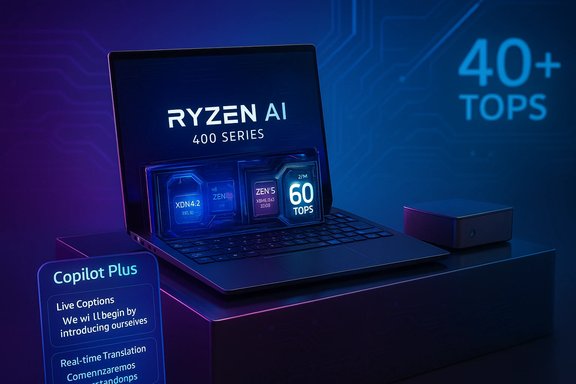
At CES 2026, AMD expanded on this industry narrative by unveiling the Ryzen AI 400 series (codenamed “Gorgon Point”) and related Ryzen AI Max+ and Halo SKUs. These parts pair Zen 5 CPU cores and RDNA 3.5 integrated graphics with a second‑generation XDNA 2 NPU block, which AMD rates up to ~60 TOPS on flagship mobile parts. AMD executives publicly argued 2026 would be the “AI PC crossover” year when AI‑enabled PC sales overtake legacy PCs — a claim backed by its product roadmap and an OEM pipeline for Copilot+‑ready devices.
Buyers and IT leaders should respond with measured optimism: pilot deployments, demand sustained throughput and battery data from vendors, and insist on clear manageability and security guarantees before scaling Copilot+ endpoints. For enthusiasts and developers, 2026 is a legitimate year to explore NPUs, port models to ONNX/DirectML, and design multi‑backend workflows. If the ecosystem executes on drivers, runtime stability, and cross‑vendor tooling, the “AI PC” will shift from marketing slogan to everyday expectation — but that shift will be judged by real user outcomes, not peak TOPS alone.
Source: MSN http://www.msn.com/en-us/news/techn...vertelemetry=1&renderwebcomponents=1&wcseo=1]
 Background: where the “AI PC” idea comes from and why it matters
The term AI PC describes a class of personal computers designed to accelerate local machine‑learning workloads using a dedicated Neural Processing Unit (NPU) alongside CPU and GPU resources. This shift from cloud‑first AI to local inference emphasizes lower latency, privacy, and the potential for always‑on, energy‑efficient features such as live captions, real‑time translation, camera effects, and generative assists baked into the operating system.Microsoft’s Copilot+ program established a pragmatic hardware bar for that vision: devices with NPUs capable of delivering meaningful on‑device inference. Industry guidance and platform materials indicate Copilot+ targets devices with NPUs in the 40+ TOPS range — a practical gate for the most responsive local experiences.
At CES 2026, AMD expanded on this industry narrative by unveiling the Ryzen AI 400 series (codenamed “Gorgon Point”) and related Ryzen AI Max+ and Halo SKUs. These parts pair Zen 5 CPU cores and RDNA 3.5 integrated graphics with a second‑generation XDNA 2 NPU block, which AMD rates up to ~60 TOPS on flagship mobile parts. AMD executives publicly argued 2026 would be the “AI PC crossover” year when AI‑enabled PC sales overtake legacy PCs — a claim backed by its product roadmap and an OEM pipeline for Copilot+‑ready devices.
AMD’s announcements: what changed at the silicon level
AMD framed its CES messaging as a full‑stack approach: combine Zen 5 CPU cores, improved RDNA 3.5 integrated graphics, and a larger on‑die NPU to enable real, everyday on‑device AI experiences. Key product highlights AMD promoted include:- Ryzen AI 400 Series (Gorgon Point) — mobile and desktop APUs built on Zen 5 cores, RDNA 3.5 iGPU, and XDNA 2 NPUs.
- Top mobile SKU examples (vendor claims): Ryzen AI 9 HX 475 — up to 12 cores / 24 threads, boost clocks around 5.2 GHz, LPDDR5X‑8533 support, integrated Radeon 890M (RDNA 3.5) with up to 16 CUs, and an NPU rated up to 60 TOPS.
- Ryzen AI Max+ and Halo variants — targeted at creators and developers with higher memory ceilings and heavier iGPU/NPU configurations for local model inference.
Technical deep dive: XDNA 2, TOPS, and what the numbers actually mean
AMD’s headline figure — up to 60 TOPS — is engineered to resonate against Copilot+ guidance and competing silicon. Yet TOPS requires context.What is TOPS?
TOPS (trillions of operations per second) measures raw integer or floating‑point throughput for simple matrix operations, often using quantized formats like INT8. It is a synthetic metric useful for comparing peak theoretical throughput, but it does not directly translate to real‑world latency, end‑to‑end inference speed, or energy‑per‑inference across diverse model families.- Vendor TOPS figures are not standardized. Different vendors measure TOPS under different precisions, counting rules, and memory models. A 60 TOPS claim for INT8 workloads is not necessarily equivalent to another vendor’s 60 TOPS measured under a different precision or pipeline.
- Sustained performance matters. NPUs can hit peak TOPS in short bursts; sustained inference throughput depends on thermal headroom, memory bandwidth, DMA efficiency, and driver maturity. Thin‑and‑light laptops and mini‑PC enclosures can constrain sustained NPU utilization.
Why 40+ TOPS is a practical threshold
Microsoft’s Copilot+ documentation and ecosystem guidance use an effective threshold in the 40+ TOPS band to define devices capable of delivering the best on‑device experiences. This makes AMD’s 50–60 TOPS figures meaningful because they aim to clear that baseline and provide headroom for multimodal and generative features. Multiple industry reports and platform guidance corroborate this practical threshold.XDNA 2 in practice
XDNA 2 is AMD’s on‑die NPU architecture. AMD positions it to accelerate quantized model inference and to participate in hybrid execution alongside CPU and GPU. In practice:- XDNA 2 will accelerate model primitives that benefit from matrix multiply cores, such as transformer inference inner loops.
- Real‑world gains depend on a complete software stack: ONNX runtime support, DirectML / vendor drivers, and tuned quantization pipelines.
- Developers and ISVs must instrument fallbacks between CPU, GPU and NPU runtimes to avoid performance cliffs and ensure compatibility.
The software and ecosystem angle: Windows 11, Copilot+, and developer tooling
Hardware on its own does not make an AI PC. Microsoft’s Windows 11 updates — notably the Copilot+ integrations and new on‑device primitives — create the software surface that turns NPU silicon into everyday features.- OS primitives and APIs such as ONNX runtimes, DirectML, and NPU device APIs make it easier for ISVs to adopt local acceleration.
- Copilot+ features (Live Captions, real‑time translation, webcam Studio Effects, Click to Do, Highlights, and context‑aware UI assists) are explicitly designed to be hardware‑accelerated when the device qualifies.
- Developer guidance is evolving to encourage multi‑backend model packaging, quantization, and adaptive fallbacks so apps can run across x86 and Arm NPUs without catastrophic performance differences.
Market dynamics: OEMs, form factors, and pricing
AMD’s argument for an “AI PC crossover” rests on three commercial trends that were visible at CES:- Hardware parity across stacks. x86 vendors (AMD, Intel) and Arm vendors (Qualcomm) are shipping NPUs sized for Copilot+‑class experiences, lowering the barrier for OEMs to label devices as “AI‑enabled.”
- OEM commitment. Major OEMs announced Copilot+‑ready devices across price tiers, including creative form factors like HP’s keyboard PC and a surge in mini‑PC designs that leverage integrated NPUs. AMD pushed the mini‑PC narrative as a fast‑growing segment for AI‑capable desktops.
- Price tiering and volume. Vendors signaled entry‑level Copilot+ units aimed at price points near $499 in some briefings, suggesting both a strategy to capture mainstream buyers and a route to reach crossover volumes. Independent coverage corroborated early availability windows for Q1 2026.
Strengths of AMD’s position
- Integrated performance per watt: By combining Zen 5 CPU cores, RDNA 3.5 integrated graphics, and XDNA 2 NPUs on the same die, AMD improves the odds that AI features run locally without massive battery penalties.
- Broad OEM pipeline: Multiple OEM commitments across laptop, mini‑PC, and specialty SKUs mean the market can sample AMD‑powered AI PCs across segments quickly.
- Copilot+ alignment: AMD targeted the Microsoft Copilot+ thresholds and emphasized certification pathways, which helps translate silicon claims into real user features when paired with Microsoft’s OS integrations.
- Developer and creative use cases: Ryzen AI Max+ and Halo targets for creators and developers reduce reliance on cloud inference in many creative workflows, lowering iteration time and cost for local model experimentation.
Risks, caveats, and the path to verification
While AMD’s thesis is credible, several practical concerns temper optimism.- TOPS are directional, not definitive. Vendor TOPS figures are helpful but not equivalent across vendors or precisions. Buyers and IT teams should treat TOPS as a signal to investigate, not a substitution for independent benchmarks.
- Thermals and sustained throughput. Peak NPU throughput is only meaningful if devices can sustain useful throughput under realistic workloads. Thinner laptops and mini‑PCs face a harder engineering trade‑off than thicker chassis.
- Software maturity and fragmentation. The user experience depends on optimized runtimes (ONNX, DirectML) and vendor drivers. ISVs must recompile or tune models to fully exploit NPUs; otherwise, hardware sits underutilized. This is a classic chicken‑and‑egg problem for platform adoption.
- Security and manageability. On‑device AI expands the attack surface (model theft, adversarial inputs, data exfiltration). Enterprises will insist on attestation (TPM, secure boot, driver update policies) and manageable update channels for fleets before deploying Copilot+ endpoints at scale.
- Supply chain and cost pressures. Advanced packaging (HBM, CoWoS), die stacking, and LPDDR5X memory availability can constrain supply or raise costs, slowing volume shipments that underpin a crossover.
What to watch: the verification checklist for buyers and reviewers
For reviewers, IT buyers, and enthusiasts deciding whether the “AI PC” promise is real, use this checklist when evaluating AMD’s Ryzen AI devices:- Verify sustained NPU throughput across real model families (not just peak TOPS). Measure latency and energy per inference under continuous workloads.
- Test Copilot+ features end‑to‑end on the device: Live Captions, real‑time translation, camera Studio Effects, and generative assists. Confirm whether experiences fall back gracefully to cloud when the device lacks headroom.
- Compare cross‑vendor performance under identical thermal and power caps. Avoid vendor‑presented “apples‑to‑oranges” slides without consistent test conditions.
- Evaluate manageability features: TPM attestation, secure boot, BIOS/driver update cadence, and vendor support for enterprise policy.
- Validate battery life under mixed workloads that include continuous on‑device inference; measure the trade‑off between responsiveness and runtime.
- Inspect developer tooling and model portability: ONNX runtime behavior, DirectML performance, and the availability of vendor toolkits for quantization and tuning.
Guidance for different buyer groups
Consumers and enthusiasts
- Focus on real features, not only TOPS. Look for hands‑on reviews demonstrating Copilot+ experiences that matter: real‑time translation, local assistant responsiveness, and generative creativity tasks.
- Compare battery life in sustained inference conditions and in standard productivity scenarios.
Creators and prosumers
- Prioritize SKUs in the Ryzen AI Max+ family if local model inference and content generation are workflow needs. Verify unified memory ceilings and developer toolchain support.
- Pilot creative workloads (Stable Diffusion variants, local model fine‑tuning, etc. to determine whether the on‑device latency and cost advantages materialize.
IT and enterprise
- Run scoped pilots before fleet‑wide purchases. Negotiate service and update guarantees, and require attestation and manageability documentation (TPM, secure boot, DCH driver policy).
- Define compliance and data governance: determine which workloads must remain local for privacy or latency reasons and which can continue to use cloud inference.
Competitive landscape: where AMD sits relative to Intel and Qualcomm
AMD’s Ryzen AI family is one leg of a three‑horse race. Intel’s Core Ultra (Panther Lake / Series 3) and Qualcomm’s Snapdragon X2 family both pushed NPU and integrated graphics upgrades at CES and in partner materials. Key dynamics:- Intel emphasizes platform integration and larger integrated GPU die sizes; its Series 3 messaging focuses on power efficiency and strong single‑thread CPU performance at scale.
- Qualcomm continues to lead early Copilot+ rollout narratives on Windows on Arm with high NPU TOPS (reported 80 TOPS on some Snapdragon X2 SKUs) and a strong efficiency story for thin devices.
- AMD is betting on aggressive NPU sizing on x86 APUs, RDNA 3.5 iGPU improvements, and a broad OEM commitment that reaches mainstream price tiers.
Conclusion: realistic optimism — but verify before you buy
AMD’s argument that 2026 could mark an “AI PC crossover” is credible and well‑timed: silicon capable of delivering Copilot+‑class experiences exists, Windows 11 includes richer AI primitives, and OEMs have product pipelines that target mainstream price points. AMD’s Ryzen AI 400 family and XDNA 2 NPU numbers (50–60 TOPS on flagship SKUs) match the practical thresholds set by platform guidance — but those figures are vendor‑reported and require independent validation to understand their real‑world impact.Buyers and IT leaders should respond with measured optimism: pilot deployments, demand sustained throughput and battery data from vendors, and insist on clear manageability and security guarantees before scaling Copilot+ endpoints. For enthusiasts and developers, 2026 is a legitimate year to explore NPUs, port models to ONNX/DirectML, and design multi‑backend workflows. If the ecosystem executes on drivers, runtime stability, and cross‑vendor tooling, the “AI PC” will shift from marketing slogan to everyday expectation — but that shift will be judged by real user outcomes, not peak TOPS alone.
Source: MSN http://www.msn.com/en-us/news/techn...vertelemetry=1&renderwebcomponents=1&wcseo=1]
