

CES 2026 arrived as a turning point for the Windows PC ecosystem: manufacturers and silicon partners moved beyond heady promises and unveiled concrete Copilot+ PC hardware, new AI-capable silicon, and bold form-factor experiments that together signal a rapid, industry-wide push to make on‑device AI a mainstream expectation rather than an optional headline feature.
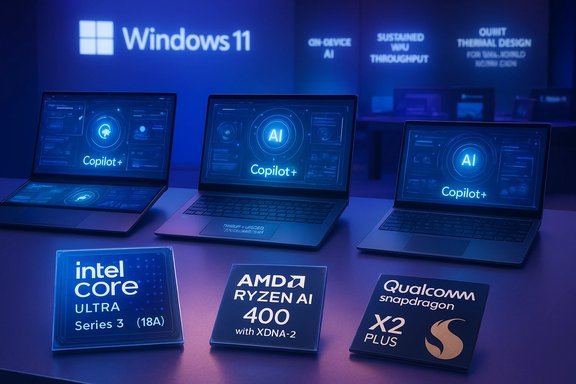
CES has long been a stage for future-facing hardware, but the 2026 show stood out for one unambiguous theme: AI moved from novelty to platform requirement. OEMs highlighted devices that include dedicated Neural Processing Units (NPUs), on-device acceleration for Copilot+ experiences, and new designs intended to reshape how people interact with Windows. This wave is driven by three concurrent forces: next‑generation silicon from Intel, AMD, and Qualcomm; OEMs integrating NPUs into everyday notebooks and novel form factors; and Microsoft’s Copilot+ program, which sets baseline hardware thresholds for local AI experiences.
The announcements break down into two broad categories: (1) new Copilot+ Windows 11 PCs and form factors — thin-and-light laptops, dual-screen machines, and even a full PC inside a keyboard — and (2) next-generation AI‑first silicon that supplies the raw NPU throughput many of those features require. This article reviews the most important reveals, verifies the big technical claims, and offers critical analysis for buyers, IT leaders, and enthusiasts weighing the real-world impact of these devices.
Caveats and verification: Intel’s performance metrics (e.g., up to 50 TOPS in top SKUs and claims of dramatic gaming and battery gains) derive from company testing and partner demos; independent public benchmarks will be necessary to validate sustained real‑world performance under typical workloads.
Caveats: Like Intel, AMD’s TOPS figures are vendor‑reported and reflect particular INT8 workloads; real‑world performance will depend on thermal envelope, memory bandwidth, and software optimization.
Risks: The perennial challenge for Arm Windows remains application compatibility and emulation overhead for x86/x64 apps. Supplier memory and component costs can also inflate final retail prices, limiting the democratization Qualcomm aims for.
Source: Windows Blog CES 2026: Showcasing new Windows 11 PC innovations across the ecosystem
 Background / Overview
CES has long been a stage for future-facing hardware, but the 2026 show stood out for one unambiguous theme: AI moved from novelty to platform requirement. OEMs highlighted devices that include dedicated Neural Processing Units (NPUs), on-device acceleration for Copilot+ experiences, and new designs intended to reshape how people interact with Windows. This wave is driven by three concurrent forces: next‑generation silicon from Intel, AMD, and Qualcomm; OEMs integrating NPUs into everyday notebooks and novel form factors; and Microsoft’s Copilot+ program, which sets baseline hardware thresholds for local AI experiences.The announcements break down into two broad categories: (1) new Copilot+ Windows 11 PCs and form factors — thin-and-light laptops, dual-screen machines, and even a full PC inside a keyboard — and (2) next-generation AI‑first silicon that supplies the raw NPU throughput many of those features require. This article reviews the most important reveals, verifies the big technical claims, and offers critical analysis for buyers, IT leaders, and enthusiasts weighing the real-world impact of these devices.
What OEMs announced: new Copilot+ PCs and daring form factors
The headline product families
OEMs used CES to position refreshed families around Copilot+ readiness and distinct user needs: Acer’s Swift and Predator lines, ASUS’s Zenbook Duo and ROG Zephyrus Duo, Dell’s revived XPS and Alienware refreshes, HP’s EliteBook/EliteBoard and OmniBook lines, Lenovo’s Aura/ThinkPad lineup, and Samsung’s Galaxy Book6 series. These launches emphasize displays, battery life, thermals, and — crucially — on‑device AI acceleration. The Windows Blog roundup captured the breadth of these partner announcements and framed them as a coordinated ecosystem push.- Acer: The Swift 16 AI and Predator Helios Neo 16S AI target creators and gamers respectively, with processors from Intel’s new Series 3 family and discrete NVIDIA GPUs in gaming SKUs. Acer claimed the Swift 16 AI ships with what it calls the world’s largest haptic touchpad as a differentiator. Independent CES hands‑on coverage confirms the size and feature set, though this remains a marketing claim rather than a third‑party standard.
- ASUS: The Zenbook DUO doubles down on integrated dual OLED touchscreens plus a detachable keyboard to enable laptop, dual‑screen, and desktop-like workflows with an on‑device NPU for real‑time translation and content generation. The ROG Zephyrus Duo brings the dual-screen concept to premium gaming with discrete RTX‑class graphics and Copilot+ positioning.
- Dell: A strategic revival of XPS with XPS 14 and XPS 16 emphasizes aluminum CNC chassis, better thermals, and what Dell calls “industry‑leading battery life”; Alienware updated displays and hinted at new AMD desktop CPUs in Area‑51 systems. The company also previewed two new UltraSharp monitors, including a 52‑inch 6K Thunderbolt hub aimed at creators and professionals.
- HP: The EliteBook X G2 Series and the HP EliteBoard G1a keyboard PC were among the most talked‑about reveals. HP marketed the EliteBoard as the world’s first full AI PC built into a keyboard — a thin, portable Copilot+ device powered by AMD Ryzen AI 300‑series silicon and an NPU rated above 50 TOPS. HP’s own press materials and multiple outlets corroborate the claims and list March availability for enterprise configurations. Independent coverage urges buyers to pilot such novel form factors in enterprise settings to validate battery life, manageability, and ergonomic tradeoffs.
- Lenovo and Samsung: Lenovo showcased Aura Edition ThinkPad and Yoga lines with AI‑forward features and new hinges, while Samsung’s Galaxy Book6 family delivered slimmer designs with integrated NPUs for secure on‑device AI, and an Ultra‑powerful Galaxy Book6 Ultra SKU sporting discrete NVIDIA graphics.
Notable design contrasts and practical tradeoffs
OEMs prioritized a few consistent areas:- Displays and UX: OLED touch, high refresh rates, anti‑glare coatings, and dual-screen innovations for multitasking.
- Thermals with sustained AI workloads: Devices now advertise sustained NPU throughput rather than bursty numbers; OEMs emphasize cooling and power‑management strategies to deliver consistent AI performance.
- Portability vs. power: The EliteBoard G1a and Snapdragon X2‑based Snapdragon machines tilt toward extreme portability and battery life, while gaming and creator SKUs still prioritize discrete GPUs and higher TGPs.
- Serviceability and enterprise features: HP emphasized module access and repairability for the EliteBoard; Dell and Lenovo continue to push Pro/Enterprise variants with security and manageability features.
The silicon trifecta: Intel, AMD, Qualcomm — what they revealed and why it matters
Intel Core Ultra Series 3 (Panther Lake) — the U.S. 18A milestone
Intel unveiled the Core Ultra Series 3, marketed as the first compute platform built on Intel’s 18A process (Panther Lake). Intel says Series 3 adds new X9/X7 classes with up to 16 CPU cores, expanded integrated Arc graphics, and NPUs large enough to underpin many Copilot+ features. Intel confirmed pre‑orders and a global availability date for the first laptops as Jan. 27, 2026. These claims are corroborated by Intel’s newsroom and press releases, and by multiple outlets covering CES. Why this matters: Intel’s 18A manufacturing milestone represents a tangible step in its foundry roadmap and signals improved energy efficiency and integrated AI capability for mainstream Windows laptops. The Series 3 family’s combination of CPU, GPU, and NPU improvements aims to deliver a balanced platform for gaming, productivity, and on‑device inference without leaning on discrete accelerators for many everyday AI tasks.Caveats and verification: Intel’s performance metrics (e.g., up to 50 TOPS in top SKUs and claims of dramatic gaming and battery gains) derive from company testing and partner demos; independent public benchmarks will be necessary to validate sustained real‑world performance under typical workloads.
AMD Ryzen AI 400 Series — x86 with aggressive NPU throughput
AMD answered with the Ryzen AI 400 family, built on Zen 5 and XDNA‑2 NPUs, promising up to 60 TOPS in higher SKUs and a refreshed lineup that spans consumer, pro, and Max+/developer‑oriented chips. AMD’s CES messaging emphasized a “full‑stack” AI approach: CPU, GPU, and a robust NPU on a single die, optimized for Windows Copilot+ tasks, and targeting thin‑and‑light laptops through to workstations. Industry press and AMD’s own newsroom echo this positioning. Why this matters: AMD’s 60 TOPS headline and refined integrated graphics (Radeon 800M series) aim to make powerful local AI available across mainstream notebooks and gaming machines. OEMs signaled immediate support, with designs announced across the big brands.Caveats: Like Intel, AMD’s TOPS figures are vendor‑reported and reflect particular INT8 workloads; real‑world performance will depend on thermal envelope, memory bandwidth, and software optimization.
Qualcomm Snapdragon X2 Plus — bringing 80 TOPS to more mainstream Arm Windows PCs
Qualcomm expanded its Windows‑focused Snapdragon X family with the Snapdragon X2 Plus, a mid‑tier part that retains an 80 TOPS Hexagon NPU (matching the higher X2 Elite series) while scaling CPU/GPU resources to hit thinner, lower‑cost device targets. Multiple outlets at CES confirmed the 80 TOPS figure and the intention to push Copilot+ capabilities into more affordable laptops. Why this matters: By putting 80 TOPS NPUs into mainstream SKUs, Qualcomm effectively lowers the barrier for on‑device AI across many price tiers. That has ecosystem implications: Windows on Arm devices can now meaningfully compete on AI capabilities and battery life, provided software and driver ecosystems continue to improve for Arm‑native performance.Risks: The perennial challenge for Arm Windows remains application compatibility and emulation overhead for x86/x64 apps. Supplier memory and component costs can also inflate final retail prices, limiting the democratization Qualcomm aims for.
Verifying the big claims — what’s marketing and what’s likely real?
- “World’s largest haptic touchpad” (Acer Swift 16 AI): Acer claims the Swift 16 AI’s haptic touchpad is the largest among comparable commercial notebooks; independent hands‑on coverage confirms a notably large haptic surface but treats the “world’s largest” label as a vendor marketing assertion that depends on the specific competitor set and measurement criteria. Treat this as an OEM differentiator, not a standard industry metric.
- Intel Series 3 availability and 18A process: Intel’s press materials state Series 3 chips are built on Intel 18A and list pre‑order and availability dates (pre‑orders Jan. 6; wide availability Jan. 27, 2026). These dates and core claims are verifiable directly from Intel’s newsroom and accompanying press kits. Independent press coverage corroborates the release timing.
- Snapdragon X2 Plus 80 TOPS: Multiple respected outlets reported Qualcomm’s CES briefing and detailed the 80 TOPS Hexagon NPU figure. That number is consistent across Qualcomm’s PR and third‑party reporting, and it’s a pivotal specification in OEM Copilot+ qualification.
- HP EliteBoard G1a “full AI PC in a keyboard” with >50 TOPS: HP’s press releases and multiple outlets confirm the EliteBoard’s specs and CES Innovation Award recognition. The claim of a full PC inside a keyboard is accurate in the sense that the device contains a CPU, NPU, RAM, storage, and I/O — nevertheless, label it a novel form factor rather than an unqualified revolution; enterprises should pilot it to evaluate TCO, ergonomics, and manageability.
Real‑world implications: Who benefits, and where are the tradeoffs?
Consumers and creators
- Benefits: Faster local content creation (AI‑assisted editing, background removal, inpainting), lower latency for Copilot interactions, improved privacy for on‑device inference, and longer battery life in Arm designs that emphasize efficiency.
- Tradeoffs: Real gains depend on app optimizations; buyers should prioritize OEMs and SKUs that reveal sustained performance figures and independent reviews rather than raw TOPS or peak bursts.
Enterprise and IT
- Benefits: Devices like the EliteBoard promise simplified provisioning and rapid hot‑desk setup, and Copilot+ features can enhance productivity and security when coupled with enterprise management stacks.
- Tradeoffs and risks:
- Manageability: Novel form factors require validation for Endpoint Manager, Windows Update cadence, firmware patching, and asset lifecycle.
- Security: On‑device AI reduces cloud exposure, but telemetry, data residency, and DLP integration must be re‑evaluated.
- TCO: Advanced NPUs and higher memory capacities raise procurement costs; however, modular, serviceable designs can reduce long‑term replacement costs if executed well.
Developers and ISVs
- Benefits: New silicon families unlock faster local model inferencing and more versatile agentic features.
- Challenges: Fragmentation across x86 and Arm, and across varying NPU architectures, will complicate testing and distribution. Investment in cross‑platform support, quantization strategies, and hardware‑aware optimizations will be essential.
Security, privacy and compliance — what to watch
- On‑device AI reduces the need to send sensitive data to the cloud, improving privacy for many workloads. However, the security model shifts: ensuring NPUs and firmware are patched, securing local model weights, and integrating DLP with Copilot workflows become critical.
- Vendors are pushing hardware security stacks (e.g., HP Wolf Security, Qualcomm Guardian). IT leaders must verify attestation mechanisms, update channels, and enterprise support options before large‑scale rollouts.
Buying guidance and practical next steps
- Prioritize real‑world tests: For any Copilot+ claim, demand independent reviews that measure sustained NPU throughput, battery life under representative workloads, thermals, and latency for target features.
- Match the device to the workload:
- Heavy creators and gamers: favor Intel Series 3 or AMD Ryzen AI 400 SKUs with robust GPU and thermal headroom.
- Mobile workers and long battery life: consider Qualcomm X2 Plus Arm designs or Snapdragon/Arm SKUs with proven battery efficiency.
- Fleet simplicity and hot‑desking: pilot HP EliteBoard‑style keyboard PCs for manageability and rapid deployment scenarios.
- Verify enterprise support: Confirm Windows 11 Pro licensing, OEM driver support windows, and how each device integrates with endpoint management tooling.
- Wait for independent benchmarks: Early CES demos are promising, but independent testing reveals the real story about throttling and day‑to‑day performance.
Risks and unanswered questions
- Software and ecosystem readiness: The value of on‑device NPUs depends on broad app support and hardware‑aware optimization. In the near term, the best experiences will be with Microsoft‑validated Copilot features and vendor‑co‑developed apps.
- Marketing vs. reality: OEMs will brand devices with “Top” or “first” labels — many of these are accurate by vendor criteria but should be parsed carefully (e.g., “world’s largest touchpad” or “world’s first keyboard PC”) and validated for your use case.
- Fragmentation: Multiple CPU and NPU architectures increase developer complexity and may delay feature parity across device classes.
- Supply-chain and pricing pressure: Memory inflation and component shortages could keep premium Copilot+ configurations expensive through 2026.
The bottom line: why CES 2026 matters for Windows users
CES 2026 was not just a parade of concept devices; it delivered a coordinated wave of market‑ready Copilot+ hardware and next‑generation silicon. Intel’s Core Ultra Series 3 validates the high end of x86 laptop design built on a U.S. 18A process, AMD’s Ryzen AI 400 series raises integrated NPU performance across mainstream and high‑performance SKUs, and Qualcomm’s Snapdragon X2 Plus democratizes an 80 TOPS NPU for more affordable Arm‑based Windows PCs. Meanwhile, OEMs are experimenting with meaningful form factors — from dual‑screen workhorses to the HP EliteBoard keyboard PC — that will force IT teams and consumers to re‑examine how they define endpoints. For buyers and IT decision‑makers, the smartest initial move is cautious optimism: pilot the new hardware in real workflows, demand independent benchmarks that measure sustained performance, and prioritize vendors that commit to long‑term driver and firmware support. If those checks pass, the Windows ecosystem’s new Copilot+ wave promises faster, more private, and more capable PCs that will reshape workflows across consumer, creator, and enterprise contexts.Conclusion
The CES 2026 announcements reveal a PC industry that has matured past hype and is building practical, verifiable capability into hardware. By fusing larger on‑device NPUs, more efficient processors, and thoughtful industrial design, partners in the Windows ecosystem are making Copilot+ functionality a tangible value proposition for consumers and businesses alike. The next six to twelve months — when independent reviews roll in and retail SKUs appear — will show which combinations of silicon, chassis, and software deliver truly noticeable improvements for everyday users. Until then, the underlying trend is clear: AI is now a defining axis of PC design, and Windows 11 is positioned as the platform that binds these hardware advances into meaningful user experiences.Source: Windows Blog CES 2026: Showcasing new Windows 11 PC innovations across the ecosystem
