

HP’s CES 2026 keynote was less a string of one-off product updates and more a coordinated strategic pivot: the company positioned itself as a one-stop vendor for the “on-device AI” era, pushing local inference into everything from keyboard-sized desktops to multifunction printers while consolidating and sharpening its gaming and commercial device portfolios. The announcements center on three clear bets — ultra-portable local AI compute, fleet-first manageability, and a unified gaming ecosystem — each with benefits for certain customers and distinct implications IT teams and procurement managers must evaluate before committing to fleet purchases.
HP’s CES message ties together a handful of device-level trends that have been accelerating across the PC industry: NPUs are becoming standard in notebooks, OEMs are experimenting with new form factors to optimize hybrid work, and enterprise management stacks are increasingly expected to handle firmware- and BIOS‑level recovery. HP framed its announcements around the Copilot+ era: devices capable of running meaningful generative and agentic workloads locally, managed centrally by IT, and integrated into office workflows — including printers. The company also used CES to reshape its gaming identity by merging OMEN and HyperX under a single HyperX master brand and to highlight sustainability and repairability as procurement levers for corporate buyers.
Those strengths come with caveats. TOPS figures, TPP numbers, and battery claims all require careful verification in real-world scenarios. Security controls, encrypted-drive workflows, and privacy for on-device Copilot must be validated by IT teams before deployment. For organizations that succeed in piloting these devices and validating policies, HP’s approach could reduce latency, improve data locality, and simplify lifecycle management — but success will depend on disciplined testing, clear procurement terms, and careful governance.
HP’s CES slate is not incremental — it’s a statement of intent for the Copilot+ era. For IT leaders, the opportunity is real, but the work starts with pilots, SKU-level verification, and tight operational controls.
Source: Dataconomy CES 2026: Everything HP announced
 Background / Overview
HP’s CES message ties together a handful of device-level trends that have been accelerating across the PC industry: NPUs are becoming standard in notebooks, OEMs are experimenting with new form factors to optimize hybrid work, and enterprise management stacks are increasingly expected to handle firmware- and BIOS‑level recovery. HP framed its announcements around the Copilot+ era: devices capable of running meaningful generative and agentic workloads locally, managed centrally by IT, and integrated into office workflows — including printers. The company also used CES to reshape its gaming identity by merging OMEN and HyperX under a single HyperX master brand and to highlight sustainability and repairability as procurement levers for corporate buyers.EliteBoard G1a: the “keyboard PC” that reimagines the desktop
What HP announced
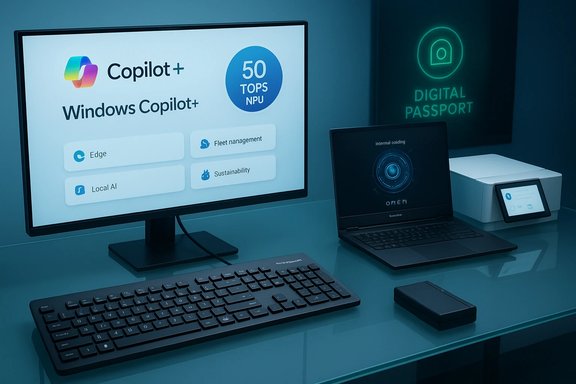
HP introduced the EliteBoard G1a Next Gen AI PC — a product that distills a full Windows Copilot+ PC into the footprint of a standard keyboard. The EliteBoard is explicitly designed for hybrid workers who want a secure, high-performance endpoint they can plug into any monitor and immediately have a complete desktop environment. HP’s materials and early press coverage list the headline specs as: AMD Ryzen AI 300 Series silicon, an integrated NPU delivering over 50 TOPS, up to 64 GB DDR5 RAM, up to 2 TB PCIe 4.0 NVMe storage, a 12 mm profile and a weight of roughly 0.75 kg. The company plans two SKUs: a permanently-attached USB4 cable variant for fixed desktops and a detachable-cable variant with a replaceable ~32 Wh battery for hybrid mobility.Why this matters
The EliteBoard reframes the concept of a desktop. For IT, the appeal is clear: a serviceable, centrally managed endpoint that’s physically small but functionally a full PC. Because it uses local NPU acceleration, Copilot+ features and other AI inference can run without round-tripping to the cloud — lowering latency and improving privacy for sensitive workloads. For hot-desking environments, hoteling, or regulated industries that require data locality, a portable “keyputer” that’s easy to ship, service, and reassign could simplify logistics and reduce mean-time-to-repair.Technical reality check and caveats
- TOPS are a useful shorthand but not a full measure of real-world AI performance. HP’s 50 TOPS figure for the EliteBoard places it above many baseline Copilot+ recommendations, but application performance will depend on model architecture, quantization, memory bandwidth, driver maturity, and the software stack. Treat TOPS as an indicator of capability, not a guarantee of latency or throughput for any particular model.
- Thermals and ergonomics are potential pressure points. Squeezing SoC, NPU, storage, and cooling into a 12 mm keyboard form requires aggressive thermal engineering. HP claims active cooling and TÜV noise certification; independent long-form reviews and sustained-load benchmarks will be the decisive test for whether the EliteBoard can maintain peak NPU performance without unacceptable throttling or surface heat.
- Compatibility with existing peripherals and docking topologies needs validation. The attached-cable SKU trades passthrough ports for simplicity; the detachable variant sacrifices a passthrough for battery mobility. Organizations should verify multi-monitor and peripheral scenarios in pilot programs.
Enterprise implications
For enterprise procurement, the EliteBoard suggests a new axis of choice: replacing fixed towers with portable, centrally managed keyboard PCs that are easier to stage, ship, and service. That can pay off in reduced depot repairs and faster redeployment — but it also shifts how IT thinks about endpoint security, physical asset control, and thermal/operational testing.HyperX consolidation and the HyperX OMEN MAX 16
The strategic move
HP consolidated OMEN and HyperX into a single master brand, HyperX, aiming to simplify the gaming portfolio and align systems, peripherals, and services under a single ecosystem. To inaugurate the consolidated identity, HP unveiled the HyperX OMEN MAX 16, which the company describes as its most thermally ambitious gaming laptop with fully internal cooling and a claimed up to 300 W Total Platform Power (TPP) without external boosters. The Max 16 is positioned to run flagship silicon — including configurations with the NVIDIA GeForce RTX 5090 Laptop GPU — without thermal throttling, according to HP’s specs.Neuro-gaming: brain-sensing headsets
HP also showcased a development partnership with Neurable to explore EEG-equipped gaming headsets that use AI to interpret brain signals in real time. The promise is adaptive game experiences that respond to player focus or stress levels and training tools for esports athletes to measure mental resilience. This is an early-stage area with significant hardware and software complexity.Strengths and immediate questions
- Consolidation under HyperX simplifies branding and could improve cross-product integration: unified tuning software, matched performance profiles, and a consistent accessory ecosystem are practical wins for gamers and IT teams supporting esports houses or gaming labs.
- The 300 W TPP claim is bold and will be scrutinized by reviewers. TPP is a platform-level design number and can be quoted differently from sustained power draw under real workloads. Independent tests are required to validate sustained performance and thermal behavior over extended gaming sessions. Early coverage acknowledges the claim but stresses the need for hands-on verification.
- Neuro-gaming is exciting but nascent. Real-time EEG interpretation for meaningful in‑game adaptation depends on low latency signal processing, robust noise rejection, and clear, actionable integration points inside games. Expect long development cycles and careful privacy considerations before widespread adoption.
EliteBook X G2 Series: one chassis, many processors
What’s new
HP’s EliteBook X G2 Series is notable for offering the same premium chassis across multiple processor architectures (AMD, Intel, Qualcomm). This lets IT standardize on a single mechanical platform while choosing the silicon that best fits workloads. The flagship EliteBook X G2q — a Snapdragon X2 Elite configuration — is claimed to deliver up to 85 TOPS of NPU performance, a figure HP says is the industry’s first for a business notebook at that level. The series also includes features tailored to enterprise IT: smart sensing to extend battery life, quantum-resistant security protocols, and sub-1 kg configurations for extreme portability.Why multi‑architecture matters
Offering AMD, Intel, and Qualcomm options in a single chassis reduces SKU proliferation from a physical design perspective and simplifies docking, docking power delivery, and peripheral compatibility. For software teams, however, it introduces driver and performance variability; line-of-business applications may behave differently on Snapdragon silicon than on x86 parts. That makes pilot testing essential before wide deployment.Verification and caveats
- Qualcomm’s Snapdragon X2 Elite family has been reported to deliver NPU counts in the ~80 TOPS range for top-tier SKUs; HP’s 85 TOPS claim aligns with those figures when measured on the higher-end X2E variants, but the delivered TOPS depends on the exact X2E SKU used and OEM power/thermal limits. Confirm the precise X2E SKU (e.g., X2E-90 versus X2E-84) when validating NPU performance for procurement.
- TOPS parity across vendors does not guarantee consistent application performance across Snapdragon, AMD’s Ryzen AI, and Intel Core Ultra platforms. ISVs and IT must validate driver readiness and optimized inference libraries for each architecture.
OmniBook and OmniStudio: HP’s consumer rebrand and creative hardware
Highlights
HP refreshed its consumer lineup under the OmniBook family and introduced the OmniStudio X 27 All‑in‑One. Standouts include the OmniBook Ultra 14 — billed as the world’s slimmest consumer notebook with the fastest AI performance in its class — and the OmniStudio X 27, the first All‑in‑One to use HP’s “Neo:LED” display with dual 100% color coverage aimed at home creatives. HP reorganized the consumer tiers into OmniBook 3, 5, 7, and X to make buying decisions simpler. The OmniBook 3 16 also carries an aggressive battery claim: up to 45 hours of local video playback in a specific configuration.Consumer implications and sanity checks
- The 45‑hour playback claim is a best-case metric tied to a specific Snapdragon configuration and tightly controlled test conditions. As with other OEM battery numbers, real-world mixed-use endurance will be considerably shorter. Treat the figure as a marketing maximum rather than a general-purpose promise.
- The Neo:LED AIO with professional color coverage is likely attractive for prosumer creatives who want a compact studio, but independent color-calibration testing will be important for color‑critical workflows.
Printers get generative intelligence: HP for Microsoft 365 Copilot
What HP announced
HP is bringing Microsoft Copilot directly to printer touch panels via a Workpath app called “HP for Microsoft 365 Copilot.” The integration turns multifunction printers into active productivity hubs by enabling on-device summarization of scanned documents, automated file naming and routing to OneDrive or SharePoint, and in-place translation. HP says the Workpath app will be available as part of a Workpath Premium bundle in Spring 2026 and requires appropriate Copilot licensing.Enterprise benefits
Embedding Copilot at the scanner reduces the manual steps involved in digitizing physical documents — a real productivity gain for legal, medical, HR, and finance teams. It also keeps sensitive document inference on-premises (when configured that way), potentially reducing exposure compared with routing everything to cloud-only endpoints.Privacy, compliance, and licensing caveats
- Availability will depend on Copilot licensing and tenant configuration. IT teams should confirm entitlement and licensing before planning deployment.
- Data governance questions are central: where exactly does inference occur (on-device vs. cloud), how long are logs retained, and which telemetry is captured by the Workpath app? Organizations in regulated sectors must validate DLP, auditability, and retention settings before enabling Copilot on printers. These details are configurable but require careful review.
Workforce Experience Platform (WXP): BIOS-level remote repair and unified telemetry
New capability
HP’s Workforce Experience Platform added “Out‑of‑Band Remote Connect,” a BIOS-level remote access and repair capability that allows IT to access and control a PC independently of the OS state. This means IT can diagnose and repair devices that won’t boot or have corrupted OS images without shipping hardware back to a depot. WXP also extends unified management to printers and adds facility analytics for meeting rooms.Why it’s consequential
For distributed workforces, reducing mean-time-to-repair (MTTR) matters. Firmware-level repairability is particularly useful for kiosks, branch devices, and remote employees where shipping is slow or expensive. The tighter integration between endpoint manageability and printer fleets also simplifies centralized device oversight.Limitations and security considerations
- BIOS-level access raises security questions. Organizations must ensure strong role-based access controls, auditing, and secure channels for remote BIOS interaction. Misconfigured or overly permissive access could become an attack surface; HP pairs WXP with HP Wolf Security, but verification of administrative controls is mandatory.
- Encrypted drives and TPM-protected systems require special handling. Verify how WXP interacts with BitLocker, TPM locks, and encrypted payloads to avoid accidental data exposure during remote repair.
New peripherals and sustainability moves
HP introduced several accessories aimed at hybrid workers and sustainability goals. Notable entries include an HP Ultra‑Fast Scroll Wireless Mouse 780M that uses a supercapacitor for ultra-quick charging instead of a conventional battery, HP Poly Studio Apps for unified peripheral management, a compact 65 W GaN charger, and sustainably sourced backpacks. The company also highlighted a “HP Digital Passport,” a QR-based device‑serial hub that surfaces a device’s sustainability story and onboarding metadata. HP reiterated that more than five billion pounds of reused, recycled, or renewable materials have been used in products and packaging since 2019.Sustainability and repairability as procurement levers
HP emphasized serviceability — replaceable batteries, accessible RAM and storage — and the Digital Passport as tools to support circularity and asset lifecycle transparency. These are practical differentiators for organizations with ESG procurement goals and can translate into lower total cost of ownership (TCO) if paired with disciplined repair-first policies.Risks, unknowns, and what to verify in procurement pilots
HP’s CES slate is both ambitious and pragmatic: ambitious in pushing AI to the edge across form factors, pragmatic in pairing new hardware with fleet management tools. Still, several important risks and verification steps are required:- Validate the exact NPU SKU and the power/thermal limits enforced by OEM firmware for each model. Different Snapdragon X2 Elite or AMD Ryzen AI variants will yield different TOPS numbers. Ask vendors for SKU-level details and test with representative models.
- Obtain independent benchmarks for the real workloads you care about (speech-to-text, large-language-model local inference, on-device vision tasks). TOPS and marketing numbers are not substitutes for application-level testing.
- Pilot the EliteBoard G1a under your typical user scenarios (multi-monitor setups, conferencing workloads, simultaneous Copilot tasks) to validate thermal performance, noise, and peripheral compatibility. Confirm test results across both attached-cable and battery SKUs.
- Confirm firmware-level recovery interactions with drive encryption. Test WXP’s Out‑of‑Band Remote Connect with BitLocker and TPM policies in a controlled environment before relying on it for remote repairs.
- Clarify privacy settings and data flows for HP for Microsoft 365 Copilot on printers. Ensure the configuration aligns with corporate retention, DLP, and auditing policies, and confirm licensing requirements for Copilot and Workpath Premium.
- For HyperX OMEN MAX 16 and the 300 W TPP claim, require extended thermal and sustained gaming tests from review units and internal QA before deploying in esports labs or performance-sensitive contexts.
A practical rollout checklist for IT teams
- Identify pilot cohorts with representative workloads (content creators, analysts, heavy videoconference users) and include at least one pilot for EliteBoard G1a and one for EliteBook X G2 Snapdragon variants.
- Request SKU-level silicon and NPU specifications and obtain power/thermal profiles from HP for each SKU you plan to test.
- Run application‑level benchmarks (not just TOPS): local LLM latency, simultaneous transcription + video conference, image inference throughput, and NVMe I/O under sustained loads.
- Test WXP firmware recovery with encrypted drives under IT supervision and validate audit trails and access controls.
- Evaluate Copilot-on-printer workflows with red-team privacy reviews and confirm tenant entitlement and licensing.
- Measure real-world battery life under mixed workloads for any mobility-bound SKUs; treat vendor battery numbers as laboratory maxima.
Conclusion
HP’s CES 2026 lineup is a coherent, platform-level play. The company is betting that the next wave of Windows devices will be defined less by marginal CPU/GPU gains and more by where and how AI runs — locally, on managed endpoints, and integrated into everyday workflows including printers. The EliteBoard G1a is the boldest statement: a portable, serviceable PC that reframes the desktop as a movable asset. The EliteBook X G2’s multi‑architecture approach and the OmniBook consumer rebrand demonstrate a pragmatic product strategy that fabrics choice around a consistent design language. On the platform side, WXP’s BIOS-level repair features and printer Copilot integrations show HP is serious about fleet manageability and workflow productivity.Those strengths come with caveats. TOPS figures, TPP numbers, and battery claims all require careful verification in real-world scenarios. Security controls, encrypted-drive workflows, and privacy for on-device Copilot must be validated by IT teams before deployment. For organizations that succeed in piloting these devices and validating policies, HP’s approach could reduce latency, improve data locality, and simplify lifecycle management — but success will depend on disciplined testing, clear procurement terms, and careful governance.
HP’s CES slate is not incremental — it’s a statement of intent for the Copilot+ era. For IT leaders, the opportunity is real, but the work starts with pilots, SKU-level verification, and tight operational controls.
Source: Dataconomy CES 2026: Everything HP announced
