

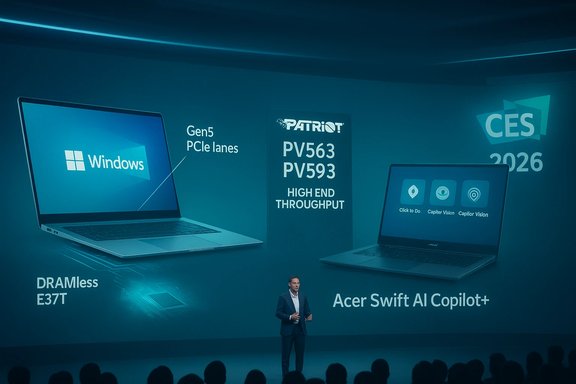
Phison’s E37T, Patriot’s DRAMless speedster, and Acer’s new Copilot+ Swift lineup together sketch the opening act of CES 2026: a clear industry push to marry blistering PCIe Gen5 throughput with lower power, smaller form factors, and on-device AI. The headlines — a DRAMless Phison controller that promises near-flagship Gen5 speeds, Patriot claiming a “world’s fastest” DRAMless SSD, and Acer refreshing its Swift Copilot+ family with Intel Core Ultra Series 3 silicon — are more than isolated product stories; they reveal vendor strategies shaping laptops, handhelds, and mainstream SSD pricing in 2026.
Two verification points matter for buyers:
Acer’s Swift Copilot+ lineup demonstrates how OEMs will pair these storage advances with on-device AI to produce snappier, more intelligent Windows experiences. The combination matters: local AI workloads benefit from low-latency storage when models or cached assets are stored on-device, and fast storage complements NPUs by shortening data fetch times.
However, the promise will resolve into tangible value only after widespread, independent testing and the usual maturity cycle of firmware and host integration. Early 2026 is the beginning of a multi-quarter transition: expect initial product launches, followed by firmware stabilization, wider NAND supply decisions, and measured performance reviews that separate marketing peaks from reliable real-world behavior.
Yet the most important next step is objective validation. Benchmarks covering sustained throughput, mixed workloads, and thermal behavior will determine where these new parts truly fit in the PC ecosystem. For now, the announcements are an encouraging sign that vendors are solving the last practical barriers to high-speed storage in compact, battery-powered systems — but buyers should temper excitement with scrutiny and demand measured, repeatable results.
Source: TechPowerUp Phison's New SSD Controllers Hands-on: E37T is the Fastest DRAMless Controller | TechPowerUp}
Source: TechPowerUp Acer Announces New Lineup of Premium Swift AI Copilot+ PCs
Source: TechPowerUp Patriot Memory Brings Swanky New SSDs to CES 2026, World's Fastest DRAMless SSD | TechPowerUp}
 Background
Why CES 2026 matters for storage and AI PCs
CES has evolved into a platform where component makers and OEMs preview how new silicon, controllers, and system-level AI features will converge in commercially available devices. This year’s themes included energy-aware PCIe Gen5 storage for thin-and-light and handheld systems, plus a second wave of Copilot+ PC designs that embed on-device AI capabilities — from OEM-optimized NPUs to system-level integration with Copilot on Windows. These trends affect Windows users directly: faster storage reduces load times and improves data throughput for creative and AI workloads, while Copilot+ devices aim to offload latency-sensitive AI tasks to local hardware.What was announced — the essentials
Phison E37T: DRAMless Gen5, high throughput, low power
Phison unveiled the E37T PCIe Gen5 controller as a cost-optimized, DRAM-less Gen5 solution aimed at notebooks, handhelds, and compact systems. Phison’s materials and independent hands-on reporting place the E37T’s peak numbers near the top of Gen5 DRAM-less designs: up to ~14.7 GB/s sequential reads, ~13.0 GB/s sequential writes, and up to 2,000K 4KB random IOPS, while keeping active power under ~2.3 W. Phison frames the E37T as a four-channel, DRAMless design that supports up to 4800 MT/s NAND and targets compact M.2 2280/2242/2230 form factors. Early demos shown at CES produced live benchmark runs that tracked Phison’s claims closely.Patriot PV563 and PV593: DRAMless speeds and mainstream Gen5 variants
Patriot showcased the PV563 — a DRAMless PCIe Gen5 x4 M.2 SSD — and the higher-end PV593 at trade events. The PV563 was positioned as “one of the first” or “the world’s first” DRAMless Gen5 drives to reach read numbers in the 14 GB/s class (Patriot’s claims: around 14,000 MB/s read and 11,500 MB/s write). The PV593 is a DRAM-equipped sibling with similar read figures and stronger sustained writes (claimed up to ~13,000 MB/s) and higher random IOPS targets. Patriot’s demonstrations emphasize cost-competitive high-end throughput, enabled by Maxiotek or similar value-oriented controller silicon paired with modern 3D TLC NAND.Acer’s Swift AI Copilot+ refresh: Intel Core Ultra Series 3 and Copilot+ features
Acer announced a refreshed Swift AI Copilot+ lineup powered by Intel Core Ultra Series 3 processors, including headline models like the Swift 16 AI (SF16-71T) and variants across Swift Edge and Swift Go families. Key product claims include haptic touchpad innovation, 3K OLED touch displays, per-key backlighting, and tight integration with Copilot on Windows via Copilot+ experiences (e.g., Click to Do, Copilot Voice, and Copilot Vision features). Acer’s emphasis is on premium thin-and-light design with on-device AI capabilities and broad regional availability in early 2026.Technical analysis and verification
Phison E37T — architecture and real trade-offs
Phison positions the E37T as a refined microarchitecture for Gen5 that trades a DRAM cache and an 8-channel topology (used in flagship parts like the E28) for a leaner 4-channel, DRAMless approach. The claimed advantages are:- Lower active power (sub-2.3 W) that keeps thermals and battery impact manageable in thin laptops and handhelds.
- Single-sided PCB compatibility for smaller form factors like M.2 2230/2242.
- Very high sequential throughput for Gen5 DRAMless silicon, narrowing the gap with DRAM-equipped flagships.
- DRAMless controllers historically rely on host-side or firmware techniques to keep latency low. For workloads with high random-write pressure or sustained mixed I/O, DRAMless designs can thermally or performance-throttle earlier than DRAM-backed parts.
- NAND speed ceilings and thermal throttling will shape real-world gains. A controller capable of 4,800 MT/s NAND access still needs matching flash and a host capable of supplying lane and thermal headroom to sustain those claims.
- Firmware maturity matters. Early firmware on new controllers often needs incremental updates to stabilize corner-case behavior: garbage collection, QD scaling, and power-pacing.
Patriot PV563 claims — marketing vs. measured truth
Patriot’s PV563 is noteworthy because it claims to deliver 14 GB/s read bandwidth without DRAM — a combination that historically sounded unattainable at comparable power budgets. Patriot’s own demonstration claims and third-party reporting support the PV563’s headline read numbers. However, caution is warranted:- “World’s fastest” is a relative marketing claim. It hinges on specific category definitions (e.g., DRAMless PCIe Gen5 M.2 2280/2230 SSDs) and on the metrics used (single-threaded peak sequential vs sustained mixed workloads).
- PR numbers are peak figures. Independent lab verification is necessary to confirm sustained writes, mixed IOPS, and behavior under real workloads (database, VDI, game installs).
- Controller and NAND partner details matter. Patriot’s use of Maxiotek MAP1806 (or similar) positions the PV563 as a value-oriented challengers to Phison E31T/E37T families; performance parity or superiority in certain synthetic tests doesn’t guarantee parity across everyday workloads or long-term firmware support.
Acer’s Copilot+ PCs — hardware + AI stack verification
Acer’s press materials and OEM documentation show consistent feature sets across the Swift AI family: Intel Core Ultra Series 3 choices, OLED 3K displays on higher SKUs, haptic touchpad claims, and wide Copilot integration with Windows 11. Acer’s timeline for availability is explicit (North America Q1/Q2 2026 windows), and the company provides per-model specs (memory, storage, GPU options).Two verification points matter for buyers:
- On-device AI capability depends on processor NPU and OEM firmware: The practical Copilot+ experience (e.g., Click to Do, Copilot Voice responsiveness, Copilot Vision privacy controls) will vary by CPU/NPU configuration and final OEM driver integration.
- Battery life and thermals vs performance: Thin 16-inch chassis promising high-end Ultra X9 processors will face the usual thin-laptop trade-offs; real-world battery life claims (Acer lists long video playback numbers for certain configurations) depend heavily on the chosen display, CPU SKU, and power profile.
What this means for Windows users, builders, and handheld OEMs
For Windows laptop buyers and content creators
- Faster Gen5 DRAMless SSDs broaden options: The E37T and Patriot PV563 enable OEMs to spec Gen5-level transfer rates in thin, single-sided SSDs that fit ultra-slim notebooks and handhelds. For content creators, that translates to faster installs, quicker scratch-disk behavior for exports, and reduced waiting in file-heavy workflows — if thermal and sustained-performance profiles are acceptable.
- Check the whole-system spec sheet, not just sequential numbers: Prioritize drives and systems with measured sustained-write numbers, thermal testing, and reasonable power draw for your use case. For large archive copies or high-frame-rate media ingest, look for drives and systems with proven cooling and firmware updates.
For handheld gaming and portable systems
- Power and thermals reign supreme: DRAMless Gen5 controllers with lower active power make high-end NVMe speeds plausible in M.2 2230 form factors, enabling handheld consoles and gaming PCs to reduce load times dramatically. However, a drive that consumes ~2–4 W under load can still heat a small chassis; host thermal design, firmware power-pacing, and chassis heat dissipation are the gating factors for sustained performance.
- OEM-level calibration will matter: Handheld vendors must test new Gen5 DRAMless drives across real gaming workloads, balancing peak bandwidth for short bursts (level loads, asset streaming) against throttling that could harm experience during long sessions.
For system builders and OEM procurement
- New price-performance tiers open: DRAMless Gen5 controllers reduce BOM complexity and enable lower-cost Gen5 products — valuable for midrange notebooks and new-device categories.
- Firmware and support are procurement items: Buyers should require firmware update channels and clear warranty policies. Early controller-firmware bugs or errata can degrade long-term reliability; insist on vendor commitments for sustained firmware support.
Strengths and opportunities
- Performance-per-watt gains: Phison’s E37T and the Patriot PV563 show that Gen5 throughput is now achievable with constrained power envelopes, unlocking faster devices across more form factors.
- Lower-cost Gen5 pathways: DRAMless designs shrink BOM costs and facilitate integration into single-sided M.2 and compact devices, broadening adoption beyond flagship desktops.
- AI PC momentum: Acer’s Swift AI refresh and Copilot+ positioning underscore how OEMs are aligning hardware, NPU capability, and Windows Copilot functionality — a shift that could materially improve local AI latency and offline capabilities for Windows users.
Risks, unknowns, and caveats
- Marketing-scope ambiguity: Phrases like “world’s fastest DRAMless SSD” depend on narrow categories and peak benchmarking methods; verify claims with independent lab tests before accepting them as universal truths.
- Sustained vs peak performance: Manufacturers often highlight peak sequential numbers measured in synthetic tools. Real-world workloads are mixed and often expose weaknesses not obvious in single-scenario demos.
- Thermal throttling and power profiles: Compact systems may force drives into power-limited states. A 14 GB/s peak is useful for short bursts, but if a drive drops sharply under sustained writes, the practical benefit for video edits or bulk transfers diminishes.
- Firmware maturity: New controller families commonly receive multiple firmware revisions in the months after launch; early adopters may face teething issues.
- Channel and NAND variability: Drive-level performance varies by the chosen NAND die geometry, vendor, and capacity. A drive model using slower or cheaper NAND may not match demo units that used best-available flash.
Practical buying guidance (for WindowsForum readers)
- Prioritize measured reviews, not just spec sheets.
- Look for sustained write tests, 4K random IOPS at realistic queue depths, and thermal throttling graphs.
- For handheld upgrades, confirm physical compatibility and thermal allowances.
- Many handhelds accept M.2 2230, but chassis heat transfer and OEM power-pacing profiles determine final real-world benefit.
- For laptops, confirm warranty and firmware update paths.
- Choose OEMs or SSD vendors that commit to firmware support and provide easy update tools.
- If you need long-term, sustainable throughput (e.g., video editing, database work), prefer drives and systems with robust thermal solutions and DRAM-backed designs, unless independent tests show parity.
- For Copilot+ PC purchases:
- Evaluate the NPU capacity of the CPU SKU, confirm whether desired Copilot features require cloud or local processing, and test battery life with your typical productivity mix.
Outlook: where this wave leads
The E37T and similar DRAMless Gen5 controllers are part of a broader democratization of high-end storage performance: performance previously reserved for flagship DRAM-backed controllers is now within reach of thinner, lower-cost systems. Patriot’s PV563 pushes the same narrative from another angle — racing to deliver Gen5 throughput at aggressive price points.Acer’s Swift Copilot+ lineup demonstrates how OEMs will pair these storage advances with on-device AI to produce snappier, more intelligent Windows experiences. The combination matters: local AI workloads benefit from low-latency storage when models or cached assets are stored on-device, and fast storage complements NPUs by shortening data fetch times.
However, the promise will resolve into tangible value only after widespread, independent testing and the usual maturity cycle of firmware and host integration. Early 2026 is the beginning of a multi-quarter transition: expect initial product launches, followed by firmware stabilization, wider NAND supply decisions, and measured performance reviews that separate marketing peaks from reliable real-world behavior.
Conclusion
CES 2026’s headlines around Phison’s E37T, Patriot’s DRAMless PV563, and Acer’s Swift Copilot+ family point to a near-term ecosystem where Gen5 speeds and on-device AI trickle down into mainstream slim laptops and handhelds. The technical gains — especially the possibility of Gen5-class throughput with low active power and single-sided SSDs — are meaningful for Windows users who want faster, more capable mobile devices.Yet the most important next step is objective validation. Benchmarks covering sustained throughput, mixed workloads, and thermal behavior will determine where these new parts truly fit in the PC ecosystem. For now, the announcements are an encouraging sign that vendors are solving the last practical barriers to high-speed storage in compact, battery-powered systems — but buyers should temper excitement with scrutiny and demand measured, repeatable results.
Source: TechPowerUp Phison's New SSD Controllers Hands-on: E37T is the Fastest DRAMless Controller | TechPowerUp}
Source: TechPowerUp Acer Announces New Lineup of Premium Swift AI Copilot+ PCs
Source: TechPowerUp Patriot Memory Brings Swanky New SSDs to CES 2026, World's Fastest DRAMless SSD | TechPowerUp}
