

Micron’s new 3610 NVMe SSD shifts the client storage conversation by delivering PCIe Gen5 bandwidth, G9 QLC density and a single-sided M.2 2230 4TB option — a combination aimed squarely at thin-and-light laptops, AI-capable PCs and compact devices that demand both capacity and low thermal/power footprints.
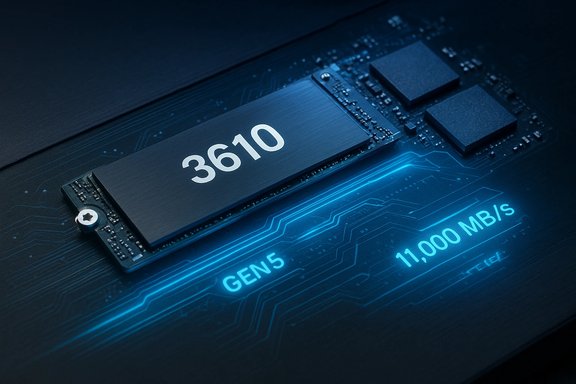
The Micron 3610 is announced as the industry’s first PCIe Gen5 G9 QLC client SSD, positioned between Micron’s high‑end Gen5 4600 series and more value-oriented Gen4 products. Micron’s own materials list headline figures of up to 11,000 MB/s sequential read, 9,300 MB/s sequential write, and random I/O peaks around 1.5M IOPS (read) and 1.6M IOPS (write), with capacities offered in 1 TB, 2 TB and 4 TB across M.2 2230, 2242 and 2280 form factors. Independent press coverage confirms Micron’s claims and highlights the product’s practical differentiators: the 3610 brings Gen5 throughput to a QLC-based client segment and uniquely offers 4 TB in a single-sided M.2 2230 package — a form factor especially attractive to ultra‑thin laptops, handhelds and embedded systems where PCB thickness and thermal design are constrained. Why this matters now: PC OEMs are rapidly integrating on‑device AI features, richer media workflows and higher-resolution assets that pressure storage latency, throughput and capacity. The Micron 3610 attempts to democratize Gen5 performance — historically a premium, desktop- or data‑center‑centric capability — into mainstream client platforms by pairing Gen5 bandwidth with lower‑cost QLC NAND and a DRAM‑less design that leverages host memory buffer (HMB) and aggressive power states.
Source: TechPowerUp Micron Launches New 3610 SSDs, World's First Gen 5 G9 QLC SSD for Client Computing | TechPowerUp}
 Background
The Micron 3610 is announced as the industry’s first PCIe Gen5 G9 QLC client SSD, positioned between Micron’s high‑end Gen5 4600 series and more value-oriented Gen4 products. Micron’s own materials list headline figures of up to 11,000 MB/s sequential read, 9,300 MB/s sequential write, and random I/O peaks around 1.5M IOPS (read) and 1.6M IOPS (write), with capacities offered in 1 TB, 2 TB and 4 TB across M.2 2230, 2242 and 2280 form factors. Independent press coverage confirms Micron’s claims and highlights the product’s practical differentiators: the 3610 brings Gen5 throughput to a QLC-based client segment and uniquely offers 4 TB in a single-sided M.2 2230 package — a form factor especially attractive to ultra‑thin laptops, handhelds and embedded systems where PCB thickness and thermal design are constrained. Why this matters now: PC OEMs are rapidly integrating on‑device AI features, richer media workflows and higher-resolution assets that pressure storage latency, throughput and capacity. The Micron 3610 attempts to democratize Gen5 performance — historically a premium, desktop- or data‑center‑centric capability — into mainstream client platforms by pairing Gen5 bandwidth with lower‑cost QLC NAND and a DRAM‑less design that leverages host memory buffer (HMB) and aggressive power states. What the Micron 3610 actually delivers
Key specifications and claimed benefits
- Interface: PCIe® Gen5 x4, NVMe.
- NAND: Micron G9 QLC (high‑density 3D QLC NAND).
- Peak sequential performance: Up to 11,000 MB/s read and 9,300 MB/s write.
- Random I/O: Up to 1.5M IOPS read and 1.6M IOPS write (manufacturer figures).
- Form factors and capacities: M.2 2230/2242/2280 in 1 TB / 2 TB / 4 TB configurations, with the 4 TB option available in single‑sided 2230.
- Architecture: DRAM‑less controller that uses HMB + DEVSLP for lower power and to fit thin form factors. Micron advertises ~43% better performance per watt vs Gen4 TLC in comparable scenarios.
Product positioning and use cases
Micron positions the 3610 as a client SSD for the AI era — optimized for fast boot, instant app launches, model caching and media workflows in thin, fanless devices. The marketing emphasizes on‑device AI readiness, citing the ability to load large models (Micron’s statement references a 20‑billion‑parameter model load in under three seconds) and better PCMark 10 scoring compared to Gen4 QLC parts. These are aggressive positioning statements intended to appeal to OEM designers and enterprise buyers planning devices with enhanced local AI capabilities. Those performance/AI model claims should be read as vendor demonstrations until independent testing validates them in real systems.Technical context: Gen5 + QLC + DRAM‑less — the tradeoffs
What Gen5 adds
PCIe Gen5 roughly doubles raw per‑lane bandwidth relative to Gen4, enabling sequential throughput and peak IOPS that were previously the domain of data‑center drives. For client devices, this translates to shorter app and game load times, faster file transfers and improved streaming of large assets (textures, models) from local storage. The challenge is turning peak throughput into sustained, thermally‑practical performance inside thin, thermally‑constrained chassis. Micron’s approach uses host‑controlled thermal management and low‑power states to balance these demands.Why Micron chose G9 QLC NAND
QLC (quad‑level cell) NAND stores four bits per cell and offers higher density and lower cost per gigabyte than TLC, but historically at the expense of endurance and sustained write performance. Micron’s G9 QLC is the company’s advanced 3D QLC process aimed at improving density while narrowing the endurance and performance gap through firmware optimization and host integration. For OEMs and system integrators, QLC enables higher OEM‑side storage capacities (e.g., 4 TB in 2230) without the BOM increase of TLC-based Gen5 drives. Micron claims the 3610 balances those tradeoffs with intelligent firmware, thermal control and targeted workload optimization.DRAM‑less controllers, HMB and real‑world behavior
Removing onboard DRAM reduces BOM cost and board area, enabling single‑sided and 2230 designs. DRAM‑less controllers use the Host Memory Buffer (HMB) to cache lookup tables in system memory, but this model shifts some latency and reliability considerations to the platform and firmware coordination layers. DRAM‑less Gen5 controllers can be highly efficient for read-heavy, bursty workloads, but they can underperform DRAM‑backed designs under sustained mixed or heavy random‑write pressure. Recent industry coverage around DRAM‑less Gen5 controllers emphasizes the gains for thin devices while cautioning that sustained throughput and firmware maturity remain the critical metrics to validate in independent tests. Community and systems engineering discussions reinforce those caveats: WindowsForum‑style analysis and procurement guidance note the importance of sustained‑write testing, thermal graphs and firmware update commitments before committing new SSDs into production thin‑client designs. Those community threads also warn that marketing peak numbers often reflect short bursts on optimized test rigs rather than long mixed workloads in consumer systems.Strengths: what Micron gets right with the 3610
- Capacity in constrained spaces. The 4 TB single‑sided M.2 2230 option is a genuine OEM enabler for ultra‑thin laptops, tablets and compact embedded systems that need large local storage without sacrificing height or thermal headroom. Micron’s engineering to place high density in 2230 is a tangible win for device designers and for end users who require large local assets.
- Gen5 bandwidth made accessible. By combining Gen5 PHYs with a QLC NAND economy and a DRAM‑less controller, Micron brings Gen5 peak throughput into form factors and price classes previously off limits. This lowers the entry barrier for faster boot times, quicker app loads and improved responsiveness in mainstream devices.
- Power efficiency narrative. Micron emphasizes improved performance per watt (quoted around 43% relative to Gen4 TLC in selected tests). For battery‑sensitive devices, lower active power and DEVSLP support can extend usable runtime during everyday workflows. If validated in independent testing, this would be an important competitive advantage for ultrabook and handheld OEMs.
- Security features. The 3610 ships with modern client security capabilities such as TCG Opal, DOE and DICE, which are meaningful for OEMs targeting enterprise and regulated markets that require stronger device identity and secure provisioning.
Risks, unknowns and practical caveats
Endurance and long‑term reliability
QLC’s inherent endurance limitations remain a practical reality. While Micron asserts firmware and controller improvements mitigate QLC weaknesses for "mainstream client workloads," buyers should demand explicit endurance (TBW) figures for the specific capacities they intend to deploy. Without those concrete TBW numbers and third‑party endurance testing, QLC drives remain a tradeoff: superior capacity and cost per GB at the likely expense of lower program/erase cycle headroom compared with TLC. Micron’s marketing language frames the tradeoff as optimized for mainstream client usage, but long‑term reliability in write‑heavy scenarios remains an area requiring validation.Sustained performance vs peak spec
Peak sequential throughput headlines are attractive for SEO and spec sheets, but real users — content creators, developers and prosumers — often care most about sustained write throughput, mixed I/O, and 4K random performance under realistic queue depths. DRAM‑less Gen5 designs can deliver exceptional bursts but may fall back under prolonged workloads. Independent lab validation (sustained‑write tests, thermal throttling curves, mixed‑workload PCMark traces) will be essential to separate marketing peaks from dependable everyday performance. Community guidance strongly recommends waiting for lab reviews that include thermal and long‑duration tests before assuming the 3610 will replace DRAM‑backed drives for write‑intensive tasks.Thermal management in ultra‑thin devices
A small M.2 2230 module that can push Gen5 bandwidth still produces heat under load. Micron’s host‑controlled thermal management and OEM power‑pacing options will be crucial for ensuring sustained performance on fanless designs. OEMs must integrate proper thermal paths (heat spreaders, chassis sinks and firmware power limits) and validate the pairing across target workloads. Failure to do so can result in frequent throttling and an experience worse than a lower‑spec Gen4 TLC drive that sustains moderate throughput without aggressive power‑pacing.Firmware maturity and update channels
New controller families and NAND pairings historically receive multiple firmware updates in the months after launch. Early adopters will want clear OEM or vendor commitments to firmware support, easy update utilities and transparency about errata discovered in initial batches. WindowsForum procurement analyses highlight firmware support as a top‑tier risk item; products with opaque or limited update paths can impose operational risk over deployment lifecycles.Marketing claims that need verification
Micron’s dramatic example about loading a 20‑billion‑parameter AI model in under three seconds is a headline‑grabbing metric but is an example of a vendor demonstration that likely relies on ideal host memory, model quantization, and dataset locality. Such claims should be treated with caution until validated in impartial, repeatable tests that specify host CPU, memory, model format and whether the model was partially cached or quantized. Micron’s press materials present the capability as illustrative of "AI‑ready speed," not as a universal guarantee for all client PCs. Flagged: marketing demo; verify in lab.What OEMs, system builders and enthusiasts should check next
- Confirm TBW/endurance numbers by capacity and ask for real workload endurance testing from Micron or the OEM.
- Require sustained write and mixed I/O benchmarks (not just peak sequential), including long‑duration writes that emulate real tasks such as game installs, media exports and VM workloads.
- Validate thermal integration in target chassis (especially fanless and handheld designs) and insist on OEM thermal test data for the target device.
- Verify firmware update procedures, availability of release notes and OEM support SLAs.
- If deploying at scale, request drive sample units and run platform‑level tests to observe p99/p999 latency behavior and queue‑depth scaling on real workloads.
Where the 3610 fits into the broader Gen5 wave
Micron’s 3610 is part of a broader industry move to push Gen5 into more compact and cost‑sensitive devices. CES‑era products from other vendors (controller vendors and drive makers) are introducing DRAM‑less Gen5 controllers and compact form factor SSDs that prioritize low power and single‑sided designs. Those second‑wave products highlight a clear trend: bringing previously premium Gen5 experience to mainstream devices, while the market sorts out best‑practice firmware, NAND mixing and thermal integration. For Windows users and device buyers, the win is faster devices with bigger local storage; the risk is the usual early‑adopter caveats — firmware churn, variance in sustained throughput across SKUs and the need for careful system integration.Practical buying guidance for WindowsForum readers
- For everyday laptop users who want faster boot times and snappier app responsiveness, the Micron 3610’s Gen5 burst performance and power efficiency promise meaningful real‑world gains, especially in new‑model thin laptops designed with the SSD’s thermal profile in mind.
- For creative professionals who rely on sustained write performance for video exports, scratch disks and large dataset work, wait for independent reviews that show sustained write graphs and thermal throttling behavior before adopting QLC Gen5 as a primary work drive. Prioritize DRAM‑backed drives for write‑heavy workflows until those sustained metrics are proven.
- For OEMs and system integrators, the 4 TB 2230 option is an attractive BOM lever for premium thin devices. However, it’s essential to budget for thermal engineering, firmware QA and clear field update mechanisms to protect long‑term device experience and warranty claims.
Conclusion
The Micron 3610 NVMe SSD is a strategic product: it combines PCIe Gen5 bandwidth, G9 QLC density and a DRAM‑less architecture to deliver a uniquely capable client drive — most notably a 4 TB single‑sided M.2 2230 option. This combination advances the practical deployment of Gen5 speeds into ultra‑thin laptops and AI‑capable client devices and will likely accelerate OEM adoption of Gen5 in mainstream designs. That said, the product’s ultimate value will be decided by sustained‑workload behavior, endurance metrics and firmware maturity in real systems. Peak sequential figures and marketing demos are important but insufficient; independent lab validation, transparent TBW figures and robust OEM thermal and firmware support will determine whether the 3610 becomes a practical standard for mainstream client storage or an interesting early example that requires cautious adoption. WindowsForum readers, system builders and procurement teams are advised to prioritize measured reviews, insist on platform integration data, and treat AI model‑loading claims as illustrative until reproducible in controlled tests.Source: TechPowerUp Micron Launches New 3610 SSDs, World's First Gen 5 G9 QLC SSD for Client Computing | TechPowerUp}
