Chandigarh University Microsoft Skill Center: AI, Cloud & Certifications for Jobs

  • Thread Author
Microsoft’s new Skill Center at Chandigarh University is more than a ribbon-cutting. It is a clear signal that the company sees higher education as a frontline battleground for AI, cloud, and certification-led workforce development in India. For Chandigarh University, the partnership adds a globally recognized technology brand to its employability pitch at a moment when students and employers alike are demanding practical, job-linked skills rather than abstract credentials.
The announcement also reflects a broader shift in how universities are positioning themselves in the AI economy. Instead of treating Microsoft Azure, AI fundamentals, GitHub-based learning, and role-aligned certifications as optional add-ons, CU is making them part of a dedicated center with lab-based learning and structured pathways. That matters because the real competition in higher education is increasingly about outcomes: jobs, internships, certifications, and the ability to adapt as technology stacks evolve.
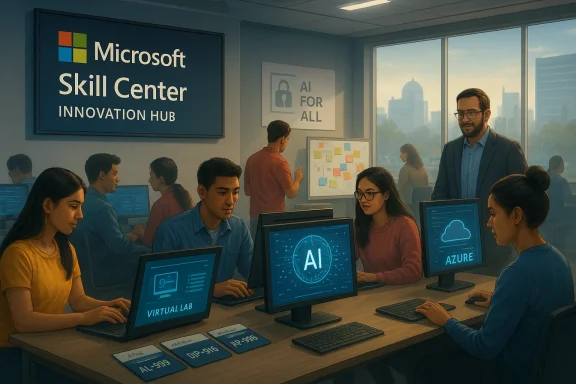
A digital visualization related to the article topic.Background​

The Chandigarh University–Microsoft collaboration arrives at a time when universities across India are under pressure to prove that their graduates can move quickly from classroom theory to workplace readiness. Employers have been signaling for years that the gap is not simply in computer science knowledge, but in applied familiarity with cloud platforms, AI tooling, data workflows, and modern development environments. In that context, a Skill Center is not just a facility; it is a curriculum strategy.
Microsoft, for its part, has steadily expanded its education-focused skilling footprint through Microsoft Learn, Microsoft Learn for Educators, bootcamps, and role-based certification pathways. Official Microsoft training materials show a strong emphasis on AI fundamentals, educator support, and institution-level capability building, including programs designed to help faculty teach students practical AI skills and use Microsoft content in the classroom.
That backdrop helps explain why the CU announcement is being framed as a hub for employability rather than just an IT lab. The value proposition is not limited to one department or one degree program. Instead, the model points toward cross-campus AI literacy, which is increasingly what employers want when they hire engineers, analysts, product managers, and even non-technical graduates who need to work alongside AI systems.
The timing is also noteworthy because the industry is moving from generic “digital skills” messaging to more specific certification and role alignment. Microsoft’s current learning ecosystem emphasizes fundamentals such as AI-900, cloud concepts, and related pathways that can be attached to job roles and measured learning outcomes. That creates a concrete framework for universities that want to offer students something more tangible than broad claims about future readiness.
For Chandigarh University, the partnership also strengthens its positioning in a crowded private university market. Institutions now compete not just on rankings and placements, but on whether they can build ecosystems with industry partners that give students access to current tools and current expectations. A Microsoft-branded center, especially one tied to AI and cloud certification, gives CU a differentiator that is easy to market and potentially easier to scale.

What the Announcement Says​

The core announcement is straightforward: CU has launched a Microsoft Skill Center focused on AI, cloud computing, and related emerging technologies. According to the press release, the center will offer Microsoft certifications, real-world hands-on training, virtual labs, and lab-based learning aligned with industry demands. The emphasis is on making students more employable through structured exposure to Microsoft’s ecosystem and certification pathways.
One of the most interesting details is the stated “AI for All” approach. The collaboration is not meant to stay confined to BTech or engineering students. Instead, the release says Microsoft courses will eventually be available across programs, suggesting a broader view of AI literacy as a campus-wide capability. That is an important distinction, because AI adoption is no longer limited to technical roles.

Key points from the announcement​

  • The center is being presented as a Center of Excellence for Microsoft-based skilling.
  • CU students will gain access to Microsoft-linked content, labs, and certification pathways.
  • The initial focus includes AI, machine learning, cloud computing, and data-related skills.
  • The program is expected to expand beyond engineering into other academic streams.
  • The university is launching a specialized B.E. in CSE with AI specialization alongside the center.
The press release also highlights collaboration with byteXL, which has been active in AI/ML and GenAI-oriented engineering education. That suggests the model is not simply vendor-to-university, but rather a three-way ecosystem of platform, curriculum, and institutional delivery. In modern higher education, those partnerships often matter as much as the physical facility itself.
There is also a strong certification angle. The release cites courses such as AZ-900, DP-900, and AI-900, which are standard entry-level Microsoft credential pathways. For students, these certifications can provide a clearer signal to employers than a line item on a transcript alone, especially when paired with lab work, projects, and internship exposure.

Why Microsoft Cares​

Microsoft’s interest in university skilling is easy to understand if you look at the company’s broader strategy. The cloud market remains fiercely competitive, but the race is no longer just about infrastructure. It is about building a pipeline of students, educators, and early-career professionals who naturally use Microsoft tools, understand Microsoft certification paths, and build mental models around Azure and related services.
That is why initiatives like Microsoft Learn for Educators matter. Microsoft’s education materials emphasize not just content access, but faculty enablement, bootcamps, and hands-on learning resources that help institutions teach AI in practical ways. In other words, Microsoft is not merely selling software licenses; it is helping shape how future professionals learn technology.
The company also has a strategic incentive to anchor AI learning early. If students can become comfortable with Microsoft’s ecosystem during college, they may carry those habits into the workplace. That has long-term implications for cloud adoption, developer preference, and enterprise tooling. The same is true for GitHub, Power BI, and Azure AI services, all of which create secondary demand when educational institutions standardize around them.

Strategic advantages for Microsoft​

  • Early exposure can drive future adoption of Azure and Microsoft developer tools.
  • Certification-led learning creates a pipeline of familiar, job-ready users.
  • Faculty partnerships make the ecosystem stickier across multiple cohorts.
  • Cross-disciplinary AI training broadens Microsoft’s reach beyond engineering.
  • University centers create real-world proof points for Microsoft’s education strategy.
This approach also fits the company’s broader AI narrative. Microsoft wants to be seen not only as a vendor of enterprise AI, but as a responsible enabler of AI literacy. By linking education, certification, and real-world skills, it can present AI adoption as practical, accessible, and employability-driven rather than intimidating or purely speculative.
Still, there is a subtle competitive angle here. Universities that build deep alliances with Microsoft may end up shaping their curricula around Microsoft-defined skill sets. That can be valuable if employers want those exact skills, but it may also create a degree of platform dependency. In the short term, the benefits are obvious; over time, the university must ensure it is teaching durable concepts, not just product familiarity.

What CU Gains​

For Chandigarh University, this move is about brand, placement outcomes, and differentiation. Private universities in India increasingly compete on visible outcomes, and nothing speaks louder to students than a promise of industry-aligned learning with a global tech company. A Microsoft Skill Center gives CU a concrete, marketable asset that can influence both admissions and employer perception.
The university is also trying to solve a persistent problem in higher education: how to bridge the gap between academic study and job readiness. By tying content to certification, lab work, and industry sessions, CU can present a more structured pathway from first-year learning to graduation. That kind of vertical integration is attractive to families investing in higher education and to students worried about their first job.

Why this matters for CU​

  • It strengthens the university’s employability narrative.
  • It supports a more industry-linked, outcome-focused curriculum.
  • It may improve student interest in AI, cloud, and data programs.
  • It creates a visible campus asset that marketing teams can leverage.
  • It may help CU deepen ties with recruiters looking for certified talent.
The specialized B.E. in CSE with AI specialization is especially important because it signals that the partnership is not a one-off event. Instead, CU appears to be weaving Microsoft-linked content into its core academic planning. That makes the initiative more durable, and it could make the program more appealing to students who want a direct path into AI-related roles.

A curriculum signal, not just a facility​

The launch of a Skill Center would matter less if it were only a showcase. Its real impact depends on how deeply the content is embedded into teaching, assessments, labs, and projects. If CU uses the center to reshape first-year and second-year learning, then it could become a meaningful part of the university’s academic identity.
If, however, the center functions primarily as an extracurricular or promotional space, the long-term impact will be more limited. The difference between a lab on paper and a lab in the curriculum is enormous, especially in fields like AI and cloud computing where practical fluency matters more than memorization.

AI For All and Cross-Disciplinary Skills​

One of the most interesting themes in the announcement is the repeated use of AI for All. That phrase is more than branding. It reflects the growing belief that AI literacy should not be reserved for computer science students or graduate researchers. Students in management, commerce, media, law, and the humanities increasingly need a working understanding of how AI systems operate and how they shape professional workflows.
Microsoft’s own educational content supports this broader framing. The company has been publishing learning modules that explain how AI affects accessibility, job roles, and sector-specific use cases. That reinforces the idea that AI training is not just about writing models, but about understanding where AI fits into different professions.

Why cross-disciplinary AI matters​

  • AI tools are entering finance, healthcare, logistics, retail, and public administration.
  • Non-technical graduates increasingly need AI fluency to stay competitive.
  • Employers value candidates who can translate between business problems and technical solutions.
  • AI literacy helps students evaluate automation risks and opportunities.
  • Broad access reduces the chance that AI becomes siloed in a single department.
This is also where the university can make a real difference. If CU uses the center to train students across departments, it could create a more flexible graduate profile. A student who understands both domain knowledge and AI-enabled tools is often more valuable than one who only knows theory or one platform.

The challenge of scale​

Scaling AI training across an entire university is difficult, though. Faculty members must be trained, curricula must be adjusted, and access to labs must be managed fairly. The promise of AI for all is compelling, but the execution will determine whether it becomes a genuine university-wide competency or simply a slogan.
That is why the reference to online and offline courses matters. Hybrid delivery can widen access and allow students from different disciplines and schedules to participate. But it also requires discipline in quality assurance, because digital access alone does not guarantee learning outcomes.

Certifications, Labs, and Job Readiness​

The most concrete part of the initiative is the certification pathway. Microsoft certifications such as AZ-900, DP-900, and AI-900 are familiar entry points for students and employers alike. They do not make a graduate an expert by themselves, but they do create a baseline of validated skills that can reduce ambiguity for recruiters.
CU’s emphasis on virtual labs and hands-on practice is just as important. In technology education, theory-heavy classrooms often produce graduates who can explain concepts but struggle when asked to use actual tools. Cloud labs, sandboxed exercises, and guided projects can help students cross that gap much more effectively than lecture-only instruction.

Certification pathways mentioned in the announcement​

  • AZ-900: Microsoft Azure Fundamentals
  • DP-900: Microsoft Azure Data Fundamentals
  • AI-900: Microsoft Azure AI Fundamentals
The naming of these courses is significant because it signals a tiered approach to skills. Students can start with fundamentals, then move into more specialized or role-based learning. That structure is useful because not every student will become a machine learning engineer, but many can still benefit from understanding cloud concepts, data basics, and AI services.
This is where the employability argument becomes strongest. Recruiters often look for candidates who can show both conceptual understanding and platform familiarity. If CU can consistently help students earn recognized credentials before graduation, it may improve interview confidence, internship conversion, and the credibility of graduates in first jobs.

Why hands-on training beats passive learning​

  • Students retain more when they build and test real workflows.
  • Lab environments reduce the fear of experimenting with new tools.
  • Certifications provide an external benchmark of achievement.
  • Project-based learning helps students talk about outcomes in interviews.
  • Real-world exposure narrows the gap between classroom and workplace.
There is also a potential ripple effect beyond first jobs. Once students gain confidence with certification-driven learning, they may continue upskilling after graduation. That is increasingly important in a field where tools, APIs, and deployment patterns change quickly, and where lifelong learning has become a career requirement rather than an optional habit.

India’s Higher-Ed Skilling Race​

The Microsoft Skill Center at CU should also be seen in the broader context of India’s higher-education skilling race. Universities, engineering colleges, and private institutes are all trying to respond to the same market pressure: students want better placement outcomes, and employers want graduates who are immediately useful. That has led to a surge of industry partnerships around cloud, AI, cybersecurity, data science, and GenAI.
This trend is not unique to CU. Across India, institutions are increasingly embedding vendor-backed training into their degree programs. The logic is simple: if technology companies are the ones shaping the tools used in the workplace, then universities need those companies inside the classroom. The challenge is making sure academic independence and industry alignment can coexist.

What this trend means for the market​

  • Universities are competing on job outcomes, not just degrees.
  • Industry certifications are becoming part of the academic value proposition.
  • Students are choosing programs that promise market relevance.
  • Employers are more willing to trust candidates with external benchmarks.
  • Platforms like Microsoft gain a deeper presence in education ecosystems.
For Microsoft, India is especially important because of the scale of its student population and its relevance to global IT services. A university partnership here can have an outsized impact if it produces a steady stream of graduates comfortable with Azure, AI fundamentals, and data tools. For CU, the partnership positions the university as a serious participant in the digital skills economy.

The competitive implication​

The more universities tie themselves to a specific ecosystem, the more they compete not just with each other but with alternative tech stacks. That is not necessarily a problem. In fact, competition can force institutions to improve quality and transparency. But it does mean the university must be careful to preserve broad conceptual training alongside platform-specific instruction.
In other words, students should learn how to think about AI, not only how to pass a Microsoft exam. The best programs will blend both.

The byteXL Factor​

The involvement of byteXL adds another layer to the announcement. The company has positioned itself around engineering education, AI/ML programs, and placement-oriented training. Its role suggests that the Skill Center is designed to be operationally practical, not just ceremonial. That matters because university-industry initiatives often succeed or fail based on implementation partners.
A strong implementation partner can help with content delivery, assessment, and student engagement. It can also help a university scale a new program more quickly than it could on its own. In a field where technologies and expectations shift every few months, that kind of operational support can be very valuable.

Why an intermediary matters​

  • It can help translate corporate content into classroom-ready delivery.
  • It may improve consistency across batches and departments.
  • It can support internships, labs, and project-based learning.
  • It may help align the curriculum to recruiter expectations.
  • It can reduce the burden on faculty who are learning new tools.
At the same time, universities must be careful not to outsource too much of their academic identity. The more layers there are between Microsoft, byteXL, and the classroom, the more important governance becomes. Questions about curriculum quality, assessment standards, and long-term ownership of the program should be answered clearly.

The governance question​

Successful industry partnerships work best when the university remains in control of outcomes. That means setting clear learning goals, monitoring performance, and ensuring that certificates reflect actual skill. If the model becomes too vendor-driven, it risks drifting away from the broader educational mission.
That said, if CU can balance external expertise with internal academic oversight, the arrangement could become a useful template for other universities. The combination of global content, local delivery, and certification-led learning is exactly the kind of hybrid model that many institutions are now experimenting with.

Strengths and Opportunities​

The biggest strength of this initiative is that it aligns student learning with real labor-market demand. It is also strategically timed, because AI fluency has moved from a niche specialization to a mainstream expectation across many occupations. If CU executes well, the Skill Center could become a model for how universities turn industry partnership into measurable student advantage.
  • Employability boost through recognized Microsoft certifications.
  • Hands-on learning that reduces the gap between theory and practice.
  • Cross-disciplinary reach through the AI for All model.
  • Stronger recruiter signal from platform-based credentials.
  • Better faculty enablement if Microsoft learning resources are integrated properly.
  • Curriculum modernization with cloud, data, and AI content.
  • Brand differentiation for CU in a crowded higher-education market.

Risks and Concerns​

The initiative is promising, but it is not risk-free. The most obvious concern is whether the program will maintain academic depth while pursuing fast-moving industry relevance. Another issue is the danger of over-reliance on a single vendor ecosystem, which could narrow exposure to alternative tools and approaches.
  • Vendor lock-in if Microsoft tools dominate the learning experience.
  • Shallow certification focus if exams become more important than understanding.
  • Uneven access if lab capacity or scheduling is not managed fairly.
  • Faculty readiness gaps if instructors are not fully trained.
  • Marketing over substance if the center is not deeply integrated into curricula.
  • Placement expectations may rise faster than actual job-market outcomes.
  • Sustainability risk if the program depends too heavily on a few partners.

What to Watch Next​

Over the next few months, the real story will be execution. The press release is compelling, but the meaningful metrics will be student participation, certification completion, internship conversions, faculty adoption, and recruiter response. Those are the indicators that will show whether this center is a launch event or the start of a lasting transformation.
Another key question is whether the program expands beyond engineering in a meaningful way. If CU can bring commerce, management, and other non-technical students into the AI learning pipeline, it would validate the “AI for All” promise. If not, the initiative may remain an important but limited technical showcase.
Finally, keep an eye on whether this becomes a broader template for other Indian universities. If CU can demonstrate strong outcomes, the model could be replicated across the country in institutions that want to build a stronger bridge between education and employment.

Key developments to monitor​

  • Student enrollment in the new Microsoft Skill Center
  • Completion rates for AZ-900, DP-900, and AI-900
  • Expansion of access beyond engineering students
  • Evidence of internship or placement gains
  • New courses added under the Microsoft partnership
  • Faculty training and classroom integration
  • Whether the center produces repeatable, measurable outcomes
The University of the Future will not be judged by how many labs it opens, but by how many students it helps adapt to a changing economy. If Chandigarh University can use this Microsoft partnership to produce graduates who are both technically fluent and industry ready, it will have done more than announce a new center. It will have built a bridge between education and the next decade of work.

Source: ANI News https://www.aninews.in/news/busines...at-chandigarh-university20260402124120/?amp=1
 

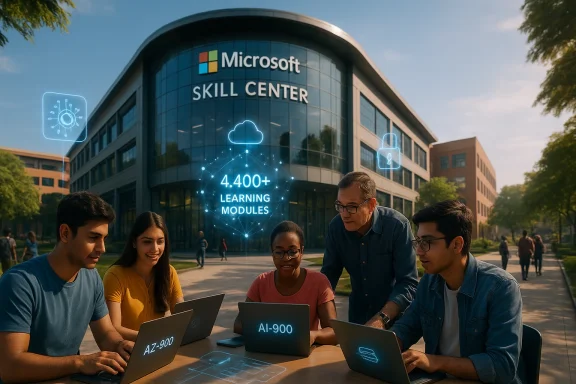
Microsoft’s new Skill Center at Chandigarh University is more than another campus ribbon-cutting. It is a signal that the race to embed AI, cloud, and certification-led learning into Indian higher education is accelerating, and that universities are increasingly being judged by how fast they can turn students into job-ready practitioners. The collaboration with Microsoft and byteXL positions Chandigarh University as an early mover in a market where employers are demanding proof of skills, not just degrees. At the same time, the timing matters: Microsoft’s own Azure AI Fundamentals certification is slated to retire on June 30, 2026, which underscores how quickly the underlying skills landscape is shifting. (learn.microsoft.com)

People collaborate outdoors at a Microsoft Skill Center, with AI-themed digital learning graphics overlayed.Overview​

The announcement fits a larger pattern in Indian higher education: universities are competing not only on rankings and placements, but on the depth of their industry partnerships. Chandigarh University has repeatedly leaned into this model, and this latest Microsoft-backed center extends a strategy that treats campus infrastructure as a bridge to the labor market rather than just a teaching environment. In that sense, the Skill Center is as much about employability branding as it is about technical training. It also reflects the growing pressure on institutions to show that students can learn current tools, not merely traditional theory.
The press release says the center will deliver training in AI, machine learning, cloud computing, data science, cybersecurity, and other emerging technologies, with certification pathways such as AZ-900, DP-900, and AI-900. Microsoft’s certification pages confirm that these are fundamentals-level credentials designed to establish baseline knowledge across cloud, data, and AI domains. AI-900, in particular, is positioned for both technical and non-technical learners, and Microsoft says no data science or software engineering experience is required. (learn.microsoft.com)
What makes this especially interesting is the university-wide framing. Microsoft’s representative described an “AI for All” approach, meaning the training is not supposed to stay inside the engineering school alone. That is a significant design choice because it suggests a broader curricular shift: if AI literacy becomes a general education layer, then law, business, commerce, media, and even hospitality students may begin to receive some version of industry-aligned tech training. The implications extend well beyond one campus, because once a model like this is normalized, other institutions will feel pressure to match it.
There is also a subtle but important timing issue. Microsoft says AI-900 is being updated as Microsoft Foundry replaces Azure AI Foundry terminology, and the course materials are being refreshed accordingly. That means the center is launching into a moving target, where the value lies not in memorizing one product name but in building a durable understanding of AI concepts and cloud workflows. In other words, the most useful part of the center may be its habit of continuous retraining, not any single syllabus. (learn.microsoft.com)

What the Announcement Actually Means​

At face value, this is a partnership announcement. In practice, it is an attempt to create a pipeline: curriculum, labs, certification, internships, and potentially placements all tied together in one ecosystem. That matters because Indian students and parents increasingly evaluate universities based on job outcomes, and employers increasingly filter candidates by demonstrable platform knowledge. The Skill Center is designed to compress that gap.
The university says the initiative will provide access to over 4,400 modules of Microsoft content linked to job roles, plus teaching materials and role-based curricula. If delivered well, that sort of content library can be more valuable than a one-time training workshop because it gives students repeatable, trackable learning paths. The challenge, of course, is execution: content libraries do not automatically translate into mastery unless they are paired with good instruction, project work, and assessment.

Why the “Skill Center” label matters​

Calling this a Skill Center rather than a lab or a classroom is deliberate. It signals that the institution wants to be seen as an applied training hub, not merely a place where students sit through lectures. That branding matters in a market where tech education is increasingly measured by whether students can leave with certifications, portfolios, and internship experience.
The center also appears to be positioned as a shared resource rather than a narrow program add-on. That is important because shared infrastructure tends to have a broader multiplier effect, especially if multiple departments are allowed to use it. If the university can make the center open to students beyond engineering, the return on investment rises sharply.
  • It creates a visible, marketable campus asset.
  • It can support multiple disciplines if access is broad.
  • It ties academic identity to employability outcomes.
  • It gives recruiters a clearer signal of student readiness.

How Microsoft benefits​

For Microsoft, this is not just philanthropy or educational outreach. It is ecosystem expansion. A university center can become a durable feeder for Azure, Power BI, GitHub, and Microsoft’s broader certification stack, which helps deepen product familiarity early in students’ careers. Once students train on Microsoft platforms during college, the company gains long-term mindshare in enterprise workflows.
Microsoft also benefits from the optics of scale. A campus partnership in India is a way to demonstrate that the company’s AI strategy is not only enterprise-facing but also talent-facing. That matters in a country where the next generation of developers, analysts, and IT professionals is being shaped today.

The Certifications on Offer​

The press release highlighted AZ-900, DP-900, and AI-900 as the initial certifications. These are entry-level credentials, but that does not make them trivial. They are often the gateway to more specialized learning, especially for students who need a structured starting point before moving into advanced Azure, AI engineering, or data roles. Microsoft’s own certification pages describe them as foundational and aligned with broader learning paths. (learn.microsoft.com)
What matters here is not the badge itself, but the sequencing. A student who can move from fundamentals to applied labs to role-based projects has a much better chance of becoming employable than one who only consumes theory. This is especially true in AI, where the field is crowded with hype, shallow certificates, and inflated resumes. A well-run fundamentals program can help separate genuine capability from buzzword fluency.

Why fundamentals still matter​

The industry sometimes treats fundamentals as an afterthought, but that is a mistake. Without a grounding in cloud concepts, data concepts, AI workloads, and NLP basics, students often struggle when they encounter real systems. Microsoft explicitly says AI-900 is suitable for technical and non-technical backgrounds and does not require prior data science or software engineering experience. (learn.microsoft.com)
That accessibility is useful because it lowers the barrier to entry. It also creates a clearer on-ramp for students in programs that are adjacent to technology rather than rooted in it. The best-case outcome is broad-based digital literacy that feeds into deeper specialization later.
  • AZ-900 introduces core Azure and cloud concepts.
  • DP-900 builds foundational data literacy.
  • AI-900 covers AI workloads and basic machine learning ideas.
  • The combined pathway can support interdisciplinary learning.

The retirement clock changes the picture​

There is a catch, though. Microsoft says the Azure AI Fundamentals certification will retire on June 30, 2026. That does not make the Skill Center obsolete, but it does mean the certification roadmap will need to stay agile. Universities that build too rigidly around a single exam risk creating a curriculum that ages quickly.
That is why the important takeaway is not the specific exam number, but the training philosophy. The durable value lies in building student fluency in AI concepts, cloud services, and project-based learning that can survive exam transitions. In that sense, the retirement timeline is a reminder that certification is a milestone, not the destination. (learn.microsoft.com)

Why Chandigarh University Is Pushing This Model​

Chandigarh University has been aggressively positioning itself as an institution that can move faster than many traditional universities. The new center fits that posture by linking campus learning to recognized industry platforms and by emphasizing hands-on training rather than abstract instruction. It is an attempt to make the university look like a career acceleration engine.
That approach also reflects the market reality in India, where higher education is under pressure to demonstrate outcomes. Parents want placement data. Students want internships. Employers want evidence of platform familiarity. Universities that can connect those dots have a stronger story to tell.

The “AI for All” angle​

The university says the program will eventually extend beyond engineering students. That is a notable step because AI literacy is no longer just a software issue; it is becoming a cross-functional workplace skill. Marketing teams use AI tools, finance teams use predictive analytics, and operations teams use dashboards and automation.
If CU can make AI training accessible across disciplines, it may help students enter the workforce with a more modern baseline. It could also create a campus culture where digital tools are seen as standard professional equipment rather than niche technical extras.
  • Broader access can reduce skill silos.
  • Non-engineering students may gain practical digital fluency.
  • Shared training can create interdisciplinary collaboration.
  • The university can market a more future-ready academic model.

A branding play as much as an academic one​

There is also a reputational dimension. The university already markets itself as a placement-focused, QS-ranked, NAAC A-grade institution. A Microsoft-branded skill center reinforces that narrative and gives it a globally recognizable anchor. In the crowded Indian private university market, association with a major technology brand is a powerful differentiator.
Still, branding alone will not be enough. The real test will be whether the center produces measurable outcomes: higher certification pass rates, stronger internship conversion, and better placement quality. If those metrics move, the partnership becomes a genuine asset rather than an attractive press release.

The Role of byteXL and the Platformization of Education​

The involvement of byteXL is an important clue to how these partnerships are evolving. byteXL has been building industry-aligned engineering education offerings, and in this case it appears to serve as an enabling layer between Microsoft content and university delivery. That matters because scaling hands-on training across thousands of students is difficult without a platform partner.
This is part of a broader trend in higher education: universities increasingly rely on edtech operators to turn corporate content into a usable academic experience. In theory, that creates more efficient learning pipelines. In practice, it raises questions about control, quality, and whether the academic mission is being outsourced too far.

Why platform partners are becoming central​

If a university wants to deliver cloud labs, certification prep, and AI modules at scale, it needs infrastructure. It also needs learner analytics, content management, and staff who can support continuous updates. A partner like byteXL can help fill that gap and make the program operationally feasible.
That said, platformization can create dependence. If the platform becomes the real delivery engine, the university may end up looking more like a host than a designer of the learning experience. The strongest partnerships are the ones where the institution retains curricular control while using the platform to increase reach.

The upside for students​

For students, a well-run platform partnership can be a real advantage. It can mean more labs, better access to current tools, and a clearer line between coursework and employability. It can also shorten the time between learning a concept and applying it in a project or certification exam.
But students need more than access. They need mentorship, feedback, and projects that test whether they can solve problems independently. Otherwise, the experience risks becoming a badge-collection exercise rather than a preparation for real jobs.

Enterprise Skills Versus Consumer Hype​

One of the biggest strengths of this initiative is that it is framed around enterprise skills, not viral consumer AI trends. The market is crowded with generic AI enthusiasm, but employers care about practical capabilities: data handling, model awareness, cloud usage, security, and tool integration. Microsoft’s fundamentals certifications are aligned with that reality, even if they are only a first step.
This matters because the gulf between consumer AI usage and enterprise AI deployment is still wide. Students may be familiar with chat interfaces and content generators, but employers want people who understand governance, workflows, data structures, and deployment constraints. The Skill Center may help bridge that gap if it stays focused on business-relevant skills.

Enterprise readiness is the real prize​

A university can get attention by teaching students to prompt an AI tool. It gets results by teaching them how to work in cloud environments, interpret data, build repeatable processes, and operate within security constraints. That is where Microsoft’s ecosystem can be genuinely useful, because it provides a structured ladder from basics to role-based specialization.
The center could also help students understand how Microsoft technologies appear in real workplaces. That kind of familiarity is valuable in India’s services economy, where a large share of tech jobs sit inside enterprise IT, consulting, analytics, and support functions.
  • Enterprise tooling is more stable than consumer app trends.
  • Employers reward workflow competence over novelty.
  • Certifications can validate baseline readiness.
  • Hands-on labs can expose students to real deployment thinking.

The risk of shallow alignment​

The danger is that institutions confuse platform exposure with employability. A student who finishes a short course on AI fundamentals is not automatically ready for an AI job. The labor market is too competitive for that. The center will only deliver value if it helps students build depth over time.
That is why the university’s emphasis on hands-on work and lab-based learning is encouraging. But it will need to resist the temptation to overpromise. Credentials matter, but only when they are backed by project experience and real problem-solving ability.

Competitive Implications for Indian Higher Education​

This announcement should be read as part of a broader contest among Indian universities to lock in major industry relationships. Whether it is LinkedIn zones, AI festivals, or cloud labs, institutions are trying to prove that they can deliver better career outcomes than their peers. The market is moving toward ecosystem education, where the university, a technology vendor, and an edtech partner jointly shape the student journey.
That shift has implications beyond Chandigarh. Other universities will likely feel pressure to announce similar centers, either with Microsoft or with competing platforms. The more these partnerships proliferate, the more they become table stakes rather than differentiators.

What rival institutions may do next​

Competing universities may respond in several ways. Some will deepen their own vendor alliances. Others will try to outdo CU by adding internship guarantees, startup incubators, or specialized AI degrees. A third group may focus on outcome metrics, arguing that results matter more than branding.
In the near term, the likely result is a wave of announcements. In the longer term, the institutions that win will be those that can prove conversion from training to employment. That is the benchmark that ultimately matters.

The placement narrative remains powerful​

Placement remains one of the most potent selling points in Indian higher education. A Microsoft-branded skill center strengthens that narrative because it implies access to global technology standards. For families making expensive education decisions, that can be persuasive.
Still, the market may become skeptical if too many universities use the same language. Once everyone says “industry-ready,” the phrase loses force. Real differentiation will come from data: certification completion rates, hiring outcomes, and employer feedback.

Potential Impact on Students and Parents​

For students, the biggest immediate benefit is clarity. Instead of wondering which skills are marketable, they can see a path that links classroom learning to recognizable industry credentials. That is valuable in a market where many learners feel overwhelmed by the pace of technological change.
For parents, the appeal is similarly straightforward. A university partnership with Microsoft suggests seriousness, relevance, and a better shot at placement. In a highly competitive education environment, that can justify tuition and reduce anxiety about job prospects.

What students may gain​

The strongest gains will likely come from students who use the center as a long-term pathway rather than a short-term certificate factory. If they move through fundamentals, labs, projects, and advanced study, they can build a profile that stands out in internships and interviews.
The broader promise is not just jobs, but career resilience. AI and cloud skills are likely to remain relevant even as specific tools evolve. That makes them a safer bet than narrow, trend-chasing courses.
  • Better exposure to cloud and AI tools.
  • More access to recognized certifications.
  • Improved confidence in technical interviews.
  • A more concrete route from study to employment.

What parents may ask​

Parents, however, are likely to ask a few hard questions. How many students actually pass the certifications? How many get internships? How many land relevant jobs? Those are fair questions, and universities that embrace industry partnerships should be ready with answers.
The more transparent the outcomes, the stronger the trust. That is especially true when a partnership is built around promises of employability and global competitiveness. The proof will need to come from results, not adjectives.

Strengths and Opportunities​

This initiative has genuine upside because it combines recognizable branding, practical infrastructure, and a broad skills agenda. If the university and its partners execute carefully, the center could become a model for how Indian campuses connect AI education to employability. The key is to treat it as a living learning system rather than a one-time announcement.
  • Strong brand association with Microsoft gives the program immediate credibility.
  • AI for All can broaden impact beyond engineering departments.
  • Certification pathways provide measurable milestones for students.
  • Lab-based learning can improve practical competence.
  • Industry-academia alignment may strengthen placements and internships.
  • Platform support from byteXL may make scale and delivery more manageable.
  • Foundational courses can create a stepping stone to advanced specialization.

Risks and Concerns​

The biggest risks are familiar ones: overpromising, under-executing, and confusing access with outcomes. If the center becomes a marketing asset more than a learning engine, it will fail the very employability test it is meant to solve. The changing Microsoft certification landscape also means the curriculum must stay nimble and regularly refreshed.
  • Certification retirement timelines can make content age quickly.
  • Shallow participation may produce badges without deep skill.
  • Vendor dependence could limit curricular autonomy.
  • Uneven faculty readiness may reduce teaching quality.
  • Placement claims may outpace actual hiring outcomes.
  • Access without mentorship could weaken long-term learning impact.
  • Branding fatigue may set in if similar announcements become too common.

Looking Ahead​

The most important question now is whether this Skill Center becomes a repeatable model or just another ambitious campus launch. If the answer is the former, expect more universities to pursue similar partnerships, especially in regions where student demand for tech jobs is high. If the answer is the latter, the announcement will still have value, but only as evidence of how intensely institutions are competing for relevance in the AI era.
The next phase should be watched through outcomes, not slogans. The real indicators will be how many students complete the certifications, how many use the labs consistently, and whether employers start to recognize CU graduates as better prepared for AI and cloud roles. In a market where the value of higher education is increasingly tied to work-readiness, those numbers will matter more than any ceremonial launch.
  • Certification completion rates across departments.
  • Expansion from engineering to non-engineering cohorts.
  • New courses added beyond AZ-900, DP-900, and AI-900.
  • Evidence of internships, projects, and recruiter engagement.
  • Updates to the curriculum as Microsoft’s AI training stack evolves.
This center may ultimately be remembered less for the day it opened and more for the standard it sets. If Chandigarh University can turn a corporate partnership into a durable, student-centered learning engine, it will have done more than install a lab; it will have helped define what future-ready education looks like in India.

Source: The Tribune Microsoft Establishes Skill Center at Chandigarh University - The Tribune
 

Microsoft’s new Skill Center at Chandigarh University is more than a campus ribbon-cutting. It is a sign that AI skilling in India is moving deeper into higher education, where universities are no longer just teaching theory but are increasingly expected to feed the labor market with job-ready graduates. The initiative, built with Microsoft, byteXL, and Chandigarh University, centers on certifications, lab-based learning, and role-aligned training in AI, cloud, and data skills, all of which are in strong demand across India’s tech sector. It also lands at a moment when Microsoft has been scaling its education and workforce skilling push across India, making this partnership part of a much larger national strategy rather than an isolated campus announcement.

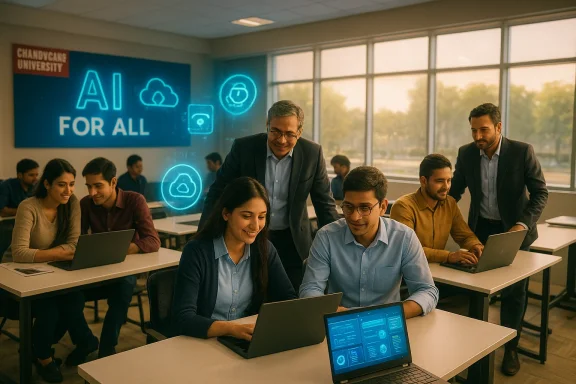
Students and a teacher collaborate in a modern classroom with an “AI for all” digital display behind them.Background​

India’s higher-education system has been under pressure for years to bridge the gap between classroom learning and employer expectations. That gap is especially visible in computing and engineering, where employers often want graduates who can contribute immediately in cloud operations, AI workflows, data analysis, and modern software delivery. University leaders know that degrees alone no longer guarantee employability; students increasingly need certifications, practical exposure, and familiarity with the same platforms used in industry.
Microsoft has spent the last several years building a broad skilling narrative in India. In 2024 and 2025, the company repeatedly framed the country as central to its AI growth plan, announcing ambitions to train millions of people and investing heavily in cloud and AI infrastructure. Microsoft also pushed partnerships with governments, training bodies, and universities, signaling that its education play is not just about selling software but about shaping the future workforce around its ecosystem.
The Chandigarh University announcement fits neatly into that pattern. According to the report carried by The Tribune, the new center is designed to give students access to Microsoft certifications in AZ-900, DP-900, and AI-900, alongside role-based and hands-on training through Microsoft technologies and lab-based instruction. The university says the first phase will focus on engineering students, but the long-term goal is broader: an “AI for All” model that opens certification pathways across the institution.
There is also a clear competitive layer. Universities in India are increasingly competing on placement statistics, industry partnerships, and the perceived relevance of their curriculum. A Microsoft-branded skill center creates a visible signal that the university is trying to stay aligned with the market, while also giving Microsoft a new distribution channel for its training stack, content, and certification ecosystem. In that sense, this is as much about brand positioning as it is about pedagogy.
The timing matters too. Microsoft’s latest education messaging has become more aggressive and more structured, especially in Asia. The company has been pushing initiatives that tie AI literacy to employability, teacher training, and regional workforce development. Against that backdrop, a university-level skill center in Punjab is less an experiment than a localized extension of Microsoft’s broader AI-first strategy.

What Microsoft Is Building​

At the core of the Chandigarh University partnership is a Microsoft Skill Center designed to mix certification prep with practical exposure. The stated aim is to help students earn credentials and develop job-ready competencies in a way that goes beyond ordinary lecture-based instruction. That means more emphasis on labs, guided projects, and curriculum tied to real job roles.

Certification as curriculum​

The university says the center will initially focus on AZ-900, DP-900, and AI-900, which are Microsoft’s foundational certifications for Azure, data, and AI concepts. These are important because they create a common baseline for students who are still early in their technical journey, especially those entering engineering programs. Microsoft Learn itself describes AI-900 as a credential for demonstrating knowledge of machine learning and AI concepts and related Azure services.
That matters for universities because certifications can turn a vague promise of “industry readiness” into something employers can actually recognize. A student who completes a degree plus a Microsoft certification bundle has a clearer signal on the resume. In theory, that should reduce friction in hiring, especially for entry-level roles where employers use certifications as screening tools.
The university also says more Microsoft courses will be added over time. That implies the center could expand into more advanced tracks if the partnership proves successful. Such expansion would align with Microsoft’s own strategy of refreshing and broadening its certification ecosystem around AI, cloud, Microsoft 365, Copilot, and agents.

Beyond the fundamentals​

One of the most interesting claims in the report is that the partnership will eventually expose students to “over 4400+ modules” linked to job roles. If that figure proves accurate in implementation, it suggests a serious attempt to make the center function as a content-rich micro-campus inside the university. That could be useful if the institution manages to integrate the modules into the normal pace of study rather than treating them as an optional add-on.
The bigger opportunity lies in turning Microsoft’s training library into a structured pathway rather than a buffet. Students often struggle when certifications are presented as disconnected extras. A well-designed center can sequence learning from basic cloud literacy to applied AI projects and then into internships or placements.
  • AZ-900 can serve as a cloud entry point.
  • DP-900 can introduce data fundamentals.
  • AI-900 can provide a foundation in AI concepts and Azure AI services.
  • Later modules can push toward applied, role-based skills.
  • The university can use these pathways to map learning to job outcomes.
That said, the credibility of the effort will depend on execution, not branding. Students will judge the center by whether it helps them actually pass exams, build projects, and secure interviews.

Why Chandigarh University Matters​

Chandigarh University is not just any institution; it is a large, private university with a strong placement-oriented identity. The university’s own materials emphasize its scale, breadth of programs, and industry-facing reputation. That means a Microsoft center at CU is likely to be marketed not as a niche lab, but as a flagship academic offering that can be replicated or scaled across disciplines.

A placement-first university model​

Private universities in India often compete on employability, and CU has been especially aggressive on this front. A Microsoft-backed center strengthens that narrative by connecting degree programs to real certifications that employers can verify. For families and students, this is attractive because it promises a more direct path from tuition to job relevance.
There is also a signaling effect for recruiters. If a university can say its students are training on Microsoft’s platforms, that may help the institution differentiate itself from peers that still rely mostly on generic computer labs. In a crowded market, that brand association can matter almost as much as the curriculum itself.
At the same time, the arrangement raises a subtle question: is the university deepening academic quality, or is it packaging vocational utility? Ideally, it should be both. But the balance between broad education and narrow employability can be hard to maintain.

Engineering first, but not engineering only​

The report says the skill center will initially serve engineering students, but eventually expand across the university under the “AI for All” umbrella. That is a smart move because AI literacy is no longer confined to computer science. Business students, commerce students, journalists, and even hospitality graduates are increasingly expected to understand data tools, automation, and digital workflows.
If CU really makes the center multidisciplinary, it could become more than a technical lab. It could become a campus-wide skills layer, helping students from non-engineering programs understand how AI changes workflows in their own fields. That would be especially valuable for young graduates entering a labor market where AI tools are already part of office productivity and analytics.
Still, multidisciplinary access only works if the modules are tailored. A one-size-fits-all technology course usually fails outside the core computing cohort. Universities that get this right tend to localize examples, assignments, and assessments to the student’s discipline.

The Role of byteXL​

The presence of byteXL is a major clue to how this collaboration is being structured. byteXL has positioned itself as a bridge between universities and industry by offering engineering programs centered on employability, internships, and newer technology stacks. In this arrangement, byteXL likely functions as the implementation layer that helps operationalize the Microsoft content and campus experience.

An execution partner, not just a name​

This matters because many university-industry MoUs look great on paper but stall in practice. A partner like byteXL can help move the partnership from announcement to delivery by managing content, student pathways, and platform integration. That reduces the chance that the Skill Center becomes a ceremonial room with no real instructional rhythm.
byteXL also brings a training-market mindset that universities sometimes lack. Institutions may know how to teach; they do not always know how to package learning into job outcomes. byteXL’s role suggests the center is intended to be outcome-driven, with internships and placement alignment built into the model.
There is, however, a risk in overreliance on external partners. If the university becomes too dependent on a vendor to define the learning experience, academic ownership can weaken. The strongest model is one where the institution controls the educational direction while the partner supplies tooling and industry alignment.

The placement promise​

The report mentions industry-certified training, paid internships, and guaranteed placements in the broader byteXL-Microsoft ecosystem. That is a powerful promise, but also the kind of promise that invites scrutiny. Students and parents will want to know what “guaranteed” means in practice, under what conditions it applies, and how durable the placement outcomes are over time.
  • Internships can improve student confidence.
  • Certifications can improve screening outcomes.
  • Projects can strengthen portfolio value.
  • Mentorship can reduce dropout from technical tracks.
  • Placement support can connect training to labor-market demand.
If byteXL helps CU integrate all of those elements coherently, the center could become a strong model for private higher education in India. If not, it risks becoming another corporate-skilling announcement with limited long-term follow-through.

Microsoft’s India Strategy​

The Chandigarh University center does not exist in isolation. Microsoft has spent the last two years publicly emphasizing India as a strategic market for AI diffusion, cloud expansion, and workforce skilling. In January 2025, Microsoft announced a $3 billion investment over two years in India focused on cloud and AI infrastructure and skilling, and said it would train 10 million people with AI skills by 2030.

Scale, not symbolism​

That broader commitment helps explain why Microsoft keeps signing education partnerships. The company is not merely trying to create isolated training centers; it is building distribution for its ecosystem at scale. By placing Microsoft content inside universities, the company can reach students before they enter the labor market and shape the tools they learn first. That is strategically valuable because first exposure often becomes long-term habit.
Microsoft’s education strategy also reflects a practical business reality: the AI economy needs more workers who know how to use its cloud, data, and productivity stack. Training students on Microsoft services increases the likelihood that future developers, analysts, and administrators will be comfortable inside the Microsoft environment when they enter industry. That is not a minor detail; it is how ecosystem lock-in is built in the modern cloud era.
The company’s outreach also shows that it understands the importance of trust and local relevance. Rather than framing AI as a distant abstract technology, Microsoft’s India messaging increasingly focuses on practical use cases, education, and employment. That makes the story more politically and socially acceptable in a country where job creation remains a central policy goal.

AI for all, but with a platform​

The phrase “AI for All” sounds inclusive, and in some respects it is. Yet it is also a platform strategy wrapped in public-interest language. By offering broad access to AI training through Microsoft tools, the company builds familiarity with its product ecosystem at the same time it promotes digital inclusion. That is not necessarily cynical; in fact, it may be the only way large-scale corporate skilling becomes sustainable.
What makes the Chandigarh University move interesting is that it combines openness with a specific platform path. The center is not just teaching generic AI theory. It is steering learners toward Microsoft certifications and Microsoft cloud services, which ties educational value to a commercial platform. That linkage is likely intentional, and it is also where the partnership becomes most powerful.
There is a broader market effect here too. If Microsoft continues embedding itself in universities, rivals such as Google, AWS, IBM, and regional edtech providers may need to deepen their own campus strategies. The result could be a more competitive skilling environment, which would be good for students as long as it does not turn universities into brand battlegrounds.

What Students Stand to Gain​

For students, the practical benefit is straightforward: more direct access to a recognizable skill pathway. The center promises certification preparation, labs, project exposure, and career-oriented training, all of which are useful when bundled correctly. For a young graduate, that bundle can be the difference between being “qualified on paper” and being hireable in practice.

From theory to demonstrable skill​

One of the persistent problems in technical education is the gap between knowing concepts and proving competence. Certifications such as AZ-900, DP-900, and AI-900 help shrink that gap because they are standardized and externally recognizable. A student who can pair classroom learning with a verified credential has a stronger story to tell in interviews.
That matters even more in an AI-heavy hiring market. Employers increasingly want evidence that applicants understand cloud fundamentals, data handling, and AI basics rather than just buzzwords. A certification center embedded in the university can reduce the friction of preparing for these expectations.
There is also a psychological benefit. Students often gain confidence when they can track progress through modular learning and visible milestones. A skill center can make technical growth feel structured instead of overwhelming.

Better alignment with employer language​

Employers rarely hire for abstract educational intent. They hire for specific tool familiarity, problem-solving ability, and role readiness. By linking student learning to Microsoft’s job-role content, the university is effectively translating academic effort into the language of recruitment.
This is especially useful in India, where the first job often sets the trajectory for a graduate’s entire early career. If the center can help students move faster into internships, fresher roles, and cloud or data support jobs, the long-term impact could be meaningful. That would be true whether they remain in IT or later move into adjacent fields.
  • Better resume differentiation.
  • More confidence in interviews.
  • Exposure to employer-recognized tools.
  • A stronger foundation for internships.
  • Faster transition from campus to workplace.
The challenge, of course, is making sure the benefits are distributed beyond the already-motivated students. The strongest centers are the ones that help average students rise, not just give top performers more credentials.

How This Changes the University-Industry Model​

The new center is another example of how universities are becoming platform partners rather than stand-alone teaching institutions. Instead of building every lab and curriculum internally, they are increasingly co-developing learning ecosystems with major technology firms. That can accelerate modernization, but it also changes the university’s role in subtle ways.

The campus as an ecosystem​

A modern tech campus increasingly looks like a service ecosystem. Students access content, labs, credentials, internships, and placement support through overlapping partnerships rather than a single academic department. Microsoft’s role at CU appears to fit exactly into that model.
The upside is agility. Universities can respond to labor-market changes faster when they are plugged into industry content and tooling. The downside is that curricula may begin to follow vendor roadmaps too closely, which can narrow the educational horizon if not managed carefully.
This is why governance matters. Universities should not just accept whatever content is offered; they should curate and contextualize it. Otherwise, they risk turning education into a certification conveyor belt.

Accreditation and academic identity​

A campus skill center also raises questions about what counts as educational excellence. Is it about placement numbers, employer recognition, research output, or holistic learning? In practice, private universities often blend all four, but the weight given to each can shift depending on market pressure.
The Microsoft center will likely strengthen CU’s employability narrative, which is not trivial. But institutions also need to preserve broader academic goals, including critical thinking, creativity, and interdisciplinary learning. If the center helps with all of that, it will be a success. If it only boosts short-term placement optics, its impact will be narrower.
It is worth noting that Microsoft’s own education initiatives now frequently include educators and entire institutions, not just students. That suggests the company sees sustainable workforce development as a systems problem, not a single-course problem. The Chandigarh University partnership should be judged by that same standard.

The Bigger Competitive Picture​

This move also reflects a broader arms race among tech companies and universities to dominate the language of future skills. Microsoft has the advantage of a massive installed base in cloud, productivity, and enterprise software. That makes it well placed to turn educational partnerships into downstream adoption pipelines.

Microsoft versus the field​

Rivals will not ignore this. AWS has long invested in certification ecosystems, Google has pushed cloud training, and IBM has continued to fund technical education programs. But Microsoft’s positioning is particularly strong because it can connect education, cloud, AI, productivity tools, and developer tooling within one narrative. That breadth gives it an edge in academic partnerships.
For universities, the competitive pressure is positive as long as it leads to better learning. If every major platform provider pushes richer campus offerings, students benefit from more choice and more relevance. The risk is that institutions start to optimize for sponsor visibility instead of educational coherence.
There is also a regional dimension. In India, universities that can show direct pathways into tech employment are likely to attract more applicants and stronger corporate interest. A Microsoft skill center is therefore not just a pedagogical asset; it is a marketing asset in a fiercely competitive higher-education environment.

A model others may copy​

If the Chandigarh University experiment performs well, expect other private universities to pursue similar arrangements. The format is appealing: a recognizable global brand, a few standardized certifications, lab-based learning, and a placement story. That is a clean product to sell to parents and students.
  • It is easy to explain.
  • It is easy to market.
  • It aligns with employer demand.
  • It scales across disciplines.
  • It can be replicated at other campuses.
Yet replication only works if there is genuine instructional depth behind the branding. The market has seen too many “centers of excellence” that look impressive in inauguration photos but fade in everyday use. Success here will depend on sustained student engagement, faculty support, and measurable outcomes.

Strengths and Opportunities​

This partnership has real upside because it aligns a major technology company, a private university with placement ambitions, and a training partner focused on employability. If executed well, it can produce students who are more confident, more credentialed, and better prepared for entry-level work in cloud and AI roles.
  • Industry relevance is immediate because Microsoft skills map closely to current hiring needs.
  • Certification value gives students a tangible, externally recognized credential.
  • Hands-on learning should improve retention and practical competence.
  • Cross-disciplinary access could spread AI literacy beyond engineering.
  • Placement branding may strengthen recruiter confidence in CU graduates.
  • Scalable content makes it easier to expand the initiative over time.
  • AI for All could become a meaningful campus-wide model if it is properly implemented.
The opportunity is not just to train students, but to reset expectations about what a university lab can be. A strong center can become a bridge between academics and industry rather than a symbolic annex.

Risks and Concerns​

The biggest risk is that the initiative becomes more promotional than transformational. Universities and vendors love announcing partnerships, but sustained outcomes require faculty buy-in, regular student participation, and transparent placement data. If those pieces do not materialize, the center may generate headlines without changing careers.
  • Vendor dependence could reduce academic independence.
  • Overpromising placements may create unrealistic student expectations.
  • Certification focus could crowd out deeper conceptual learning.
  • Uneven access might leave non-engineering students underserved.
  • Execution gaps could turn the center into a branding exercise.
  • Curriculum rigidity may not keep pace with fast-moving AI tools.
  • Outcome opacity could make it hard to assess true impact.
There is also a reputational risk for Microsoft if the courses feel too tightly tied to its ecosystem without enough broader transferability. Students want skills that work in the market, not just skills that work inside one vendor’s stack. That distinction matters, especially as AI tools evolve quickly and certifications change.

Looking Ahead​

The real test begins after the inauguration ceremony. The next few semesters will reveal whether the Microsoft Skill Center becomes a living part of campus learning or settles into the familiar pattern of announcement-first, delivery-later. The strongest sign of success will be whether students outside the initial engineering cohort begin using it meaningfully and whether faculty integrate the center into real coursework.
Microsoft’s larger India strategy suggests this is unlikely to be its last education partnership. The company is clearly betting that AI skilling at scale will shape both public perception and future revenue opportunities. If Chandigarh University can demonstrate a credible model, it may become a reference point for similar centers across Indian higher education.
What to watch next:
  • whether CU publishes student enrollment and certification completion numbers
  • whether the center expands beyond engineering into other academic streams
  • whether internships and placements follow the certification pipeline
  • whether Microsoft adds more advanced courses beyond the fundamentals trio
  • whether other universities in India copy the model
If the university can convert a polished announcement into measurable skill gains, this could become one of the more meaningful campus-industry collaborations in India’s current AI wave. If not, it will still have served as a reminder that the race for AI readiness is now being fought in classrooms, labs, and placement offices as much as in boardrooms and cloud regions.

Source: TheWire.in Microsoft Establishes Skill Center at Chandigarh University - The Wire
 

Microsoft’s new Skill Center at Chandigarh University is less a standalone campus ribbon-cutting than a signpost for a much larger shift in India’s higher-education market: the race to turn degrees into job-ready digital credentials. According to the announcement, the center will package Microsoft certifications, Azure-based labs, AI and cloud coursework, and role-linked learning into a single university-branded skilling pipeline. For students, that could mean earlier exposure to industry tools and a clearer route to employability; for Microsoft and its partners, it is another way to scale AI adoption by embedding the company’s ecosystem deeper into the classroom. The timing matters, too: India’s universities are under pressure to produce graduates who can work with AI, not merely talk about it.

A digital visualization related to the article topic.Background​

The Chandigarh University move fits neatly into Microsoft’s broader India strategy, which has increasingly tied AI adoption to workforce skilling, education partnerships, and cloud platform usage. Over the past two years, Microsoft has repeatedly emphasized training at population scale in India, including commitments announced in 2024 and 2025 to expand AI skills for students, educators, developers, and working professionals. That larger push framed education not just as social impact, but as an engine for cloud, tooling, and ecosystem growth.
What makes this particular announcement notable is the way it combines branding, curriculum, and infrastructure. A “Skill Center” is not merely a lab room with a logo on the wall; it is a distribution channel for Microsoft learning content, certification pathways, and platform familiarity. In practice, that means a student who starts with fundamentals like AZ-900, DP-900, or AI-900 may later be funneled naturally toward Azure services, Microsoft-backed labs, and role-based learning that reinforces the same vendor stack.
It also lands in a competitive higher-ed landscape where universities are no longer judged only by legacy metrics such as placement percentages or faculty count. They are being judged on their ability to produce graduates who can demonstrate verifiable skills through microcredentials, internships, and project work. For institutions, the appeal is obvious: a recognized technology partner can help modernize the curriculum faster than internal reform alone.
At the same time, this is part of a broader education trend in India and globally: the fusion of AI literacy, cloud literacy, and career readiness. Employers increasingly want evidence that students can operate in real environments, not just pass theory-heavy exams. That is why university partnerships with global tech vendors are proliferating, and why Microsoft has been willing to deepen its presence in education as AI becomes the centerpiece of both product strategy and public policy.

Why this matters now​

The timing is not accidental. AI skills have become a baseline expectation in many entry-level tech roles, while cloud computing remains a core hiring filter across software, data, cybersecurity, and analytics. A university center dedicated to these skills can give students a leg up early, especially if the training begins in the first year rather than waiting until final-semester placement prep.
The broader significance is that universities are increasingly becoming platform-aware institutions. They are not just teaching abstract computer science; they are aligning with vendor ecosystems that employers already use. That may improve employability, but it also raises questions about curriculum independence and the long-term balance between universal foundations and vendor-specific skills.
  • Microsoft is extending its education strategy in India.
  • Chandigarh University gains access to structured, certification-oriented content.
  • Students may receive earlier exposure to AI and cloud tools.
  • The partnership reflects a growing demand for job-linked credentials.

Overview​

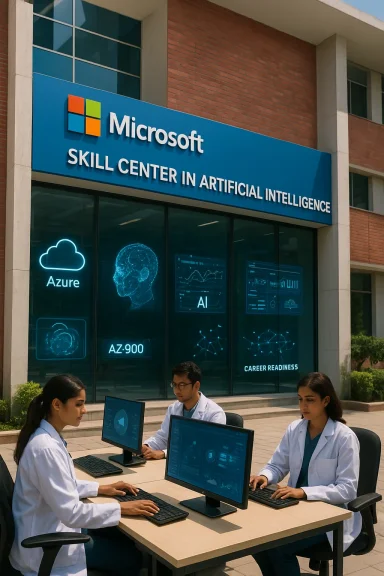
The announcement described the center as a Microsoft Skill Center in Artificial Intelligence designed to boost employability through hands-on learning, Microsoft certifications, and lab-based training. It will reportedly support coursework across AI, machine learning, cloud computing, data science, cybersecurity, and other emerging digital areas. The university also said the center would initially serve engineering students, then expand access across disciplines under an “AI for All” approach.
That phrase is important because it signals an institutional shift from narrow technical skilling to campus-wide digital literacy. In the old model, AI training was reserved for a select group of computer science or electronics students. In the new model, the logic is that lawyers, managers, media students, and hospitality majors may all need AI competence to remain relevant in the labor market.
The announcement also highlights a familiar Microsoft playbook: combine a university partnership with certification pathways, cloud infrastructure, and learning content that is already aligned to the company’s own platforms. That is efficient for Microsoft because it creates continuity between education and enterprise adoption. It is also attractive for universities because it promises a more direct line between what students learn and what employers ask for.
There is another subtle but important element here: the partnership appears to rely partly on byteXL, an education technology company that has already been working with Microsoft on engineering education in India. That matters because the effective delivery of skill programs often depends less on the announcement itself and more on the implementation partner, lab design, content sequencing, assessments, and faculty support.

The university angle​

For Chandigarh University, the gain is reputational and operational. A Microsoft-branded center can strengthen the university’s image as an industry-connected institution, especially in a market where placement outcomes and corporate links are highly visible to prospective students. It also gives the university a ready-made narrative around employability, which remains one of the strongest selling points in Indian higher education.
But the value goes beyond marketing. If the center genuinely integrates labs, certification prep, and project-based learning, it could help CU shorten the gap between academic instruction and industry practice. That is the real prize: not the logo, but the transition from theoretical learning to demonstrable skill.
  • The center is framed as an employability engine.
  • Access will likely start with engineering and then broaden.
  • The model blends online content, labs, and certifications.
  • Delivery quality will matter more than the announcement itself.

The Microsoft Certification Pipeline​

One of the most consequential parts of the announcement is the certification pathway. The university said it will initially offer AZ-900: Microsoft Azure Fundamentals, DP-900: Microsoft Azure Data Fundamentals, and AI-900: Microsoft Azure AI Fundamentals. Those are entry-level credentials, but they are strategically important because they create early familiarity with Microsoft’s ecosystem and a common language for recruiters.
Fundamentals exams are often misunderstood as trivial, but their real value lies in standardization. They give students a credible first credential, help institutions benchmark learning outcomes, and create a ladder toward more advanced role-based certifications. For many students, that first badge is the difference between being a classroom learner and a visible participant in the digital economy.

Why fundamentals matter​

Microsoft has spent years building a certification framework that maps to real-world job functions. That makes the learning path easier to explain to students, parents, and employers alike. A learner who starts with foundational content may later move into data engineering, cloud administration, AI engineering, or security pathways that build on the same conceptual base.
The practical benefit is that students gain a structured progression rather than a one-off workshop. The risk, however, is over-indexing on certification at the expense of deep problem-solving. A badge can open the door, but it does not replace the ability to architect systems, debug code, or reason through business tradeoffs.
  • AZ-900 introduces cloud concepts and Azure services.
  • DP-900 builds data literacy around Microsoft’s analytics stack.
  • AI-900 teaches baseline AI concepts and workload awareness.
  • Foundational credentials can unlock advanced pathways.

AI for All and Campus-Wide Adoption​

The announcement repeatedly invokes AI for All, and that phrase is doing a lot of work. It suggests that Microsoft and Chandigarh University are not limiting access to a single department or the technically elite. Instead, the skill center is positioned as a campus-wide resource, a model that could help normalize AI usage in daily academic life.
That is strategically smart because the future workforce will not be divided neatly between “tech” and “non-tech.” Marketing teams use generative AI. Finance teams rely on dashboards and predictive tools. Teachers increasingly need AI literacy. If the center can train across disciplines, it may produce graduates who are not just employed, but adaptable.

Beyond engineering students​

The announcement says the initiative will start with engineering students and expand to the broader university community. That phased rollout is sensible because engineering cohorts often provide the easiest pilot group for labs, assessments, and technical course alignment. Once the model proves stable, universities can adapt it for other domains with less complex technical depth.
This broadening is also where the real institutional transformation happens. If students from management, commerce, journalism, or design can access structured AI learning, the university begins to look less like a collection of departments and more like a digital capability ecosystem. That shift could matter just as much as the center itself.
  • AI literacy is becoming a cross-disciplinary requirement.
  • Campus-wide access can widen the talent pipeline.
  • Early pilots in engineering reduce implementation risk.
  • The long-term goal is cultural, not just technical.

The Role of byteXL​

The announcement also places byteXL in the delivery chain, and that deserves attention. Education partners often determine whether a university skilling initiative is actually integrated into teaching or merely appended as a side program. byteXL’s involvement suggests that Microsoft content may be coupled with a platform and delivery model already familiar to Indian engineering institutions.
That matters because scaling skills inside a university is harder than issuing access codes. Faculty need training. Students need sequencing. Labs need maintenance. Assessments need to be aligned with learning outcomes. A partner like byteXL can potentially bridge the gap between Microsoft content and day-to-day classroom execution.

What the partner model can do​

If the model works, byteXL can help convert static content into a more guided student journey. That might include lab-based assignments, internship pathways, project mentoring, and placement-linked preparation. It can also reduce the burden on faculty who may otherwise struggle to keep pace with fast-moving AI tooling.
But the partner model also introduces a dependency. Universities must ensure that the curriculum remains pedagogically strong and not just commercially efficient. Too much reliance on one external platform can narrow exposure if students are not also taught underlying principles, open tools, and vendor-neutral thinking.
  • Delivery partners can make skilling operationally feasible.
  • Faculty support is essential for adoption.
  • Vendor concentration can create curriculum bias.
  • Implementation quality will determine student outcomes.

Industry-Academia Collaboration in India​

This announcement is part of a much larger industry-academia convergence taking place across India’s higher-education sector. Employers increasingly say graduates lack hands-on exposure, while universities argue that they need stronger industry support to modernize laboratories, curriculum, and internships. Partnerships like this one are a response to that gap.
Microsoft has been especially active in this space because skilling aligns with its broader cloud and AI business. The company benefits when students learn on Azure, use Microsoft learning paths, and become comfortable with the tools they may later encounter in the workforce. Universities benefit when they can promise modern training without building everything from scratch.

The market logic​

The competitive implication is that universities are now competing partly on ecosystem quality. A degree from a university with recognized industry partnerships may carry more signaling power than a degree from a school with weaker connections. That is especially true in a labor market where employers want proof of practical competence.
This also creates pressure on rival edtech and cloud vendors to offer deeper academic partnerships. As more universities adopt platform-based skill centers, the market may shift from occasional workshops to long-term institutional embeds. In other words, the education market is moving from guest lectures to embedded capability.
  • Universities want employability gains.
  • Vendors want platform adoption and early talent familiarity.
  • Students want credentials that recruiters recognize.
  • The strongest institutions will blend all three.

Enterprise Relevance and Hiring Impact​

From an enterprise standpoint, the key question is whether these credentials and learning pathways improve hiring quality. If students can graduate with a meaningful mix of certification, lab work, and project experience, employers may see a smaller ramp-up period for entry-level hires. That would be particularly valuable in sectors such as software services, analytics, and cloud operations.
Microsoft’s bet is that the job market increasingly rewards skill signals that are concrete and verifiable. In that context, a certification in AI fundamentals or cloud fundamentals is more than a resume line. It is a shorthand for a learner’s readiness to work with modern technology stacks, even if further training will still be required on the job.

Consumer and student impact​

For students and families, the most immediate promise is employability. A university-endorsed skilling center may improve confidence that tuition is producing career-oriented outcomes. It can also create a more visible ladder from classroom learning to internships, hackathons, and first jobs.
Still, expectations should stay realistic. Certifications do not guarantee employment, and not every student who completes a pathway will become an AI engineer. The most useful outcome may be broader: graduates who are comfortable with digital tools, data interpretation, and cloud concepts across multiple domains.
  • Employers value shorter onboarding cycles.
  • Certifications provide verifiable skill signals.
  • Students gain confidence and career direction.
  • The impact is strongest when paired with projects and internships.

The Competitive Stakes for Microsoft​

This is also about market positioning. Microsoft is not just selling software here; it is shaping the learning environment in which future buyers, admins, developers, and decision-makers are trained. That is a long game, and it is one of the reasons the company has been so consistent about education initiatives across India and other regions.
The company’s competitive advantage lies in ecosystem breadth. Azure, Microsoft Learn, certification programs, and enterprise tools can all be woven into one narrative. If a student becomes comfortable with that stack during university, the odds rise that they will continue using it professionally, especially in organizations already standardized on Microsoft products.

Strategic upside​

This type of partnership can help Microsoft defend and expand share against rivals in cloud and AI. It is a soft-power play built on curriculum influence, institutional trust, and early familiarity. It may not show up immediately in revenue attribution, but it can shape the talent pipeline for years.
At the same time, Microsoft must prove that the relationship is not just a branding exercise. The center will be judged by measurable outcomes: certifications earned, projects completed, internships secured, faculty participation, and graduate placement. Without that evidence, the initiative risks being perceived as another well-marketed education tie-up.
  • Microsoft deepens ecosystem lock-in through education.
  • Early familiarity can influence future platform choice.
  • The partnership is part of a long-term talent strategy.
  • Outcomes, not logos, will determine credibility.

How This Fits Microsoft’s India Skilling Push​

The Chandigarh announcement sits inside a broader arc of Microsoft’s skilling work in India, where the company has increasingly paired AI investments with training commitments. Recent Microsoft messaging has emphasized training at scale, educator enablement, and partnerships with governments, universities, and industry players. The company clearly sees India as both a market and a talent engine.
That larger strategy matters because India’s digital economy is not just consuming global technology; it is increasingly expected to produce it. Universities like Chandigarh become nodes in a national pipeline that connects student learning, startup creation, enterprise hiring, and public-sector transformation. The Skill Center is therefore a microcosm of a much larger policy and market trend.

Why India is central​

India offers Microsoft a rare combination of scale, technical ambition, and institutional diversity. A single university partnership can reach thousands of students, and those students often move quickly into high-growth service or product roles. That gives skilling programs unusually strong network effects.
For India, the upside is equally clear: more graduates with real AI and cloud literacy. The downside is that the education system can become overly dependent on a handful of multinational platforms. The challenge is to capture the benefits of scale without narrowing the intellectual diversity of the curriculum.
  • India is a priority market for Microsoft skilling.
  • Universities are becoming distribution points for AI education.
  • The country benefits from scale and labor-market readiness.
  • Curriculum independence remains a valid concern.

Strengths and Opportunities​

The biggest strength of the Chandigarh University Skill Center is that it answers a real market problem: graduates need practical, recognized, technology-enabled skills now, not after a long redesign cycle. If implemented well, the center could become a model for how universities blend certification, labs, and employability in a single framework.
It also creates opportunities beyond immediate placements. A stronger AI and cloud culture can support student startups, research projects, faculty upskilling, and employer engagement. In that sense, the initiative could become a platform for broader academic modernization.
  • Improves student access to industry-recognized certifications
  • Accelerates hands-on learning in AI and cloud
  • Strengthens the university’s employer-facing brand
  • Supports cross-disciplinary AI literacy
  • Creates a pipeline for internships and placements
  • Can improve faculty exposure to current technology trends
  • May foster student innovation and startup activity

Risks and Concerns​

The main risk is that the initiative becomes more symbolic than transformative. If the center is underused, poorly integrated into the curriculum, or too dependent on one vendor’s content, it will not produce the employability gains being promised. Universities have seen enough branded innovation centers to know that signage is easier than sustained outcomes.
There are also pedagogical risks. Students may focus on passing certification exams rather than mastering foundational concepts. And if the curriculum leans too heavily on one ecosystem, it may limit exposure to vendor-neutral principles that matter over a longer career.
  • Risk of becoming a branding exercise rather than a learning engine
  • Possible overreliance on a single vendor ecosystem
  • Certification prep can crowd out deeper conceptual learning
  • Implementation quality may vary by faculty and department
  • Student participation may be uneven across disciplines
  • Employability gains may be overstated if internships lag
  • Long-term sustainability depends on governance and updates

Looking Ahead​

The next phase will be judged by execution, not announcement language. If Chandigarh University can quickly show strong enrollment, meaningful lab usage, and a steady flow of certification completions, the center could become a credible template for other institutions. If not, it will remain a localized partnership with limited lasting impact.
The broader test is whether AI for All becomes an operating principle rather than a slogan. That means opening the center to non-engineering students, supporting faculty adoption, and linking coursework to projects and internships. It also means making sure the program evolves as AI tools change, because static skilling is a contradiction in a fast-moving field.
  • Watch student enrollment and certification completion rates
  • Track whether non-engineering departments gain access
  • Monitor internship and placement outcomes
  • Look for faculty adoption and curriculum integration
  • See whether additional Microsoft courses are added
  • Assess whether the model spreads to other universities
  • Pay attention to student feedback on relevance and quality
The biggest story here is not that one university opened one center. It is that higher education is rapidly becoming a battlefield for AI influence, cloud familiarity, and workforce preparation. Microsoft, Chandigarh University, and byteXL are all betting that the universities that win this race will be the ones that make practical digital skills as central to the campus experience as lectures and exams. If that bet pays off, this Skill Center could be remembered less as a press-release moment and more as an early marker of how Indian higher education adjusted to the AI era.

Source: ANI News https://www.aninews.in/news/busines...enter-at-chandigarh-university20260402124120/
 

Back
Top