

John Lambert’s argument to “change the physics of cyber defense” is both a wake‑up call and a pragmatic roadmap: represent your environment as a graph, harden the terrain, invest in expert defenders and collaboration, and put modern AI and high‑fidelity telemetry to work so defenders regain the initiative. This is not theory — it is a synthesis of lessons learned at scale inside Microsoft’s security operations and a direct response to the accelerating, AI‑amplified threat landscape described in their recent deputy‑CISO briefing.
Microsoft’s Office of the CISO has framed the current environment as one in which attackers no longer “break in” so much as they “sign in,” using credential theft, automation, and commoditized toolchains to attack at machine speed. John Lambert traces a decade of operational experience — from founding the Microsoft Threat Intelligence Center (MSTIC) to building telemetry‑backed hunt and detection programs — and concludes defenders must shift representation, tooling, and posture to match the attacker’s mental model. Why this matters now: generative AI and automation lower the cost of reconnaissance and social engineering; cloud‑native patterns create ephemeral attack windows; and identity‑centric attacks dominate everyday risk calculations. Those facts drive a new engineering and governance agenda for CISOs: treat detection and response as machine‑speed outcomes and make prevention and hygiene so good that attackers are left chasing false positives.
Treat vendor telemetry as strategic signals. Validate headline numbers against local data. Prioritize identity and asset hygiene first, then expand into graph reasoning and governed automation. The path is iterative, but the destination is clear: a defensible environment in which compromise is survivable, recoverable, and increasingly unattractive to attackers.
Source: Microsoft Changing the physics of cyber defense | Microsoft Security Blog
 Background
Microsoft’s Office of the CISO has framed the current environment as one in which attackers no longer “break in” so much as they “sign in,” using credential theft, automation, and commoditized toolchains to attack at machine speed. John Lambert traces a decade of operational experience — from founding the Microsoft Threat Intelligence Center (MSTIC) to building telemetry‑backed hunt and detection programs — and concludes defenders must shift representation, tooling, and posture to match the attacker’s mental model. Why this matters now: generative AI and automation lower the cost of reconnaissance and social engineering; cloud‑native patterns create ephemeral attack windows; and identity‑centric attacks dominate everyday risk calculations. Those facts drive a new engineering and governance agenda for CISOs: treat detection and response as machine‑speed outcomes and make prevention and hygiene so good that attackers are left chasing false positives. The graph is the new lingua franca of cyber defense
Why graphs, not just tables
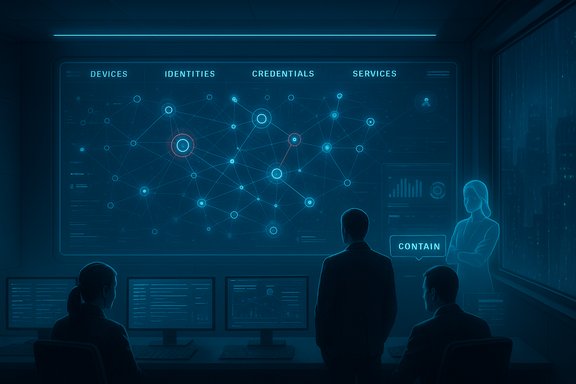
Infrastructure, identities, credentials, entitlements, devices and services — all of these elements form a directed, dependency‑rich network. Lambert’s core insight is straightforward: if attackers model targets as attack graphs, defenders should too. Graphs make transitive trust, lateral movement paths, and blast radii visible in ways that relational tables and flat logs do not. Representing security data as nodes and edges lets analysts and automated systems ask highly expressive questions such as “can identity A reach resource B?” or “what is the effective blast radius of this service principal?” and get back results that are directly actionable. At Microsoft this thinking is grounded in real engineering: their telemetry stack includes Azure Data Explorer (ADX) and Kusto Query Language (KQL) for ingest and search, supplemented by graph‑oriented views that enable traversal, impact analysis, and automated reasoning. Embedding graph reasoning into detection pipelines converts disconnected logs into a coherent “red thread” of activity that exposes pivot paths and privilege escalation sequences.The practical defensive edge
- Graphs accelerate triage. Instead of chasing isolated alerts, a graph can reveal the shortest paths from a compromised account to critical resources.
- Graph reasoning supports blast‑radius checks for proposed changes (e.g., “if this service principal is granted contributor rights, what can it reach?”).
- Graphs enable precision mitigations: revoke a single high‑risk token or quarantine a node rather than broad, disruptive containment.
- Graphs feed AI models better context: features drawn from graph topology (centrality, cut‑sets, edge attributes) are far more informative than isolated log features.
The “algebras of defense”: multiple representations, richer detection
Lambert proposes that defenders should not be limited to relational or graph representations alone — he calls for broadening to include anomalies and vectors over time, forming what he terms the algebras of defense. Each algebra is specialized: relational tables capture structured telemetry, graphs capture relationships, anomaly spaces highlight outliers, and temporal vectors encode sequencing and cadence. Combining these gives defenders (and AI) multiple lenses to detect sophisticated tradecraft. This is an important conceptual shift: rather than shoehorning every analytic need into one store or model, let the data speak in the representation best suited to the question. Practically, that means pipelines that can transform logs into graphs, extract temporal vectors, and surface anomalies into a unified analysis fabric where AI assistants can reason across modalities. The result is faster, higher‑precision detection and fewer blind spots.Build difficult terrain: prevention and hygiene that raise attack cost
A central theme of the post is that a well‑managed environment is simply harder to attack. This is not flashy — it’s engineering discipline applied to security.Core hygiene priorities
- Phasing out legacy systems. Retire unsupported software and replace brittle, brittle apps that create long attack paths.
- Entitlement hygiene. Continuously audit and enforce least privilege; retire unused service principals and orphaned accounts.
- Asset management. Maintain canonical, near‑real‑time inventories of devices, software, and cloud resources.
- Network and identity segmentation. Make admin activities only possible from hardened, pre‑identified locations and dedicate jump hosts or secure admin workstations.
- Phishing‑resistant MFA. Deploy FIDO2/passkeys or certificate‑based auth where possible to remove credential capture as an easy vector. Microsoft’s own telemetry and public reporting show that phishing‑resistant MFA blocks the overwhelming majority of automated credential attacks.
Layered controls and predictability
Lambert emphasizes reducing randomness on the defender side. Predictability (in the sense of consistent controls, enforced access boundaries, and audited workflows) removes the noise that attackers exploit. Layered defenses — endpoint protections plus identity controls plus segmentation plus telemetry — work together to reduce dwell time and eliminate whole classes of opportunistic attackers.Invest in people, and share the fight
Even the best tooling is ineffective without skilled analysts who understand adversary behavior and can distinguish signal from noise. Lambert insists on two complementary actions: grow internal expertise, and collaborate across industry.- Train analysts in graph reasoning and adversary tradecraft.
- Bake incident playbooks into operations and exercise them regularly.
- Maintain human‑in‑the‑loop checks for high‑impact automated remediations.
Where AI helps — and where it creates new hazards
AI is a force multiplier for both attackers and defenders. Lambert’s view is pragmatic: use AI to amplify human intuition and scale routine detection, but govern it carefully.What AI can do for defenders
- Rapidly correlate cross‑source telemetry into narratives.
- Convert the algebras of defense into high‑dimensional detection features.
- Auto‑generate containment playbooks and suggest targeted mitigations.
- Help junior analysts by translating KQL, graph traversals, and forensic artifacts into succinct summaries.
The attacker side of the ledger
Generative AI has already demonstrably improved attack effectiveness: Microsoft and subsequent independent reporting show AI‑generated phishing achieving much higher engagement than conventional phishing — figures cited include a 54% click‑through rate for AI phishing vs ~12% for human‑crafted lures, roughly a 4.5× increase in click likelihood. That same reporting warns AI can raise phishing profitability by orders of magnitude. These are vendor‑reported telemetry figures that have been widely discussed in the press and should be treated as high‑confidence directional signals. Caveat: numerical claims like exact click rates, mean times to compromise, or profitability multipliers are telemetry‑dependent. They are powerful for prioritization, but readers should validate these numbers against their own environment or independent datasets before making wholesale program changes. Lambert himself flags this nuance: vendor telemetry is invaluable, but it must be operationalized locally.Practical, prioritized takeaways for enterprise defenders
The blog lays a practical path for teams to follow. Below is a distilled operational roadmap adapted into tactical steps.- Immediate (0–3 months)
- Enforce phishing‑resistant MFA for privileged accounts and high‑risk users.
- Inventory internet‑facing services and enable DDoS/WAF/CDN protections where appropriate.
- Run incident response tabletop exercises that include legal, PR, and business continuity.
- Near term (3–9 months)
- Build or acquire a graph view of identity, entitlements, and service dependencies.
- Integrate SOAR playbooks to automate high‑confidence containment actions.
- Harden CI/CD pipelines: scan for secrets, enforce image signing, and require short‑lived credentials.
- Mid term (9–18 months)
- Roll out least‑privilege and ephemeral credentials across cloud workloads.
- Adopt managed identities for automation and eliminate wide‑scoped long‑lived keys.
- Pilot AI‑assisted detection with strict governance and human‑in‑the‑loop controls.
- Long term (18+ months)
- Institutionalize continuous assurance programs and recovery tests at machine speed.
- Mature collective defense relationships and contribute operational playbooks to trusted partners.
Risks, caveats, and unverifiable claims
A responsible reading of Lambert’s piece recognizes where vendor telemetry and forward projections intersect with uncertainty.- Vendor telemetry bias: many headline metrics come from Microsoft’s broad telemetry surface. They are legitimate and operationally important, but local exposure, sector specifics, and regional attacker behavior vary. Treat vendor numbers as directional signaling, not universal law.
- AI‑phishing statistics: the 54% figure has been widely reported and is supported by Microsoft’s Digital Defense reporting, but independent replication at scale is still emerging in public literature; organizations should validate impact against their own email flows and user cohorts.
- “48‑hour” compromise windows for containers: this kind of number can be operationally useful to accelerate patching and pipeline hardening, yet it is highly dependent on exposure patterns and attacker focus. Use it to prioritize rapid pipeline hygiene, not to claim universal timelines.
- AI governance and model drift: automations help, but unchecked models can drift, generate false positives, or be adversarially manipulated. Maintain audit trails, human checkpoints for high‑impact actions, and clear rollback procedures.
How Windows administrators and mid‑market teams should act today
Lambert’s essay is aimed at enterprise CISOs, but much of it is actionable for smaller teams responsible for Windows environments.- Prioritize phishing‑resistant MFA (FIDO2/passkeys where possible) for admins and any remote access tools. Microsoft telemetry indicates this control prevents the vast majority of automated credential attacks.
- Build an authoritative asset inventory and enforce patch and driver management for Windows endpoints. You cannot protect what you do not know you own.
- Start small with graph reasoning: map admin accounts, service principals, and high‑value servers. Even a modest graph reveals surprising privilege paths.
- Automate containment playbooks for the highest‑frequency incidents (credential compromise, suspicious token use, ransomware indicators) with manual approvals for escalations.
- Train users with realistic simulations that reflect the new AI‑augmented social‑engineering threats. The quality of phishing lures is changing; so must the realism of training.
The final appraisal: why this matters for defenders
Lambert’s thesis reframes defense as an engineering problem: model the environment correctly, reduce attack surface and entropy, invest in knowledgeable people, and apply AI with governance. The practical consequences are compelling:- Faster, more accurate detection when telemetry is represented in the right form.
- Lower mean time to contain via automated, narrowly targeted mitigations.
- A structural shift in attacker economics — raise cost, reduce ROI, and make many attacks unattractive.
Conclusion
Changing the physics of cyber defense is not a single product purchase or a one‑quarter initiative — it is an architectural and cultural reorientation. John Lambert’s blueprint blends concept and practice: model your infrastructure as graphs, harden the terrain through relentless hygiene, cultivate internal expertise, share intelligence externally, and let AI amplify human judgement under strict governance. Applied together, these measures shift advantage back to defenders by increasing attacker cost, shrinking attacker dwell time, and enabling machine‑speed containment.Treat vendor telemetry as strategic signals. Validate headline numbers against local data. Prioritize identity and asset hygiene first, then expand into graph reasoning and governed automation. The path is iterative, but the destination is clear: a defensible environment in which compromise is survivable, recoverable, and increasingly unattractive to attackers.
Source: Microsoft Changing the physics of cyber defense | Microsoft Security Blog
