

Patients looking for medical advice or help decoding health insurance are not spreading their questions evenly across the AI market. ChatGPT is the clear front-runner, with Google Gemini a distant second, while Microsoft Copilot, Meta AI, Claude, Grok, Perplexity, and other tools occupy far smaller roles in this emerging consumer health-information ecosystem.
A new Pollfish survey of 1,250 insured U.S. adults presents a revealing snapshot of where patients turn when they want fast answers about coverage, bills, care costs, symptoms, and medical decisions. The results point to a familiar pattern for Windows users and the broader technology market: the chatbot with the strongest consumer mindshare often becomes the default interface for complex tasks—even when the stakes are far higher than drafting an email or troubleshooting a PC.
That default matters. Health insurance is notoriously difficult to navigate, and conversational AI can translate jargon, organize paperwork, and help consumers formulate better questions. But the same ease of use that makes an AI chatbot useful for understanding an explanation of benefits can make it dangerously tempting as a substitute for a clinician, insurer, or emergency service.
The central finding is not simply that patients use AI for health information. It is that they are developing platform preferences, and those preferences increasingly shape how they encounter medical and insurance guidance.
Among respondents who expressed a preferred AI chatbot for health insurance questions, 28% selected ChatGPT. Google Gemini followed at 21.3%, making the two platforms the dominant choices in the survey.
The gap between the leaders and the rest of the field is substantial:
For many consumers, AI selection is driven by visibility and habit rather than a technical evaluation of model quality. ChatGPT has become a generic shorthand for AI assistance in the same way that “Google it” became shorthand for web search. Gemini benefits from Google’s immense consumer footprint and association with search, information retrieval, and Android devices.
Microsoft Copilot’s comparatively modest showing is especially notable from a Windows perspective. Copilot is deeply integrated into Microsoft’s ecosystem, including Windows, Microsoft 365, Edge, and enterprise environments. Yet its 6.4% preference rate in this health insurance-focused survey suggests that broad platform integration does not automatically translate into consumer trust for personal healthcare questions.
That gap may reflect a branding challenge as much as a product challenge. Many people encounter Copilot in a work context, where its identity is tied to documents, meetings, spreadsheets, and productivity. ChatGPT, by contrast, is often treated as a general-purpose conversational companion. When users want an immediate explanation of a bill, a deductible, or a confusing clinical term, that conversational identity carries weight.
Reported uses include:
A chatbot can help a patient convert a confusing document into plain English. It can explain the difference between a billed amount and a negotiated rate, distinguish an explanation of benefits from an invoice, or generate a checklist for calling an insurer. It can also help a user identify the specific terms to search for in a summary plan description.
A chatbot can explain what “prior authorization” usually means. It cannot guarantee that a specific procedure will be covered under a specific plan. It can describe common appeal steps. It cannot establish a filing deadline, submit an appeal, or override an insurer’s decision.
Users should treat AI-generated insurance guidance as a preparation tool rather than an authoritative answer. The most reliable workflow is straightforward:
That is a fundamentally different use case from asking a chatbot to define “out-of-network deductible.” It places AI in the gap between a patient who needs care and a healthcare system that may feel financially inaccessible.
The survey also found that 40% of people who turned to AI for medical advice because they could not afford a doctor said they skipped, delayed, or sought treatment based solely on chatbot guidance. That figure deserves careful attention.
AI can reduce uncertainty in low-risk situations. It can help a user prepare for an appointment, summarize a medication list, explain common side effects, or identify questions worth asking a pharmacist. It can sometimes encourage appropriate escalation by flagging symptoms that may require urgent evaluation.
But it cannot perform a physical examination. It cannot palpate an abdomen, listen to lungs, check reflexes, assess skin color accurately through a camera, observe a patient’s gait, or obtain a reliable set of vital signs. It cannot fully capture the subtle clinical context that a healthcare professional develops through history-taking, examination, testing, and follow-up.
The danger is not only that an AI response could be factually wrong. The more subtle risk is false reassurance. A chatbot may provide a plausible, calm, well-written explanation that feels personalized enough to delay care for a condition that needs urgent attention.
Reported usage declined across older age groups:
Still, it would be a mistake to frame the issue as solely a low-income trend. Some of the highest reported rates appeared in middle-income brackets, reinforcing the reality that being insured or earning a moderate salary does not necessarily make healthcare easy to afford.
A person can have coverage and still postpone treatment because of copays, deductibles, coinsurance, missed work, transportation costs, limited appointment availability, or fear of a bill that is difficult to predict in advance.
These are not minor advantages. They directly address common consumer frustrations.
A person can ask an AI chatbot a question at midnight without navigating a phone tree, waiting on hold, or trying to find an appointment. They can restate the question in plain language, request a simpler explanation, and ask follow-up questions without feeling rushed or judged.
For healthcare and insurance organizations, the lesson is clear: people increasingly expect conversational access to information.
That is a much safer deployment model than positioning an AI tool as an all-purpose substitute for clinical judgment.
Some consumers do not trust AI. Others lack confidence with digital tools, prefer a human conversation, have accessibility needs, or simply know that their situation is too complex to reduce to a text prompt. A patient dealing with a denied cancer treatment, a confusing hospital bill, or a sudden change in medication needs a reliable route to a trained person.
Healthcare providers and insurers should therefore avoid treating AI as a cost-cutting replacement for human support. The better model is AI-assisted service with human escalation.
A well-designed system should make it easy to move from chatbot to person when:
Copilot has meaningful potential in healthcare-adjacent workflows. In a properly governed environment, it can support document drafting, summarization, data analysis, meeting notes, patient communication templates, and administrative productivity. Microsoft’s enterprise identity, security tools, and integration with business software can be valuable to healthcare organizations managing large volumes of structured work.
But patients do not necessarily experience Copilot through that lens. For an individual trying to understand a deductible or compare two treatment options, a general-purpose chatbot with a strong consumer reputation may feel more approachable.
Microsoft’s opportunity is to make Copilot more visibly useful in the places where patients already interact with healthcare systems:
A generic Copilot answer can explain what a deductible is. A well-integrated healthcare Copilot could tell a consenting patient where to find the deductible status in their own portal and connect them with a human representative if the information is unclear.
That is the difference between conversational novelty and meaningful healthcare usability.
This creates a privacy problem that extends beyond traditional concerns about data breaches. The user must understand:
Even when a platform offers enhanced privacy controls, users should read the terms carefully and distinguish between a specialized health feature and an ordinary chat. Privacy protections can differ depending on the feature used, account settings, connected apps, and the information supplied.
Yet more data does not automatically create a safe medical advisor.
Health records can be incomplete. Medication lists can be outdated. Billing codes can be ambiguous. Wearable devices can generate misleading signals. A model can misunderstand a detail, overemphasize an irrelevant pattern, or fail to account for a missing clinical fact.
Personalization may make a response feel more authoritative, which can increase the risk of overreliance. The safer principle is simple: more context may improve an AI explanation, but it does not turn a chatbot into a doctor.
The survey was conducted through an online Pollfish panel and included 1,250 U.S. adults with health insurance coverage. It reported a full-sample margin of error of approximately plus or minus 2.8 percentage points. Results for smaller groups—such as individual age brackets, income bands, or users of a particular chatbot—have wider uncertainty.
Several limitations matter:
That distinction should guide both regulation and product design. The more a conversation moves from explanation toward diagnosis, treatment, triage, or a decision to forgo care, the more safeguards and human involvement are needed.
The survey shows that ChatGPT currently owns the strongest consumer preference, with Gemini as its closest challenger. Microsoft Copilot and other assistants remain far behind in this narrowly defined health insurance use case, despite their broader presence in the technology market.
But the more consequential finding is that a significant number of people are using AI when cost or access prevents them from seeing a clinician. That is not merely a chatbot adoption statistic. It is evidence of a healthcare access problem appearing inside a technology trend.
The most responsible path forward is not to discourage every health-related AI interaction. It is to build a clearer division of labor. Let AI explain paperwork, translate jargon, summarize records, organize questions, and guide patients toward the correct support channel. Let trained professionals make clinical judgments, deliver care, confirm coverage, and handle situations where a wrong answer could carry real harm.
For patients, the best use of AI is as a smart assistant for understanding and preparation, not as the final authority on a diagnosis, treatment, or insurance outcome. For healthcare organizations, the task is to meet the demand for immediate, conversational help without allowing convenience to replace accountability.
A new Pollfish survey of 1,250 insured U.S. adults presents a revealing snapshot of where patients turn when they want fast answers about coverage, bills, care costs, symptoms, and medical decisions. The results point to a familiar pattern for Windows users and the broader technology market: the chatbot with the strongest consumer mindshare often becomes the default interface for complex tasks—even when the stakes are far higher than drafting an email or troubleshooting a PC.
That default matters. Health insurance is notoriously difficult to navigate, and conversational AI can translate jargon, organize paperwork, and help consumers formulate better questions. But the same ease of use that makes an AI chatbot useful for understanding an explanation of benefits can make it dangerously tempting as a substitute for a clinician, insurer, or emergency service.
The central finding is not simply that patients use AI for health information. It is that they are developing platform preferences, and those preferences increasingly shape how they encounter medical and insurance guidance.
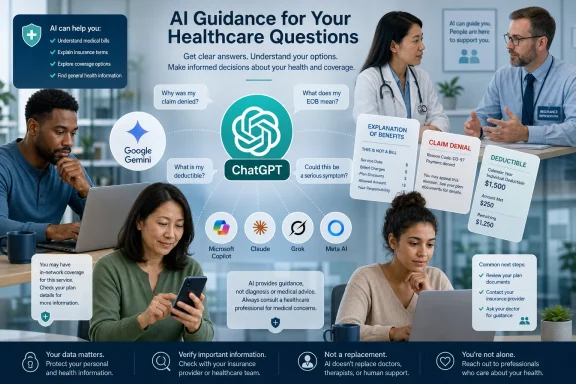 ChatGPT Leads the Consumer Health AI Race
Among respondents who expressed a preferred AI chatbot for health insurance questions, 28% selected ChatGPT. Google Gemini followed at 21.3%, making the two platforms the dominant choices in the survey.The gap between the leaders and the rest of the field is substantial:
- ChatGPT: 28%
- Google Gemini: 21.3%
- Microsoft Copilot: 6.4%
- Meta AI: 4%
- Claude: 2.3%
- Grok: 1.6%
- Perplexity and other AI tools: Less than 1% each
For many consumers, AI selection is driven by visibility and habit rather than a technical evaluation of model quality. ChatGPT has become a generic shorthand for AI assistance in the same way that “Google it” became shorthand for web search. Gemini benefits from Google’s immense consumer footprint and association with search, information retrieval, and Android devices.
Microsoft Copilot’s comparatively modest showing is especially notable from a Windows perspective. Copilot is deeply integrated into Microsoft’s ecosystem, including Windows, Microsoft 365, Edge, and enterprise environments. Yet its 6.4% preference rate in this health insurance-focused survey suggests that broad platform integration does not automatically translate into consumer trust for personal healthcare questions.
That gap may reflect a branding challenge as much as a product challenge. Many people encounter Copilot in a work context, where its identity is tied to documents, meetings, spreadsheets, and productivity. ChatGPT, by contrast, is often treated as a general-purpose conversational companion. When users want an immediate explanation of a bill, a deductible, or a confusing clinical term, that conversational identity carries weight.
The Real Story Is Health Insurance Confusion
The survey’s most constructive takeaway is that AI chatbots are being used to interpret systems that consumers often find frustratingly opaque. Patients are not only asking chatbots about symptoms. They are using them to understand the financial mechanics of getting care.Reported uses include:
- Understanding what a health plan covers
- Comparing insurance plans
- Interpreting medical bills
- Making sense of an explanation of benefits
- Learning about deductibles, copays, and coinsurance
- Preparing questions for a payer or provider
- Considering how to respond to a claim denial
A chatbot can help a patient convert a confusing document into plain English. It can explain the difference between a billed amount and a negotiated rate, distinguish an explanation of benefits from an invoice, or generate a checklist for calling an insurer. It can also help a user identify the specific terms to search for in a summary plan description.
Explanation Is Not Determination
There is a crucial boundary, however: an AI explanation is not a coverage determination.A chatbot can explain what “prior authorization” usually means. It cannot guarantee that a specific procedure will be covered under a specific plan. It can describe common appeal steps. It cannot establish a filing deadline, submit an appeal, or override an insurer’s decision.
Users should treat AI-generated insurance guidance as a preparation tool rather than an authoritative answer. The most reliable workflow is straightforward:
- Use AI to translate the document and identify the issues.
- Check the actual plan materials, insurer portal, or benefits handbook.
- Contact the insurer or provider billing office for confirmation.
- Keep records of names, dates, reference numbers, and written responses.
- Escalate through formal appeals or consumer-assistance channels when appropriate.
Affordability Is Pushing AI Beyond Information Lookup
The survey raises a more serious concern: 25% of respondents said they had asked an AI chatbot a medical question because they could not afford to see a doctor.That is a fundamentally different use case from asking a chatbot to define “out-of-network deductible.” It places AI in the gap between a patient who needs care and a healthcare system that may feel financially inaccessible.
The survey also found that 40% of people who turned to AI for medical advice because they could not afford a doctor said they skipped, delayed, or sought treatment based solely on chatbot guidance. That figure deserves careful attention.
AI can reduce uncertainty in low-risk situations. It can help a user prepare for an appointment, summarize a medication list, explain common side effects, or identify questions worth asking a pharmacist. It can sometimes encourage appropriate escalation by flagging symptoms that may require urgent evaluation.
But it cannot perform a physical examination. It cannot palpate an abdomen, listen to lungs, check reflexes, assess skin color accurately through a camera, observe a patient’s gait, or obtain a reliable set of vital signs. It cannot fully capture the subtle clinical context that a healthcare professional develops through history-taking, examination, testing, and follow-up.
The danger is not only that an AI response could be factually wrong. The more subtle risk is false reassurance. A chatbot may provide a plausible, calm, well-written explanation that feels personalized enough to delay care for a condition that needs urgent attention.
The Youngest Adults Are Most Likely to Turn to AI
Age was one of the sharpest dividing lines in the survey. Adults ages 18 to 24 were the most likely to report asking a chatbot a medical question because they could not afford a clinician, at 53.1%.Reported usage declined across older age groups:
- Ages 18–24: 53.1%
- Ages 25–34: 41.2%
- Ages 35–44: 38.2%
- Ages 45–54: 28.4%
- Ages 55–64: 16.1%
- Ages 65 and older: 6.8%
Still, it would be a mistake to frame the issue as solely a low-income trend. Some of the highest reported rates appeared in middle-income brackets, reinforcing the reality that being insured or earning a moderate salary does not necessarily make healthcare easy to afford.
A person can have coverage and still postpone treatment because of copays, deductibles, coinsurance, missed work, transportation costs, limited appointment availability, or fear of a bill that is difficult to predict in advance.
Why Chatbots Feel Better Than Traditional Healthcare Channels
The appeal of AI is not difficult to understand. The survey found that respondents value chatbots for their constant availability, ability to explain complex concepts, and ease of contact compared with conventional payer channels.These are not minor advantages. They directly address common consumer frustrations.
A person can ask an AI chatbot a question at midnight without navigating a phone tree, waiting on hold, or trying to find an appointment. They can restate the question in plain language, request a simpler explanation, and ask follow-up questions without feeling rushed or judged.
For healthcare and insurance organizations, the lesson is clear: people increasingly expect conversational access to information.
The Convenience Advantages
AI chatbots have several obvious strengths in consumer health navigation:- Always-on availability for questions outside business hours
- Plain-language explanations of complex terms and documents
- Rapid summarization of lengthy insurance or clinical text
- Interactive follow-up, rather than a static FAQ page
- Translation and accessibility support for many users
- Appointment preparation, including lists of questions to ask
- Administrative guidance for claims, bills, and plan comparisons
That is a much safer deployment model than positioning an AI tool as an all-purpose substitute for clinical judgment.
Why Call Centers Still Matter
More than a third of survey respondents said they would never use AI for health or health insurance information. That group is too large to dismiss as a temporary holdout population.Some consumers do not trust AI. Others lack confidence with digital tools, prefer a human conversation, have accessibility needs, or simply know that their situation is too complex to reduce to a text prompt. A patient dealing with a denied cancer treatment, a confusing hospital bill, or a sudden change in medication needs a reliable route to a trained person.
Healthcare providers and insurers should therefore avoid treating AI as a cost-cutting replacement for human support. The better model is AI-assisted service with human escalation.
A well-designed system should make it easy to move from chatbot to person when:
- The user asks for a coverage determination
- A claim is denied or appears incorrect
- The matter involves urgent symptoms
- The user expresses confusion or distress
- A legal, financial, or clinical decision is at stake
- The chatbot cannot confidently answer from verified plan data
- The user simply requests human assistance
Microsoft Copilot’s Opportunity—and Its Limitations
Microsoft Copilot’s lower preference rate in the survey should not be read as evidence that it has no role in healthcare. Instead, it highlights the difference between workplace AI adoption and consumer health AI trust.Copilot has meaningful potential in healthcare-adjacent workflows. In a properly governed environment, it can support document drafting, summarization, data analysis, meeting notes, patient communication templates, and administrative productivity. Microsoft’s enterprise identity, security tools, and integration with business software can be valuable to healthcare organizations managing large volumes of structured work.
But patients do not necessarily experience Copilot through that lens. For an individual trying to understand a deductible or compare two treatment options, a general-purpose chatbot with a strong consumer reputation may feel more approachable.
Microsoft’s opportunity is to make Copilot more visibly useful in the places where patients already interact with healthcare systems:
- Secure patient portals
- Benefits and enrollment websites
- Billing and payment workflows
- Appointment scheduling tools
- Care-navigation services
- Accessible Windows and Edge experiences for older adults and people with disabilities
A generic Copilot answer can explain what a deductible is. A well-integrated healthcare Copilot could tell a consenting patient where to find the deductible status in their own portal and connect them with a human representative if the information is unclear.
That is the difference between conversational novelty and meaningful healthcare usability.
Privacy Is the Other Major Risk
Patients are increasingly comfortable sharing sensitive material with AI systems. That may include symptoms, medication lists, test results, physician notes, insurance documents, claim details, and family medical history.This creates a privacy problem that extends beyond traditional concerns about data breaches. The user must understand:
- What information is being uploaded
- Whether the data is retained
- Whether it is used to improve models
- Whether it is available in chat history
- Who can access it
- What happens if an account is compromised
- Whether the service is covered by healthcare-specific privacy agreements
- Whether the content could reveal information about another person
Even when a platform offers enhanced privacy controls, users should read the terms carefully and distinguish between a specialized health feature and an ordinary chat. Privacy protections can differ depending on the feature used, account settings, connected apps, and the information supplied.
Better Health Data Does Not Eliminate Clinical Risk
AI platforms are moving toward more personalized healthcare experiences, including optional connections to medical records, wellness applications, wearable data, and patient information. Better context can improve explanations and reduce the need for patients to repeatedly re-enter details.Yet more data does not automatically create a safe medical advisor.
Health records can be incomplete. Medication lists can be outdated. Billing codes can be ambiguous. Wearable devices can generate misleading signals. A model can misunderstand a detail, overemphasize an irrelevant pattern, or fail to account for a missing clinical fact.
Personalization may make a response feel more authoritative, which can increase the risk of overreliance. The safer principle is simple: more context may improve an AI explanation, but it does not turn a chatbot into a doctor.
Reading the Survey With Appropriate Caution
The platform-preference results are useful, but they should be interpreted as a directional measure of consumer behavior rather than a clinical-quality ranking.The survey was conducted through an online Pollfish panel and included 1,250 U.S. adults with health insurance coverage. It reported a full-sample margin of error of approximately plus or minus 2.8 percentage points. Results for smaller groups—such as individual age brackets, income bands, or users of a particular chatbot—have wider uncertainty.
Several limitations matter:
- Preference does not equal accuracy.
- Self-reported behavior may not match actual usage.
- Online-panel respondents may differ from the broader population.
- Subgroup percentages can shift substantially with smaller samples.
- The survey does not establish that one chatbot gives safer medical advice than another.
- The exact wording and answer choices can influence platform preference results.
That distinction should guide both regulation and product design. The more a conversation moves from explanation toward diagnosis, treatment, triage, or a decision to forgo care, the more safeguards and human involvement are needed.
A Better Role for AI in Patient Care
AI chatbots are becoming a front door to healthcare information because they solve a real usability problem. They are available immediately, speak in plain language, and do not force users through a maze of websites and hold queues.The survey shows that ChatGPT currently owns the strongest consumer preference, with Gemini as its closest challenger. Microsoft Copilot and other assistants remain far behind in this narrowly defined health insurance use case, despite their broader presence in the technology market.
But the more consequential finding is that a significant number of people are using AI when cost or access prevents them from seeing a clinician. That is not merely a chatbot adoption statistic. It is evidence of a healthcare access problem appearing inside a technology trend.
The most responsible path forward is not to discourage every health-related AI interaction. It is to build a clearer division of labor. Let AI explain paperwork, translate jargon, summarize records, organize questions, and guide patients toward the correct support channel. Let trained professionals make clinical judgments, deliver care, confirm coverage, and handle situations where a wrong answer could carry real harm.
For patients, the best use of AI is as a smart assistant for understanding and preparation, not as the final authority on a diagnosis, treatment, or insurance outcome. For healthcare organizations, the task is to meet the demand for immediate, conversational help without allowing convenience to replace accountability.