

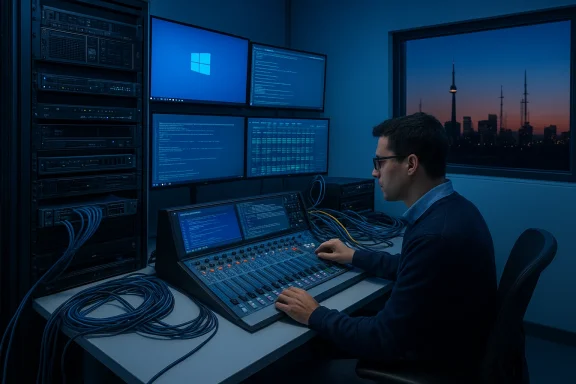
CHIN Radio/TV International is hiring an Information Technology (IT) / Broadcast Technician — a hands‑on role that sits squarely at the intersection of traditional RF engineering and modern IT operations. The posting describes a full‑time, in‑person position based in Toronto that pairs frontline IT support (Office 365, Windows and Linux servers, SQL Server, PowerShell) with classic broadcast responsibilities: configuring audio routing, maintaining transmitters and audio processors, managing site‑to‑transmitter links (STLs) and IP multicast networks, and implementing failover strategies to keep AM/FM, HD and streaming services on air. The employer notes access to Wheatstone consoles, traffic and music scheduling systems, DAWs, analog/digital audio interfaces and RF transmission systems — a clear signal that this is a role geared to someone who wants practical, mixed IT/broadcast experience rather than purely theoretical work. (Job copy provided by the hiring announcement.)
CHIN Radio/TV International is one of Canada’s long‑standing multicultural broadcasters, operating multiple AM and FM services that target Toronto’s diverse communities. The organization’s public materials describe a portfolio that reaches dozens of language communities across Greater Toronto and Southern Ontario. CHIN’s legacy as a multicultural broadcaster and its continued operation on AM and FM make the maintenance of legacy RF infrastructure just as important as day‑to‑day IT reliability.
At the same time, radio engineering has moved decisively toward IP convergence. Modern studios and transmission chains increasingly depend on Audio‑over‑IP (AoIP) consoles, IP multicast for distribution, virtualized automation servers and cloud‑backed streaming. The CHIN posting reflects that hybrid reality: candidates are expected to handle both transmitter site work and the configuration and troubleshooting of IP, virtual and cloud systems. The skillset is therefore broad and practical, blending wired and RF diagnostics, server administration and careful network design.
Why that matters in practice: AoIP devices rely heavily on multicast and precise timing; misconfigured switches (IGMP snooping, querier behavior) or missing QoS can make audio disappear or cause dropouts. The job’s explicit call for IP multicast know‑how is therefore sensible and necessary.
Typical progression:
At the same time, candidates should be honest about gaps. If you have never managed multicast or haven’t seen an RF transmitter in the field, be transparent and show a plan to upskill quickly. The most common operational risks are network configuration failures, insufficient documentation and under‑engineered remote access. A small team must therefore prioritize monitoring, repeatable procedures and conservative change control to prevent accidental on‑air interruptions. Industry material from automation vendors and transmitter manufacturers underscores the need for redundancy and thorough testing during any upgrade or migration.
One last practical note: the posting lists benefits and RRSP matching but does not publish a salary. That’s common for some local broadcaster postings; expect to ask about salary bands and on‑call expectations early in the interview process and to confirm any additional certifications or safety training the employer will provide.
Conclusion
CHIN’s Information Technology (IT) / Broadcast Technician role is a clear example of modern broadcast engineering in action: a hybrid job that demands both IT discipline and broadcast practicality. The position offers excellent hands‑on learning — from Wheatstone AoIP consoles to transmitter maintenance — and it requires the kind of agility that comes from working in production environments where a single mistake can take a station off the air. Candidates with an appetite for mixed‑mode engineering, a willingness to learn multicast and virtualization, and a readiness for fieldwork will find real career value here. For CHIN, hiring someone who can bridge IT and RF reliably is not just convenience; it’s mission critical — the technical heartbeat of a multicultural broadcaster whose content matters to communities across Toronto.
Source: Broadcast Dialogue Information Technology (IT)/Broadcast Technician - Broadcast Dialogue
 Background / Overview
CHIN Radio/TV International is one of Canada’s long‑standing multicultural broadcasters, operating multiple AM and FM services that target Toronto’s diverse communities. The organization’s public materials describe a portfolio that reaches dozens of language communities across Greater Toronto and Southern Ontario. CHIN’s legacy as a multicultural broadcaster and its continued operation on AM and FM make the maintenance of legacy RF infrastructure just as important as day‑to‑day IT reliability.At the same time, radio engineering has moved decisively toward IP convergence. Modern studios and transmission chains increasingly depend on Audio‑over‑IP (AoIP) consoles, IP multicast for distribution, virtualized automation servers and cloud‑backed streaming. The CHIN posting reflects that hybrid reality: candidates are expected to handle both transmitter site work and the configuration and troubleshooting of IP, virtual and cloud systems. The skillset is therefore broad and practical, blending wired and RF diagnostics, server administration and careful network design.
What the job says — a practical breakdown
IT support (on‑site and remote)
- Provide front‑line support for on‑air systems, office servers and endpoints, phone sets and peripherals.
- Work independently and collaborate with peers; remote support capabilities are valued.
- Required familiarity with Office 365, Windows Server, Linux, SQL Server and PowerShell (scripting for automation and troubleshooting).
Technical operations (control room / studio / transmitter)
- Configure audio signal routing and program studio control rooms and live remote setups.
- Maintain and upgrade automation systems, audio consoles and IP audio infrastructure (converged IT/Broadcast equipment).
- Expected exposure to Wheatstone systems, DAWs and traffic/music scheduling systems.
Broadcast continuity & failover
- Maintain continuous on‑air status for AM/FM, HD channels and streaming services.
- Implement failover to automation systems for rapid recovery during planned or unplanned outages.
Systems maintenance & networks
- Keep transmitters, audio processors, automation servers, STLs, IP VPN links and IP multicast networks healthy and resilient.
- Analyze trends to improve operational resiliency.
Collaboration, communication & travel
- Work with Radio Operators and both technical/non‑technical staff.
- Regular travel across the GTA to transmitter sites and remote broadcast locations; flexible scheduling is required.
- Good written documentation skills are called out as an asset.
Why this role matters now: convergence, resilience and local media
The CHIN posting is a microcosm of the broader evolution in broadcast engineering. For decades, radio engineering was largely about RF — transmitters, antennas, analog audio chains. Today, every part of the signal chain accepts IP as a first‑class transport: studio consoles, routing fabrics, automation servers and even STLs are operated over IP networks that also carry corporate traffic. That convergence offers big benefits (flexibility, remote production, consolidated monitoring) but it also introduces IT challenges: multicast, VLAN segmentation, QoS, path redundancy, virtualization, security and latency control. The posting’s mix of RF and IT requirements is therefore not eclectic — it’s practical and necessary. Audinate, Wheatstone and other vendors have pushed AES67/AoIP interoperability into mainstream broadcast deployments; the job listing’s mention of AoIP knowledge (and Wheatstone access) is consistent with that industry direction.Technical realities and vendor specifics (verified)
Audio‑over‑IP (AoIP) and AES67 interoperability
The job asks for familiarity with AoIP signals and their integration. AES67 is the Audio Engineering Society’s interoperability profile that allows different AoIP systems to exchange audio streams at the RTP layer. Dante (Audinate) supports AES67 interoperability; Wheatstone’s WheatNet‑IP systems also integrate with AES67 workflows. This means an engineer who understands multicast RTP streams, timing and network QoS will be able to work across devices from multiple vendors.Why that matters in practice: AoIP devices rely heavily on multicast and precise timing; misconfigured switches (IGMP snooping, querier behavior) or missing QoS can make audio disappear or cause dropouts. The job’s explicit call for IP multicast know‑how is therefore sensible and necessary.
Network hardware: Cisco and Ubiquiti
The posting lists corporate network and virtualization tech such as NAS, Cisco and Ubiquiti. Both vendor families are common in broadcast facilities: Cisco for enterprise‑grade switching and routing, Ubiquiti for cost‑effective Wi‑Fi and edge switching. However, real‑world experience shows that Ubiquiti UniFi environments sometimes require careful configuration for multicast and mDNS/Bonjour traffic used by audio device discovery — enabling IGMP snooping, multicast enhancement and the correct IGMP querier behavior are common troubleshooting points. In other words, the presence of Ubiquiti equipment is practical — but multicast and AoIP add operational nuance.Virtualization (Hyper‑V) and server platforms
The posting highlights Hyper‑V and corporate virtualization. Microsoft Hyper‑V is a supported choice for broadcasting servers and virtualized playout systems; Hyper‑V’s tooling (replication, clustering, VM live migration) is widely used to build resilient server platforms. Experience with Hyper‑V, Windows Server and Linux support are therefore realistic requirements for a modern broadcast tech role.IP Codecs, SIP, VoIP, AoIP integration
IP codecs and SIP/VoIP are used to connect remote reporters and external feeds, and also for telephone hybrids. Comrex, Tieline, Telos and others provide IP codec solutions that integrate into playout systems. Engineers with SIP and codec experience will understand how to route live remotes, secure sessions and troubleshoot codec negotiation and latency — skills the listing explicitly values. (This is an area where vendor documentation and hands‑on testing are essential; protocol behavior varies between manufacturers.)Strengths signalled by the posting
- Cross‑skill exposure. The job provides hands‑on experience with both RF infrastructure and modern IT environments — a fast path to becoming a well‑rounded broadcast technologist.
- Vendor access and training opportunities. The mention of Wheatstone consoles, DAWs and traffic/automation systems points to a role where you’ll use professional audio systems rather than just patch cables.
- Community and mission. CHIN’s multicultural remit and local focus provide concrete, visible outcomes — keeping community programming on air — which can be highly motivating for staff who like mission‑driven work.
- Benefits & stability. The posting lists group benefits, RRSP matching, vacation and stat holidays — signals that the employer is offering a standard Canadian benefits package for a permanent hire (though exact salary is not listed).
Risks, tradeoffs and operational realities candidates should know
- Broad remit means rapid context switching. Expect to move from desktop support to RF site climbs in a single day. That requires physical readiness and an ability to prioritise urgent on‑air failures over scheduled IT projects.
- Multicast and network complexity. AoIP depends on correct multicast handling, IGMP snooping and querier configuration. Cheap or misconfigured network gear can break device discovery and audio flows; UniFi/Ubiquiti deployments sometimes require custom gateway config or IGMP proxy tweaks to be reliable in production AoIP environments. Candidates who haven’t managed multicast at scale will face a learning curve.
- Safety and site hazards. Work at transmitter sites involves weather exposure, climbing and dealing with high‑voltage equipment; the posting explicitly mentions working in various weather conditions and altitudes and requires a clean driving abstract. RF safety and tower‑work rules are real hazards; the employer may expect familiarity or at least willingness to certify for safe site visits.
- Legacy systems and regulatory pressure. AM transmitters and older processing chains can be temperamental and require parts or expertise that are increasingly rare. Broadcasting organizations often balance maintenance of aging RF fleets with investments in IP streaming and automation — which can strain team resources. CHIN’s dual requirement to maintain AM/FM and HD/streaming is an example of that tradeoff.
- Security and remote access exposure. Remote monitoring and STLs make life easier, but they expand the attack surface. Best practice requires segmented networks (separate VLANs for AoIP and corporate traffic), hardened remote access and a vulnerability remediation program. Large‑scale broadcaster guidance echoes these controls.
How to evaluate the role as a candidate: checklist and interview questions
Must‑have technical checklist
- Comfortable with Windows Server and Linux administration.
- Practical PowerShell skills for scripting, automation and diagnostics.
- Basic SQL Server familiarity for playout/automation database troubleshooting.
- Experience with virtualized environments (Hyper‑V) and NAS storage workflows.
- Hands‑on network experience: VLANs, IGMP, multicast, QoS and firewall rules.
- Basic RF/transmitter knowledge or demonstrated eagerness to learn safe transmitter practices.
Nice‑to‑have
- Hands‑on with AoIP consoles (Wheatstone/WheatNet, Dante ecosystem).
- Experience with IP codecs (Comrex, Tieline) and SIP troubleshooting.
- Experience with broadcast automation systems and traffic/music scheduling.
- Valid driver’s license and clean driving record (explicitly required).
Suggested interview questions
- Describe a time you diagnosed and fixed a multicast audio dropout. Which tools and switches did you use?
- How have you used PowerShell (or equivalent) to automate a recurring maintenance task or to triage an outage?
- Explain how you would design network segmentation for a small radio facility that needs AoIP, office IT and guest Wi‑Fi.
- What steps do you take to harden an IP codec or SIP endpoint that must accept incoming connections from outside your corporate network?
- Tell us about any RF or transmitter site work you’ve done. How do you prepare for a tower climb or cold‑weather site visit?
Recommended onboarding and training plan for CHIN (practical and low‑cost)
- Immediate: instrument the network with a basic monitoring stack (SNMP + host/port checks) and document all audio flows and multicast groups.
- Short term (30–90 days): build a lab to replicate AoIP flows (one Wheatstone/Dante/AES67 device or software emulator, a managed switch with IGMP snooping) to reproduce issues and test firmware/patches safely.
- Medium term: create a redundancy playbook — documented steps and automation for playout failover, DNS‑based stream failover, and contact escalation for transmitter hardware failures.
- Ongoing: vendor‑led training on Wheatstone and automation systems; safety training for transmitter site work and tower‑access certification as required.
Career path and development — why this role is attractive
For technologists who want to be “practical integrators,” this role is a strong career move. You’ll learn RF maintenance (transmitters, antennas), AoIP and studio routing, server virtualization, network engineering and broadcast automation — a combination that makes you highly hireable at regional and national broadcasters, live sports production houses and systems integrators.Typical progression:
- IT/Broadcast Technician (hands‑on)
- Senior Broadcast Engineer / Systems Integrator
- Broadcast IT Manager / Head of Engineering
- Consultant or systems integrator for multi‑site broadcast networks
Practical application tips for candidates
- Tailor your resume to highlight both IT and broadcast experience: list specific consoles, audio routing systems, virtualization platforms and any transmitter/site work.
- Bring examples: a short case study (one page) of a multicast problem you fixed, a PowerShell script you wrote to automate a routine check, or a network diagram you created for a lab.
- Be explicit about safety and mobility: confirm you have a valid driver’s license and can carry out travel to transmitter sites.
- Prepare to demonstrate troubleshooting: many interviews for this role include live troubleshooting scenarios or whiteboard exercises covering network flows and failover steps.
Final assessment — strengths, gaps and what to watch for
CHIN’s listing is a pragmatic invitation for engineers who want to learn — and apply — a broad set of skills in a small team environment. The role promises exposure to professional Wheatstone systems and real transmitter maintenance while demanding the routine discipline of IT operations. That combination is a significant professional accelerator.At the same time, candidates should be honest about gaps. If you have never managed multicast or haven’t seen an RF transmitter in the field, be transparent and show a plan to upskill quickly. The most common operational risks are network configuration failures, insufficient documentation and under‑engineered remote access. A small team must therefore prioritize monitoring, repeatable procedures and conservative change control to prevent accidental on‑air interruptions. Industry material from automation vendors and transmitter manufacturers underscores the need for redundancy and thorough testing during any upgrade or migration.
One last practical note: the posting lists benefits and RRSP matching but does not publish a salary. That’s common for some local broadcaster postings; expect to ask about salary bands and on‑call expectations early in the interview process and to confirm any additional certifications or safety training the employer will provide.
Conclusion
CHIN’s Information Technology (IT) / Broadcast Technician role is a clear example of modern broadcast engineering in action: a hybrid job that demands both IT discipline and broadcast practicality. The position offers excellent hands‑on learning — from Wheatstone AoIP consoles to transmitter maintenance — and it requires the kind of agility that comes from working in production environments where a single mistake can take a station off the air. Candidates with an appetite for mixed‑mode engineering, a willingness to learn multicast and virtualization, and a readiness for fieldwork will find real career value here. For CHIN, hiring someone who can bridge IT and RF reliably is not just convenience; it’s mission critical — the technical heartbeat of a multicultural broadcaster whose content matters to communities across Toronto.
Source: Broadcast Dialogue Information Technology (IT)/Broadcast Technician - Broadcast Dialogue
