Choosing the Right AI Personal Finance Assistant: ChatGPT Gemini Copilot Claude

  • Thread Author
AI personal‑finance assistants are no longer curiosities — they are practical tools that can speed up budgeting, summarize dense plan documents, and automate spreadsheet work, but choosing the right one requires matching capabilities to where your data lives, how much auditability you need, and how you plan to verify results.

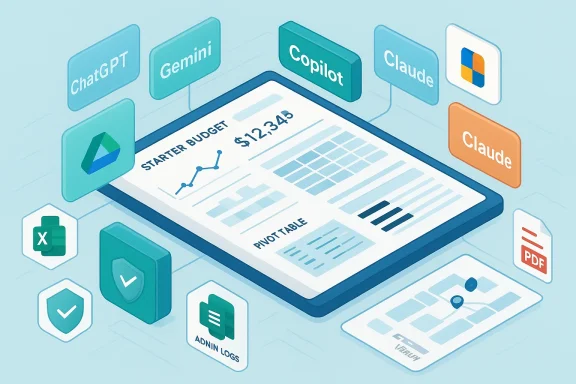
Tablet displays a starter budget with charts, surrounded by floating AI-tool icons.Background​

AI assistants such as ChatGPT, Google Gemini, Microsoft Copilot, and Anthropic Claude have moved from experimental chatbots to integrated productivity features. They share common underlying technologies — large language models, retrieval layers, and connector APIs — but their real-world value for personal finance stems from differences in ecosystem integration, context‑window capacity, privacy controls, and governance options. These practical differences determine whether an assistant is merely handy for learning or actually useful for reconciling bank statements, reviewing 401(k) plan PDFs, or automating Excel scenarios.
Across multiple hands‑on comparisons and vendor documentation, three evaluation axes repeatedly determine suitability for money work:
  • Where your data lives (Google Drive, Microsoft 365, local files, or multiple places).
  • Grounding and provenance (web retrieval, authenticated connectors, or manual paste).
  • Governance and privacy (non‑training clauses, tenant grounding, admin logs, data residency).
This article summarizes the practical strengths and gaps for each assistant, explains safe workflows for everyday tasks, and provides a pragmatic rollout plan for individuals and small teams. It flags unverifiable claims and highlights risk mitigation strategies you should adopt before feeding any financial data to an AI.

Quick comparative snapshot​

  • ChatGPT — Best generalist for learning, drafting, and plugin‑driven automation. Strong at plain‑English explanations and iterative drafting; broad plugin ecosystem for connectors.
  • Gemini — Best for Google Workspace users. Seamless with Gmail, Drive, Docs, and Sheets; good at exporting parsed statements to Sheets and pulling live web data.
  • Microsoft Copilot — Best for Windows and Microsoft 365 tenants. Deep Excel automation and tenant grounding with admin logging and Purview integration for auditable trails.
  • Claude — Best for long documents and conservative summarization. Designed for very large context windows and safety‑first responses, useful when you need auditable, traceable summaries of lengthy disclosures.
These role assignments are driven more by ecosystem access and governance than by marketing claims about model “IQ.” Practical choice depends on the specific finance task and the surrounding controls you require.

Deep dive: ChatGPT — the flexible generalist​

What ChatGPT does exceptionally well​

ChatGPT excels at conversational explanations, iterative drafting, and rapid prototyping of budgets and emails. It’s the fastest on‑ramp for turning messy notes or a cleaned CSV into a readable monthly budget or a debt‑repayment plan. The platform’s plugin and Custom GPT ecosystems enable authenticated connectors and automated exports when configured correctly, which makes ChatGPT a versatile drafting hub.

Practical use cases​

  • Converting a redacted bank CSV into categorized expenses and a starter budget.
  • Explaining Roth vs. Traditional contributions in plain English for a particular tax bracket.
  • Drafting concise follow‑up questions for your financial advisor after uploading meeting notes.

Strengths and limits​

  • Strength: natural language fluency and broad plugin marketplace that enables secure connectors without pasting credentials in many cases.
  • Limit: Grounding depends on retrieval modes or plugins. Without explicit retrieval, jurisdictional rules and up‑to‑date market rates may be out of date. Hallucinations — confidently stated inaccuracies — remain a real risk for computed totals and legal/tax interpretations. Verify figures programmatically in spreadsheets.

Best fit​

Individuals who want plain‑English teaching, drafting, and a flexible automation hub — especially if they are comfortable pairing ChatGPT with a citation‑forward verification tool.

Deep dive: Google Gemini — Workspace‑native and web‑grounded​

What Gemini does best​

Gemini is optimized for users who keep their finance data in Google Drive and Sheets. It simplifies extracting invoices and statements into structured Sheets with formulas and scenario tabs and can pull live web data (e.g., current mortgage indices or FX rates) when configured with Google’s retrieval layers. If your workflow revolves around Gmail, Drive, Docs, and Sheets, Gemini reduces friction dramatically.

Practical use cases​

  • Summarizing an inbox of billing emails and placing vendor totals in a Sheets reconciliation tab.
  • Exporting a Drive‑stored PDF statement into a working spreadsheet with prebuilt formulas.
  • Quick web‑grounded checks of market headlines or interest‑rate changes.

Strengths and limits​

  • Strength: direct Sheets export and seamless Drive integration that streamlines reconciliation tasks.
  • Limit: Ecosystem lock‑in. The best value requires Workspace connectivity, which introduces governance tradeoffs if shared Drives hold sensitive files. Confirm data‑use and non‑training contractual language for business plans before uploading regulated documents.

Best fit​

Users heavily invested in Google Workspace who favor quick spreadsheet exports and live web grounding.

Deep dive: Microsoft Copilot — tenant grounding and Excel automation​

What Copilot does best​

Copilot shines inside Microsoft 365: it generates complex Excel formulas, reconciles across multiple workbooks, and drafts context‑aware emails in Outlook or SharePoint. Copilot’s tenant grounding, Microsoft Graph integration, and Purview logging provide audit trails and admin controls that enterprise or privacy‑sensitive users need. That governance posture is why small businesses and regulated workflows often prefer Copilot when their files already live in a Microsoft tenant.

Practical use cases​

  • Reconciling payroll exports across Excel sheets stored in SharePoint within a tenant.
  • Generating template‑consistent creditor negotiation emails from meeting notes in Outlook.
  • Running tenant‑scoped Excel macros or formula generation on protected workbooks.

Strengths and limits​

  • Strength: governance and auditable tenant grounding — Copilot supports SSO, admin controls, and logging that are critical for regulated finance tasks.
  • Limit: Copilot’s advantages diminish if your finance data lives outside Microsoft 365. Licensing and SKU complexity require careful verification of which Copilot capabilities are included in a particular plan.

Best fit​

Windows and Microsoft 365 users who need deep Excel power combined with enterprise controls.

Deep dive: Claude — long‑context specialist and conservative summarizer​

What Claude does best​

Anthropic Claude is designed for long‑form reasoning and conservative outputs. It can ingest very large documents in a single session and tends to produce outputs that prefer caution over confident but potentially wrong assertions. This makes Claude a strong fit for summarizing multi‑year financial statements, plan documents, or regulatory disclosures where traceability and auditable phrasing matter.

Practical use cases​

  • Summarizing a lengthy 401(k) plan document and producing a short list of action items to discuss with an advisor.
  • Producing conservative, traceable narratives for regulator‑facing communications or creditor negotiations.
  • Handling batch processing of long PDFs, provided you model token costs carefully.

Strengths and limits​

  • Strength: very large context windows and a safety‑first posture that reduces confident hallucinations and yields auditable summaries. Paid tiers advertise hundreds of thousands to enterprise‑scale token windows for very long documents.
  • Limit: long‑context processing can be pricey due to token economics; public usage metrics may undercount private enterprise deployments. Test token costs before scaling.

Best fit​

Users who must process long, complex documents and prioritize conservative, auditable outputs.

Common practical tasks and exactly how to approach them​

1. Budget audit from a bank CSV​

  • Step 1: Export transactions into a CSV and redact account numbers or SSNs.
  • Step 2: Use an assistant to classify transactions into categories, flag subscriptions, and produce a starter monthly budget.
  • Step 3: Verify all computed totals in Excel/Sheets using pivot sums or cross‑sums rather than relying solely on the assistant’s narrative totals.

2. Explain a 401(k) match and vesting schedule​

  • Upload the plan PDF (redacted) or paste key clauses. Ask the assistant to summarize vesting rules, employer match formula, and possible action items. Use Claude or a long‑context mode if the document is very long. Cross‑check fee figures and legal language against the original plan document.

3. Debt management and scenario planning​

  • Provide a cleaned spreadsheet with balances, interest rates, and payment terms. Ask for multiple payoff scenarios (snowball vs. avalanche) and have the assistant compute interest savings. Validate formulas in Excel/Sheets and test edge cases (deferred interest, variable rates).

4. Drafting correspondence​

  • Use the assistant to draft polite, concise emails to HR or creditors. Keep drafts as first passes — human review is essential before sending. Claude and ChatGPT both perform well for drafting; Copilot will produce tenant‑scoped drafts if your mail is in Outlook.

Safety and privacy checklist — non‑negotiables​

Before using any assistant for finance tasks:
  • Turn on multi‑factor authentication (MFA) and strengthen account security.
  • Prefer OAuth connectors and read‑only scopes where available; never paste credentials into a chat window.
  • Strip or redact direct identifiers (bank account numbers, routing numbers, Social Security numbers) before uploading documents.
  • For regulated data, insist on enterprise contracts with explicit non‑training clauses and data residency terms. Don’t assume consumer plans provide these protections.
  • Keep a human validation gate for any action that moves money, files taxes, or changes legal standing.
Flag any vendor claims about exact model rollout dates, precise context window sizes, or single‑quarter pricing as provisional; packaging and pricing change rapidly, and these details should be verified on the vendor’s current documentation before committing.

Hallucinations, provenance, and verification strategies​

Hallucinations — plausible but incorrect assertions — are the most consequential technical failure mode for finance prompts. Independent testing has documented that assistants can invent figures, misattribute allowances, or apply tax rules incorrectly. The recommended mitigations are:
  • Use retrieval‑grounded modes or a citation‑forward verification tool that returns sources for factual claims.
  • Adopt a two‑assistant workflow: one assistant for drafting (high fluency) and a second, citation‑first tool (or manual sourcing) for verification.
  • Programmatically verify computed totals in a spreadsheet (pivot sums, checksums) rather than relying on narrative totals.
In short: treat AI output as a high‑quality draft that requires human and programmatic verification before acting on it financially.

Pricing, context windows, and token economics — what to watch​

  • Consumer premium tiers for many assistants often cluster in a similar price band (commonly around $19–$20/month) for advanced consumer access, but enterprise SKUs vary widely. Compare plan features, not just price.
  • Claude and other long‑context models price long documents differently — token economics can dominate monthly costs for high‑volume document processing. Pilot with representative documents to estimate spend.
  • Copilot enterprise and tenant offerings may carry per‑user add‑on costs that differ from consumer bundles; verify which SKU contains the features you need (Excel automation, agents, tenant grounding).
Flag: Any quoted context window size, single‑quarter price, or model rollout should be verified against current vendor documentation before purchase because packaging is frequently updated.

A pragmatic rollout checklist (7–14 day pilot)​

  • Map primary finance tasks (top 2–3) you want to accelerate: budgeting, 401(k) summaries, debt planning.
  • Create redacted/sandbox files for testing. Remove account numbers and SSNs.
  • Pilot two assistants per task (one drafting assistant + one verification assistant). Measure accuracy, time saved, and token/quota usage.
  • Confirm data‑use clauses and enable privacy settings (non‑training, data residency) before processing regulated documents.
  • Require human approval for any action that moves money, files taxes, or legally binds you. Keep logs and snapshots of AI outputs used in decisions.

Critical appraisal — strengths, risks, and where vendors overclaim​

Notable strengths​

  • Modern assistants deliver real, measurable productivity gains for drafting, spreadsheet automation, and summarizing long documents when matched to the right ecosystem.
  • Governance features (tenant grounding, admin logs, non‑training contractual options) are now available and are decisive for regulated workflows.

Significant risks​

  • Hallucinations and synthesis errors remain persistent and dangerous for finance tasks. Even polished narrative outputs can hide miscomputed totals or false legal interpretations.
  • Privacy and contractual ambiguity: consumer chats may be used for training unless you explicitly select a plan or contract that excludes training. Don’t assume privacy defaults protect regulated data.
  • Cost volatility: token economics, per‑token API pricing, and enterprise surcharges for long‑context processing mean that heavy usage can quickly exceed simple subscription fees.

Where vendors tend to overclaim​

  • Fixed numbers for context window sizes, single‑quarter pricing, or precise model rollout timelines. Treat these as provisional and verify current vendor documentation before planning large‑scale use.

Final recommendations — pick, pilot, and pair​

  • If you primarily want plain‑English explanations and rapid drafting: start with ChatGPT, then pair it with a citation‑first verification tool for facts and totals.
  • If your finance documents live in Google Drive/Sheets: choose Gemini for the fastest path from a PDF or email to a working spreadsheet and for web‑grounded facts.
  • If you operate inside Microsoft 365 and need governance and Excel automation: deploy Copilot under tenant contracts. Enforce admin controls and audit logging.
  • If you must process very long documents and prioritize conservative, auditable language: evaluate Claude while modeling token costs.
Adopt purposeful pluralism: use one assistant to draft and another to verify. For most people, the safest approach is a short pilot (7–14 days) on the two most important finance tasks, measure accuracy and cost, then decide whether to upgrade to paid or enterprise tiers based on measured gains.

Conclusion​

AI assistants can materially accelerate everyday money tasks — from producing tidy starter budgets to summarizing dense plan documents — but they are not substitutes for licensed financial or legal advice. The practical choice among ChatGPT, Gemini, Copilot, and Claude depends less on model marketing and more on ecosystem fit, grounding, governance, and how you will verify outputs. Treat AI as a drafting partner, insist on human and programmatic verification for financial numbers, avoid pasting sensitive identifiers, and confirm contractual privacy guarantees before processing regulated data. With careful piloting and basic controls in place, these tools can be powerful productivity enhancers; without those controls, they risk producing convincing mistakes with real financial impact.

Source: newspressnow.com Comparing AI personal finance assistants: ChatGPT, Gemini, Copilot and Claude
 

AI personal‑finance assistants are no longer novelty chatbots — they’re practical tools that can speed budgeting, reconcile statements, summarize dense plan documents, and automate spreadsheet work, but choosing between ChatGPT, Google Gemini, Microsoft Copilot and Anthropic Claude requires matching capabilities to where your data lives, how much auditability you need, and how you plan to verify outputs.

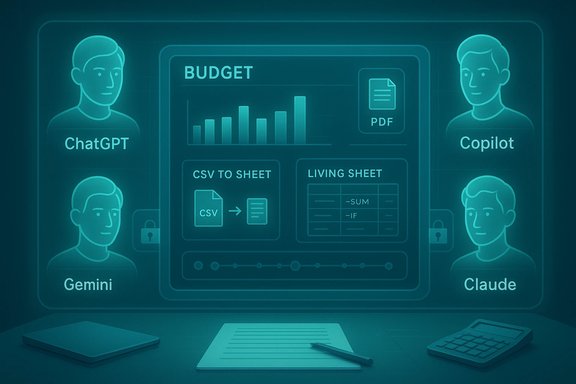
Futuristic budget dashboard projected on a wall, flanked by avatars ChatGPT, Gemini, Copilot and Claude.Background / Overview​

The consumer and enterprise AI assistants that matter for personal finance have converged into four practical product positions: ChatGPT as a flexible generalist and plugin hub; Gemini as Google’s Workspace‑native, web‑grounded assistant; Microsoft Copilot as the tenant‑grounded productivity copilot for Windows and Microsoft 365; and Claude as a safety‑first, long‑context specialist. These roles shape which assistant is best for budgeting, transaction reconciliation, long PDF summaries, spreadsheet automation and other money workflows.
Across hands‑on tests and vendor docs, three evaluation axes determine practical suitability and risk:
  • Where your data lives (Drive, OneDrive/SharePoint/Excel, local files).
  • Grounding and provenance (live web retrieval, OAuth connectors, citation‑forward modes).
  • Governance and privacy (non‑training contractual commitments, tenant isolation, admin logs).
The Fredericksburg summary and subsequent practical tests emphasize the same point: ecosystem access, connector design, and auditability matter more than headline model claims.

Quick snapshot — which assistant for which job​

  • ChatGPT — Best generalist for drafting, iterative work, and plugin‑driven connectors. Great for plain‑English explanations and rapid templates.
  • Gemini — Best for Google Workspace users who want tight integration with Drive, Gmail, Docs and native export to Sheets. Ideal when a live web grounding or quick spreadsheet export matters.
  • Microsoft Copilot — Best for Microsoft 365/Windows tenants that need tenant controls, Purview auditing and deep Excel automation. Choose Copilot when governance (SSO, audit logs, DPA) is a procurement requirement.
  • Claude — Best for long‑document ingestion and conservative, auditable summaries; recommended for multi‑year statements and regulatory narratives where traceability is essential.

ChatGPT — the flexible generalist​

What it does well​

ChatGPT is excellent as a drafting and iteration engine: it turns messy meeting notes into follow‑ups, converts CSV exports into categorized budgets, and drafts negotiation templates and emails quickly. Its plugin ecosystem and custom GPTs let users add authenticated connectors for pulling transaction data or exporting spreadsheets when configured securely. OpenAI’s consumer premium tier (ChatGPT Plus) is commonly priced at $20/month for individual users.

Strengths​

  • Low friction for drafting: Fast on‑ramp to create budgets, letters to creditors, or plain‑English tax checklists.
  • Plugin ecosystem: Connectors and Actions can automate exports to Sheets or trigger external workflows when you use verified integrations.

Limitations and risks​

  • Grounding depends on connectors or retrieval modes. Ungrounded sessions can return out‑of‑date or incorrect numbers.
  • Training‑data and privacy defaults vary by plan. Consumer chats can be used to improve models unless you opt out or buy business/enterprise plans with contractual non‑training guarantees. Verify the specific data‑use terms in your account or contract.

Gemini — Google’s Workspace‑native assistant​

What it does well​

Gemini’s strength is native integration with Google Drive, Docs and especially Sheets — the path from a PDF or email to a working spreadsheet is often a single click. Its web grounding and Deep Research features can pull recent market headlines, mortgage or FX rates and fold them into a report. Users on paid Google AI plans commonly see a consumer price point similar to other premium assistants.

Strengths​

  • Export to Sheets / Docs: Built‑in flows that convert parsed statements and tables into Sheets with formulas and scenario tabs.
  • Web‑grounded facts: Useful for pulling current rates and headlines into a planning conversation where citations are visible.

Limitations and risks​

  • Value tightly coupled to Workspace storage — storing sensitive financial docs in shared Drive folders creates governance trade‑offs.
  • Feature access depends on plan and region. Confirm which Workspace tier and Google One/Gemini features your account receives before sharing regulated documents.

Microsoft Copilot — tenant grounding and Office automation​

What it does well​

When your finance records are already in Excel, OneDrive, SharePoint or Outlook inside a Microsoft tenant, Copilot’s integration with Microsoft Graph and Purview provides powerful automation plus auditable trails that procurement teams value. Copilot can generate complex formulas, reconcile across workbooks, and surface tenant‑scoped drafts for emails and reports — all with admin controls exposed in the Microsoft 365 admin center.

Strengths​

  • Tenant isolation and governance: Admins can manage Copilot access, enforce policies, and retain audit logs and eDiscovery hooks through the Copilot control system and Purview.
  • Excel automation: Deep formula generation and workbook reconciliation within the tenant reduce the need to export sensitive spreadsheets externally.

Limitations and risks​

  • Cost and licensing complexity: Copilot licensing historically carries per‑user add‑ons; organizations must confirm which SKUs include specific agent features and whether SMB pricing options apply. Licensing documentation and partner briefings show SKU changes and bundled options that require verification at purchase.
  • Data movement assumptions: Copilot is most valuable when data stays inside the tenant; if your records live elsewhere, the Copilot advantage diminishes.

Claude — conservative, long‑context specialist​

What it does well​

Anthropic’s Claude is designed with a safety‑first posture and very large context windows for ingesting long PDFs and multi‑year financial statements. Where auditors, compliance teams or legal counsels require a conservative, traceable narrative, Claude’s tendency to decline to guess and to produce clearly structured assumptions is valuable. Anthropic documents and pricing confirm extended context windows (including a 1M‑token beta for Sonnet models) — a material factor when processing very large documents without fragmenting the analysis.

Strengths​

  • Large context support: Long‑context models reduce the need to split documents and risk losing cross‑document traceability.
  • Conservative defaults: Claude often flags uncertainty rather than fabricating answers — useful in regulatory or fiduciary contexts.

Limitations and risks​

  • Token economics: Long‑context requests are priced at a premium once they exceed vendor thresholds; Anthropic’s docs show premium rates for inputs above 200K tokens and specific access tiers for 1M tokens. Plan for token costs if you intend to process many multi‑page PDFs.
  • Distribution and support: Public telemetry may undercount private enterprise deployments; confirm availability and support for the exact Sonnet tier you need.

Security, privacy and compliance — the non‑negotiables​

Personal finance data is among the most sensitive personal information. Independent guidance and vendor documentation converge on a practical checklist:
  • Use OAuth‑based connectors and read‑only scopes whenever possible; never paste credentials into chat.
  • Prefer enterprise/non‑training contractual guarantees for regulated work; confirm the exact contractual language before sending regulated documents. OpenAI, Anthropic and Google offer business/enterprise contracts with differing terms around model training and data handling — verify with your vendor rep.
  • Require human review gates for any action that moves money, alters accounts, or files taxes. Treat AI outputs as high‑quality drafts, not final legal or tax advice.
  • Retain audit trails and logs. If your workflow requires traceability, prefer tenant‑grounded deployments with admin logging (Microsoft’s Purview + Copilot control system are explicit about these features).

Hallucination and provenance — why this matters for finance​

Hallucinations (confident but incorrect outputs) are the most consequential failure mode for money work. Academic reviews and recent research confirm that LLMs still produce fabrications, especially in domain‑specific and high‑stakes contexts like finance and law. The best mitigations are multi‑layered:
  • Use retrieval‑augmented generation (RAG) or citation‑forward modes that surface sources for factual claims.
  • Adopt a two‑assistant workflow: one assistant for drafting and another citation‑first tool (or manual checking) for verification.
  • Programmatically verify computed totals inside spreadsheets (pivot sums, checksums) rather than trusting narrative totals.
Academic surveys show mitigation strategies (structured prompts, retrieval layers, domain fine‑tuning) reduce hallucinations but do not eliminate them — human verification remains essential.

Pricing, context windows and token economics — what to watch​

  • Consumer premium tiers for core assistants frequently cluster near the $20/month mark for individual users (ChatGPT Plus at $20/month is documented by OpenAI). Enterprise plans vary by SKU and often include non‑training guarantees and higher context windows.
  • Long‑context pricing matters. Anthropic documents show premium billing once requests exceed thresholds (e.g., >200K input tokens triggers long‑context rates, with 1M token windows available under beta or higher‑tier contracts). Expect token costs to dominate if you batch heavy PDF processing.
  • Copilot licensing is per‑user and historically carried add‑on complexity; Microsoft’s Copilot offerings and SMB variants have been adjusted, so verify which SKU and per‑user price apply to your tenant before rolling out.

Recommended pilot and rollout checklist (practical, 7–14 day pilot)​

  • Map the top 2–3 finance tasks you want to accelerate (budgeting, 401(k) plan summarization, transaction reconciliation).
  • Create sandbox or redacted files (remove account numbers, SSNs).
  • Run identical prompts across two assistants (one drafting assistant + one verification assistant). Measure time saved, error rates and costs.
  • Use OAuth connectors and confirm non‑training/data residency clauses for paid tiers before moving regulated documents.
  • Keep a human approval gate for any irreversible action (moving money, filing taxes).
  • Monitor token usage and quotas weekly; model token economics can escalate quickly for repeated long‑document jobs.

Practical workflows and example prompts​

  • “Summarize this 401(k) plan PDF and list five action items I can discuss with my advisor. Keep bullets under 12 words.” — Use Claude or a long‑context model for the summary and ChatGPT for drafting follow‑up questions.
  • “From this cleaned bank CSV, group expenses, flag subscriptions, and show a simple monthly budget.” — Start with ChatGPT for quick classification; export to Sheets with Gemini or to Excel with Copilot for formula validation.
  • “Explain Roth vs Traditional contributions in plain English for a W‑2 employee in a 24% bracket; add pros/cons.” — Draft in ChatGPT, then verify jurisdictional tax specifics with a tax professional; do not treat the AI as a substitute for a CPA.

Strengths, weaknesses and critical analysis​

Notable strengths​

  • Modern assistants deliver genuine productivity gains for routine finance tasks: drafting budgets, cleaning CSVs, and automating spreadsheet formulas. These gains are strongest when the assistant matches your ecosystem (Drive vs OneDrive/SharePoint vs local files).
  • Governance features (tenant grounding, audit logs, non‑training contractual options) are now mature enough that procurement buys governance as much as capability. This is the core reason enterprises prefer Copilot or enterprise editions of other assistants for regulated workflows.

Potential risks and weaknesses​

  • Hallucinations remain a material risk for computed totals and jurisdictional tax rules. Independent testing and academic reviews document persistent hallucination behavior in finance contexts; programmatic verification is required.
  • Token and licensing economics can make bulk document processing expensive. For high‑volume PDF ingestion, per‑token costs (especially for long‑context tiers) often eclipse simple subscription fees. Anthropic’s long‑context premium rates are an explicit example.
  • Rapid vendor packaging changes. Pricing and SKU definitions change frequently; any single price or context window claim should be verified against current vendor documentation before purchasing or committing to a rollout.

Bottom line — pick, pilot, pair​

The right AI personal‑finance assistant will be the one that aligns with where your data lives and how much governance you require:
  • If you want a flexible drafting environment and a large plugin ecosystem, start with ChatGPT and pair it with a verification tool for facts and totals.
  • If your workflows live inside Google Drive/Sheets, choose Gemini for the fastest path from a PDF or email to a working spreadsheet.
  • If you operate inside Microsoft 365 and need tenant controls, deploy Copilot under tenant contracts and use Purview and admin controls to retain audit trails.
  • If you must process very large documents and prioritize conservative, auditable language, evaluate Claude while modeling token costs.
Adopt a pragmatic pluralism: use one assistant for drafting and another for verification, pilot the two most important finance tasks for 7–14 days, and require human sign‑off for any action that affects your money or taxes. The productivity benefits are real — but they must be balanced with deliberate governance, verification and cost control.

Modern AI assistants can materially accelerate everyday money work, but the decision is no longer about which model is cleverest on paper — it’s about ecosystem fit, grounding, governance, and verification. Treat AI outputs as drafts, design human approval gates into workflows, and verify pricing and contractual terms before committing to high‑volume or regulated usage.

Source: Fredericksburg.com Comparing AI personal finance assistants: ChatGPT, Gemini, Copilot and Claude
 

Back
Top