

Google Chrome fixed CVE-2026-14152 on June 30, 2026, in Chrome 150.0.7871.47 for Windows and Mac, after disclosing an ANGLE out-of-bounds read/write flaw that could help an attacker escape the browser sandbox after first compromising the renderer process. The oddity is not that Chrome had another memory bug; the oddity is the gap between Chromium’s “Low” severity label and CISA’s critical CVSS score. For Windows users and administrators, that gap is the story: browser risk is now measured less by a single bug’s label than by how quickly a chained exploit can turn a web page into host-level access.
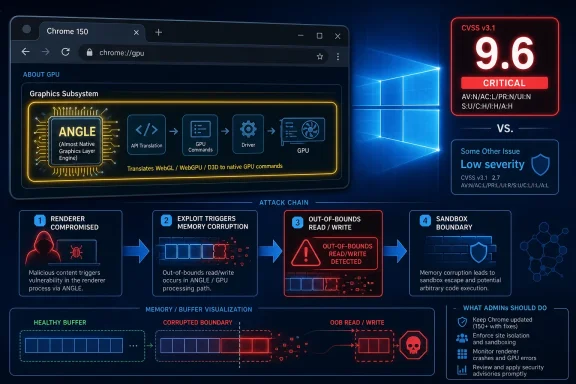
CVE-2026-14152 sits in ANGLE, the graphics translation layer used by Chromium to map web graphics APIs onto platform graphics back ends. In plain English, ANGLE is part of the machinery that lets a web page draw accelerated 2D and 3D graphics across Windows, macOS, Linux, and mobile hardware without every site having to understand the user’s GPU stack.
That makes ANGLE both useful and strategically exposed. Modern browsers intentionally place complex rendering, scripting, media, and graphics code near untrusted web content, then rely on process isolation and sandboxing to contain the blast radius when something goes wrong. A bug in that zone may not immediately mean “remote code execution on the PC,” but it can become one link in the exploit chain that gets an attacker there.
The National Vulnerability Database entry, sourced from Chrome and modified after enrichment, describes the issue as an out-of-bounds read and write in ANGLE before Chrome 150.0.7871.47. The stated attack path requires a remote attacker who has already compromised the renderer process and then uses a crafted HTML page to potentially escape the sandbox. That condition is why Chromium can call the bug “Low” while security teams still treat it with urgency.
This is the browser security paradox in 2026. The bugs that matter most in real-world attacks are often not lone “click once and own the box” vulnerabilities. They are stackable weaknesses: one bug gets code running in a renderer, another loosens a boundary, a third gives the payload a more durable foothold.
Those labels are not necessarily contradictory. Chromium’s severity system often reflects the bug’s role inside Chrome’s own exploit mitigation model. If a flaw requires the renderer to be compromised first, Chrome may rate it lower than a direct renderer remote-code-execution bug, because the attacker needs another step.
CVSS, by contrast, is trying to describe the consequence of successful exploitation in a standardized way. If the vulnerability changes security scope and can contribute to full compromise after user interaction, the score can become severe even when the vendor’s internal triage label looks modest. That is why CVSS can feel alarmist to browser engineers and why vendor severity can feel underpowered to enterprise defenders.
The practical reading is simple: do not let the word “Low” slow patching. In browser land, “requires a compromised renderer” is not a comfort blanket. Renderer bugs are among the most relentlessly hunted bug classes in the world, and exploit developers build chains precisely because browser vendors have made one-shot compromise harder.
WebGL, GPU acceleration, canvas rendering, video paths, and cross-platform graphics abstractions all live close to attacker-controlled input. A malicious page can send data into graphics code at enormous speed and complexity, and the browser has to decide which operations are legitimate, which are malformed, and which should be stopped before they touch memory they do not own. Out-of-bounds read/write bugs are particularly uncomfortable because they imply memory safety failure: code reached beyond the object or buffer it was supposed to access.
That does not automatically mean every vulnerable Chrome installation was one page view away from compromise. The CVE description explicitly says the attacker must already have compromised the renderer process. But that precondition also tells us where this bug fits: not as the opening move, but as the move that may make the opening move matter more.
For WindowsForum.com readers, the Windows angle is not that this was a Windows-only bug. It was fixed in Chrome builds for major desktop platforms. The Windows angle is that Chrome and Chromium-based browsers are now core enterprise runtime infrastructure on Windows PCs, and GPU-adjacent browser bugs are part of the workstation attack surface whether or not an organization thinks of itself as running “graphics workloads.”
That matters because CVE-2026-14152 did not arrive in isolation. Administrators are not being asked to react to one ANGLE bug in a calm month. They are being asked to keep pace with a browser release channel that is shipping hundreds of security fixes at a time, with some flaws described as sandbox-escape candidates and others sitting in adjacent high-risk components.
The Chrome release cadence is doing two things at once. It is clearly delivering fixes at a scale that would have looked absurd a decade ago. It is also turning patch verification into a constant operational discipline rather than a monthly event.
For unmanaged users, the answer is still mundane: open Chrome’s About page, let it check for updates, and restart the browser. For managed Windows fleets, the real work is policy hygiene. If update deferrals, pinned versions, VDI gold images, browser relaunch suppression, or third-party packaging processes delay Chrome past 150.0.7871.47, the organization has converted a patched vendor bug into a local exposure window.
For CVE-2026-14152, the relevant product is Google Chrome before 150.0.7871.47, and the NVD change history shows a CPE configuration being added for Google Chrome versions up to, but excluding, that fixed build. That is the core mapping most vulnerability tools need. But the Chromium ecosystem complicates the story.
Microsoft Edge, Brave, Vivaldi, Opera, Electron-based applications, embedded Chromium frameworks, and other downstream consumers do not all ship Google Chrome’s exact version number at the exact same time. A flaw in Chromium or a Chromium component may be fixed in Chrome first, then land elsewhere through each vendor’s own build, test, and release process. The CVE record may name Chrome because Chrome assigned or published it, while the underlying code pattern may matter beyond Chrome.
That does not mean every Chromium-based product is automatically vulnerable to CVE-2026-14152 in the same way. Build flags, platform support, component versions, disabled features, and backported patches can all change exposure. But it does mean asset teams should resist the lazy conclusion that a Chrome CPE exhausts the operational question.
The right question is not merely “does my scanner show the Chrome CPE?” It is “where do we run Chromium code that includes ANGLE, and how do those products receive Chromium security fixes?” On a Windows estate, that can include browsers, collaboration clients, packaged web apps, development tools, kiosk shells, and legacy applications with embedded web views.
In the early browser-security era, memory corruption in a renderer was often catastrophic by itself. Today, the renderer is more like a dangerous room behind reinforced doors. Attackers still want in, but the bigger prize is getting out.
That is why sandbox escapes matter so much. A renderer compromise may allow theft of data visible to that renderer or manipulation of page context, but sandbox escape raises the stakes. It can potentially enable broader file access, process interaction, persistence setup, credential theft paths, or staging for additional local privilege escalation, depending on the exploit chain and the host environment.
CVE-2026-14152 is not publicly described as exploited in the wild in the material provided. CISA’s SSVC entry lists exploitation as “none,” automatable as “no,” and technical impact as “total.” That combination should shape the response: this is not a confirmed wildfire, but it is dry brush near a power line.
That is a mundane operational point, but it is where many browser CVEs become enterprise problems. A machine can have the updated installer staged while still running vulnerable browser processes. A user can have Chrome “updated” in the About dialog but postpone the restart that actually swaps the running code. A non-persistent VDI pool can revert to an older image every morning if the base image is not maintained.
Administrators should verify the installed and running browser version, not merely the package approval state. On Windows, that means inventory from endpoint management, browser cloud management, EDR process telemetry, or scripting that checks the actual executable version. In regulated environments, it also means proving that update policy did not merely exist, but succeeded.
The same principle applies to Edge and other Chromium-derived browsers, though the version numbers and advisory timing differ by vendor. Microsoft’s Edge release flow generally incorporates Chromium security updates, but enterprises still need to watch the Edge stable and extended stable channels they actually deploy. “Chromium fixed it” is not the same as “our browser fleet is remediated.”
Renderer compromise bugs are common enough that defenders should assume attackers will keep finding them. Sandbox escapes are valuable because they turn those renderer bugs into more decisive compromise. A low-severity sandbox-adjacent issue today can become a high-value chain component tomorrow if paired with the right renderer vulnerability.
This is why browser vendors restrict bug details until users have updated. Google’s long-standing practice of limiting access to bug reports is not just secrecy for secrecy’s sake. It is an attempt to prevent proof-of-concept details from becoming a menu of chainable primitives before the patch reaches the majority of users.
CVE-2026-14152 also illustrates the uncomfortable limits of public vulnerability records. The NVD entry can tell defenders the component, version boundary, weakness class, and general attack condition. It cannot tell them whether a threat actor already has a compatible renderer exploit in a private toolkit, whether a downstream Chromium product carries the same vulnerable code path, or whether a particular enterprise configuration exposes the relevant graphics surface.
Chrome’s security model has become remarkably good at absorbing individual failures. That is the good news. The bad news is that the volume of fixed bugs shows how many failures there still are to absorb.
ANGLE is an especially telling location because it sits at the boundary between web standards, GPU drivers, platform abstraction, and performance pressure. Graphics code must be fast enough for games, maps, video effects, design tools, and modern web interfaces. It must also reject malicious inputs designed not to render a triangle but to corrupt memory.
That tension is not going away. WebGPU and increasingly ambitious browser workloads will keep pushing complex computation into the browser. The attack surface will follow the capability.
Both views are useful and incomplete. The scanner is right to care about possible total impact after sandbox escape. The engineer is right that the bug is not the first stage of exploitation as described. The administrator’s job is to translate both into action.
For most organizations, that action is not a special emergency meeting. It is rapid confirmation that Chrome is at or above 150.0.7871.47 on Windows and Mac, that Linux is at or above the corresponding fixed Chrome 150 build, and that managed browsers are allowed to relaunch promptly. It is also a nudge to check downstream Chromium products whose update status may not be captured by the Chrome CPE alone.
Where the environment includes high-risk users — journalists, executives, developers with production credentials, finance staff, government users, or anyone targeted by spyware operators — the bar should be higher. Browser patch latency should be measured in hours or a small number of days, not in “next maintenance window” language borrowed from server patching.
 A Low-Severity Chrome Bug That Still Deserves a Fast Patch
CVE-2026-14152 sits in ANGLE, the graphics translation layer used by Chromium to map web graphics APIs onto platform graphics back ends. In plain English, ANGLE is part of the machinery that lets a web page draw accelerated 2D and 3D graphics across Windows, macOS, Linux, and mobile hardware without every site having to understand the user’s GPU stack.That makes ANGLE both useful and strategically exposed. Modern browsers intentionally place complex rendering, scripting, media, and graphics code near untrusted web content, then rely on process isolation and sandboxing to contain the blast radius when something goes wrong. A bug in that zone may not immediately mean “remote code execution on the PC,” but it can become one link in the exploit chain that gets an attacker there.
The National Vulnerability Database entry, sourced from Chrome and modified after enrichment, describes the issue as an out-of-bounds read and write in ANGLE before Chrome 150.0.7871.47. The stated attack path requires a remote attacker who has already compromised the renderer process and then uses a crafted HTML page to potentially escape the sandbox. That condition is why Chromium can call the bug “Low” while security teams still treat it with urgency.
This is the browser security paradox in 2026. The bugs that matter most in real-world attacks are often not lone “click once and own the box” vulnerabilities. They are stackable weaknesses: one bug gets code running in a renderer, another loosens a boundary, a third gives the payload a more durable foothold.
The CVSS Number Tells a Different Story Than Chromium’s Label
CISA’s ADP enrichment assigned CVE-2026-14152 a CVSS 3.1 score of 9.6, with a vector indicating network attackability, low attack complexity, no privileges required, user interaction required, changed scope, and high impact to confidentiality, integrity, and availability. NVD itself had not yet provided its own CVSS score when the record was shown, which leaves administrators staring at two competing signals: Chromium severity “Low” and third-party enrichment “Critical.”Those labels are not necessarily contradictory. Chromium’s severity system often reflects the bug’s role inside Chrome’s own exploit mitigation model. If a flaw requires the renderer to be compromised first, Chrome may rate it lower than a direct renderer remote-code-execution bug, because the attacker needs another step.
CVSS, by contrast, is trying to describe the consequence of successful exploitation in a standardized way. If the vulnerability changes security scope and can contribute to full compromise after user interaction, the score can become severe even when the vendor’s internal triage label looks modest. That is why CVSS can feel alarmist to browser engineers and why vendor severity can feel underpowered to enterprise defenders.
The practical reading is simple: do not let the word “Low” slow patching. In browser land, “requires a compromised renderer” is not a comfort blanket. Renderer bugs are among the most relentlessly hunted bug classes in the world, and exploit developers build chains precisely because browser vendors have made one-shot compromise harder.
ANGLE Is Infrastructure, Not a Footnote
ANGLE is easy to overlook because it rarely appears in user-facing feature lists. It is not the address bar, the password manager, or the extension store. It is plumbing. But in a browser, plumbing is often where the security boundary is stressed hardest.WebGL, GPU acceleration, canvas rendering, video paths, and cross-platform graphics abstractions all live close to attacker-controlled input. A malicious page can send data into graphics code at enormous speed and complexity, and the browser has to decide which operations are legitimate, which are malformed, and which should be stopped before they touch memory they do not own. Out-of-bounds read/write bugs are particularly uncomfortable because they imply memory safety failure: code reached beyond the object or buffer it was supposed to access.
That does not automatically mean every vulnerable Chrome installation was one page view away from compromise. The CVE description explicitly says the attacker must already have compromised the renderer process. But that precondition also tells us where this bug fits: not as the opening move, but as the move that may make the opening move matter more.
For WindowsForum.com readers, the Windows angle is not that this was a Windows-only bug. It was fixed in Chrome builds for major desktop platforms. The Windows angle is that Chrome and Chromium-based browsers are now core enterprise runtime infrastructure on Windows PCs, and GPU-adjacent browser bugs are part of the workstation attack surface whether or not an organization thinks of itself as running “graphics workloads.”
Chrome 150 Was a Security Train, Not a Single Patch
Google’s Chrome Releases blog announced the Chrome 150 stable update on June 30, 2026, with Windows and Mac moving to 150.0.7871.46/.47 and Linux to 150.0.7871.46. Malwarebytes reported the same update as carrying hundreds of security fixes, and other security coverage quickly framed Chrome 150 as another oversized browser patch bundle rather than a narrow emergency fix.That matters because CVE-2026-14152 did not arrive in isolation. Administrators are not being asked to react to one ANGLE bug in a calm month. They are being asked to keep pace with a browser release channel that is shipping hundreds of security fixes at a time, with some flaws described as sandbox-escape candidates and others sitting in adjacent high-risk components.
The Chrome release cadence is doing two things at once. It is clearly delivering fixes at a scale that would have looked absurd a decade ago. It is also turning patch verification into a constant operational discipline rather than a monthly event.
For unmanaged users, the answer is still mundane: open Chrome’s About page, let it check for updates, and restart the browser. For managed Windows fleets, the real work is policy hygiene. If update deferrals, pinned versions, VDI gold images, browser relaunch suppression, or third-party packaging processes delay Chrome past 150.0.7871.47, the organization has converted a patched vendor bug into a local exposure window.
The CPE Question Is More Than Database Housekeeping
The NVD record’s “Are we missing a CPE here?” prompt looks like boilerplate, but it points to a real vulnerability-management problem. CPEs are how scanners, dashboards, procurement systems, compliance workflows, and patch reports map a CVE to installed products. If the CPE data is incomplete, late, or awkwardly modeled, the human reader may understand the risk before the machine does.For CVE-2026-14152, the relevant product is Google Chrome before 150.0.7871.47, and the NVD change history shows a CPE configuration being added for Google Chrome versions up to, but excluding, that fixed build. That is the core mapping most vulnerability tools need. But the Chromium ecosystem complicates the story.
Microsoft Edge, Brave, Vivaldi, Opera, Electron-based applications, embedded Chromium frameworks, and other downstream consumers do not all ship Google Chrome’s exact version number at the exact same time. A flaw in Chromium or a Chromium component may be fixed in Chrome first, then land elsewhere through each vendor’s own build, test, and release process. The CVE record may name Chrome because Chrome assigned or published it, while the underlying code pattern may matter beyond Chrome.
That does not mean every Chromium-based product is automatically vulnerable to CVE-2026-14152 in the same way. Build flags, platform support, component versions, disabled features, and backported patches can all change exposure. But it does mean asset teams should resist the lazy conclusion that a Chrome CPE exhausts the operational question.
The right question is not merely “does my scanner show the Chrome CPE?” It is “where do we run Chromium code that includes ANGLE, and how do those products receive Chromium security fixes?” On a Windows estate, that can include browsers, collaboration clients, packaged web apps, development tools, kiosk shells, and legacy applications with embedded web views.
Sandbox Escapes Have Become the Browser’s Second Act
The CVE wording is precise: the attacker must have compromised the renderer process. That phrase is easy to skim past, but it describes the architecture of modern browser defense. The renderer is the process that handles risky web content; the sandbox is supposed to keep compromise there from becoming compromise of the rest of the machine.In the early browser-security era, memory corruption in a renderer was often catastrophic by itself. Today, the renderer is more like a dangerous room behind reinforced doors. Attackers still want in, but the bigger prize is getting out.
That is why sandbox escapes matter so much. A renderer compromise may allow theft of data visible to that renderer or manipulation of page context, but sandbox escape raises the stakes. It can potentially enable broader file access, process interaction, persistence setup, credential theft paths, or staging for additional local privilege escalation, depending on the exploit chain and the host environment.
CVE-2026-14152 is not publicly described as exploited in the wild in the material provided. CISA’s SSVC entry lists exploitation as “none,” automatable as “no,” and technical impact as “total.” That combination should shape the response: this is not a confirmed wildfire, but it is dry brush near a power line.
Windows Administrators Should Treat Browser Restarts as Security Work
Chrome auto-update is excellent when measured against the old world of manual patch installers. It is less excellent when a user leaves the browser open for days, when an enterprise suppresses relaunch prompts, or when update policies are tuned for user convenience more than exposure reduction. The patch is not really deployed until the vulnerable process is gone.That is a mundane operational point, but it is where many browser CVEs become enterprise problems. A machine can have the updated installer staged while still running vulnerable browser processes. A user can have Chrome “updated” in the About dialog but postpone the restart that actually swaps the running code. A non-persistent VDI pool can revert to an older image every morning if the base image is not maintained.
Administrators should verify the installed and running browser version, not merely the package approval state. On Windows, that means inventory from endpoint management, browser cloud management, EDR process telemetry, or scripting that checks the actual executable version. In regulated environments, it also means proving that update policy did not merely exist, but succeeded.
The same principle applies to Edge and other Chromium-derived browsers, though the version numbers and advisory timing differ by vendor. Microsoft’s Edge release flow generally incorporates Chromium security updates, but enterprises still need to watch the Edge stable and extended stable channels they actually deploy. “Chromium fixed it” is not the same as “our browser fleet is remediated.”
The Renderer Precondition Is a Warning, Not a Reassurance
It is tempting to downgrade concern because CVE-2026-14152 needs a prior renderer compromise. That instinct makes sense if vulnerabilities are evaluated as isolated events. It makes less sense against modern exploit development, where attackers assemble chains from separately useful primitives.Renderer compromise bugs are common enough that defenders should assume attackers will keep finding them. Sandbox escapes are valuable because they turn those renderer bugs into more decisive compromise. A low-severity sandbox-adjacent issue today can become a high-value chain component tomorrow if paired with the right renderer vulnerability.
This is why browser vendors restrict bug details until users have updated. Google’s long-standing practice of limiting access to bug reports is not just secrecy for secrecy’s sake. It is an attempt to prevent proof-of-concept details from becoming a menu of chainable primitives before the patch reaches the majority of users.
CVE-2026-14152 also illustrates the uncomfortable limits of public vulnerability records. The NVD entry can tell defenders the component, version boundary, weakness class, and general attack condition. It cannot tell them whether a threat actor already has a compatible renderer exploit in a private toolkit, whether a downstream Chromium product carries the same vulnerable code path, or whether a particular enterprise configuration exposes the relevant graphics surface.
Memory Safety Remains the Browser Tax
Out-of-bounds write, use-after-free, type confusion, and insufficient validation continue to dominate browser security notes because browsers are massive native-code applications parsing hostile content at high speed. Sandboxing, site isolation, Control Flow Guard, MiraclePtr-style mitigations, hardened allocators, and compiler defenses all raise the bar. They do not repeal memory unsafety.Chrome’s security model has become remarkably good at absorbing individual failures. That is the good news. The bad news is that the volume of fixed bugs shows how many failures there still are to absorb.
ANGLE is an especially telling location because it sits at the boundary between web standards, GPU drivers, platform abstraction, and performance pressure. Graphics code must be fast enough for games, maps, video effects, design tools, and modern web interfaces. It must also reject malicious inputs designed not to render a triangle but to corrupt memory.
That tension is not going away. WebGPU and increasingly ambitious browser workloads will keep pushing complex computation into the browser. The attack surface will follow the capability.
Security Scanners Need Judgment Added Back In
The CVE ecosystem gives administrators indispensable machinery: identifiers, CPEs, CVSS scores, weakness mappings, and change histories. But CVE-2026-14152 shows why the machinery cannot replace interpretation. A scanner may elevate the bug because of a 9.6 CVSS score, while a browser engineer may point to the renderer precondition and call it low severity.Both views are useful and incomplete. The scanner is right to care about possible total impact after sandbox escape. The engineer is right that the bug is not the first stage of exploitation as described. The administrator’s job is to translate both into action.
For most organizations, that action is not a special emergency meeting. It is rapid confirmation that Chrome is at or above 150.0.7871.47 on Windows and Mac, that Linux is at or above the corresponding fixed Chrome 150 build, and that managed browsers are allowed to relaunch promptly. It is also a nudge to check downstream Chromium products whose update status may not be captured by the Chrome CPE alone.
Where the environment includes high-risk users — journalists, executives, developers with production credentials, finance staff, government users, or anyone targeted by spyware operators — the bar should be higher. Browser patch latency should be measured in hours or a small number of days, not in “next maintenance window” language borrowed from server patching.
The Chrome 150 Lesson for Windows Fleets
The useful lesson from CVE-2026-14152 is not panic; it is prioritization. The vulnerability is specific, the fixed version is known, and the exploitation status in the public record does not indicate active exploitation. But its location and attack role make it exactly the kind of bug that belongs in a fast browser patch lane.- Chrome on Windows and Mac should be updated to 150.0.7871.47 or later, with browser restarts completed rather than deferred indefinitely.
- Chrome on Linux should be checked against the fixed Chrome 150 stable build identified by Google for that platform.
- Vulnerability teams should confirm that scanner logic recognizes the Google Chrome CPE added to the NVD record and does not miss assets because enrichment lagged the CVE publication.
- Administrators should review Chromium-based browsers and embedded Chromium applications separately instead of assuming the Google Chrome CVE mapping covers the entire estate.
- Security teams should treat the “compromised renderer required” condition as a sign of chainability, not as a reason to leave the patch to the next routine cycle.
- High-risk users and managed fleets should prioritize relaunch enforcement, because a staged browser update does not protect a still-running vulnerable process.
References
- Primary source: NVD / Chromium
Published: 2026-07-03T07:00:22-07:00
NVD - CVE-2026-14152
 nvd.nist.gov
- Security advisory: MSRC
Published: 2026-07-03T07:00:22-07:00
Original feed URL
Security Update Guide - Microsoft Security Response Center
 msrc.microsoft.com
- Related coverage: cvefeed.io
CVE-2026-14152 - ANGLE Out-of-Bounds Read/Write Sandbox Escape
Out of bounds read and write in ANGLE in Google Chrome prior to 150.0.7871.47 allowed a remote attacker who had compromised the renderer process to potentially perform a sandbox escape via a crafted HTML page. (Chromium security severity: Low)cvefeed.io - Related coverage: radar.offseq.com
CVE-2026-14152: Out of bounds write in Google Chrome - Live Threat Intelligence - Threat Radar | OffSeq.com
Detailed information about CVE-2026-14152: Out of bounds write in Google Chrome affecting Google Chrome. Get real-time updates, technical details, and mitigatioradar.offseq.com
