

Google fixed CVE-2026-14015, a medium-severity WebRTC race condition affecting Chrome on Windows before version 150.0.7871.47, in the June 30, 2026 Chrome 150 stable desktop release, after NVD published the bug as a cross-origin data leak reachable through a crafted HTML page. The plain-English version is less dramatic than “remote code execution,” but more serious than the word “medium” makes it sound. This is a browser isolation story, and browser isolation is the bargain Windows users make every time they treat a random web page as if it were safely boxed away from everything else. Google’s own Chrome Releases post, NVD’s entry, and CISA’s enrichment data all point to the same conclusion: the patch matters because a web platform feature designed for real-time communication again became a place where timing, state, and trust boundaries collided.
CVE-2026-14015 is not the kind of vulnerability that usually dominates security headlines. It is not described as a sandbox escape. It is not a known exploited zero-day. It does not arrive with the emergency tone that accompanies a critical V8 bug already being used in the wild.
But it sits inside WebRTC, and that changes the reading. WebRTC is the machinery that lets browsers handle real-time audio, video, and peer-to-peer communication without a plug-in. It is also one of the places where Chrome has to juggle permissions, networking, media pipelines, device access, frame boundaries, and a lot of asynchronous state.
The NVD description says the issue is a race in WebRTC in Google Chrome on Windows prior to 150.0.7871.47 that allowed a remote attacker to leak cross-origin data via a crafted HTML page. CISA’s ADP entry assigns it a CVSS 3.1 score of 6.5, with network attack vector, low attack complexity, no privileges required, user interaction required, and high confidentiality impact.
That combination is the story. A victim still has to interact with a malicious page, and the bug is not described as automatic exploitation at internet scale. Yet the potential result is a breach of the web’s same-origin model, the rulebook that is supposed to stop one site from reading another site’s data.
For Windows administrators, that is exactly the class of bug that tends to disappear into patch dashboards until it becomes an incident investigation footnote. The browser did not crash. The user did not install malware. A page was loaded, a race was won, and data that should not have crossed an origin boundary reportedly could cross it.
That number is both impressive and uncomfortable. It reflects the scale of automated testing, internal bug discovery, fuzzing, and security engineering inside Chromium. It also shows how large the browser attack surface has become.
CVE-2026-14015 appears in Google’s list as a medium-severity “Inappropriate implementation in WebRTC,” reported by Google on May 27, 2026. NVD’s later wording sharpens that into a race condition and names the effect: cross-origin data leakage on Windows before 150.0.7871.47.
The mismatch between Google’s terse release-note label and NVD’s fuller description is normal, but it is also revealing. Chrome release notes often intentionally withhold bug detail until a majority of users have updated, a policy Google repeats in its advisories. That is defensible security practice, but it leaves defenders reading tea leaves from component names, severity ratings, and CVSS vectors.
In this case, the tea leaves are not subtle. WebRTC plus race condition plus cross-origin leak equals a confidentiality problem inside a feature many organizations cannot simply disable without breaking collaboration tools, customer support flows, telehealth portals, remote interviews, classrooms, or internal conferencing apps.
It is also why security teams wince when WebRTC appears in advisories. The feature necessarily operates near sensitive boundaries. It negotiates network paths, exposes media devices after permission grants, coordinates with codecs and capture stacks, and handles real-time state changes where delays of milliseconds matter.
Race conditions thrive in that environment. A race bug usually means the software makes a security-relevant decision based on state that can change before the decision is safely enforced. In a browser, that can become especially dangerous when the moving parts include frames, origins, permissions, device sessions, redirects, or object lifetimes.
The CVE’s CWE mapping, CWE-362, names concurrent execution using a shared resource with improper synchronization. That sounds abstract, but the browser-level consequence is concrete: two operations happen in an order the designers did not intend, and the attacker tries to exploit the gap.
The important point is that this is not merely a WebRTC flaw in the consumer-video-chat sense. It is a flaw in a subsystem that enterprise web apps, embedded support widgets, and browser-based communication platforms increasingly treat as infrastructure. When WebRTC has a security failure, it is not limited to people who click “join meeting.”
A cross-origin leak does not always mean the attacker gets everything. The NVD entry does not claim full account takeover, arbitrary code execution, or complete browser compromise. It says a remote attacker could leak cross-origin data via a crafted HTML page.
That is enough to matter. Browser security is cumulative; attackers chain small leaks with phishing, session confusion, cached data, timing attacks, permission prompts, and social engineering. A confidentiality-only bug may become useful when paired with another weakness or when aimed at high-value users.
CISA’s vector captures this nuance. User interaction is required, and CISA’s SSVC data says exploitation was “none” at the time of enrichment and “automatable” was “no.” But confidentiality impact is marked high, which means the expected damage is not trivial if exploitation succeeds.
This is why “medium” should not be read as “optional.” It means the bug does not satisfy the scoring conditions for a higher bucket. It does not mean the affected boundary is unimportant.
The Chrome Releases post lists the stable Windows/Mac build as 150.0.7871.46/.47, while the CVE description sets the Windows fixed threshold at 150.0.7871.47. That distinction matters for asset inventory. In a mixed fleet, “Chrome 150” is not precise enough; the patch question is whether Windows systems are at or above 150.0.7871.47.
Administrators should also avoid assuming that Chrome’s automatic update model has solved the problem everywhere. Auto-update is effective on unmanaged consumer machines, but enterprise reality is messier. Some systems are pinned. Some sit behind change windows. Some virtual desktops are rebuilt from stale base images. Some kiosk or lab machines only update when someone remembers they exist.
Then there are Chromium-based browsers. The user-provided NVD entry is about Google Chrome, not every Chromium derivative, and defenders should resist copy-pasting the same fixed version across products. But Chromium engine vulnerabilities have a habit of becoming everybody’s problem on a delay, especially when the affected code lives in shared components.
Microsoft Edge, Brave, Vivaldi, Opera, Electron apps, and embedded Chromium runtimes are not automatically covered by Google’s Chrome version number. Each vendor has to ship its own integration of the fix. The correct operational habit is to track the Chrome fix as an early warning, then verify downstream browsers and runtimes separately.
The “Are we missing a CPE here?” prompt on NVD is not a smoking gun. It is a standard invitation for corrections when affected software configuration data may be incomplete. In this case, the available CPE entry appears to capture the core affected configuration: Chrome as the application and Windows as the operating system condition.
Still, the CPE detail highlights a recurring problem in vulnerability management. CPEs are useful for scanners, dashboards, and compliance workflows, but they are often a lossy translation of real software exposure. A browser bug may be tied to a platform-specific code path, a build variant, a feature flag, a library version, or a vendor fork.
That means a scanner that keys only on “Google Chrome before 150.0.7871.47 on Windows” may correctly find the obvious exposure and still miss related operational risk. It may not account for Chromium runtimes bundled inside applications. It may not know whether a browser has updated but not restarted. It may not distinguish between installed version and running process version.
For IT teams, the CPE answer is therefore “not obviously missing for the stated Chrome-on-Windows CVE, but not sufficient as your whole exposure model.” That is not a satisfying sentence, but it is how browser patching works in the real world.
In browser security, these bugs often arise when asynchronous systems meet trust boundaries. A permission state changes while a media operation is still being resolved. A document navigates while an object still points to old state. A frame relationship changes while an access check assumes the previous relationship. The public CVE entry does not provide those implementation details, but the class of weakness is well understood.
That is why race conditions can be stubborn. They may not reproduce reliably. They can depend on CPU scheduling, event timing, renderer behavior, network state, or specific OS interactions. Security researchers and browser teams spend enormous effort turning rare timing windows into reliable test cases.
The medium severity rating may partly reflect those constraints. CISA’s “not automatable” assessment suggests exploitation is not a push-button mass compromise scenario. But if the confidentiality impact is high, defenders do not get to ignore it just because the exploit path is fiddly.
Attackers who care about a target often have patience. A crafted page can try repeatedly. A spear-phishing link can be tuned to a known browser and operating system. A bug that is unreliable in the general population may be reliable enough against a small set of machines.
Google’s advisory explicitly thanks researchers and points to tools such as sanitizers and fuzzers in its standard language across Chrome releases. Many bugs in the Chrome 150 list are reported by Google itself, suggesting a significant volume came from internal discovery, automated systems, or project-side review.
That is the good news. The bad news is that the modern browser has become an operating system for the internet, and its bug classes increasingly resemble the bug classes of operating systems. GPU stacks, media engines, Bluetooth, USB, WebGPU-related components, WebRTC, password managers, extension systems, and enterprise controls all appear in Chrome security lists with numbing regularity.
CVE-2026-14015 sits in the middle of that tension. It is a medium bug in a massive patch train, not a headline-grabbing emergency. Yet it affects one of the platform’s core promises: that a hostile page should not be able to learn protected data from another origin.
For Windows users, the browser is now a primary security boundary. That makes Chrome updates feel less like app maintenance and more like OS servicing. The browser is where credentials are entered, sessions are maintained, documents are opened, meetings are held, and internal apps are accessed.
That is a real mitigating factor. It matters for prioritization, especially compared with unauthenticated, no-click remote code execution in exposed services. But browser bugs live in a threat model where user interaction is already the normal delivery mechanism.
Employees click links. Support agents open customer pages. Developers test third-party sites. Executives read webmail. Students search for assignments. Journalists, researchers, and analysts visit unfamiliar domains as part of their work. Requiring a crafted HTML page is not a high operational bar.
Modern phishing also makes “crafted page” sound too quaint. Attackers can host convincing portals, abuse ad networks, compromise legitimate sites, or send links through trusted collaboration tools. If the exploit requires a user to land on a page, that still fits comfortably inside the browser attack economy.
The better mitigation is not scolding users into perfect behavior. It is making sure the vulnerable browser version disappears quickly, reducing exposure time so that a theoretical crafted page has fewer viable targets.
Enterprise fleets are different. Some organizations delay browser updates for compatibility testing. Some have legacy web apps that break under new browser behavior. Some use ring deployments. Some depend on VDI images, packaged installers, or endpoint management policies that lag behind upstream release cadence.
That is not negligence; it is the cost of running browsers as application platforms. But it creates a gap between “fixed by vendor” and “fixed in production.” CVE-2026-14015 lives in that gap.
The Chrome 150 release is especially awkward because it includes hundreds of security fixes at once. A single medium WebRTC issue might not justify an emergency change on its own in every environment. But it does not arrive alone. The same release includes critical and high-severity fixes across extensions, GPU, ANGLE, Dawn, Skia, Bluetooth, Chromoting, V8, and other components.
That changes the calculus. The practical question is not whether CVE-2026-14015 alone deserves accelerated rollout. The question is whether any organization wants to remain on a pre-150.0.7871.47 Windows Chrome build after Google shipped a release train this dense.
But CVE-2026-14015 should not be treated as a policy-only problem. The available description says a crafted HTML page could leak cross-origin data through a WebRTC race. Unless Google documents a specific policy-based mitigation, the fix is the browser update.
There is also a business constraint. Many organizations cannot simply disable WebRTC without breaking legitimate workflows. Sales demos, contact centers, virtual care, hybrid classrooms, recruiting interviews, remote support, and internal meetings may all depend on browser-based real-time communication.
Security teams therefore need a layered response. Patch first. Confirm restart completion. Audit browser versions. Review whether WebRTC is actually needed for all user groups. Apply stricter defaults where business use is limited. But do not mistake hardening for remediation.
This is the recurring lesson of browser security in managed Windows environments. Controls are valuable, but version currency is still the foundation.
At the same time, this policy forces defenders to act with partial information. They know the component, severity, affected version, and broad impact. They may not know the exploit mechanics, proof-of-concept reliability, precise data exposure, or whether a mitigation short of patching is meaningful.
That uncertainty is not a reason to wait. It is a reason to make browser updates boring and fast. If every medium browser bug requires a bespoke risk committee, the process has already failed. The only scalable answer is to treat stable browser security releases as routine, high-priority maintenance.
This is especially true when the issue touches cross-origin data. Organizations should not need exploit code to understand that cross-origin leakage is a category worth closing quickly. The details can wait; the patch should not.
The publication pattern also means that CVE write-ups often become clearer after the riskiest window has passed. By then, defenders who waited for clarity may have spent days exposed to a bug the vendor had already fixed.
For WindowsForum readers, this is where the story broadens from “update Chrome” to “inventory your Chromium footprint.” A Windows machine may have Chrome, Edge, a secondary browser, multiple Electron apps, a WebView2 runtime, and vendor-specific embedded browser components. Not all of those share the same exposure to this exact CVE, but they share a dependence on Chromium security work.
Microsoft Edge generally tracks Chromium fixes quickly, but administrators should verify the specific Edge security release rather than assuming same-day equivalence. The same is true for alternative browsers. A vendor may backport a fix, ship it under a different version number, or determine that a platform-specific issue does not affect its build.
The right operational question is not “Do we run Chrome?” It is “Where do we run Chromium code that can process untrusted web content?” That question is harder to answer, which is why browser vulnerability management keeps surprising organizations that thought they had a simple software list.
CVE-2026-14015 may ultimately remain a Chrome-on-Windows footnote. The discipline it demands is larger than that.
The bigger issue is restart behavior. Chrome can download an update and still run the old vulnerable code until the browser is relaunched. Users who keep dozens of tabs open for weeks are often “updated” in theory and exposed in practice.
The same pattern applies in small businesses without formal endpoint management. Someone may assume Chrome auto-updates and never verify. In most cases, that assumption works. During security-heavy releases, verification is cheap insurance.
Users should also remember that browser security updates are not just about stopping malware installation. They protect session boundaries, saved credentials, webmail, internal dashboards, cloud admin consoles, and every other sensitive thing now mediated by a tab.
A medium WebRTC bug may not sound urgent next to ransomware headlines. But if the browser is your front door to work, banking, health care, and identity, then a cross-origin leak is a front-door problem.
But it should not be minimized either. The bug affects Chrome on Windows before 150.0.7871.47. It sits in WebRTC. It is classified as a race condition. It can reportedly leak cross-origin data. Its confidentiality impact is scored high by CISA’s ADP vector.
Those facts are enough to justify prompt action. In enterprises, prompt action means more than waiting for auto-update. It means confirming deployment, confirming browser restarts, and checking the machines that fall outside the happy path.
The irony of modern browser security is that the scariest fixes are often the easiest to perform and the hardest to operationalize. Updating Chrome is simple. Proving that every Windows endpoint is actually running the fixed build is the work.
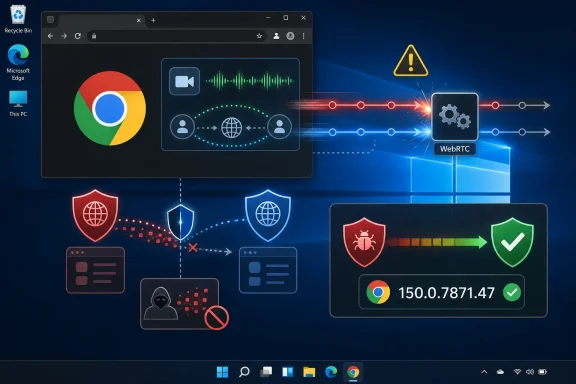 Chrome’s “Medium” Bug Lands in the Most Sensitive Part of the Browser
CVE-2026-14015 is not the kind of vulnerability that usually dominates security headlines. It is not described as a sandbox escape. It is not a known exploited zero-day. It does not arrive with the emergency tone that accompanies a critical V8 bug already being used in the wild.But it sits inside WebRTC, and that changes the reading. WebRTC is the machinery that lets browsers handle real-time audio, video, and peer-to-peer communication without a plug-in. It is also one of the places where Chrome has to juggle permissions, networking, media pipelines, device access, frame boundaries, and a lot of asynchronous state.
The NVD description says the issue is a race in WebRTC in Google Chrome on Windows prior to 150.0.7871.47 that allowed a remote attacker to leak cross-origin data via a crafted HTML page. CISA’s ADP entry assigns it a CVSS 3.1 score of 6.5, with network attack vector, low attack complexity, no privileges required, user interaction required, and high confidentiality impact.
That combination is the story. A victim still has to interact with a malicious page, and the bug is not described as automatic exploitation at internet scale. Yet the potential result is a breach of the web’s same-origin model, the rulebook that is supposed to stop one site from reading another site’s data.
For Windows administrators, that is exactly the class of bug that tends to disappear into patch dashboards until it becomes an incident investigation footnote. The browser did not crash. The user did not install malware. A page was loaded, a race was won, and data that should not have crossed an origin boundary reportedly could cross it.
The Patch Is One Line in a 433-Fix Avalanche
Google’s Chrome Releases blog announced Chrome 150’s promotion to stable on Tuesday, June 30, 2026, for Windows, Mac, and Linux. The build listed Windows and Mac at 150.0.7871.46/.47, Linux at 150.0.7871.46, and said rollout would happen over the following days and weeks. Buried inside that post was a remarkable number: 433 security fixes.That number is both impressive and uncomfortable. It reflects the scale of automated testing, internal bug discovery, fuzzing, and security engineering inside Chromium. It also shows how large the browser attack surface has become.
CVE-2026-14015 appears in Google’s list as a medium-severity “Inappropriate implementation in WebRTC,” reported by Google on May 27, 2026. NVD’s later wording sharpens that into a race condition and names the effect: cross-origin data leakage on Windows before 150.0.7871.47.
The mismatch between Google’s terse release-note label and NVD’s fuller description is normal, but it is also revealing. Chrome release notes often intentionally withhold bug detail until a majority of users have updated, a policy Google repeats in its advisories. That is defensible security practice, but it leaves defenders reading tea leaves from component names, severity ratings, and CVSS vectors.
In this case, the tea leaves are not subtle. WebRTC plus race condition plus cross-origin leak equals a confidentiality problem inside a feature many organizations cannot simply disable without breaking collaboration tools, customer support flows, telehealth portals, remote interviews, classrooms, or internal conferencing apps.
WebRTC Keeps Paying the Price for Being Useful
WebRTC is one of the web’s great convenience layers. It lets a browser become a phone, camera client, screen-sharing tool, video room, or low-latency data channel without asking users to install native software. That is why it became foundational to modern collaboration.It is also why security teams wince when WebRTC appears in advisories. The feature necessarily operates near sensitive boundaries. It negotiates network paths, exposes media devices after permission grants, coordinates with codecs and capture stacks, and handles real-time state changes where delays of milliseconds matter.
Race conditions thrive in that environment. A race bug usually means the software makes a security-relevant decision based on state that can change before the decision is safely enforced. In a browser, that can become especially dangerous when the moving parts include frames, origins, permissions, device sessions, redirects, or object lifetimes.
The CVE’s CWE mapping, CWE-362, names concurrent execution using a shared resource with improper synchronization. That sounds abstract, but the browser-level consequence is concrete: two operations happen in an order the designers did not intend, and the attacker tries to exploit the gap.
The important point is that this is not merely a WebRTC flaw in the consumer-video-chat sense. It is a flaw in a subsystem that enterprise web apps, embedded support widgets, and browser-based communication platforms increasingly treat as infrastructure. When WebRTC has a security failure, it is not limited to people who click “join meeting.”
Cross-Origin Leaks Are the Browser’s Quiet Catastrophe Class
The web’s same-origin policy is one of the oldest and most important browser security guarantees. It says, in effect, that one origin should not be able to read another origin’s protected data. Your payroll site, your webmail, your bank, your intranet dashboard, and a random malicious page are supposed to live in separate compartments.A cross-origin leak does not always mean the attacker gets everything. The NVD entry does not claim full account takeover, arbitrary code execution, or complete browser compromise. It says a remote attacker could leak cross-origin data via a crafted HTML page.
That is enough to matter. Browser security is cumulative; attackers chain small leaks with phishing, session confusion, cached data, timing attacks, permission prompts, and social engineering. A confidentiality-only bug may become useful when paired with another weakness or when aimed at high-value users.
CISA’s vector captures this nuance. User interaction is required, and CISA’s SSVC data says exploitation was “none” at the time of enrichment and “automatable” was “no.” But confidentiality impact is marked high, which means the expected damage is not trivial if exploitation succeeds.
This is why “medium” should not be read as “optional.” It means the bug does not satisfy the scoring conditions for a higher bucket. It does not mean the affected boundary is unimportant.
Windows Is Not a Footnote Here
The NVD description specifically names Google Chrome on Windows prior to 150.0.7871.47. That is not incidental for this audience. Windows is where Chrome remains deeply entrenched in consumer, business, school, and government fleets, even when Microsoft Edge ships by default.The Chrome Releases post lists the stable Windows/Mac build as 150.0.7871.46/.47, while the CVE description sets the Windows fixed threshold at 150.0.7871.47. That distinction matters for asset inventory. In a mixed fleet, “Chrome 150” is not precise enough; the patch question is whether Windows systems are at or above 150.0.7871.47.
Administrators should also avoid assuming that Chrome’s automatic update model has solved the problem everywhere. Auto-update is effective on unmanaged consumer machines, but enterprise reality is messier. Some systems are pinned. Some sit behind change windows. Some virtual desktops are rebuilt from stale base images. Some kiosk or lab machines only update when someone remembers they exist.
Then there are Chromium-based browsers. The user-provided NVD entry is about Google Chrome, not every Chromium derivative, and defenders should resist copy-pasting the same fixed version across products. But Chromium engine vulnerabilities have a habit of becoming everybody’s problem on a delay, especially when the affected code lives in shared components.
Microsoft Edge, Brave, Vivaldi, Opera, Electron apps, and embedded Chromium runtimes are not automatically covered by Google’s Chrome version number. Each vendor has to ship its own integration of the fix. The correct operational habit is to track the Chrome fix as an early warning, then verify downstream browsers and runtimes separately.
The CPE Entry Tells a Small but Important Truth
The NVD change history includes a CPE configuration that combines Google Chrome versions before 150.0.7871.47 with Microsoft Windows. That is exactly what one would expect for a Windows-specific Chrome vulnerability.The “Are we missing a CPE here?” prompt on NVD is not a smoking gun. It is a standard invitation for corrections when affected software configuration data may be incomplete. In this case, the available CPE entry appears to capture the core affected configuration: Chrome as the application and Windows as the operating system condition.
Still, the CPE detail highlights a recurring problem in vulnerability management. CPEs are useful for scanners, dashboards, and compliance workflows, but they are often a lossy translation of real software exposure. A browser bug may be tied to a platform-specific code path, a build variant, a feature flag, a library version, or a vendor fork.
That means a scanner that keys only on “Google Chrome before 150.0.7871.47 on Windows” may correctly find the obvious exposure and still miss related operational risk. It may not account for Chromium runtimes bundled inside applications. It may not know whether a browser has updated but not restarted. It may not distinguish between installed version and running process version.
For IT teams, the CPE answer is therefore “not obviously missing for the stated Chrome-on-Windows CVE, but not sufficient as your whole exposure model.” That is not a satisfying sentence, but it is how browser patching works in the real world.
A Race Condition Is a Timing Bug, Not a Speed Contest
The phrase race condition invites a misleading mental model. It is not simply that attackers have to be fast. It is that the program’s correctness depends on operations happening in a safe order, and the attacker may be able to influence or exploit a situation where the order breaks.In browser security, these bugs often arise when asynchronous systems meet trust boundaries. A permission state changes while a media operation is still being resolved. A document navigates while an object still points to old state. A frame relationship changes while an access check assumes the previous relationship. The public CVE entry does not provide those implementation details, but the class of weakness is well understood.
That is why race conditions can be stubborn. They may not reproduce reliably. They can depend on CPU scheduling, event timing, renderer behavior, network state, or specific OS interactions. Security researchers and browser teams spend enormous effort turning rare timing windows into reliable test cases.
The medium severity rating may partly reflect those constraints. CISA’s “not automatable” assessment suggests exploitation is not a push-button mass compromise scenario. But if the confidentiality impact is high, defenders do not get to ignore it just because the exploit path is fiddly.
Attackers who care about a target often have patience. A crafted page can try repeatedly. A spear-phishing link can be tuned to a known browser and operating system. A bug that is unreliable in the general population may be reliable enough against a small set of machines.
Chrome’s Security Model Is Working and Straining at the Same Time
It is tempting to look at 433 security fixes and conclude that Chrome is uniquely broken. That is the wrong lesson. The better lesson is that Chrome is large, aggressively tested, constantly changing software whose security program finds and fixes enormous numbers of bugs before they become public disasters.Google’s advisory explicitly thanks researchers and points to tools such as sanitizers and fuzzers in its standard language across Chrome releases. Many bugs in the Chrome 150 list are reported by Google itself, suggesting a significant volume came from internal discovery, automated systems, or project-side review.
That is the good news. The bad news is that the modern browser has become an operating system for the internet, and its bug classes increasingly resemble the bug classes of operating systems. GPU stacks, media engines, Bluetooth, USB, WebGPU-related components, WebRTC, password managers, extension systems, and enterprise controls all appear in Chrome security lists with numbing regularity.
CVE-2026-14015 sits in the middle of that tension. It is a medium bug in a massive patch train, not a headline-grabbing emergency. Yet it affects one of the platform’s core promises: that a hostile page should not be able to learn protected data from another origin.
For Windows users, the browser is now a primary security boundary. That makes Chrome updates feel less like app maintenance and more like OS servicing. The browser is where credentials are entered, sessions are maintained, documents are opened, meetings are held, and internal apps are accessed.
The User Interaction Requirement Is Not Much Comfort
CISA’s vector marks user interaction as required. In practical terms, that means the attack is not described as a wormable network event. Someone has to visit or otherwise interact with crafted web content.That is a real mitigating factor. It matters for prioritization, especially compared with unauthenticated, no-click remote code execution in exposed services. But browser bugs live in a threat model where user interaction is already the normal delivery mechanism.
Employees click links. Support agents open customer pages. Developers test third-party sites. Executives read webmail. Students search for assignments. Journalists, researchers, and analysts visit unfamiliar domains as part of their work. Requiring a crafted HTML page is not a high operational bar.
Modern phishing also makes “crafted page” sound too quaint. Attackers can host convincing portals, abuse ad networks, compromise legitimate sites, or send links through trusted collaboration tools. If the exploit requires a user to land on a page, that still fits comfortably inside the browser attack economy.
The better mitigation is not scolding users into perfect behavior. It is making sure the vulnerable browser version disappears quickly, reducing exposure time so that a theoretical crafted page has fewer viable targets.
Enterprise Patch Latency Is the Real Exploit Window
Chrome’s rapid release model assumes that most users update quickly. For unmanaged users, that assumption is often true enough. Chrome checks for updates, downloads them, and applies them after restart.Enterprise fleets are different. Some organizations delay browser updates for compatibility testing. Some have legacy web apps that break under new browser behavior. Some use ring deployments. Some depend on VDI images, packaged installers, or endpoint management policies that lag behind upstream release cadence.
That is not negligence; it is the cost of running browsers as application platforms. But it creates a gap between “fixed by vendor” and “fixed in production.” CVE-2026-14015 lives in that gap.
The Chrome 150 release is especially awkward because it includes hundreds of security fixes at once. A single medium WebRTC issue might not justify an emergency change on its own in every environment. But it does not arrive alone. The same release includes critical and high-severity fixes across extensions, GPU, ANGLE, Dawn, Skia, Bluetooth, Chromoting, V8, and other components.
That changes the calculus. The practical question is not whether CVE-2026-14015 alone deserves accelerated rollout. The question is whether any organization wants to remain on a pre-150.0.7871.47 Windows Chrome build after Google shipped a release train this dense.
WebRTC Policy Controls Help, but They Are Not a Patch
Administrators sometimes respond to WebRTC risk by tightening browser policy. That can be useful. Chrome enterprise policies can control aspects of media capture, permissions, URL access, and related behavior. Network teams may also restrict certain real-time communication patterns.But CVE-2026-14015 should not be treated as a policy-only problem. The available description says a crafted HTML page could leak cross-origin data through a WebRTC race. Unless Google documents a specific policy-based mitigation, the fix is the browser update.
There is also a business constraint. Many organizations cannot simply disable WebRTC without breaking legitimate workflows. Sales demos, contact centers, virtual care, hybrid classrooms, recruiting interviews, remote support, and internal meetings may all depend on browser-based real-time communication.
Security teams therefore need a layered response. Patch first. Confirm restart completion. Audit browser versions. Review whether WebRTC is actually needed for all user groups. Apply stricter defaults where business use is limited. But do not mistake hardening for remediation.
This is the recurring lesson of browser security in managed Windows environments. Controls are valuable, but version currency is still the foundation.
The Restricted Bug Detail Policy Is Rational and Frustrating
Google’s Chrome advisory repeats the standard warning that access to bug details and links may remain restricted until most users have updated. Security people understand why. Publishing exploit-ready details while millions of browsers are still vulnerable would be irresponsible.At the same time, this policy forces defenders to act with partial information. They know the component, severity, affected version, and broad impact. They may not know the exploit mechanics, proof-of-concept reliability, precise data exposure, or whether a mitigation short of patching is meaningful.
That uncertainty is not a reason to wait. It is a reason to make browser updates boring and fast. If every medium browser bug requires a bespoke risk committee, the process has already failed. The only scalable answer is to treat stable browser security releases as routine, high-priority maintenance.
This is especially true when the issue touches cross-origin data. Organizations should not need exploit code to understand that cross-origin leakage is a category worth closing quickly. The details can wait; the patch should not.
The publication pattern also means that CVE write-ups often become clearer after the riskiest window has passed. By then, defenders who waited for clarity may have spent days exposed to a bug the vendor had already fixed.
Chromium Derivatives Need Their Own Receipts
Chrome is the named affected product in the NVD entry, but Chromium is an ecosystem. Microsoft Edge, Brave, Opera, Vivaldi, and many specialized browsers pull from Chromium at their own cadence. Electron-based desktop apps may lag further still, depending on how actively they are maintained.For WindowsForum readers, this is where the story broadens from “update Chrome” to “inventory your Chromium footprint.” A Windows machine may have Chrome, Edge, a secondary browser, multiple Electron apps, a WebView2 runtime, and vendor-specific embedded browser components. Not all of those share the same exposure to this exact CVE, but they share a dependence on Chromium security work.
Microsoft Edge generally tracks Chromium fixes quickly, but administrators should verify the specific Edge security release rather than assuming same-day equivalence. The same is true for alternative browsers. A vendor may backport a fix, ship it under a different version number, or determine that a platform-specific issue does not affect its build.
The right operational question is not “Do we run Chrome?” It is “Where do we run Chromium code that can process untrusted web content?” That question is harder to answer, which is why browser vulnerability management keeps surprising organizations that thought they had a simple software list.
CVE-2026-14015 may ultimately remain a Chrome-on-Windows footnote. The discipline it demands is larger than that.
Home Users Should Check the Version, Not the Vibe
For individual Windows users, the advice is simple but still worth spelling out. Chrome should be at least 150.0.7871.47 on Windows. The quickest check is Chrome’s About page, which also triggers update checks in normal configurations.The bigger issue is restart behavior. Chrome can download an update and still run the old vulnerable code until the browser is relaunched. Users who keep dozens of tabs open for weeks are often “updated” in theory and exposed in practice.
The same pattern applies in small businesses without formal endpoint management. Someone may assume Chrome auto-updates and never verify. In most cases, that assumption works. During security-heavy releases, verification is cheap insurance.
Users should also remember that browser security updates are not just about stopping malware installation. They protect session boundaries, saved credentials, webmail, internal dashboards, cloud admin consoles, and every other sensitive thing now mediated by a tab.
A medium WebRTC bug may not sound urgent next to ransomware headlines. But if the browser is your front door to work, banking, health care, and identity, then a cross-origin leak is a front-door problem.
The Practical Read on CVE-2026-14015 Is Narrow but Urgent
CVE-2026-14015 should not be inflated into a crisis it is not. There is no public indication in the supplied NVD data or Google’s release post that it was exploited in the wild as of the early July enrichment. CISA’s SSVC entry says exploitation was “none,” and the attack requires user interaction.But it should not be minimized either. The bug affects Chrome on Windows before 150.0.7871.47. It sits in WebRTC. It is classified as a race condition. It can reportedly leak cross-origin data. Its confidentiality impact is scored high by CISA’s ADP vector.
Those facts are enough to justify prompt action. In enterprises, prompt action means more than waiting for auto-update. It means confirming deployment, confirming browser restarts, and checking the machines that fall outside the happy path.
The irony of modern browser security is that the scariest fixes are often the easiest to perform and the hardest to operationalize. Updating Chrome is simple. Proving that every Windows endpoint is actually running the fixed build is the work.
The Build Number Is the Boundary Line
CVE-2026-14015 is a reminder that browser security lives in details small enough to fit in a version string and broad enough to reshape enterprise risk. The important facts are concrete, and they lead to concrete work.- Google fixed the Chrome-on-Windows issue in version 150.0.7871.47, released through the Chrome 150 stable desktop update announced on June 30, 2026.
- NVD describes the vulnerability as a WebRTC race condition that could let a remote attacker leak cross-origin data through a crafted HTML page.
- CISA’s ADP scoring rates the issue medium at 6.5 under CVSS 3.1, with high confidentiality impact and required user interaction.
- The NVD CPE configuration appears to capture the stated affected pairing of Google Chrome and Microsoft Windows, but scanners still need real version and restart validation.
- Administrators should treat this as part of the larger Chrome 150 security release, not as an isolated medium-severity cleanup item.
- Chromium-based browsers and embedded runtimes need separate vendor verification rather than assumptions based on Chrome’s version number.
References
- Primary source: NVD / Chromium
Published: 2026-07-03T07:00:53-07:00
NVD - CVE-2026-14015
 nvd.nist.gov
- Security advisory: MSRC
Published: 2026-07-03T07:00:53-07:00
Original feed URL
Security Update Guide - Microsoft Security Response Center
 msrc.microsoft.com
- Related coverage: cvefeed.io
CVE-2026-14015 - Google Chrome WebRTC Use-After-Free Information Disclosure
Race in WebRTC in Google Chrome on Windows prior to 150.0.7871.47 allowed a remote attacker to leak cross-origin data via a crafted HTML page. (Chromium security severity: Medium)cvefeed.io
