

Google fixed CVE-2026-14155 in Chrome 150.0.7871.47 for Windows and Mac on June 30, 2026, after documenting that a StorageAccessAPI policy-enforcement flaw could let a remote attacker leak cross-origin data through a crafted HTML page. The vulnerability is not the scariest bug in Chrome 150, and Chromium itself rates it Low, but that is exactly why it deserves attention. The modern browser is no longer a document viewer; it is the security boundary for identity, payments, enterprise SaaS, and the private state of the web. When a “low” browser bug is really about cross-origin data leakage, administrators should read past the label.
The National Vulnerability Database describes CVE-2026-14155 as “insufficient policy enforcement” in Chrome’s StorageAccessAPI, affecting Google Chrome versions before 150.0.7871.47. CISA’s ADP enrichment gives it a CVSS 3.1 score of 6.5, with network attack vector, low attack complexity, no privileges required, user interaction required, and high confidentiality impact. NIST had not yet assigned its own CVSS score as of its July 2 update, but it did add the Chrome CPE range covering versions up to, but excluding, 150.0.7871.47.
That split matters. Chromium’s internal security severity is Low, while CISA’s CVSS contribution reads more like a medium-risk confidentiality problem. This is not necessarily a contradiction; it is a reminder that browser security scoring depends heavily on exploitability assumptions, sandboxing context, user interaction, and what “data leak” means in practice.
Google’s Chrome Releases blog says Chrome 150 was promoted to stable for Windows, Mac, and Linux on June 30, 2026, with Windows and Mac receiving 150.0.7871.46/.47 and Linux receiving 150.0.7871.46. The same post says the release contains 433 security fixes, a staggering number even by modern Chromium standards. CVE-2026-14155 is one entry inside that flood, but it sits in a particularly sensitive layer: the machinery that decides when one site may access storage associated with another context.
That is the real story. The web’s privacy model increasingly depends on fine-grained exceptions to old browser rules. StorageAccessAPI exists because browsers are trying to reconcile a privacy clampdown on third-party tracking with the reality that embedded login widgets, federated identity, payments, comments, media, and enterprise apps still need controlled access to state. A policy-enforcement bug in that machinery is not merely a “web API bug.” It is a crack in the arbitration system.
StorageAccessAPI is part of the compromise. It gives embedded third-party content a path to request access to storage that browsers might otherwise block, typically under user-gesture and policy constraints. In plain English, it is one of the valves that decides when a third-party frame can behave less like an isolated stranger and more like a recognized participant in the user’s browsing session.
That makes enforcement everything. The API is not dangerous because storage access exists; it is dangerous if the browser grants, leaks, infers, or exposes too much under the wrong conditions. The boundary is not just technical, either. It reflects a policy judgment about privacy, compatibility, and user intent, encoded in browser logic and then exposed to billions of endpoints.
CVE-2026-14155’s wording is sparse, as Chrome vulnerability descriptions often are while bug details remain restricted. But the phrase “leak cross-origin data” is enough to place it in a category that security teams should not wave away. Cross-origin data leakage is rarely about a movie-plot attacker instantly emptying a bank account. It is more often about violating assumptions: what one site can infer about another, what state can be observed, and which private signals become visible to attacker-controlled code.
Google notes in its release advisory that access to bug details and links may remain restricted until most users are updated. That is standard Chrome practice and, in many cases, sensible. But it also creates a familiar administrative problem: defenders must patch before they can fully understand.
The Chrome Releases post complicates the picture slightly because the release spans multiple platforms and build numbers. Google lists Chrome 150.0.7871.46 for Linux and 150.0.7871.46/.47 for Windows and Mac. The CVE entry provided by Chrome and enriched by NVD uses 150.0.7871.47 as the fixed point for the affected product. In a managed Windows environment, that means administrators should not settle for “Chrome 150” as a compliance answer; they should check the full build.
That distinction matters because Chrome’s version cadence has become both fast and noisy. A major milestone number tells you roughly where you are in the channel, but it does not prove that a particular security fix is present. For security reporting, “150” is a headline. For endpoint management, 150.0.7871.47 is the control objective.
It is also worth noting what the current public record does not say. CISA’s SSVC entry lists exploitation as “none,” automatable as “no,” and technical impact as “partial.” That does not make the bug harmless; it says that, at the time of enrichment, there was no known exploitation and that the decision model did not classify it as an easily automated mass-exploitation condition. In browser terms, that usually puts the patch in the “roll out promptly” bucket rather than the “drop everything and isolate hosts” bucket.
Still, user interaction is not a high bar on the web. The CVSS vector requires UI because the victim must reach or interact with a crafted page. That is the default shape of browser exploitation. Phishing, malvertising, compromised legitimate sites, hostile embeds, and watering-hole pages all live in the space between “requires user interaction” and “happens constantly.”
This is the paradox of Chromium security in 2026. The project is one of the most aggressively tested, fuzzed, and patched codebases on the planet, yet it remains a continuous source of vulnerabilities because it is also one of the most ambitious runtime environments ever shipped to consumer desktops. Every feature added for compatibility, graphics, storage, identity, device integration, AI acceleration, media, or enterprise control expands the attack surface.
That does not mean Chrome is uniquely unsafe. It means the browser is doing too much to fit the old mental model of “application.” The browser is a renderer, VM host, hardware broker, sync client, credential surface, extension platform, update agent, PDF reader, media stack, identity mediator, and policy endpoint. In Windows shops, it is also often the front door to the company.
The StorageAccessAPI bug should therefore be read as part of the ongoing complexity tax. Privacy features create new state machines. State machines create edge cases. Edge cases create security bugs. The cure for tracking and cross-site abuse is not simply “block everything,” because the commercial and enterprise web will break; the cure is conditional access, and conditional access is notoriously hard to implement perfectly.
Chrome 150’s release also reinforces why browser patching cannot be treated as a monthly ritual aligned with operating-system updates. Google ships browser fixes when they are ready, and attackers do not wait for Patch Tuesday. Windows administrators who have matured their OS patching but still let browsers drift for weeks are leaving one of the most exposed pieces of client software on a slower clock than the threat model allows.
From a Chromium engineering perspective, a policy-enforcement flaw requiring a crafted page, user interaction, and producing limited leakage may reasonably sit below memory corruption, sandbox escape, or remote code execution. From an enterprise risk perspective, cross-origin leakage can be more consequential than its exploit primitive suggests, especially where browsers hold authenticated sessions into internal SaaS, identity dashboards, HR systems, ticketing platforms, and cloud consoles.
Severity also depends on chaining. A data leak that is merely interesting on its own can become useful when paired with a phishing flow, token theft technique, compromised embed, or another browser bug. Attackers do not experience vulnerabilities as isolated CVE cards. They experience them as parts.
This is why administrators should resist the urge to filter browser updates by the highest CVE in the release. Chrome 150 includes critical and high-severity issues that will naturally draw more attention, but the lower-severity privacy and policy bugs often reveal where the web platform’s trust assumptions are fraying. They can be early warnings of classes of mistakes, not just isolated defects.
For home users, the answer is not to panic over StorageAccessAPI. It is to keep Chrome current and restart the browser when prompted. For organizations, the answer is to measure browser build compliance with the same seriousness applied to Windows cumulative updates, because the browser is frequently the application through which the rest of the enterprise is attacked.
The public description of CVE-2026-14155 does not disclose the exact leakage mechanism, and it would be irresponsible to invent one. But the affected component gives enough context to understand the class of concern. Storage access is often adjacent to cookies, session state, embedded frames, federated identity, and the messy world of third-party content trying to operate inside privacy restrictions.
The enterprise version of this problem is not limited to public websites. Many businesses rely on web apps that embed identity providers, analytics platforms, content widgets, support tooling, document viewers, and dashboards. A weakness in how the browser enforces storage access policy can intersect with single sign-on flows and third-party integrations in ways that are hard for any one administrator to model.
This is also why browser privacy engineering is so unforgiving. Users demand that browsers stop cross-site tracking. Businesses demand that legitimate embedded services keep working. Regulators demand clearer consent and stronger data boundaries. Developers demand stable APIs. The browser vendor is left building conditional mechanisms that satisfy all four groups without creating a side channel.
CVE-2026-14155 is not evidence that the model has failed. It is evidence that the model is complicated enough to require relentless patching. In a less complex web, there would be fewer policy toggles to enforce. In the web we actually have, the policy engine is part of the attack surface.
The immediate administrative task is straightforward: inventory Chrome versions and ensure Windows endpoints are at least 150.0.7871.47 where Chrome Stable is deployed. If your organization uses Chrome Enterprise policies, endpoint management, software inventory, or vulnerability scanning, the check should key off the full version string rather than the major milestone. If the scanner still says “CPEs loading” or lags NVD enrichment, the NIST change history gives the exclusion boundary to validate against.
Administrators should also remember that Chrome updates are not only Google’s problem. Microsoft Edge, Brave, Vivaldi, Opera, and other Chromium-based browsers track Chromium at different cadences and with different branding. This CVE is listed against Google Chrome, and the public NVD entry names Chrome specifically, but a StorageAccessAPI issue in Chromium code naturally raises the question of downstream exposure. The correct response is not to assume every Chromium browser is vulnerable in the same way; it is to check each vendor’s advisory and version mapping.
On Windows, the restart problem remains stubborn. Users may assume that a browser has updated because the update downloaded. Security teams know better. The patched binary must be running. That may require prompting, forced relaunch windows, or user education around the “Update” indicator that appears in Chrome’s menu.
There is also a reporting lesson here. If an executive asks whether the company is exposed to CVE-2026-14155, “Chrome auto-updates are enabled” is not the strongest answer. “Ninety-eight percent of managed Windows endpoints are running 150.0.7871.47 or later, and the remainder are being forced through a browser restart policy” is the answer that reduces risk.
This is why vulnerability management tools sometimes appear confused in the first days after a browser release. A CVE may exist before NVD scoring is complete. CPEs may arrive after scanners first ingest the item. Vendor advisories may list dozens or hundreds of fixes while public bug details remain restricted. The result is a messy interim period where the safest source of truth is the vendor’s fixed version, not the fully enriched database record.
In this case, the vendor boundary is clear enough. Chrome prior to 150.0.7871.47 is the relevant affected range in the CVE record, and Google’s June 30 stable-channel update is the advisory that delivered the fix. The NVD record’s “NVD assessment not yet provided” status for CVSS is not a reason to wait. It is a reason to avoid overinterpreting the absence of a NIST score.
CISA’s SSVC fields are also useful, but only if read carefully. “Exploitation: none” does not mean “unexploitable.” “Automatable: no” does not mean “irrelevant.” “Technical impact: partial” does not mean “no business impact.” These are decision-support signals, not permission slips to ignore the patch.
The vulnerability pipeline is improving, but it remains asynchronous. Vendors patch, CVEs publish, CISA enriches, NIST analyzes, scanners ingest, administrators remediate, and users restart. CVE-2026-14155 is a reminder that the lag between those verbs is where exposure lives.
The web platform has increasingly moved from bright-line rules to negotiated exceptions. Third-party cookies are restricted, except when access is granted. Storage is partitioned, except when compatibility requires a release valve. Embedded services are constrained, except when the browser can infer or request user intent. Every exception is an opportunity for policy logic to drift away from the security model it is supposed to enforce.
That makes “insufficient policy enforcement” one of the more interesting phrases in vulnerability writing. It usually means the browser had a rule, but the implementation failed to apply it fully under some condition. Those bugs can be less flashy than memory corruption, but they are conceptually revealing. They show where the policy surface is too subtle, too stateful, or too dependent on edge-case sequencing.
For users, the result is invisible. Nobody sees StorageAccessAPI. Nobody receives a clear warning that says, “This embedded frame is asking for state that may reveal your relationship with another site.” The browser vendor, therefore, becomes the proxy for user intent. If enforcement is wrong, the user cannot realistically compensate.
That asymmetry is why the browser update channel is a privacy control. We tend to think of privacy settings as toggles in a UI, but many privacy guarantees are shipped as code fixes to APIs most users will never hear about. CVE-2026-14155 belongs to that quieter category.
For Windows enthusiasts and IT pros, this is where curiosity should translate into practice. Check the version. Confirm that Chrome is not merely staged for update but actually relaunched. Watch for downstream Chromium-based browser advisories. Do not let the absence of known exploitation become a substitute for patch compliance.
There is a temptation to treat every Chrome CVE as either “actively exploited zero-day” or “background noise.” CVE-2026-14155 sits in the uncomfortable middle. It is not a public emergency, but it touches the browser’s cross-origin privacy model, and that model is foundational to how users safely move between modern web apps.
The same applies to vulnerability scoring. A Low from Chromium and a Medium from CISA are useful signals, not final judgments. In the enterprise, the practical severity of a browser confidentiality flaw depends on who browses from the affected machine, which apps they are signed into, and what an attacker could learn from a crafted page.
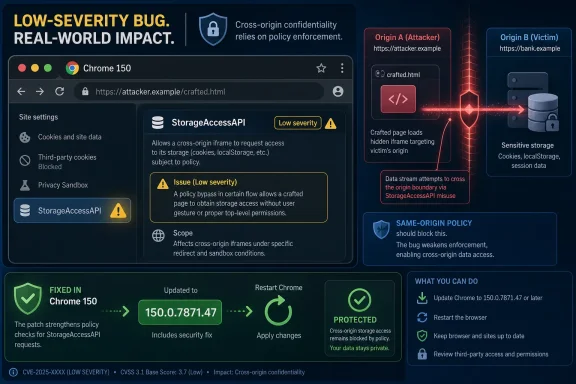 A Low-Severity Bug Lands in a High-Stakes Part of the Browser
The National Vulnerability Database describes CVE-2026-14155 as “insufficient policy enforcement” in Chrome’s StorageAccessAPI, affecting Google Chrome versions before 150.0.7871.47. CISA’s ADP enrichment gives it a CVSS 3.1 score of 6.5, with network attack vector, low attack complexity, no privileges required, user interaction required, and high confidentiality impact. NIST had not yet assigned its own CVSS score as of its July 2 update, but it did add the Chrome CPE range covering versions up to, but excluding, 150.0.7871.47.That split matters. Chromium’s internal security severity is Low, while CISA’s CVSS contribution reads more like a medium-risk confidentiality problem. This is not necessarily a contradiction; it is a reminder that browser security scoring depends heavily on exploitability assumptions, sandboxing context, user interaction, and what “data leak” means in practice.
Google’s Chrome Releases blog says Chrome 150 was promoted to stable for Windows, Mac, and Linux on June 30, 2026, with Windows and Mac receiving 150.0.7871.46/.47 and Linux receiving 150.0.7871.46. The same post says the release contains 433 security fixes, a staggering number even by modern Chromium standards. CVE-2026-14155 is one entry inside that flood, but it sits in a particularly sensitive layer: the machinery that decides when one site may access storage associated with another context.
That is the real story. The web’s privacy model increasingly depends on fine-grained exceptions to old browser rules. StorageAccessAPI exists because browsers are trying to reconcile a privacy clampdown on third-party tracking with the reality that embedded login widgets, federated identity, payments, comments, media, and enterprise apps still need controlled access to state. A policy-enforcement bug in that machinery is not merely a “web API bug.” It is a crack in the arbitration system.
StorageAccessAPI Is Where Privacy Policy Becomes Executable Code
For years, the browser’s promise was summarized by the same-origin policy: pages from one origin should not freely read the data of another. That principle still anchors web security, but the modern web has complicated it almost beyond recognition. Cookies, embedded frames, partitioned storage, identity providers, tracking prevention, and anti-fraud scripts all compete inside the same browser process, each with a plausible reason to exist and a potential route to abuse.StorageAccessAPI is part of the compromise. It gives embedded third-party content a path to request access to storage that browsers might otherwise block, typically under user-gesture and policy constraints. In plain English, it is one of the valves that decides when a third-party frame can behave less like an isolated stranger and more like a recognized participant in the user’s browsing session.
That makes enforcement everything. The API is not dangerous because storage access exists; it is dangerous if the browser grants, leaks, infers, or exposes too much under the wrong conditions. The boundary is not just technical, either. It reflects a policy judgment about privacy, compatibility, and user intent, encoded in browser logic and then exposed to billions of endpoints.
CVE-2026-14155’s wording is sparse, as Chrome vulnerability descriptions often are while bug details remain restricted. But the phrase “leak cross-origin data” is enough to place it in a category that security teams should not wave away. Cross-origin data leakage is rarely about a movie-plot attacker instantly emptying a bank account. It is more often about violating assumptions: what one site can infer about another, what state can be observed, and which private signals become visible to attacker-controlled code.
Google notes in its release advisory that access to bug details and links may remain restricted until most users are updated. That is standard Chrome practice and, in many cases, sensible. But it also creates a familiar administrative problem: defenders must patch before they can fully understand.
The Version Number Is the Practical Boundary
For WindowsForum readers, the key operational line is simple: Chrome before 150.0.7871.47 is in scope for CVE-2026-14155 on Windows and Mac, according to the NVD entry and Google’s stable-channel advisory. NIST’s change history added the CPE configuration on July 2, specifying Google Chrome versions up to, but excluding, 150.0.7871.47. That is the version boundary vulnerability scanners and asset tools should converge on.The Chrome Releases post complicates the picture slightly because the release spans multiple platforms and build numbers. Google lists Chrome 150.0.7871.46 for Linux and 150.0.7871.46/.47 for Windows and Mac. The CVE entry provided by Chrome and enriched by NVD uses 150.0.7871.47 as the fixed point for the affected product. In a managed Windows environment, that means administrators should not settle for “Chrome 150” as a compliance answer; they should check the full build.
That distinction matters because Chrome’s version cadence has become both fast and noisy. A major milestone number tells you roughly where you are in the channel, but it does not prove that a particular security fix is present. For security reporting, “150” is a headline. For endpoint management, 150.0.7871.47 is the control objective.
It is also worth noting what the current public record does not say. CISA’s SSVC entry lists exploitation as “none,” automatable as “no,” and technical impact as “partial.” That does not make the bug harmless; it says that, at the time of enrichment, there was no known exploitation and that the decision model did not classify it as an easily automated mass-exploitation condition. In browser terms, that usually puts the patch in the “roll out promptly” bucket rather than the “drop everything and isolate hosts” bucket.
Still, user interaction is not a high bar on the web. The CVSS vector requires UI because the victim must reach or interact with a crafted page. That is the default shape of browser exploitation. Phishing, malvertising, compromised legitimate sites, hostile embeds, and watering-hole pages all live in the space between “requires user interaction” and “happens constantly.”
Chrome 150’s 433 Fixes Tell a Bigger Story Than One CVE
CVE-2026-14155 arrived inside a Chrome 150 stable release that Google says contains 433 security fixes. That number is the loudest signal in the advisory, even if individual CVEs will dominate scanner dashboards. Chrome’s security machine is now operating at a scale where a single stable milestone can carry hundreds of fixes, including critical use-after-free flaws, type confusion bugs, validation failures, and policy-enforcement issues across browser subsystems.This is the paradox of Chromium security in 2026. The project is one of the most aggressively tested, fuzzed, and patched codebases on the planet, yet it remains a continuous source of vulnerabilities because it is also one of the most ambitious runtime environments ever shipped to consumer desktops. Every feature added for compatibility, graphics, storage, identity, device integration, AI acceleration, media, or enterprise control expands the attack surface.
That does not mean Chrome is uniquely unsafe. It means the browser is doing too much to fit the old mental model of “application.” The browser is a renderer, VM host, hardware broker, sync client, credential surface, extension platform, update agent, PDF reader, media stack, identity mediator, and policy endpoint. In Windows shops, it is also often the front door to the company.
The StorageAccessAPI bug should therefore be read as part of the ongoing complexity tax. Privacy features create new state machines. State machines create edge cases. Edge cases create security bugs. The cure for tracking and cross-site abuse is not simply “block everything,” because the commercial and enterprise web will break; the cure is conditional access, and conditional access is notoriously hard to implement perfectly.
Chrome 150’s release also reinforces why browser patching cannot be treated as a monthly ritual aligned with operating-system updates. Google ships browser fixes when they are ready, and attackers do not wait for Patch Tuesday. Windows administrators who have matured their OS patching but still let browsers drift for weeks are leaving one of the most exposed pieces of client software on a slower clock than the threat model allows.
The “Low” Label Is Doing Too Much Work
Security teams love severity labels because they make triage possible. They are also dangerous because they compress nuance into a color. CVE-2026-14155 is a useful example: Chromium labels the underlying issue Low, CISA’s CVSS contribution lands at Medium, and the confidentiality impact component is High. None of those statements is necessarily wrong.From a Chromium engineering perspective, a policy-enforcement flaw requiring a crafted page, user interaction, and producing limited leakage may reasonably sit below memory corruption, sandbox escape, or remote code execution. From an enterprise risk perspective, cross-origin leakage can be more consequential than its exploit primitive suggests, especially where browsers hold authenticated sessions into internal SaaS, identity dashboards, HR systems, ticketing platforms, and cloud consoles.
Severity also depends on chaining. A data leak that is merely interesting on its own can become useful when paired with a phishing flow, token theft technique, compromised embed, or another browser bug. Attackers do not experience vulnerabilities as isolated CVE cards. They experience them as parts.
This is why administrators should resist the urge to filter browser updates by the highest CVE in the release. Chrome 150 includes critical and high-severity issues that will naturally draw more attention, but the lower-severity privacy and policy bugs often reveal where the web platform’s trust assumptions are fraying. They can be early warnings of classes of mistakes, not just isolated defects.
For home users, the answer is not to panic over StorageAccessAPI. It is to keep Chrome current and restart the browser when prompted. For organizations, the answer is to measure browser build compliance with the same seriousness applied to Windows cumulative updates, because the browser is frequently the application through which the rest of the enterprise is attacked.
Cross-Origin Data Leakage Is a Business-Risk Phrase, Not Just a Browser-Risk Phrase
The term cross-origin can sound like web-developer plumbing, but the concept maps directly to business risk. Origins are how the browser separates one site’s private data from another’s. If that separation weakens, a page controlled by an attacker may gain information it should not have about a user’s activity, identity, authentication state, or data available in another web context.The public description of CVE-2026-14155 does not disclose the exact leakage mechanism, and it would be irresponsible to invent one. But the affected component gives enough context to understand the class of concern. Storage access is often adjacent to cookies, session state, embedded frames, federated identity, and the messy world of third-party content trying to operate inside privacy restrictions.
The enterprise version of this problem is not limited to public websites. Many businesses rely on web apps that embed identity providers, analytics platforms, content widgets, support tooling, document viewers, and dashboards. A weakness in how the browser enforces storage access policy can intersect with single sign-on flows and third-party integrations in ways that are hard for any one administrator to model.
This is also why browser privacy engineering is so unforgiving. Users demand that browsers stop cross-site tracking. Businesses demand that legitimate embedded services keep working. Regulators demand clearer consent and stronger data boundaries. Developers demand stable APIs. The browser vendor is left building conditional mechanisms that satisfy all four groups without creating a side channel.
CVE-2026-14155 is not evidence that the model has failed. It is evidence that the model is complicated enough to require relentless patching. In a less complex web, there would be fewer policy toggles to enforce. In the web we actually have, the policy engine is part of the attack surface.
Windows Administrators Need Browser Patch Telemetry, Not Just Browser Auto-Update
Chrome’s auto-update system is one of the reasons consumer browser security is better than it used to be. But managed Windows environments should not confuse auto-update availability with installed-state certainty. A browser can download an update and remain vulnerable until restart. A user can keep sessions alive for days. A virtual desktop image can lag behind. A third-party Chromium browser can inherit the vulnerability class but ship fixes on a different schedule.The immediate administrative task is straightforward: inventory Chrome versions and ensure Windows endpoints are at least 150.0.7871.47 where Chrome Stable is deployed. If your organization uses Chrome Enterprise policies, endpoint management, software inventory, or vulnerability scanning, the check should key off the full version string rather than the major milestone. If the scanner still says “CPEs loading” or lags NVD enrichment, the NIST change history gives the exclusion boundary to validate against.
Administrators should also remember that Chrome updates are not only Google’s problem. Microsoft Edge, Brave, Vivaldi, Opera, and other Chromium-based browsers track Chromium at different cadences and with different branding. This CVE is listed against Google Chrome, and the public NVD entry names Chrome specifically, but a StorageAccessAPI issue in Chromium code naturally raises the question of downstream exposure. The correct response is not to assume every Chromium browser is vulnerable in the same way; it is to check each vendor’s advisory and version mapping.
On Windows, the restart problem remains stubborn. Users may assume that a browser has updated because the update downloaded. Security teams know better. The patched binary must be running. That may require prompting, forced relaunch windows, or user education around the “Update” indicator that appears in Chrome’s menu.
There is also a reporting lesson here. If an executive asks whether the company is exposed to CVE-2026-14155, “Chrome auto-updates are enabled” is not the strongest answer. “Ninety-eight percent of managed Windows endpoints are running 150.0.7871.47 or later, and the remainder are being forced through a browser restart policy” is the answer that reduces risk.
The NVD Timeline Shows the Vulnerability Pipeline Working, Slowly
The CVE chronology is a small but useful case study in how vulnerability information becomes operational. Chrome issued the CVE on June 30, 2026. CISA-ADP modified the record on July 1 with CVSS, CWE, and SSVC data. NIST added its initial analysis and CPE configuration on July 2. That is a quick turnaround by public-vulnerability-database standards, but it still creates a window where security teams may see incomplete data.This is why vulnerability management tools sometimes appear confused in the first days after a browser release. A CVE may exist before NVD scoring is complete. CPEs may arrive after scanners first ingest the item. Vendor advisories may list dozens or hundreds of fixes while public bug details remain restricted. The result is a messy interim period where the safest source of truth is the vendor’s fixed version, not the fully enriched database record.
In this case, the vendor boundary is clear enough. Chrome prior to 150.0.7871.47 is the relevant affected range in the CVE record, and Google’s June 30 stable-channel update is the advisory that delivered the fix. The NVD record’s “NVD assessment not yet provided” status for CVSS is not a reason to wait. It is a reason to avoid overinterpreting the absence of a NIST score.
CISA’s SSVC fields are also useful, but only if read carefully. “Exploitation: none” does not mean “unexploitable.” “Automatable: no” does not mean “irrelevant.” “Technical impact: partial” does not mean “no business impact.” These are decision-support signals, not permission slips to ignore the patch.
The vulnerability pipeline is improving, but it remains asynchronous. Vendors patch, CVEs publish, CISA enriches, NIST analyzes, scanners ingest, administrators remediate, and users restart. CVE-2026-14155 is a reminder that the lag between those verbs is where exposure lives.
The StorageAccessAPI Bug Is Also a Privacy Architecture Story
The privacy war in browsers has spent years focused on cookies, trackers, fingerprinting, and ad-tech workarounds. StorageAccessAPI belongs to that same story because it tries to give browsers a controlled way to allow necessary cross-site storage access without reopening the door to indiscriminate tracking. That is noble engineering, but it produces a fragile class of code: security decisions based on context, gesture, origin, policy, and state.The web platform has increasingly moved from bright-line rules to negotiated exceptions. Third-party cookies are restricted, except when access is granted. Storage is partitioned, except when compatibility requires a release valve. Embedded services are constrained, except when the browser can infer or request user intent. Every exception is an opportunity for policy logic to drift away from the security model it is supposed to enforce.
That makes “insufficient policy enforcement” one of the more interesting phrases in vulnerability writing. It usually means the browser had a rule, but the implementation failed to apply it fully under some condition. Those bugs can be less flashy than memory corruption, but they are conceptually revealing. They show where the policy surface is too subtle, too stateful, or too dependent on edge-case sequencing.
For users, the result is invisible. Nobody sees StorageAccessAPI. Nobody receives a clear warning that says, “This embedded frame is asking for state that may reveal your relationship with another site.” The browser vendor, therefore, becomes the proxy for user intent. If enforcement is wrong, the user cannot realistically compensate.
That asymmetry is why the browser update channel is a privacy control. We tend to think of privacy settings as toggles in a UI, but many privacy guarantees are shipped as code fixes to APIs most users will never hear about. CVE-2026-14155 belongs to that quieter category.
The Patch Is Simple; the Lesson Is Not
The remediation for CVE-2026-14155 is not complicated: update Chrome to a fixed version and restart it. The broader lesson is that browser security has become a continuous discipline, not a periodic hygiene task. A single Chrome release can include hundreds of fixes, some catastrophic, some subtle, and some that matter mainly because they protect the policy boundaries users cannot see.For Windows enthusiasts and IT pros, this is where curiosity should translate into practice. Check the version. Confirm that Chrome is not merely staged for update but actually relaunched. Watch for downstream Chromium-based browser advisories. Do not let the absence of known exploitation become a substitute for patch compliance.
There is a temptation to treat every Chrome CVE as either “actively exploited zero-day” or “background noise.” CVE-2026-14155 sits in the uncomfortable middle. It is not a public emergency, but it touches the browser’s cross-origin privacy model, and that model is foundational to how users safely move between modern web apps.
The same applies to vulnerability scoring. A Low from Chromium and a Medium from CISA are useful signals, not final judgments. In the enterprise, the practical severity of a browser confidentiality flaw depends on who browses from the affected machine, which apps they are signed into, and what an attacker could learn from a crafted page.
Chrome 150 Draws a Clear Line for Defenders
The useful thing about this vulnerability is that it gives defenders a clean compliance target. The uncomfortable thing is that it arrives in a release so large that individual bugs can blur together. Treat CVE-2026-14155 as both a patch item and a reminder of where browser risk is heading.- Chrome users on Windows and Mac should be on 150.0.7871.47 or later to clear the affected range described for CVE-2026-14155.
- The vulnerability affects StorageAccessAPI policy enforcement and could allow cross-origin data leakage through a crafted HTML page.
- CISA-ADP rates the CVSS 3.1 severity as 6.5 Medium, while Chromium’s own security severity is Low.
- NIST added the affected Chrome CPE range on July 2, 2026, after Chrome issued the CVE on June 30 and CISA enriched it on July 1.
- Administrators should verify the full Chrome build number and require browser restarts, rather than assuming auto-update alone has completed remediation.
- Organizations using Chromium-based browsers beyond Chrome should review those vendors’ advisories instead of assuming Google’s version number maps cleanly to every derivative browser.
References
- Primary source: NVD / Chromium
Published: 2026-07-03T07:00:26-07:00
NVD - CVE-2026-14155
 nvd.nist.gov
- Security advisory: MSRC
Published: 2026-07-03T07:00:26-07:00
Original feed URL
Security Update Guide - Microsoft Security Response Center
 msrc.microsoft.com
- Related coverage: radar.offseq.com
CVE-2026-14155: Insufficient policy enforcement in Google Chrome - Live Threat Intelligence - Threat Radar | OffSeq.com
Detailed information about CVE-2026-14155: Insufficient policy enforcement in Google Chrome affecting Google Chrome. Get real-time updates, technical details, aradar.offseq.com
