

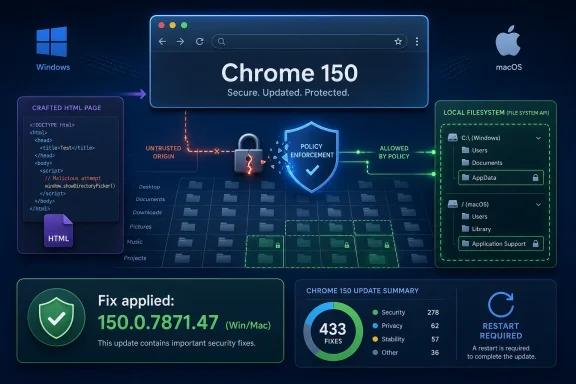
Google fixed CVE-2026-14052 in Chrome 150.0.7871.47 for Windows and Mac on June 30, 2026, closing a low-severity FileSystem policy-enforcement flaw that could let a remote attacker bypass discretionary access controls through a crafted HTML page. The bug is not the sort of browser vulnerability that should send admins into emergency-response mode by itself. But it is exactly the sort of small boundary failure that explains why modern browser patching has become less about individual CVE drama and more about keeping the whole Chromium surface moving.
The National Vulnerability Database entry, sourced from Chrome and later enriched by CISA’s ADP program, describes the issue as improper access control and gives it a CVSS 3.1 score of 4.3, while Google’s own Chrome Releases post classifies it as low severity. Google also notes that access to bug details may remain restricted until most users have received the fix, which means defenders are left with the familiar browser-security bargain: patch now, understand later. That asymmetry is frustrating, but in this case it is also rational.
CVE-2026-14052 sits in Chrome’s FileSystem area, a place where web convenience and local trust meet uneasily. The browser is supposed to mediate what a page can touch, what it can request, and what an origin is allowed to remember or reuse. When that mediation is described as “insufficient policy enforcement,” the important word is not insufficient but policy.
Policy bugs are different from memory-corruption bugs. A use-after-free in V8 or GPU code can suggest a plausible route toward code execution, sandbox escape, or spyware-grade exploitation. A policy enforcement bug more often means that Chrome made a wrong decision about whether something should be allowed, blocked, scoped, or isolated.
That distinction helps explain the low Chromium severity. NVD’s CISA-supplied vector says the attack is network-reachable, low complexity, requires no privileges, and requires user interaction; it also records no confidentiality or availability impact, with only low integrity impact. In plain English, the published scoring says this is a crafted-page problem, not a drive-by compromise that silently steals files or executes arbitrary code.
Still, FileSystem bugs deserve attention because they are boundary bugs. Browsers are operating-system-adjacent now: they broker authentication, sync, local storage, device APIs, file pickers, enterprise policy, password managers, and web apps that behave increasingly like desktop apps. A low-rated flaw in that zone can matter less for what it does alone than for what it reveals about the complexity of the permission machine around it.
That number should stop readers more than the individual CVE does. Chrome updates have become less like periodic patches and more like rolling infrastructure maintenance for one of the most exposed runtimes on the planet. Every tab is an interpreter of hostile input, every browser API is a contract with potentially malicious code, and every regression in enforcement logic is a possible escape hatch from the browser’s model of trust.
The FileSystem bug appears deep in a long list that includes critical, high, medium, and low findings across the browser stack. Google listed CVE-2026-14052 as a low-severity “Insufficient policy enforcement in FileSystem” issue, reported internally by Google on April 12, 2026. That timing matters because it suggests this was not publicly disclosed as an emergency zero-day; it was part of the factory work of hardening a browser before and during a major stable release.
For users, the operational instruction is simple: if Chrome is below 150.0.7871.47 on Windows or Mac, it is behind the fix described in the CVE. For Linux, Google’s Chrome 150 stable build line in the same announcement is 150.0.7871.46. The version split is normal for Chrome releases, but it is exactly the sort of detail that endpoint dashboards and vulnerability scanners can mishandle if they flatten all desktop platforms into one version string.
Chrome’s security model depends heavily on origin separation, user gestures, prompts, and scoped access. The ideal is that a page gets only what the user explicitly grants and only within the boundaries the browser enforces. A discretionary access-control bypass, even one with limited impact, says that some part of that intent-vs-enforcement chain did not hold.
The public description does not say that an attacker could read arbitrary local files. In fact, the CVSS vector published by CISA records no confidentiality impact, which is a meaningful restraint on interpretation. The safer reading is that a crafted HTML page could cause some unauthorized state change or access-control bypass with limited integrity consequences, not that the bug is a full file-stealing primitive.
That restraint is important because vulnerability writeups often inflate browser bugs into cinematic compromise chains. Low-severity Chrome FileSystem policy enforcement flaw is not the same as remote code execution. It is also not nothing. It is a reminder that the browser’s local-facing APIs are powerful enough that small mistakes merit rapid deployment, especially in managed environments where browser state, identity state, and SaaS workflows are inseparable.
That is a compact but useful triage picture. “No exploitation” does not mean impossible to exploit; it means there was no known exploitation signal in the enrichment record. “Not automatable” fits the user-interaction requirement. “Partial technical impact” keeps the bug in the realm of bounded consequences rather than system compromise.
The NVD change history also shows that NIST later added a CPE configuration for Google Chrome versions up to, but excluding, 150.0.7871.47. That answers the practical question many vulnerability managers ask first: yes, there is a CPE association in the NVD record now, even if the page’s product section may display with the familiar lag or “CPEs loading” behavior in the browser. The relevant configuration is Google Chrome before 150.0.7871.47.
This matters because vulnerability management has become an exercise in reconciling multiple partially complete data streams. Chrome publishes the release note. CVE provides the identifier and description. NVD structures the record and eventually attaches CPE data. CISA-ADP may add scoring and SSVC context before NVD finishes its own analysis. The result is better than silence, but it is not a single clean oracle.
For CVE-2026-14052, the NVD change record says NIST added a CPE configuration covering Chrome versions earlier than 150.0.7871.47. That is the right automation hook for most vulnerability-management products, though tools may still need time to ingest the updated feed. The awkward part is that users looking at the page can see contradictory signals: the product panel may appear to be loading, while the change history already records the CPE addition.
That split between human page rendering and machine-readable change history is not new, but it matters. Admins should not stop at the top-level visual state of an NVD page when building a patch decision. They should check vendor release notes, endpoint inventory, and feed timestamps. The CPE is useful, but Chrome’s own version inventory remains the more direct control.
For Windows administrators, the cleanest test is not “Does my scanner show CVE-2026-14052?” but “Are all managed Chrome installations on the fixed Chrome 150 build or later?” Browser patch compliance is one of the rare areas where version state is often easier to verify than CVE state. If your fleet can tell you Chrome versions accurately, you do not need to wait for every enrichment field to settle before acting.
That does not make every user-interaction bug urgent. It does mean “UI:R” should not be translated as “unlikely.” Browsers exist so users can interact with untrusted content all day. The line between normal web behavior and exploit precondition is thinner in Chrome than it is in, say, a server daemon listening on an internal port.
In this case, CISA’s score still lands at medium while Chromium’s severity lands at low. That discrepancy is not a scandal; it reflects different scoring systems and priorities. Google is judging the bug in the context of Chromium exploitability and component impact, while CVSS is describing attack characteristics and security impact in a standardized vocabulary.
The useful synthesis is this: CVE-2026-14052 does not justify panic, but it does justify normal Chrome patch urgency. If the browser is already set to auto-update and users restart it promptly, the risk should collapse quickly. If the browser sits open for weeks in kiosk sessions, VDI images, lab machines, or line-of-business workstations, low severity becomes less reassuring.
That is why browser patching should be managed as a restart problem, not merely an update problem. Admins need telemetry that distinguishes available, installed, and active versions. A machine that has downloaded Chrome 150 but is still running a vulnerable 149 or early 150 process is not patched in the way a risk dashboard usually implies.
The practical controls are familiar. Use Chrome enterprise policies to manage update cadence, require relaunch notifications where appropriate, and avoid indefinite deferrals for stable-channel security updates. For high-risk users—finance teams, help desks, executives, developers with production access—the tolerance for stale browser processes should be lower than the tolerance for ordinary desktop application drift.
There is also a Chromium ecosystem angle. Microsoft Edge, Brave, Vivaldi, Opera, and other Chromium-based browsers must pick up relevant Chromium fixes through their own release processes. CVE-2026-14052 is named against Google Chrome in the NVD record, but the underlying component is Chromium’s FileSystem area. Admins who standardize on non-Google Chromium browsers should track vendor advisories rather than assume Chrome’s version number maps directly to their fleet.
The gap is especially noticeable for low-severity bugs because the public wants to know whether a bug is genuinely low impact or merely low in isolation. Browser exploitation is often compositional: one bug nudges a permission boundary, another leaks state, a third obtains code execution, and a fourth escapes a sandbox. A FileSystem policy bypass might be boring alone but interesting in a chain.
Nothing in the public record for CVE-2026-14052 indicates active exploitation. CISA’s SSVC enrichment says exploitation is none, and Google did not flag this CVE as exploited in the wild. That should temper the story. This is not a zero-day alarm.
Yet restricted details also mean defenders cannot easily write custom detections or assess application-specific exposure. Organizations that run complex internal web apps using file and storage features may reasonably want more detail than the CVE gives them. They are unlikely to get it until patch uptake is high or the underlying Chromium issue is opened further.
A browser with 433 security fixes in one stable update is both reassuring and unsettling. Reassuring, because the project is finding and fixing large numbers of defects. Unsettling, because the attack surface is so large that triple-digit patch counts no longer feel extraordinary.
For WindowsForum readers, the relevant frame is operational resilience. If your patch process depends on manually reading each CVE, ranking it, and deciding whether this one matters, Chrome has already beaten your process. The only sustainable model is to treat stable browser security updates as routine, fast-moving maintenance, with exceptions for compatibility—not the other way around.
That does not mean abandoning risk judgment. It means applying judgment at the right layer. The decision is not whether CVE-2026-14052 alone deserves deployment. The decision is whether an internet-facing interpreter of untrusted code should remain behind a stable security release that fixes hundreds of issues, including critical memory-safety bugs and low-severity policy defects alike.
The National Vulnerability Database entry, sourced from Chrome and later enriched by CISA’s ADP program, describes the issue as improper access control and gives it a CVSS 3.1 score of 4.3, while Google’s own Chrome Releases post classifies it as low severity. Google also notes that access to bug details may remain restricted until most users have received the fix, which means defenders are left with the familiar browser-security bargain: patch now, understand later. That asymmetry is frustrating, but in this case it is also rational.
 A Low-Severity Chrome Bug Still Lives in a High-Value Boundary
CVE-2026-14052 sits in Chrome’s FileSystem area, a place where web convenience and local trust meet uneasily. The browser is supposed to mediate what a page can touch, what it can request, and what an origin is allowed to remember or reuse. When that mediation is described as “insufficient policy enforcement,” the important word is not insufficient but policy.Policy bugs are different from memory-corruption bugs. A use-after-free in V8 or GPU code can suggest a plausible route toward code execution, sandbox escape, or spyware-grade exploitation. A policy enforcement bug more often means that Chrome made a wrong decision about whether something should be allowed, blocked, scoped, or isolated.
That distinction helps explain the low Chromium severity. NVD’s CISA-supplied vector says the attack is network-reachable, low complexity, requires no privileges, and requires user interaction; it also records no confidentiality or availability impact, with only low integrity impact. In plain English, the published scoring says this is a crafted-page problem, not a drive-by compromise that silently steals files or executes arbitrary code.
Still, FileSystem bugs deserve attention because they are boundary bugs. Browsers are operating-system-adjacent now: they broker authentication, sync, local storage, device APIs, file pickers, enterprise policy, password managers, and web apps that behave increasingly like desktop apps. A low-rated flaw in that zone can matter less for what it does alone than for what it reveals about the complexity of the permission machine around it.
Chrome 150 Was Not a One-CVE Update
The Stable Channel update that delivered the fix was much larger than CVE-2026-14052. Google’s Chrome Releases blog announced Chrome 150’s promotion to the stable channel on June 30 for Windows, Mac, and Linux, with rollout over the following days and weeks. The same post said the release included 433 security fixes.That number should stop readers more than the individual CVE does. Chrome updates have become less like periodic patches and more like rolling infrastructure maintenance for one of the most exposed runtimes on the planet. Every tab is an interpreter of hostile input, every browser API is a contract with potentially malicious code, and every regression in enforcement logic is a possible escape hatch from the browser’s model of trust.
The FileSystem bug appears deep in a long list that includes critical, high, medium, and low findings across the browser stack. Google listed CVE-2026-14052 as a low-severity “Insufficient policy enforcement in FileSystem” issue, reported internally by Google on April 12, 2026. That timing matters because it suggests this was not publicly disclosed as an emergency zero-day; it was part of the factory work of hardening a browser before and during a major stable release.
For users, the operational instruction is simple: if Chrome is below 150.0.7871.47 on Windows or Mac, it is behind the fix described in the CVE. For Linux, Google’s Chrome 150 stable build line in the same announcement is 150.0.7871.46. The version split is normal for Chrome releases, but it is exactly the sort of detail that endpoint dashboards and vulnerability scanners can mishandle if they flatten all desktop platforms into one version string.
The FileSystem Surface Is Where Web Apps Become Local Actors
The modern web has spent years clawing its way toward desktop-like capability. Users can edit files in web apps, drag local documents into workflows, store large blobs offline, and interact with browser-mediated storage that feels less like a cookie jar and more like a miniature application workspace. That evolution is useful, but it creates a bigger permissions story than the old “web page displays remote content” model ever required.Chrome’s security model depends heavily on origin separation, user gestures, prompts, and scoped access. The ideal is that a page gets only what the user explicitly grants and only within the boundaries the browser enforces. A discretionary access-control bypass, even one with limited impact, says that some part of that intent-vs-enforcement chain did not hold.
The public description does not say that an attacker could read arbitrary local files. In fact, the CVSS vector published by CISA records no confidentiality impact, which is a meaningful restraint on interpretation. The safer reading is that a crafted HTML page could cause some unauthorized state change or access-control bypass with limited integrity consequences, not that the bug is a full file-stealing primitive.
That restraint is important because vulnerability writeups often inflate browser bugs into cinematic compromise chains. Low-severity Chrome FileSystem policy enforcement flaw is not the same as remote code execution. It is also not nothing. It is a reminder that the browser’s local-facing APIs are powerful enough that small mistakes merit rapid deployment, especially in managed environments where browser state, identity state, and SaaS workflows are inseparable.
NVD’s Entry Shows the New Vulnerability Data Reality
The NVD page for CVE-2026-14052 is almost as interesting for its metadata as for the vulnerability itself. NVD had not provided its own CVSS assessment when the entry was viewed, but it displayed CISA-ADP’s CVSS 3.1 score and CWE mapping. CISA mapped the issue to CWE-284, Improper Access Control, and its SSVC data marked exploitation as none, automatable as no, and technical impact as partial.That is a compact but useful triage picture. “No exploitation” does not mean impossible to exploit; it means there was no known exploitation signal in the enrichment record. “Not automatable” fits the user-interaction requirement. “Partial technical impact” keeps the bug in the realm of bounded consequences rather than system compromise.
The NVD change history also shows that NIST later added a CPE configuration for Google Chrome versions up to, but excluding, 150.0.7871.47. That answers the practical question many vulnerability managers ask first: yes, there is a CPE association in the NVD record now, even if the page’s product section may display with the familiar lag or “CPEs loading” behavior in the browser. The relevant configuration is Google Chrome before 150.0.7871.47.
This matters because vulnerability management has become an exercise in reconciling multiple partially complete data streams. Chrome publishes the release note. CVE provides the identifier and description. NVD structures the record and eventually attaches CPE data. CISA-ADP may add scoring and SSVC context before NVD finishes its own analysis. The result is better than silence, but it is not a single clean oracle.
The CPE Question Is Really an Automation Question
The user-facing anxiety around “Are we missing a CPE?” is not pedantry. If an enterprise scanner cannot map a CVE to a product, the CVE may not flow into dashboards, patch SLAs, executive risk reports, or exception workflows. In the age of continuous browser updates, a missing or delayed CPE can turn a fixed vulnerability into an invisible one.For CVE-2026-14052, the NVD change record says NIST added a CPE configuration covering Chrome versions earlier than 150.0.7871.47. That is the right automation hook for most vulnerability-management products, though tools may still need time to ingest the updated feed. The awkward part is that users looking at the page can see contradictory signals: the product panel may appear to be loading, while the change history already records the CPE addition.
That split between human page rendering and machine-readable change history is not new, but it matters. Admins should not stop at the top-level visual state of an NVD page when building a patch decision. They should check vendor release notes, endpoint inventory, and feed timestamps. The CPE is useful, but Chrome’s own version inventory remains the more direct control.
For Windows administrators, the cleanest test is not “Does my scanner show CVE-2026-14052?” but “Are all managed Chrome installations on the fixed Chrome 150 build or later?” Browser patch compliance is one of the rare areas where version state is often easier to verify than CVE state. If your fleet can tell you Chrome versions accurately, you do not need to wait for every enrichment field to settle before acting.
User Interaction Lowers the Score, Not the Need to Patch
The CVSS vector requires user interaction, and that often leads to underreaction. In browser-land, user interaction is not a high bar. Clicking a link, visiting a page, opening a web app, interacting with a file picker, or following a lure inside email or chat can satisfy the condition depending on the bug.That does not make every user-interaction bug urgent. It does mean “UI:R” should not be translated as “unlikely.” Browsers exist so users can interact with untrusted content all day. The line between normal web behavior and exploit precondition is thinner in Chrome than it is in, say, a server daemon listening on an internal port.
In this case, CISA’s score still lands at medium while Chromium’s severity lands at low. That discrepancy is not a scandal; it reflects different scoring systems and priorities. Google is judging the bug in the context of Chromium exploitability and component impact, while CVSS is describing attack characteristics and security impact in a standardized vocabulary.
The useful synthesis is this: CVE-2026-14052 does not justify panic, but it does justify normal Chrome patch urgency. If the browser is already set to auto-update and users restart it promptly, the risk should collapse quickly. If the browser sits open for weeks in kiosk sessions, VDI images, lab machines, or line-of-business workstations, low severity becomes less reassuring.
Enterprise Chrome Fleets Fail at the Restart, Not the Download
Chrome’s update system is good enough that many users receive patches without knowing it. The weak point is activation. A browser can download an update and still run old code until the process restarts, and enterprise fleets are full of users who treat browser restarts as optional.That is why browser patching should be managed as a restart problem, not merely an update problem. Admins need telemetry that distinguishes available, installed, and active versions. A machine that has downloaded Chrome 150 but is still running a vulnerable 149 or early 150 process is not patched in the way a risk dashboard usually implies.
The practical controls are familiar. Use Chrome enterprise policies to manage update cadence, require relaunch notifications where appropriate, and avoid indefinite deferrals for stable-channel security updates. For high-risk users—finance teams, help desks, executives, developers with production access—the tolerance for stale browser processes should be lower than the tolerance for ordinary desktop application drift.
There is also a Chromium ecosystem angle. Microsoft Edge, Brave, Vivaldi, Opera, and other Chromium-based browsers must pick up relevant Chromium fixes through their own release processes. CVE-2026-14052 is named against Google Chrome in the NVD record, but the underlying component is Chromium’s FileSystem area. Admins who standardize on non-Google Chromium browsers should track vendor advisories rather than assume Chrome’s version number maps directly to their fleet.
Google’s Bug Silence Is Annoying, and Usually Correct
Google’s Chrome release notes repeat the standard warning that bug details and links may remain restricted until most users are updated. Security researchers dislike that opacity, administrators dislike patching from sparse descriptions, and journalists dislike writing around the blank space. But for browser vulnerabilities, early detail can be a gift to attackers.The gap is especially noticeable for low-severity bugs because the public wants to know whether a bug is genuinely low impact or merely low in isolation. Browser exploitation is often compositional: one bug nudges a permission boundary, another leaks state, a third obtains code execution, and a fourth escapes a sandbox. A FileSystem policy bypass might be boring alone but interesting in a chain.
Nothing in the public record for CVE-2026-14052 indicates active exploitation. CISA’s SSVC enrichment says exploitation is none, and Google did not flag this CVE as exploited in the wild. That should temper the story. This is not a zero-day alarm.
Yet restricted details also mean defenders cannot easily write custom detections or assess application-specific exposure. Organizations that run complex internal web apps using file and storage features may reasonably want more detail than the CVE gives them. They are unlikely to get it until patch uptake is high or the underlying Chromium issue is opened further.
The Real Lesson Is Patch Throughput, Not Vulnerability Theater
The temptation with any named CVE is to make it the star of the story. Here, that would be backwards. CVE-2026-14052 is a small piece of a much larger Chrome 150 security release, and the release itself is evidence of the scale of modern browser hardening.A browser with 433 security fixes in one stable update is both reassuring and unsettling. Reassuring, because the project is finding and fixing large numbers of defects. Unsettling, because the attack surface is so large that triple-digit patch counts no longer feel extraordinary.
For WindowsForum readers, the relevant frame is operational resilience. If your patch process depends on manually reading each CVE, ranking it, and deciding whether this one matters, Chrome has already beaten your process. The only sustainable model is to treat stable browser security updates as routine, fast-moving maintenance, with exceptions for compatibility—not the other way around.
That does not mean abandoning risk judgment. It means applying judgment at the right layer. The decision is not whether CVE-2026-14052 alone deserves deployment. The decision is whether an internet-facing interpreter of untrusted code should remain behind a stable security release that fixes hundreds of issues, including critical memory-safety bugs and low-severity policy defects alike.
Chrome 150 Turns One FileSystem Bug Into a Fleet Hygiene Test
CVE-2026-14052 is most useful as a diagnostic for how well an organization understands its browsers. The answer should not require a week of spreadsheet archaeology. It should be visible in endpoint management within hours or days of the Chrome 150 rollout.- Chrome for Windows and Mac should be at 150.0.7871.47 or later to cover the version threshold named in the CVE record.
- The NVD change history records a CPE configuration for Google Chrome versions earlier than 150.0.7871.47, even if page rendering or downstream tools lag.
- CISA-ADP scored the issue as CVSS 3.1 4.3 medium, while Chromium’s release note labels it low severity.
- The public record does not indicate active exploitation, and CISA’s SSVC enrichment lists exploitation as none.
- User interaction is required, but that is a modest condition for browser bugs because normal browsing is interaction with untrusted content.
- The fix arrived inside a much larger Chrome 150 stable release containing 433 security fixes, making version compliance more important than single-CVE triage.
References
- Primary source: NVD / Chromium
Published: 2026-07-03T07:00:35-07:00
NVD - CVE-2026-14052
 nvd.nist.gov
- Security advisory: MSRC
Published: 2026-07-03T07:00:35-07:00
Original feed URL
Security Update Guide - Microsoft Security Response Center
 msrc.microsoft.com
- Related coverage: cvefeed.io
CVE-2026-14052 - Google Chrome FileSystem Insufficient Policy Enforcement
Insufficient policy enforcement in FileSystem in Google Chrome prior to 150.0.7871.47 allowed a remote attacker to bypass discretionary access control via a crafted HTML page. (Chromium security severity: Low)cvefeed.io - Related coverage: vuldb.com
CVE-2026-14052 Google Chrome Fileystem access control (ID 501810)
A flaw has been found in Google Chrome. This vulnerability appears as CVE-2026-14052. It is suggested to upgrade the affected component.vuldb.com - Official source: nist.gov
National Vulnerability Database
NIST maintains the National Vulnerability Database (NVD), a repository of information on software and hardware flaws that can compromise computer security. This is a key piece of the nation’s cybersecurity infrastructure.www.nist.gov - Related coverage: labs.cloudsecurityalliance.org
NVD Enrichment Triage: Enterprise Vulnerability Programs Must Adapt
PDF documentlabs.cloudsecurityalliance.org
