

CVE-2026-14156 is a Google Chrome StorageAccessAPI policy-enforcement flaw disclosed on June 30, 2026, affecting Chrome versions before 150.0.7871.47 and allowing a remote attacker with an already-compromised renderer process to bypass same-origin policy using a crafted HTML page. The short answer to the CPE question is: based on the NVD record as modified on July 2, the obvious Chrome CPE is already present, but the record may still be incomplete for downstream Chromium-based products. That distinction matters because this is exactly the kind of browser vulnerability that looks small in isolation and becomes operationally messy once it enters enterprise vulnerability scanners, browser forks, managed endpoints, and compliance dashboards. The bug is not a panic-grade zero-day, but it is a useful reminder that browser security is now a chain of assumptions, and inventory systems only see the links they are taught to recognize.
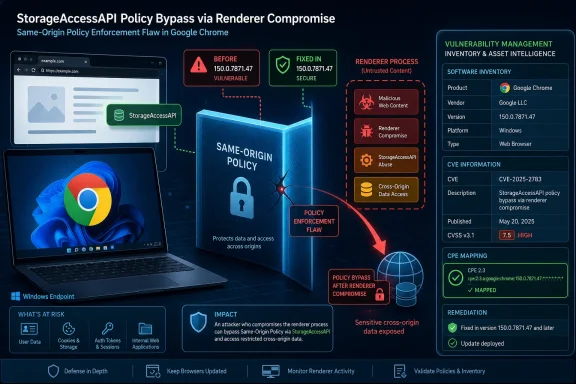
Google’s own description, later reflected in the National Vulnerability Database, is narrow and careful: insufficient policy enforcement in Chrome’s StorageAccessAPI before version 150.0.7871.47 could let an attacker who had already compromised the renderer process bypass the same-origin policy through a crafted HTML page. Chromium classifies the issue as Low severity, while NVD and CISA-ADP attach a CVSS 3.1 base score of 6.5, which lands in Medium territory.
That mismatch is not necessarily a contradiction. Chromium’s severity label is usually about practical exploitability within Chrome’s architecture and the bug’s place in the browser’s defense-in-depth model. CVSS, by contrast, is a standardized scoring system that sees a network-deliverable, user-interaction-triggered integrity impact and produces a number that can look more alarming than the vendor’s internal label.
The key phrase is already compromised the renderer process. This is not, on its face, a clean drive-by bug that gives an attacker arbitrary code execution from a single malicious page. It is a post-compromise policy bypass inside a browser component whose job is to mediate cross-site storage access in a web platform increasingly shaped by privacy controls, embedded content, and third-party cookie deprecation.
That makes CVE-2026-14156 less interesting as a standalone catastrophe and more interesting as a browser hardening failure. Modern Chrome security is built on layers: site isolation, sandboxing, renderer boundaries, origin checks, storage partitioning, permission prompts, enterprise policies, and update velocity. A flaw that lets an attacker skip a same-origin guard after compromising the renderer is not the first domino, but it may be the domino that makes another bug more useful.
StorageAccessAPI exists because the modern web has made that boundary more complicated. Sites embed identity providers, payment widgets, analytics frames, federated login flows, comment systems, and enterprise portals. Browsers have also been tightening third-party storage access to reduce tracking, which means legitimate embedded content sometimes needs a structured way to request access to cookies or other storage that used to be available by default.
That is fertile ground for bugs. Any API that arbitrates between privacy, compatibility, identity, and origin boundaries must answer a deceptively simple question: when should embedded content be allowed to behave as if it belongs closer to the user’s current site context? If enforcement is inconsistent, an attacker may not need to break the browser’s entire model; they only need to find a place where policy says no and implementation accidentally says yes.
CVE-2026-14156 appears to sit in that seam. The public description does not give exploit code or detailed reproduction steps, and the linked Chromium issue is permission-restricted, which is normal while users are still updating. But the combination of StorageAccessAPI, compromised renderer, and same-origin policy bypass tells administrators enough to classify it properly: this is a boundary weakness that can amplify renderer compromise, not a standalone remote takeover.
The harder question is whether the CVE record fully captures the affected ecosystem. Chrome is both a product and the flagship downstream of Chromium. Microsoft Edge, Brave, Vivaldi, Opera, Electron-based apps, embedded WebView-style components, and specialized enterprise browsers may share parts of the Chromium codebase, but they do not automatically inherit Chrome’s CPE. A vulnerability in a Chromium component can be fixed in Chrome first, then ripple through other products on their own schedules.
That does not mean NVD should casually assign every Chromium-derived product to the CVE. CPEs are supposed to represent known affected software configurations, not guesses. If a vendor has not confirmed impact, if the vulnerable code path is not present, if a fork has already patched independently, or if a component is built with different flags, broad CPE assignment can create false positives at scale.
But the inverse failure is also real. If only Google Chrome receives a CPE, asset owners who run Chromium-based alternatives may see nothing in their dashboards even though the underlying code path could be relevant. Vulnerability management teams then learn about risk through release notes, vendor advisories, Reddit reports, or breakage in managed fleets rather than through the supposedly authoritative CVE-to-product mapping.
That is a reasonable record for a new Chrome CVE. It is not empty, and it is not obviously malformed. But it also demonstrates why enterprise teams cannot treat NVD enrichment as a complete source of truth, especially for fast-moving browser code. The database can tell you the Chrome product line is affected before 150.0.7871.47; it cannot automatically tell you whether every Chromium cousin in your environment has absorbed the fix.
This is where CPEs become both essential and brittle. They are the glue between vulnerability records and asset inventories, but they are also string-based abstractions over a messy software supply chain. A managed Windows endpoint may have Chrome installed per-machine, Edge installed with the operating system, an Electron-based chat client, a line-of-business app bundling an old Chromium runtime, and a browser control inside a vendor console. A single CPE rarely describes that reality.
Security teams know this pain well. A CVE record with no CPE breaks automation because the scanner cannot map the vulnerability to installed software. A CVE record with too many CPEs creates noise and burns analyst time. A CVE record with a correct but narrow CPE is technically accurate and still operationally insufficient.
The catch is that Chrome versioning varies slightly by platform and channel. Desktop stable updates often land with adjacent build numbers across Windows, macOS, and Linux, and staged rollout means not every endpoint receives the update at the same minute. That is normal browser operations, but it complicates compliance snapshots taken during the rollout window.
In a consumer setting, the answer is simple: open Chrome, let it update, restart the browser. In a managed Windows environment, the answer is policy-driven: confirm update policy, verify version reporting, watch for restart deferrals, and make sure security tools are reading the actual installed browser version rather than stale inventory. Chrome’s fast release cadence only helps if the last mile — restart and verification — actually happens.
There is also the Extended Stable question. Enterprises that choose slower browser channels for predictability often accept a different risk cadence. Extended Stable can be a rational choice, but it requires administrators to understand when a security fix is backported, when a channel lags, and when a supposedly “minor” browser bug is relevant to regulated workflows or sensitive web apps.
The renderer is where untrusted web content lives. Chrome’s architecture assumes renderers may encounter hostile HTML, JavaScript, images, fonts, media, WebAssembly, and a long tail of web platform features. The sandbox is designed to limit damage when a renderer is compromised, but browser vendors continue to patch post-renderer weaknesses because containment is not the same as immunity.
A same-origin policy bypass after renderer compromise may give an attacker a better position inside the browser’s web security model. It could help manipulate cross-origin state, interfere with trust assumptions, or combine with an authenticated user session in ways that are highly application-specific. NVD’s vector marks confidentiality impact as none and integrity impact as high, which suggests the public scoring emphasizes unauthorized modification rather than data theft.
That integrity emphasis should catch the eye of administrators who protect cloud consoles, identity portals, SaaS admin panels, and internal web applications. Many enterprise disasters do not begin with data exfiltration; they begin with an authenticated user being induced into making, approving, or carrying out a state-changing action. A browser bug that weakens cross-origin barriers deserves attention even when it is not the flashiest item in the patch bundle.
That compromise is technically difficult because the browser must preserve user privacy without breaking the web’s dependency on embedded workflows. Identity is a prime example. A company may use a third-party identity provider inside an embedded frame, or a payment provider may need session continuity across a merchant site. The browser has to decide when that is legitimate and when it is tracking or abuse.
Policy enforcement bugs in this area are therefore not surprising. The platform is full of edge cases: nested frames, redirects, user gestures, sandbox attributes, permissions policies, partitioned storage, private browsing modes, enterprise policies, and site-specific exceptions. The more nuanced the rulebook becomes, the more likely it is that a single code path applies the wrong rule at the wrong time.
That is the architectural lesson of CVE-2026-14156. The modern browser is no longer merely a document viewer with a JavaScript engine. It is an application runtime, identity broker, privacy mediator, GPU client, password manager, policy endpoint, and enterprise access layer. Every new web capability adds value, but also another place where the policy model must be enforced exactly.
The more strategic task is verifying that browser updates are not assumed into existence. Chrome can download updates silently, but the running browser may still need a restart. Users can keep sessions open for days or weeks, particularly on Windows laptops that sleep instead of rebooting. In managed environments, a dashboard that says an update is available is not the same as a process list showing the fixed browser running.
Administrators should also check whether security tooling distinguishes Chrome from Chromium and Chromium-derived browsers. A fleet may be “Chrome compliant” while still carrying risk through another browser runtime. The CPE record for Google Chrome is useful, but it will not inventory everything that embeds Chromium code.
The same logic applies to golden images and packaged applications. If a base Windows image includes Chrome, update the image rather than relying entirely on post-deployment patching. If a vendor ships an Electron app, track that vendor’s update notes separately. If a line-of-business application pins a browser runtime, ask whether the fixed Chromium change has been absorbed.
Still, administrators should not stop at that formal boundary. If the vulnerable code is in shared Chromium components, Edge may require its own corresponding fix, version threshold, or advisory. Microsoft typically publishes Edge release notes and security information separately, and enterprise patch teams should track those rather than infer safety from the Chrome record alone.
This is one reason browser consolidation is a double-edged sword. Chromium’s dominance means security fixes can propagate quickly across a large ecosystem once they are understood. It also means a subtle bug in a shared component may matter far beyond the Chrome install count. The dependency graph is flatter than it looks from a desktop shortcut.
For Windows shops, the right mental model is not “Chrome versus Edge.” It is “Chromium lineage plus vendor-specific patch state.” Chrome 150.0.7871.47 answers the Google Chrome question. It does not, by itself, answer every Chromium question on a Windows endpoint.
That maps neatly to a crafted web page scenario. A victim needs to interact with or load attacker-controlled content, the attacker does not need credentials, and the impact is framed around integrity rather than direct data disclosure. But the requirement for renderer compromise is not fully captured in the emotional weight of the number. CVSS can describe characteristics; it cannot narrate the exploit chain.
Chromium’s Low severity label adds the missing context, but it can undersell the issue to organizations that only ingest NVD. The result is a familiar split-screen: vendor says Low, NVD says Medium, scanners generate tickets, and analysts must decide whether to accelerate patching or let normal browser update policy handle it.
For most environments, the answer is normal-but-verified patching. This is not the sort of Chrome bug that should trigger emergency weekend incident response absent evidence of exploitation. But browsers are high-value software exposed to hostile content every day, so “normal” should still mean fast. A low-drama browser patch is still a browser patch.
The goal is to avoid giving attackers a roadmap while the patch is still propagating. Browser vendors often disclose enough to let defenders identify affected versions and prioritize updates, while delaying technical detail until the fix has reached a broad population. That balance is imperfect, but it is preferable to publishing a proof-of-concept before managed fleets have restarted.
This opacity does place more responsibility on vendor trust. Administrators have to act on sparse descriptions, version thresholds, and severity labels. In the case of CVE-2026-14156, the public record is sufficient for remediation but insufficient for deep exploit modeling.
That is another reason CPE accuracy matters. When details are intentionally withheld, automated mapping becomes more important, not less. If the CVE record correctly identifies affected products, defenders can move without waiting for exploit detail. If it does not, the silence around the bug widens the visibility gap.
This ambiguity is not unique to Chrome. The same pattern appears across OpenSSL, libxml, WebKit, Electron, SQLite, and countless embedded libraries. A vulnerability can be born in one upstream project, assigned to one CVE, patched by one vendor, and then slowly surface across products that share code but expose it differently.
CPE was not designed to express all of that nuance elegantly. It can name products and versions, but it struggles with vendored code, statically linked components, downstream forks, feature flags, and product-specific exposure. Software bills of materials were supposed to help with this, but SBOM adoption and vulnerability correlation remain uneven.
The most mature organizations therefore treat CPE as one signal among several. They combine NVD enrichment, vendor advisories, endpoint telemetry, browser version reporting, software composition analysis, and threat intelligence. That sounds cumbersome because it is. The alternative is a clean dashboard that lies by omission.
The assurance problem is harder. Did every user restart? Did all Windows profiles update? Are there per-user Chrome installations outside the managed path? Are portable browsers present? Are kiosk systems pinned? Are VDI pools refreshed? Are security scanners checking the actual executable version or only registry evidence?
Chrome’s enterprise controls can help here. Administrators can set update policies, enforce minimum versions, and gather inventory through endpoint management platforms. But enforcement should be tested, not presumed. Browser update failures are rarely dramatic; they accumulate quietly in the corners of fleets.
The same applies to non-Chrome Chromium runtimes. If your environment depends on Electron apps or Chromium-embedded products, version assurance usually moves from the browser management console to vendor management. That is a weaker and slower channel, which is why security teams need a process for asking vendors whether a Chromium security fix is applicable.
If the question is whether the CPE coverage is complete for every potentially affected Chromium-derived product, the answer is not established by the public record. NVD’s entry names Chrome as the source and Chrome as the affected product. Without vendor confirmation from other browser or application makers, adding more CPEs could create false positives.
The best phrasing for a vulnerability-management note would be deliberately precise: “The NVD record includes the Google Chrome CPE for versions prior to 150.0.7871.47; organizations should separately validate Chromium-based browsers and embedded Chromium runtimes through their vendors.” That avoids both underreaction and speculative overreach.
This is the difference between database correctness and operational completeness. The database can be correct and still leave work for administrators. CVE-2026-14156 sits squarely in that gap.
But the wrong lesson would be to ignore it because the bug is “only” a policy bypass after renderer compromise. Browser security failures are cumulative. The industry patches defense-in-depth bugs because attackers build chains, and every weakened boundary gives them more room to maneuver.
The right lesson is narrower and more useful. Patch Chrome, verify version 150.0.7871.47 or later, and do not let the presence of one CPE convince you that the Chromium ecosystem has been fully accounted for. This is a routine update with non-routine implications for inventory hygiene.
For Windows administrators, that means Chrome is the immediate target, Edge is the natural adjacent check, and embedded Chromium runtimes are the long tail. None of that requires panic. It requires the discipline to turn a small CVE into a clean inventory exercise before the next larger browser bug arrives.
 A Low-Severity Chrome Bug Becomes an Inventory Test
Google’s own description, later reflected in the National Vulnerability Database, is narrow and careful: insufficient policy enforcement in Chrome’s StorageAccessAPI before version 150.0.7871.47 could let an attacker who had already compromised the renderer process bypass the same-origin policy through a crafted HTML page. Chromium classifies the issue as Low severity, while NVD and CISA-ADP attach a CVSS 3.1 base score of 6.5, which lands in Medium territory.That mismatch is not necessarily a contradiction. Chromium’s severity label is usually about practical exploitability within Chrome’s architecture and the bug’s place in the browser’s defense-in-depth model. CVSS, by contrast, is a standardized scoring system that sees a network-deliverable, user-interaction-triggered integrity impact and produces a number that can look more alarming than the vendor’s internal label.
The key phrase is already compromised the renderer process. This is not, on its face, a clean drive-by bug that gives an attacker arbitrary code execution from a single malicious page. It is a post-compromise policy bypass inside a browser component whose job is to mediate cross-site storage access in a web platform increasingly shaped by privacy controls, embedded content, and third-party cookie deprecation.
That makes CVE-2026-14156 less interesting as a standalone catastrophe and more interesting as a browser hardening failure. Modern Chrome security is built on layers: site isolation, sandboxing, renderer boundaries, origin checks, storage partitioning, permission prompts, enterprise policies, and update velocity. A flaw that lets an attacker skip a same-origin guard after compromising the renderer is not the first domino, but it may be the domino that makes another bug more useful.
The Same-Origin Policy Is Still the Browser’s Load-Bearing Wall
The same-origin policy is one of the web’s oldest and most important security boundaries. It is the rule that says a script running on one origin should not freely read or manipulate content belonging to another origin. Without it, the browser would become a universal credential blender: one compromised tab could reach across to banking sessions, webmail, intranet dashboards, admin consoles, and cloud control planes.StorageAccessAPI exists because the modern web has made that boundary more complicated. Sites embed identity providers, payment widgets, analytics frames, federated login flows, comment systems, and enterprise portals. Browsers have also been tightening third-party storage access to reduce tracking, which means legitimate embedded content sometimes needs a structured way to request access to cookies or other storage that used to be available by default.
That is fertile ground for bugs. Any API that arbitrates between privacy, compatibility, identity, and origin boundaries must answer a deceptively simple question: when should embedded content be allowed to behave as if it belongs closer to the user’s current site context? If enforcement is inconsistent, an attacker may not need to break the browser’s entire model; they only need to find a place where policy says no and implementation accidentally says yes.
CVE-2026-14156 appears to sit in that seam. The public description does not give exploit code or detailed reproduction steps, and the linked Chromium issue is permission-restricted, which is normal while users are still updating. But the combination of StorageAccessAPI, compromised renderer, and same-origin policy bypass tells administrators enough to classify it properly: this is a boundary weakness that can amplify renderer compromise, not a standalone remote takeover.
The CPE Is Present, but That Does Not End the Story
The user-facing NVD question — “Are we missing a CPE here?” — is easy to misread. According to the NVD change history, NIST added a vulnerable software configuration on July 2:cpe:2.3:a:google:chrome:*:*:*:*:*:*:*:* for versions up to, but excluding, 150.0.7871.47. For Google Chrome itself, that is the expected CPE. If a scanner understands the CPE and has accurate Chrome version inventory, it should be able to flag Chrome installations below the fixed build.The harder question is whether the CVE record fully captures the affected ecosystem. Chrome is both a product and the flagship downstream of Chromium. Microsoft Edge, Brave, Vivaldi, Opera, Electron-based apps, embedded WebView-style components, and specialized enterprise browsers may share parts of the Chromium codebase, but they do not automatically inherit Chrome’s CPE. A vulnerability in a Chromium component can be fixed in Chrome first, then ripple through other products on their own schedules.
That does not mean NVD should casually assign every Chromium-derived product to the CVE. CPEs are supposed to represent known affected software configurations, not guesses. If a vendor has not confirmed impact, if the vulnerable code path is not present, if a fork has already patched independently, or if a component is built with different flags, broad CPE assignment can create false positives at scale.
But the inverse failure is also real. If only Google Chrome receives a CPE, asset owners who run Chromium-based alternatives may see nothing in their dashboards even though the underlying code path could be relevant. Vulnerability management teams then learn about risk through release notes, vendor advisories, Reddit reports, or breakage in managed fleets rather than through the supposedly authoritative CVE-to-product mapping.
NVD’s Enrichment Gap Is Now an Operational Problem
The NVD entry shows the current mechanics of vulnerability enrichment in miniature. The CVE was received from Chrome on June 30, modified by CISA-ADP on July 1, and initially analyzed by NIST on July 2. NIST added the CVSS vector, mapped the issue to CWE-862 for missing authorization, and added the Google Chrome CPE. CISA-ADP separately mapped it to CWE-284 for improper access control and recorded SSVC options indicating no known exploitation, not automatable, and partial technical impact.That is a reasonable record for a new Chrome CVE. It is not empty, and it is not obviously malformed. But it also demonstrates why enterprise teams cannot treat NVD enrichment as a complete source of truth, especially for fast-moving browser code. The database can tell you the Chrome product line is affected before 150.0.7871.47; it cannot automatically tell you whether every Chromium cousin in your environment has absorbed the fix.
This is where CPEs become both essential and brittle. They are the glue between vulnerability records and asset inventories, but they are also string-based abstractions over a messy software supply chain. A managed Windows endpoint may have Chrome installed per-machine, Edge installed with the operating system, an Electron-based chat client, a line-of-business app bundling an old Chromium runtime, and a browser control inside a vendor console. A single CPE rarely describes that reality.
Security teams know this pain well. A CVE record with no CPE breaks automation because the scanner cannot map the vulnerability to installed software. A CVE record with too many CPEs creates noise and burns analyst time. A CVE record with a correct but narrow CPE is technically accurate and still operationally insufficient.
Chrome 150.0.7871.47 Is the Line Administrators Should Draw
The fixed version in the CVE record is Chrome 150.0.7871.47. Google’s Stable Channel update for desktop, referenced by NVD, is the vendor anchor for remediation. For Windows administrators, that version threshold is the practical dividing line: Chrome below it should be considered vulnerable to CVE-2026-14156, and Chrome at or above it should not be flagged for this specific issue.The catch is that Chrome versioning varies slightly by platform and channel. Desktop stable updates often land with adjacent build numbers across Windows, macOS, and Linux, and staged rollout means not every endpoint receives the update at the same minute. That is normal browser operations, but it complicates compliance snapshots taken during the rollout window.
In a consumer setting, the answer is simple: open Chrome, let it update, restart the browser. In a managed Windows environment, the answer is policy-driven: confirm update policy, verify version reporting, watch for restart deferrals, and make sure security tools are reading the actual installed browser version rather than stale inventory. Chrome’s fast release cadence only helps if the last mile — restart and verification — actually happens.
There is also the Extended Stable question. Enterprises that choose slower browser channels for predictability often accept a different risk cadence. Extended Stable can be a rational choice, but it requires administrators to understand when a security fix is backported, when a channel lags, and when a supposedly “minor” browser bug is relevant to regulated workflows or sensitive web apps.
Renderer Compromise Is Not a Comfort Blanket
It is tempting to dismiss CVE-2026-14156 because exploitation requires a compromised renderer process. That requirement is important, but it is not a free pass. Browser exploitation often works as a chain, and vulnerabilities that look modest alone can become useful when paired with memory corruption, sandbox weaknesses, logic bugs, or malicious extensions.The renderer is where untrusted web content lives. Chrome’s architecture assumes renderers may encounter hostile HTML, JavaScript, images, fonts, media, WebAssembly, and a long tail of web platform features. The sandbox is designed to limit damage when a renderer is compromised, but browser vendors continue to patch post-renderer weaknesses because containment is not the same as immunity.
A same-origin policy bypass after renderer compromise may give an attacker a better position inside the browser’s web security model. It could help manipulate cross-origin state, interfere with trust assumptions, or combine with an authenticated user session in ways that are highly application-specific. NVD’s vector marks confidentiality impact as none and integrity impact as high, which suggests the public scoring emphasizes unauthorized modification rather than data theft.
That integrity emphasis should catch the eye of administrators who protect cloud consoles, identity portals, SaaS admin panels, and internal web applications. Many enterprise disasters do not begin with data exfiltration; they begin with an authenticated user being induced into making, approving, or carrying out a state-changing action. A browser bug that weakens cross-origin barriers deserves attention even when it is not the flashiest item in the patch bundle.
StorageAccessAPI Sits at the Collision Point of Privacy and Compatibility
StorageAccessAPI is part of a broader effort to civilize third-party storage on the web. Browser vendors want to reduce invisible tracking, but web developers still need embedded services to function. The result is a permissions-shaped compromise: storage access becomes something requested, mediated, and constrained rather than simply assumed.That compromise is technically difficult because the browser must preserve user privacy without breaking the web’s dependency on embedded workflows. Identity is a prime example. A company may use a third-party identity provider inside an embedded frame, or a payment provider may need session continuity across a merchant site. The browser has to decide when that is legitimate and when it is tracking or abuse.
Policy enforcement bugs in this area are therefore not surprising. The platform is full of edge cases: nested frames, redirects, user gestures, sandbox attributes, permissions policies, partitioned storage, private browsing modes, enterprise policies, and site-specific exceptions. The more nuanced the rulebook becomes, the more likely it is that a single code path applies the wrong rule at the wrong time.
That is the architectural lesson of CVE-2026-14156. The modern browser is no longer merely a document viewer with a JavaScript engine. It is an application runtime, identity broker, privacy mediator, GPU client, password manager, policy endpoint, and enterprise access layer. Every new web capability adds value, but also another place where the policy model must be enforced exactly.
Windows Fleets Need Browser Patch Discipline, Not Browser Panic
For WindowsForum readers, the practical exposure is straightforward: if Chrome is installed on Windows endpoints and is older than 150.0.7871.47, update it. That applies to personal systems, managed desktops, VDI images, kiosk machines, and lab boxes that often miss routine browser restarts. The patch is the remediation; there is no need to wait for more exploit detail.The more strategic task is verifying that browser updates are not assumed into existence. Chrome can download updates silently, but the running browser may still need a restart. Users can keep sessions open for days or weeks, particularly on Windows laptops that sleep instead of rebooting. In managed environments, a dashboard that says an update is available is not the same as a process list showing the fixed browser running.
Administrators should also check whether security tooling distinguishes Chrome from Chromium and Chromium-derived browsers. A fleet may be “Chrome compliant” while still carrying risk through another browser runtime. The CPE record for Google Chrome is useful, but it will not inventory everything that embeds Chromium code.
The same logic applies to golden images and packaged applications. If a base Windows image includes Chrome, update the image rather than relying entirely on post-deployment patching. If a vendor ships an Electron app, track that vendor’s update notes separately. If a line-of-business application pins a browser runtime, ask whether the fixed Chromium change has been absorbed.
Microsoft Edge Is the Unspoken Comparison
Any Chrome CVE on Windows inevitably raises the Edge question. Microsoft Edge is Chromium-based, ships broadly on Windows, and has its own update channel and advisory process. A Chrome CPE does not automatically mean Edge is vulnerable, and the NVD entry discussed here names Google Chrome, not Microsoft Edge.Still, administrators should not stop at that formal boundary. If the vulnerable code is in shared Chromium components, Edge may require its own corresponding fix, version threshold, or advisory. Microsoft typically publishes Edge release notes and security information separately, and enterprise patch teams should track those rather than infer safety from the Chrome record alone.
This is one reason browser consolidation is a double-edged sword. Chromium’s dominance means security fixes can propagate quickly across a large ecosystem once they are understood. It also means a subtle bug in a shared component may matter far beyond the Chrome install count. The dependency graph is flatter than it looks from a desktop shortcut.
For Windows shops, the right mental model is not “Chrome versus Edge.” It is “Chromium lineage plus vendor-specific patch state.” Chrome 150.0.7871.47 answers the Google Chrome question. It does not, by itself, answer every Chromium question on a Windows endpoint.
The CVSS Number Is Useful, but the Attack Chain Is the Story
A CVSS 3.1 score of 6.5 Medium gives procurement systems, vulnerability dashboards, and service-level agreements something to sort. It is not a full risk assessment. CVSS says the attack vector is network, attack complexity is low, privileges are not required, user interaction is required, scope is unchanged, confidentiality impact is none, integrity impact is high, and availability impact is none.That maps neatly to a crafted web page scenario. A victim needs to interact with or load attacker-controlled content, the attacker does not need credentials, and the impact is framed around integrity rather than direct data disclosure. But the requirement for renderer compromise is not fully captured in the emotional weight of the number. CVSS can describe characteristics; it cannot narrate the exploit chain.
Chromium’s Low severity label adds the missing context, but it can undersell the issue to organizations that only ingest NVD. The result is a familiar split-screen: vendor says Low, NVD says Medium, scanners generate tickets, and analysts must decide whether to accelerate patching or let normal browser update policy handle it.
For most environments, the answer is normal-but-verified patching. This is not the sort of Chrome bug that should trigger emergency weekend incident response absent evidence of exploitation. But browsers are high-value software exposed to hostile content every day, so “normal” should still mean fast. A low-drama browser patch is still a browser patch.
Public Bug Silence Is a Feature, Not a Cover-Up
The Chromium issue linked from the CVE is permission-restricted. That will frustrate researchers and administrators who want to know exactly how the bypass works. It is also standard practice for browser vendors, especially when a fix is recent and many users may not have updated yet.The goal is to avoid giving attackers a roadmap while the patch is still propagating. Browser vendors often disclose enough to let defenders identify affected versions and prioritize updates, while delaying technical detail until the fix has reached a broad population. That balance is imperfect, but it is preferable to publishing a proof-of-concept before managed fleets have restarted.
This opacity does place more responsibility on vendor trust. Administrators have to act on sparse descriptions, version thresholds, and severity labels. In the case of CVE-2026-14156, the public record is sufficient for remediation but insufficient for deep exploit modeling.
That is another reason CPE accuracy matters. When details are intentionally withheld, automated mapping becomes more important, not less. If the CVE record correctly identifies affected products, defenders can move without waiting for exploit detail. If it does not, the silence around the bug widens the visibility gap.
One Chrome CPE Cannot Carry the Chromium Ecosystem
The NVD’s Chrome CPE answers the narrow database question, but not the ecosystem question. Google Chrome before 150.0.7871.47 is represented. Other products should not be assumed affected solely because they use Chromium, but they also should not be assumed safe because their names do not appear in the record.This ambiguity is not unique to Chrome. The same pattern appears across OpenSSL, libxml, WebKit, Electron, SQLite, and countless embedded libraries. A vulnerability can be born in one upstream project, assigned to one CVE, patched by one vendor, and then slowly surface across products that share code but expose it differently.
CPE was not designed to express all of that nuance elegantly. It can name products and versions, but it struggles with vendored code, statically linked components, downstream forks, feature flags, and product-specific exposure. Software bills of materials were supposed to help with this, but SBOM adoption and vulnerability correlation remain uneven.
The most mature organizations therefore treat CPE as one signal among several. They combine NVD enrichment, vendor advisories, endpoint telemetry, browser version reporting, software composition analysis, and threat intelligence. That sounds cumbersome because it is. The alternative is a clean dashboard that lies by omission.
The Fix Is Easy; the Assurance Is Hard
From a patching standpoint, CVE-2026-14156 is refreshingly simple. Update Chrome to 150.0.7871.47 or later. Restart the browser. Confirm the version. Watch for stragglers. That is the whole tactical playbook.The assurance problem is harder. Did every user restart? Did all Windows profiles update? Are there per-user Chrome installations outside the managed path? Are portable browsers present? Are kiosk systems pinned? Are VDI pools refreshed? Are security scanners checking the actual executable version or only registry evidence?
Chrome’s enterprise controls can help here. Administrators can set update policies, enforce minimum versions, and gather inventory through endpoint management platforms. But enforcement should be tested, not presumed. Browser update failures are rarely dramatic; they accumulate quietly in the corners of fleets.
The same applies to non-Chrome Chromium runtimes. If your environment depends on Electron apps or Chromium-embedded products, version assurance usually moves from the browser management console to vendor management. That is a weaker and slower channel, which is why security teams need a process for asking vendors whether a Chromium security fix is applicable.
The Useful Answer for the CPE Field Is “Yes and Not Enough”
If the question is whether the NVD entry is missing the Google Chrome CPE, the answer appears to be no. NIST added the Google Chrome CPE for versions below 150.0.7871.47 during its July 2 initial analysis. A scanner that consumes the updated NVD data should have a basic product-version mapping for Chrome.If the question is whether the CPE coverage is complete for every potentially affected Chromium-derived product, the answer is not established by the public record. NVD’s entry names Chrome as the source and Chrome as the affected product. Without vendor confirmation from other browser or application makers, adding more CPEs could create false positives.
The best phrasing for a vulnerability-management note would be deliberately precise: “The NVD record includes the Google Chrome CPE for versions prior to 150.0.7871.47; organizations should separately validate Chromium-based browsers and embedded Chromium runtimes through their vendors.” That avoids both underreaction and speculative overreach.
This is the difference between database correctness and operational completeness. The database can be correct and still leave work for administrators. CVE-2026-14156 sits squarely in that gap.
The Browser Patch That Teaches the Wrong Lesson If You Only Read the Score
CVE-2026-14156 is not the scariest Chrome vulnerability of the year, and it should not be treated like one. CISA-ADP’s SSVC data indicates no known exploitation, no automation, and partial technical impact. Chromium’s own severity is Low. Those are meaningful signals.But the wrong lesson would be to ignore it because the bug is “only” a policy bypass after renderer compromise. Browser security failures are cumulative. The industry patches defense-in-depth bugs because attackers build chains, and every weakened boundary gives them more room to maneuver.
The right lesson is narrower and more useful. Patch Chrome, verify version 150.0.7871.47 or later, and do not let the presence of one CPE convince you that the Chromium ecosystem has been fully accounted for. This is a routine update with non-routine implications for inventory hygiene.
For Windows administrators, that means Chrome is the immediate target, Edge is the natural adjacent check, and embedded Chromium runtimes are the long tail. None of that requires panic. It requires the discipline to turn a small CVE into a clean inventory exercise before the next larger browser bug arrives.
Chrome 150.0.7871.47 Draws a Clean Line, but Only for the Systems You Can See
The concrete takeaways are simpler than the platform politics around them. Treat the Chrome version threshold as settled, treat the CPE mapping as useful but narrow, and treat Chromium-derived software as a vendor-validation problem rather than an assumption.- Google Chrome installations older than 150.0.7871.47 should be updated and restarted to address CVE-2026-14156.
- The NVD record includes a Google Chrome CPE for versions up to but excluding 150.0.7871.47, so the obvious Chrome CPE does not appear to be missing.
- The public record does not prove that every Chromium-based browser or embedded Chromium runtime is affected, and it also does not prove that they are safe.
- The bug’s requirement for a compromised renderer lowers urgency, but it does not eliminate risk because browser exploits are often chained.
- Windows administrators should verify actual browser versions across endpoints rather than relying only on update availability or stale inventory.
- Organizations using Chromium-based applications should track vendor advisories separately from the Google Chrome CVE record.
References
- Primary source: NVD / Chromium
Published: 2026-07-03T07:00:28-07:00
NVD - CVE-2026-14156
 nvd.nist.gov
- Security advisory: MSRC
Published: 2026-07-03T07:00:28-07:00
Original feed URL
Security Update Guide - Microsoft Security Response Center
 msrc.microsoft.com
- Related coverage: cvefeed.io
CVE-2026-14156 - Google Chrome StorageAccessAPI Same Origin Policy Bypass
Insufficient policy enforcement in StorageAccessAPI in Google Chrome prior to 150.0.7871.47 allowed a remote attacker who had compromised the renderer process to bypass same origin policy via a crafted HTML page. (Chromium security severity: Low)cvefeed.io - Official source: nist.gov
National Vulnerability Database
NIST maintains the National Vulnerability Database (NVD), a repository of information on software and hardware flaws that can compromise computer security. This is a key piece of the nation’s cybersecurity infrastructure.www.nist.gov - Related coverage: radar.offseq.com
CVE-2026-14155: Insufficient policy enforcement in Google Chrome - Live Threat Intelligence - Threat Radar | OffSeq.com
Detailed information about CVE-2026-14155: Insufficient policy enforcement in Google Chrome affecting Google Chrome. Get real-time updates, technical details, aradar.offseq.com - Related coverage: labs.cloudsecurityalliance.org
NVD Enrichment Triage: Guidance for AI Security Programs
PDF documentlabs.cloudsecurityalliance.org
