

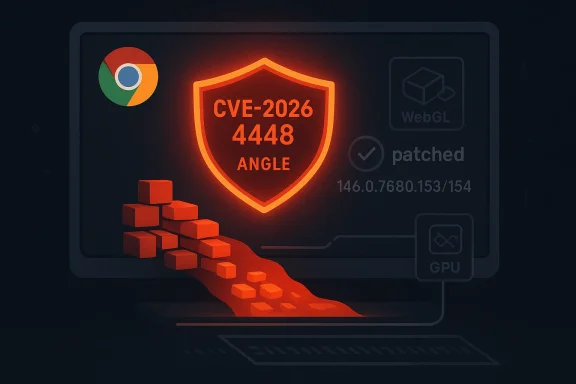
Google’s Chrome security team has patched a serious heap buffer overflow in ANGLE, tracked as CVE-2026-4448, in Chrome 146.0.7680.153 and later. The flaw could let a remote attacker trigger heap corruption through a crafted HTML page, which makes it especially important because the attack surface is simply the web browser itself, not a separate plugin or installed app. The issue is rated High in Chromium’s own severity language, and the corresponding release notes place it in a dense March 2026 update that fixed a cluster of memory-safety bugs across Chrome’s graphics and rendering stack. (chromereleases.googleblog.com)
The headline matters because ANGLE sits in one of the most sensitive parts of the browser: the graphics translation layer that helps web content talk to the machine’s GPU stack. Chromium’s public source describes ANGLE as the default WebGL backend on Windows and as a rendering layer used broadly for accelerated graphics paths, which means any memory corruption bug in that component can become a high-value target for attackers. In practical terms, a flaw here is not just a crash risk; it can be a stepping stone toward code execution if the exploit chain is sophisticated enough.
This vulnerability also fits an uncomfortable pattern for modern browsers: the most dangerous bugs are often not in the page’s JavaScript logic but in the native code paths that interpret complex content on the user’s behalf. That is why the issue description emphasizes a remote attacker and a crafted HTML page rather than a local privilege escalation or a malformed file format. Browser renderers are huge, fast-moving, and performance-sensitive, which creates exactly the kind of environment where memory corruption bugs can survive long enough to reach stable releases. (chromereleases.googleblog.com)
The March 18, 2026 Chrome stable update is especially notable because CVE-2026-4448 was not alone. Google’s release notes show a broad security sweep with many high-severity issues, including bugs in WebGL, V8, Blink, WebRTC, PDFium, Skia, and ANGLE. That is a reminder that browser security is increasingly about whole-system hardening rather than one-off patching, because attackers can pivot across subsystems that all consume untrusted web input. (chromereleases.googleblog.com)
For enterprise defenders, the practical implication is straightforward: patching Chrome promptly is not optional hygiene; it is a direct exposure reduction measure. The difference between one browser build and the next can mean the difference between a trivially reachable crash path and a closed exploit surface. In a managed environment, that matters even more because browsers are one of the few applications nearly every user opens daily, making them an ideal initial access vector for opportunistic and targeted attackers alike. (chromereleases.googleblog.com)
That matters because browsers are exposed to adversarial input constantly. A malicious page does not need to install software or convince a user to run an attachment; it only needs to persuade the browser to parse content, execute script, or process rendering data in a vulnerable way. The description of CVE-2026-4448 explicitly says that a crafted HTML page could trigger heap corruption, which underscores how little friction exists between an attacker and the vulnerable code path. (chromereleases.googleblog.com)
The issue also sits in a broader Chrome release cycle that shows how browser vendors handle sensitive fixes. Google’s stable channel notes routinely withhold some bug details until a majority of users are updated, because full disclosure too early can help attackers weaponize the flaw before the patch reaches enough devices. That operational practice is a sign that browser vendors treat release notes as both a customer service artifact and a defensive control. (chromereleases.googleblog.com)
From a defensive history perspective, Chrome has spent years reducing memory-unsafe exposure through sanitizers, fuzzers, and stronger compiler/runtime mitigations. Google’s release notes explicitly cite tools such as AddressSanitizer, MemorySanitizer, UndefinedBehaviorSanitizer, Control Flow Integrity, libFuzzer, and AFL as part of the security development pipeline. That tells us the browser’s security model is no longer just “find bugs and patch them,” but “industrialize bug finding before code ships.” (chromereleases.googleblog.com)
There is also a market-wide reason graphics bugs matter so much: browser vendors increasingly share similar rendering stacks or concepts, which means a weakness in one abstraction layer can echo across the ecosystem. Even when a specific CVE is Chrome-only, the underlying coding patterns can inform hardening work in competing browsers and embedded Chromium products. In other words, one bug often buys security lessons for many downstream products.
The most important operational detail is that the bug was shipped in a release that also covered adjacent rendering and memory-safety issues. That does not automatically mean the bugs were related, but it does indicate that Chrome’s graphics and JavaScript surfaces are under sustained pressure from researchers and fuzzers alike. The sheer concentration of fixes suggests attackers and defenders are both heavily focused on browser memory corruption as a class. (chromereleases.googleblog.com)
The update cadence also matters for enterprise IT teams that rely on policy-managed browsers. If a fleet is not configured for rapid browser updating, the organization can end up carrying a vulnerable version long after Google has published a fix. That is not a theoretical risk; browser patch latency is one of the most common reasons “known fixed” vulnerabilities still show up in incident-response cases. (chromereleases.googleblog.com)
The exploitability risk is also elevated because graphics bugs are often reachable from content that users perceive as harmless. A web page can load scripts, draw canvases, or invoke graphics workloads without asking for elevated permissions or showing obvious warning signs. That makes the user interaction element of the attack much lighter than, say, installing software or opening a protected document. (chromereleases.googleblog.com)
That is why the phrase “heap buffer overflow” should not be read as merely a crash diagnosis. In a browser context, heap corruption can be exploitable if the attacker can shape allocations and reliably influence adjacent memory. The exact exploitability depends on mitigations, heap layout, and sanitization barriers, but the risk class is well understood and historically dangerous. (chromereleases.googleblog.com)
The enterprise risk is not uniform, though. Managed desktops with enforced auto-update and short reboot cycles are much safer than roaming endpoints that stay open for days. If users suspend laptops, ignore restart prompts, or run multiple browser channels, then even a fixed vulnerability can stay alive in the fleet longer than security teams expect. Patch availability is not the same thing as patch exposure reduction. (chromereleases.googleblog.com)
The next step is coordination with endpoint management. Organizations that centralize updates through MDM, GPO, or browser management consoles should prioritize restart enforcement and version verification rather than relying on passive update channels alone. If a high-risk campaign is underway, forcing browser restarts can be just as important as deploying the new binary. (chromereleases.googleblog.com)
This is also a reminder that browser prompts can be deceptively reassuring. Many users think of browser updates as feature refreshes, but in practice they are frontline security maintenance. The fact that Chrome shipped this fix in a release with many other memory-safety patches reinforces how much of browser safety now depends on continual patching rather than one-time configuration. (chromereleases.googleblog.com)
Consumers should also understand that browser restarts matter. Chrome can download an update in the background, but the old executable remains active until the session is fully relaunched. Security advice that sounds mundane—restart the browser, verify the version, keep auto-update enabled—is often the difference between being protected and being passively vulnerable. (chromereleases.googleblog.com)
There is also competitive pressure in the other direction: each public Chrome vulnerability becomes a reminder to rivals that browser security is a core product differentiator. Vendors that can ship faster, reduce crash rates, or harden graphics paths more aggressively can turn security into a trust advantage. In a market where browser choice is sticky but not immutable, trust can matter almost as much as performance. (chromereleases.googleblog.com)
The broader ecosystem also has to deal with user expectations. Consumers often assume that “the browser” is a single app with interchangeable implementations, but the underlying engines can differ sharply in security posture and update cadence. That mismatch between perception and reality is one reason high-profile browser CVEs continue to matter far beyond the code itself. (chromereleases.googleblog.com)
One especially important comparison is between the ANGLE bugs and the WebGL issues in the same release. WebGL content often flows through graphics backends, so a bug in the translation layer and bugs in the graphics API itself are part of the same defensive neighborhood. The coexistence of multiple high-severity graphics fixes is a sign that browsers are still catching up to the complexity of modern web rendering workloads. (chromereleases.googleblog.com)
Clusters also matter because they can reveal where the browser’s abstractions are thinnest. When independent researchers and internal fuzzing both keep finding flaws in related rendering code, the likely explanation is not random bad luck; it is systemic complexity. Systemic complexity is the real adversary here, not any one researcher or release note. (chromereleases.googleblog.com)
Another important question is whether this bug becomes a signal for broader hardening work in graphics translation layers. Browser vendors can patch individual overflows indefinitely, but the long-term win comes from reducing the number of places where untrusted page content touches memory-unsafe native code. That is a hard engineering problem, but it is also the only durable one. (chromereleases.googleblog.com)
Source: NVD / Chromium Security Update Guide - Microsoft Security Response Center
 Overview
The headline matters because ANGLE sits in one of the most sensitive parts of the browser: the graphics translation layer that helps web content talk to the machine’s GPU stack. Chromium’s public source describes ANGLE as the default WebGL backend on Windows and as a rendering layer used broadly for accelerated graphics paths, which means any memory corruption bug in that component can become a high-value target for attackers. In practical terms, a flaw here is not just a crash risk; it can be a stepping stone toward code execution if the exploit chain is sophisticated enough.This vulnerability also fits an uncomfortable pattern for modern browsers: the most dangerous bugs are often not in the page’s JavaScript logic but in the native code paths that interpret complex content on the user’s behalf. That is why the issue description emphasizes a remote attacker and a crafted HTML page rather than a local privilege escalation or a malformed file format. Browser renderers are huge, fast-moving, and performance-sensitive, which creates exactly the kind of environment where memory corruption bugs can survive long enough to reach stable releases. (chromereleases.googleblog.com)
The March 18, 2026 Chrome stable update is especially notable because CVE-2026-4448 was not alone. Google’s release notes show a broad security sweep with many high-severity issues, including bugs in WebGL, V8, Blink, WebRTC, PDFium, Skia, and ANGLE. That is a reminder that browser security is increasingly about whole-system hardening rather than one-off patching, because attackers can pivot across subsystems that all consume untrusted web input. (chromereleases.googleblog.com)
For enterprise defenders, the practical implication is straightforward: patching Chrome promptly is not optional hygiene; it is a direct exposure reduction measure. The difference between one browser build and the next can mean the difference between a trivially reachable crash path and a closed exploit surface. In a managed environment, that matters even more because browsers are one of the few applications nearly every user opens daily, making them an ideal initial access vector for opportunistic and targeted attackers alike. (chromereleases.googleblog.com)
Background
ANGLE stands for Almost Native Graphics Layer Engine, and its job is to translate OpenGL ES-style commands into platform-native graphics APIs. Chromium’s own source notes that ANGLE serves as the default WebGL backend for Chrome on Windows and is used for graphics rendering paths beyond WebGL as well, which is why its correctness has outsized security importance. The more translation and emulation a layer performs, the more opportunities there are for boundary mistakes, integer miscalculations, and buffer management bugs.That matters because browsers are exposed to adversarial input constantly. A malicious page does not need to install software or convince a user to run an attachment; it only needs to persuade the browser to parse content, execute script, or process rendering data in a vulnerable way. The description of CVE-2026-4448 explicitly says that a crafted HTML page could trigger heap corruption, which underscores how little friction exists between an attacker and the vulnerable code path. (chromereleases.googleblog.com)
The issue also sits in a broader Chrome release cycle that shows how browser vendors handle sensitive fixes. Google’s stable channel notes routinely withhold some bug details until a majority of users are updated, because full disclosure too early can help attackers weaponize the flaw before the patch reaches enough devices. That operational practice is a sign that browser vendors treat release notes as both a customer service artifact and a defensive control. (chromereleases.googleblog.com)
From a defensive history perspective, Chrome has spent years reducing memory-unsafe exposure through sanitizers, fuzzers, and stronger compiler/runtime mitigations. Google’s release notes explicitly cite tools such as AddressSanitizer, MemorySanitizer, UndefinedBehaviorSanitizer, Control Flow Integrity, libFuzzer, and AFL as part of the security development pipeline. That tells us the browser’s security model is no longer just “find bugs and patch them,” but “industrialize bug finding before code ships.” (chromereleases.googleblog.com)
Why graphics bugs keep recurring
Graphics code is notoriously hard to secure because it combines performance pressure, cross-platform abstraction, and enormous parsing complexity. A browser graphics subsystem has to accept content from hostile or simply malformed web pages and then produce stable, high-performance output across GPUs, drivers, and operating systems. That is an ugly combination for memory safety, because the code must be both fast and defensive at the same time.There is also a market-wide reason graphics bugs matter so much: browser vendors increasingly share similar rendering stacks or concepts, which means a weakness in one abstraction layer can echo across the ecosystem. Even when a specific CVE is Chrome-only, the underlying coding patterns can inform hardening work in competing browsers and embedded Chromium products. In other words, one bug often buys security lessons for many downstream products.
What Google Patched
Google’s March 18 stable update moved Chrome desktop to 146.0.7680.153/154 on Windows and Mac and 146.0.7680.153 on Linux, and the release notes list 26 security fixes. Among them, CVE-2026-4448 appears as a High heap buffer overflow in ANGLE, reported by researcher M. Fauzan Wijaya (Gh05t666nero). That attribution is important because it signals that the issue was found and disclosed through the normal vulnerability-research pipeline rather than only by in-the-wild exploitation. (chromereleases.googleblog.com)The most important operational detail is that the bug was shipped in a release that also covered adjacent rendering and memory-safety issues. That does not automatically mean the bugs were related, but it does indicate that Chrome’s graphics and JavaScript surfaces are under sustained pressure from researchers and fuzzers alike. The sheer concentration of fixes suggests attackers and defenders are both heavily focused on browser memory corruption as a class. (chromereleases.googleblog.com)
Release engineering implications
For browser vendors, a patch like this is not just a code fix; it is a synchronized rollout problem. Chrome’s release notes say the update will roll out “over the coming days/weeks,” which means many users remain exposed until the update reaches their device. That lag is precisely why exploit chains often target recently disclosed browser bugs: the window between patch publication and universal adoption remains open long enough to matter. (chromereleases.googleblog.com)The update cadence also matters for enterprise IT teams that rely on policy-managed browsers. If a fleet is not configured for rapid browser updating, the organization can end up carrying a vulnerable version long after Google has published a fix. That is not a theoretical risk; browser patch latency is one of the most common reasons “known fixed” vulnerabilities still show up in incident-response cases. (chromereleases.googleblog.com)
- Chrome moved to 146.0.7680.153/154 on desktop.
- The release included 26 security fixes.
- CVE-2026-4448 is explicitly labeled High.
- The bug is in ANGLE, Chrome’s graphics translation layer.
- The attack vector is a crafted HTML page. (chromereleases.googleblog.com)
Why ANGLE Is a High-Value Target
ANGLE is worth patching urgently because it sits between web content and hardware-accelerated rendering, and that intermediary role multiplies the consequences of a bug. Chromium’s project documentation states that ANGLE is the default WebGL backend for Chrome on Windows and that Chrome uses it for all graphics rendering on Windows, including accelerated Canvas2D paths. That means a single memory-safety issue can sit beneath multiple browser features, not just one API endpoint.The exploitability risk is also elevated because graphics bugs are often reachable from content that users perceive as harmless. A web page can load scripts, draw canvases, or invoke graphics workloads without asking for elevated permissions or showing obvious warning signs. That makes the user interaction element of the attack much lighter than, say, installing software or opening a protected document. (chromereleases.googleblog.com)
Browser graphics and the attack surface
Web graphics APIs were designed to make rich content possible, but they inevitably expose a large and complex native backend. The browser must parse inputs, validate sizes, allocate buffers, and hand work off to driver-facing layers that are not always memory-safe by design. When those checks fail, attackers can move from data corruption to heap corruption, and sometimes from heap corruption to code execution. (chromereleases.googleblog.com)That is why the phrase “heap buffer overflow” should not be read as merely a crash diagnosis. In a browser context, heap corruption can be exploitable if the attacker can shape allocations and reliably influence adjacent memory. The exact exploitability depends on mitigations, heap layout, and sanitization barriers, but the risk class is well understood and historically dangerous. (chromereleases.googleblog.com)
- Native graphics code is a persistent security hotspot.
- Cross-platform abstraction increases complexity.
- Web content can trigger the vulnerable path without extra trust.
- Heap corruption can sometimes be turned into code execution.
- Patch speed matters because users update at different rates. (chromereleases.googleblog.com)
Enterprise Impact
For enterprise defenders, CVE-2026-4448 should be treated as a priority browser patch, not a routine maintenance update. Chrome is often the first application loaded after login, and it frequently handles authenticated sessions to email, identity portals, SaaS dashboards, and internal web apps. That means a browser memory bug can become a practical foothold into a much more sensitive environment. (chromereleases.googleblog.com)The enterprise risk is not uniform, though. Managed desktops with enforced auto-update and short reboot cycles are much safer than roaming endpoints that stay open for days. If users suspend laptops, ignore restart prompts, or run multiple browser channels, then even a fixed vulnerability can stay alive in the fleet longer than security teams expect. Patch availability is not the same thing as patch exposure reduction. (chromereleases.googleblog.com)
Operational response
A sensible enterprise response starts with inventory. Security teams should identify all Chromium-based browsers in use, because Chrome’s rendering-stack vulnerabilities can also matter to downstream products that inherit Chromium code. They should then verify browser version compliance and confirm that update policies actually force the target build onto user devices.The next step is coordination with endpoint management. Organizations that centralize updates through MDM, GPO, or browser management consoles should prioritize restart enforcement and version verification rather than relying on passive update channels alone. If a high-risk campaign is underway, forcing browser restarts can be just as important as deploying the new binary. (chromereleases.googleblog.com)
- Confirm Chrome desktop versions are at 146.0.7680.153/154 or later.
- Check downstream Chromium browsers for equivalent patched releases.
- Force restarts where policy allows, because updates are not effective until loaded.
- Review web-facing workflows that depend heavily on graphics rendering.
- Monitor endpoint telemetry for browser crashes or unusual GPU-related errors. (chromereleases.googleblog.com)
Consumer Impact
For consumers, the message is simpler: update Chrome immediately and restart the browser. The vulnerability is reachable through ordinary web browsing, which means the safest assumption is that any untrusted page could be part of an attack chain. Users do not need to do anything exotic for exposure to exist; they only need to visit the wrong page before updating. (chromereleases.googleblog.com)This is also a reminder that browser prompts can be deceptively reassuring. Many users think of browser updates as feature refreshes, but in practice they are frontline security maintenance. The fact that Chrome shipped this fix in a release with many other memory-safety patches reinforces how much of browser safety now depends on continual patching rather than one-time configuration. (chromereleases.googleblog.com)
What users should expect
Most consumer users will see only one visible symptom of a vulnerable graphics bug: instability, if anything. That is exactly what makes these flaws dangerous, because crashes are only the easiest outcome to observe and not necessarily the worst one. A page that appears to “just freeze Chrome” may still have been a successful exploitation attempt under the hood. (chromereleases.googleblog.com)Consumers should also understand that browser restarts matter. Chrome can download an update in the background, but the old executable remains active until the session is fully relaunched. Security advice that sounds mundane—restart the browser, verify the version, keep auto-update enabled—is often the difference between being protected and being passively vulnerable. (chromereleases.googleblog.com)
- Keep automatic updates enabled.
- Restart Chrome after updates are downloaded.
- Be cautious with unexpected links and unfamiliar sites.
- Avoid running outdated Chromium-based browsers.
- Treat crashes after visiting a site as possible security signals. (chromereleases.googleblog.com)
Competitive and Ecosystem Implications
Chrome vulnerabilities rarely stay isolated to Chrome in the market’s eyes, because Chromium underpins a large ecosystem of browsers and embedded products. Even when the exact bug is specific to Google’s branch and release schedule, the security lesson propagates to other vendors that consume similar code paths or rendering concepts. That means the patch has indirect importance for Edge, Brave, Opera, and other Chromium-based products that must absorb upstream fixes on their own timelines.There is also competitive pressure in the other direction: each public Chrome vulnerability becomes a reminder to rivals that browser security is a core product differentiator. Vendors that can ship faster, reduce crash rates, or harden graphics paths more aggressively can turn security into a trust advantage. In a market where browser choice is sticky but not immutable, trust can matter almost as much as performance. (chromereleases.googleblog.com)
Security posture as product strategy
For browser makers, the lesson is that graphics acceleration is no longer just a speed story. It is a hardening problem, a fuzzing problem, and a rollout problem. The vendors that can minimize the blast radius of a bug like CVE-2026-4448 will likely win more confidence from enterprise buyers who are tired of emergency patch cycles. (chromereleases.googleblog.com)The broader ecosystem also has to deal with user expectations. Consumers often assume that “the browser” is a single app with interchangeable implementations, but the underlying engines can differ sharply in security posture and update cadence. That mismatch between perception and reality is one reason high-profile browser CVEs continue to matter far beyond the code itself. (chromereleases.googleblog.com)
- Chromium vendors inherit security expectations from upstream Chrome.
- Faster patching can become a competitive advantage.
- Graphics acceleration remains a high-risk design area.
- Security reputation now influences enterprise browser selection.
- Users may underestimate the difference between browser brands built on the same engine. (chromereleases.googleblog.com)
Relationship to Other March 2026 Chrome Fixes
CVE-2026-4448 is easiest to understand when viewed alongside the rest of the March 18 update. Chrome fixed multiple bugs in WebGL, V8, Blink, WebRTC, PDFium, and ANGLE, which suggests that Google’s security pipeline is dealing with a wide spread of memory-unsafe and logic-flaw issues at once. That breadth matters because it shows attackers do not need a single magical vulnerability; they only need to find one path among many in a very large attack surface. (chromereleases.googleblog.com)One especially important comparison is between the ANGLE bugs and the WebGL issues in the same release. WebGL content often flows through graphics backends, so a bug in the translation layer and bugs in the graphics API itself are part of the same defensive neighborhood. The coexistence of multiple high-severity graphics fixes is a sign that browsers are still catching up to the complexity of modern web rendering workloads. (chromereleases.googleblog.com)
Why clusters matter
Security clusters tell defenders where pressure is building. If multiple high-severity bugs appear in one subsystem across a short time span, that subsystem deserves extra hardening, more telemetry, and tighter operational oversight. The March 2026 Chrome release notes effectively map a concentration of risk, and ANGLE is clearly inside that hot zone. (chromereleases.googleblog.com)Clusters also matter because they can reveal where the browser’s abstractions are thinnest. When independent researchers and internal fuzzing both keep finding flaws in related rendering code, the likely explanation is not random bad luck; it is systemic complexity. Systemic complexity is the real adversary here, not any one researcher or release note. (chromereleases.googleblog.com)
- Multiple rendering bugs in one release imply a high-pressure code area.
- ANGLE sits close to WebGL and other graphics paths.
- Security teams should watch for recurring patterns, not only CVEs.
- Large browser subsystems need continuous fuzzing and hardening.
- Repeated fixes often indicate architectural fragility rather than isolated mistakes. (chromereleases.googleblog.com)
Strengths and Opportunities
Chrome’s response to CVE-2026-4448 shows a few things working well at once: responsible disclosure, rapid patching, broad security tooling, and clear release-note signaling. The update also gives IT teams a concrete version target, which simplifies compliance checks and makes remediation less ambiguous. More importantly, the fix demonstrates that Google is still successfully catching dangerous memory bugs before they become a public crisis. (chromereleases.googleblog.com)- Clear version guidance to 146.0.7680.153/154.
- Broad use of fuzzing and sanitizers in development.
- Public release notes that help admins validate exposure.
- Strong researcher ecosystem feeding high-quality reports.
- Fast disclosure-to-fix turnaround for a High severity issue.
- A chance to harden adjacent graphics code paths proactively.
- Better enterprise awareness of browser patch urgency. (chromereleases.googleblog.com)
Risks and Concerns
The big concern is that this is a memory corruption bug in a browser graphics layer, which is exactly the kind of issue attackers prize. The second concern is that even after a patch is available, many users and organizations take days or weeks to fully adopt it, leaving a residual exploit window. The third is that graphics bugs are often only one piece of a larger chain, so the full impact may not be visible from the public description alone. (chromereleases.googleblog.com)- Heap corruption can sometimes be weaponized into code execution.
- Rollout delays create a real-world exposure window.
- Chromium-based forks may lag behind upstream Chrome.
- Users may not restart promptly, delaying protection.
- Public bug details are often intentionally restricted early.
- Graphics code remains a persistent high-complexity attack surface.
- Exploit chains may remain undisclosed, limiting defensive visibility. (chromereleases.googleblog.com)
Looking Ahead
The next thing to watch is whether Chrome and downstream Chromium vendors push equivalent fixes quickly across their stable channels. Security teams should also watch for signs that attackers are probing the newly patched ANGLE path or attempting to identify related flaws in adjacent rendering code. If history is any guide, browser security researchers will continue to find more issues in the same subsystem until architectural complexity is reduced. (chromereleases.googleblog.com)Another important question is whether this bug becomes a signal for broader hardening work in graphics translation layers. Browser vendors can patch individual overflows indefinitely, but the long-term win comes from reducing the number of places where untrusted page content touches memory-unsafe native code. That is a hard engineering problem, but it is also the only durable one. (chromereleases.googleblog.com)
- Track Chromium-based browser update lag.
- Verify enterprise devices actually restarted into the patched build.
- Watch for future ANGLE or WebGL fixes in subsequent releases.
- Monitor threat intelligence for exploit activity targeting graphics code.
- Prioritize defense-in-depth around browser exposure, not just patching. (chromereleases.googleblog.com)
Source: NVD / Chromium Security Update Guide - Microsoft Security Response Center
