

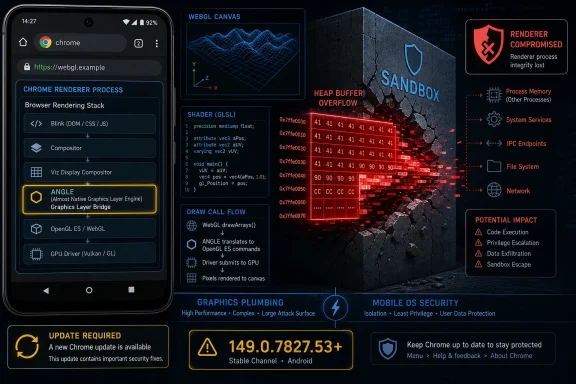
The Vulnerability Is Android-Specific, but the Product Name Still Says Chrome
CVE-2026-10929 describes a heap buffer overflow in ANGLE, the graphics translation layer Chromium uses to bridge web graphics APIs and platform graphics back ends. ANGLE is not a consumer-facing feature, but it is part of why complex WebGL and graphics-heavy browser content can run across different devices without every site developer writing separate rendering paths for each platform.
The published description narrows the affected scenario to Google Chrome on Android before 149.0.7827.53. That matters. Many vulnerability feeds flatten “Chrome” into a single product bucket, but Chrome on Android, Chrome on Windows, Chromium packages on Linux distributions, and embedded Chromium runtimes are not interchangeable targets.
The exploitation chain described here also has a precondition: the attacker has already compromised the renderer process. That does not make the issue harmless. Modern browser compromise often looks like a chain, with one bug getting code execution in a constrained renderer and another bug punching out of the sandbox. CVE-2026-10929 belongs in that second category: a possible escape from the containment that is supposed to limit damage after the first failure.
That is why a CVSS 3.1 score of 8.3 can coexist with attack complexity marked high and user interaction required. A crafted HTML page still has to be reached by the victim, and the attacker still needs a renderer foothold. But if those conditions are met, the consequences can be severe: confidentiality, integrity, and availability are all rated high, and scope changes because the bug can cross a security boundary.
ANGLE Is Exactly Where Browser Security Gets Messy
The browser security story is often told as a neat sequence: JavaScript engine bugs, renderer bugs, sandbox escapes, full compromise. Real browsers are messier. Graphics code is a particularly uncomfortable place because it sits close to hardware acceleration, driver interfaces, GPU processes, shared memory, and performance-sensitive parsing of complex inputs.
ANGLE has appeared in Chromium security notes before because it is part of a large attack surface that web content can indirectly exercise. A malicious page does not need to ask the user for permission to render graphics. It can create canvases, trigger WebGL paths, feed shaders, and push the browser through code that was designed to be fast and compatible across devices.
Heap buffer overflows are old-school memory corruption bugs, but they remain dangerous in modern browsers because the surrounding environment is rich. The attacker’s problem is harder than it was in the 2000s; mitigations, sandboxing, and memory protections raise the bar. The defender’s problem is that a browser is an almost perfect delivery system for attacker-controlled inputs.
The Android angle raises the stakes for mobile fleets. Corporate phones and tablets are often treated as managed endpoints, but browser patching on Android can vary depending on device policy, app-store rollout timing, user behavior, and whether Chrome is managed directly or simply assumed to update itself. In many environments, that assumption is the weakest link.
The CPE Record Is Trying to Express a Compound Target
The user-facing puzzle in the NVD entry is the CPE configuration. It shows Google Chrome versions before 149.0.7827.53 and Android as a platform condition. That structure looks odd if one expects a single vulnerable software line that says, in plain English, “Google Chrome for Android before 149.0.7827.53.”
But CPEs often express this as a logical configuration rather than a tidy product label. In this case, the record indicates a Chrome application version constraint and an Android operating-system platform constraint. Read that way, the entry is not obviously missing Android; it is encoding “Chrome running on Android” as a combination.
The problem is that vulnerability-management tools do not all interpret these configurations with equal care. Some scanners may ingest the Chrome CPE and flag desktop Chrome installations even when the platform condition should narrow applicability. Others may look for a Chrome-for-Android CPE that is not present in the way their inventory expects. Still others may suppress the alert because they do not model mobile app versions and OS platform CPEs together.
That is where the record’s “Are we missing a CPE?” prompt becomes more than boilerplate. For human readers, the description is clear enough: Android is the affected platform named in the text. For automation, the difference between a clean platform-specific CPE and a compound configuration can be the difference between accurate exposure and noisy dashboards.
The Desktop Release Note Reference Adds More Fog Than Light
One of the awkward details is that the referenced Chrome release note is a desktop stable-channel update. That does not automatically mean the CVE affects desktop Chrome. Chrome release posts often bundle many security fixes, and public vulnerability records sometimes point to the vendor advisory that introduced the fixed version even when the CVE description narrows the affected platform.
Still, it creates a credibility tax. If a CVE says “Chrome on Android” but points to a desktop stable-channel update, administrators are left to reconcile the mismatch themselves. Security teams accustomed to vendor advisories that cleanly separate desktop, Android, iOS, and extended stable channels may find this frustrating.
There are plausible explanations. The underlying Chromium fix may have landed in shared code and been shipped across multiple channels, while the exploitable condition described by the CNA is Android-specific. Google may also have disclosed the issue in a desktop release post because the stable milestone and security-fix batch were organized there, not because every listed issue maps neatly to every platform.
But “plausible” is not the same as operationally clean. A vulnerability record should reduce ambiguity. Here, it names Android clearly in the description, then leans on a desktop advisory as the public reference. That forces defenders to treat the prose as authoritative while treating the reference as context.
Renderer Compromise Is a Precondition, Not a Comfort Blanket
The phrase “who had compromised the renderer process” may tempt some teams to down-rank the issue. That would be a mistake. Browser exploit chains are built from pieces, and a sandbox escape is often the piece that turns a contained browser crash or renderer-level foothold into a device-level incident.
Chrome’s architecture assumes hostile web content. The renderer is deliberately sandboxed because it parses and executes untrusted material all day long. If attackers can pair a renderer compromise with a separate sandbox escape, the browser’s main defensive boundary weakens.
This is why high-severity sandbox escapes deserve prompt patching even when no active exploitation is confirmed in the public record. They are not always independently useful, but they are highly useful to attackers who already have or later discover a renderer bug. In a mature exploit market, the second bug may be the more valuable one.
For Android users, the page delivery mechanism is also ordinary. The description’s “crafted HTML page” means the exploit path can begin with normal browsing, malicious ads, compromised sites, messaging links, or any application flow that launches Chrome or a Chrome-backed browser surface. The user interaction requirement is real, but it is not reassuringly exotic.
Chrome 149 Was Not a Normal Patch Tuesday Moment
CVE-2026-10929 arrived inside a large Chrome 149 security wave, with public reporting and advisory mirrors pointing to an unusually large number of fixes in the milestone. That broader context matters less because of any single CVE count and more because of what it says about modern browser maintenance: the patch train is now the security boundary.
For consumers, the advice remains boring and correct: update Chrome. For managed environments, the issue is policy lag. If Chrome updates are deferred, staged too slowly, blocked by testing rings, or inconsistently applied across Android devices, high-severity graphics and sandbox bugs stay alive long after fixes exist.
Desktop administrators may understandably ask whether this Android-specific CVE should trigger a Windows Chrome emergency. Based on the public description, CVE-2026-10929 itself is not framed as a Windows Chrome vulnerability. But Chrome 149 contained many other fixes, and desktop Chrome still needs to be kept current for its own reasons.
That distinction is the hard part of good vulnerability management. Not every Chrome CVE is your Chrome CVE. But every Chrome patch cycle is still a reminder that the browser is one of the highest-risk applications on any endpoint.
Mobile Fleet Management Is the Real Test
Enterprises have become better at patching Windows browsers than mobile browsers, partly because Windows patching has decades of tooling discipline behind it. Android app patching is often treated as more automatic, more consumer-like, and less visible. That may work for casual software hygiene, but it is weak risk management when a CVE is explicitly Android-specific.
A managed Android fleet needs to know three things quickly: which devices have Chrome installed, which version is installed, and whether policy allows or forces updates without waiting for user action. Those answers are not always available in the same console. Some organizations manage Android through enterprise mobility management, others through device-owner modes, and others through a loose bring-your-own-device model with limited app inventory.
CVE-2026-10929 is a useful reminder that mobile browser exposure cannot be delegated entirely to app-store optimism. Google can publish a fix, but the organization still needs evidence that the fix reached devices. “Auto-update is enabled” is a policy preference, not a patch-status report.
For security teams, the most practical control is verification. Sample devices, query MDM inventory, check app versions, and make sure Chrome is at or beyond 149.0.7827.53 where Android Chrome is in scope. If the environment cannot answer that question, the vulnerability has exposed an asset-management gap whether or not it is being exploited.
The NVD Gap Is Becoming Part of the Story
The NVD entry shows no NIST CVSS score at the time reflected in the supplied record, while CISA’s ADP enrichment provides a CVSS 3.1 vector and high severity. That split is increasingly familiar. The vulnerability ecosystem has been moving toward a more distributed model, where CNAs, CISA enrichment, vendor advisories, and NVD analysis do not always land at the same time or with the same depth.
This is not just bureaucratic trivia. Many security tools use NVD fields as inputs for prioritization, matching, dashboards, and service-level agreements. If NIST enrichment lags, if CPE configurations are sparse or ambiguous, or if CVSS comes from a non-NIST source, downstream systems may behave differently than analysts expect.
CVE-2026-10929 is a compact example of the problem. The description is precise enough for a human. The CPE logic is plausible but not necessarily friendly to every scanner. The reference points to a desktop release note while the text says Android. The NVD score is not yet provided, but another authoritative enrichment source has already assigned an 8.3 high rating.
The lesson is not that NVD is useless. The lesson is that vulnerability intelligence now requires reading the record, not merely ingesting the record. For high-volume enterprise operations, that is an uncomfortable regression: humans are being pulled back into interpretation at exactly the moment vulnerability volume is increasing.
Security Teams Should Treat This as a Triage Problem, Not a Panic Button
There is no public indication in the supplied material that CVE-2026-10929 is being exploited in the wild. That matters. A high-severity sandbox escape candidate should be patched promptly, but it does not automatically outrank an actively exploited zero-day or an internet-facing server flaw with reliable unauthenticated exploitation.
The correct response is targeted urgency. Android Chrome installations below 149.0.7827.53 should be updated. Mobile fleets should verify update completion. Vulnerability teams should tune detection logic so desktop Chrome assets are not incorrectly reported solely because a platform condition was lost in translation.
For WindowsForum’s core audience, the Windows angle is mostly indirect. Windows desktop Chrome should still be updated because Chrome 149 and subsequent releases include their own security fixes, but CVE-2026-10929 as described is not a reason to claim that Windows Chrome is affected by this specific ANGLE sandbox-escape path. The distinction is important because sloppy over-scoping leads to alert fatigue.
The better incident note would say: “This CVE applies to Chrome on Android before 149.0.7827.53; verify Android fleet coverage, and separately ensure desktop Chrome is current for other Chrome 149 security fixes.” That is less dramatic than a red banner, but it is more useful.
The Patch Is Simple; the Inventory Is Not
The remediation is straightforward on paper: move Chrome on Android to version 149.0.7827.53 or later. The difficulty is proving that every relevant device has done so. That difficulty grows in mixed environments where personal devices access corporate mail, unmanaged Android tablets run line-of-business apps, or kiosk devices are patched only during maintenance windows.
Administrators should also be careful with Chromium-derived browsers. The CVE is assigned to Chrome, and the provided affected software information names Google Chrome on Android. But ANGLE is a Chromium component, and downstream browsers or embedded runtimes may need their own vendor fixes depending on whether they include the vulnerable code and how they ship updates.
That does not mean every Chromium-based product is automatically vulnerable in the same way. It means asset owners should look for vendor advisories from the products they actually deploy. In a browser ecosystem built on shared components, the initial CVE is often the start of the question, not the end.
Security-conscious users have the simplest path. Open Chrome on Android, check the version, and update from the official app channel if needed. If the version is already newer than 149.0.7827.53, this particular advisory is no longer the issue; the next issue is whether updates stay automatic and timely.
The Practical Reading of This CVE Is Narrow but Serious
CVE-2026-10929 is not a universal Chrome apocalypse, and it should not be marketed as one. It is a high-severity Android Chrome sandbox-escape candidate in a graphics component, requiring a prior renderer compromise and user interaction through crafted web content. That is narrower than some headlines will imply.
It is also not a paper cut. Sandbox escapes are valuable because they complete exploit chains. Graphics-layer memory corruption is credible browser attack surface. Android fleet visibility is often weaker than desktop fleet visibility. Those three facts make the CVE operationally meaningful even without public exploit activity.
The CPE question should be answered with nuance. The NVD configuration appears to encode Chrome plus Android rather than omit Android entirely. But if an organization’s tooling cannot preserve that relationship, the practical result may look like a missing or misleading CPE. Security teams should validate how their scanners interpret the record instead of assuming the dashboard got it right.
The Signal Hidden in One Android Chrome Bug
This CVE leaves defenders with a few concrete lessons, none of them glamorous and all of them useful.
- CVE-2026-10929 should be treated as affecting Google Chrome on Android before 149.0.7827.53 unless later vendor clarification broadens or narrows that scope.
- The public CPE configuration appears to express a compound Chrome-on-Android condition, so tools that drop the Android platform constraint may over-report exposure.
- The desktop Chrome release-note reference should not override the CVE description’s Android-specific wording, but desktop Chrome should still be kept current for other security fixes in the same release stream.
- The exploit scenario requires prior renderer compromise and user interaction, which lowers trivial exploitability but still leaves the bug valuable as part of a browser exploit chain.
- Mobile device management teams should verify installed Chrome versions directly rather than relying on assumptions about app-store auto-updates.
- Chromium-based downstream products should be checked through their own vendor advisories because shared components do not always translate into identical affected-version ranges.
CVE-2026-10929 is a small window into the larger future of browser defense: more shared components, more platform-specific exploitability, more machine-readable records that still require human judgment, and less tolerance for organizations that cannot prove what version of a browser is running on every device that touches their data. The patch itself is routine; the discipline it demands is not.