

CVE-2026-12019 is a high-severity heap buffer overflow in Chrome’s Codecs component, disclosed by Chrome on June 11, 2026, affecting Google Chrome on Linux and ChromeOS before version 149.0.7827.115 and potentially enabling sandbox escape through a crafted HTML page. The vulnerability is not the sort of browser bug that lets any website instantly seize a machine from a pristine tab. It is more interesting, and more worrying, because it sits in the second act of a modern browser compromise: after the renderer is already lost, but before the attacker is trapped. That is where Chrome’s security model is supposed to earn its keep.
The plain-English description of CVE-2026-12019 sounds almost modest: a heap buffer overflow in Codecs, exploitable by a remote attacker who has already compromised the renderer process. For casual users, that qualifier may read like a major limitation. For security teams, it reads like a familiar and uncomfortable pattern.
Chrome’s renderer sandbox exists because the browser assumes web content is hostile. JavaScript engines, media parsers, graphics stacks, font handlers, and codecs all process complex untrusted input at enormous scale. When one layer fails, the sandbox is meant to keep the failure contained.
CVE-2026-12019 matters because it is explicitly framed as a possible sandbox escape. In other words, it is not merely about crashing a tab or corrupting memory inside a disposable renderer. It is about the path from a compromised renderer toward privileges and access the web page was never supposed to have.
That makes the bug a reminder of the real shape of browser exploitation in 2026. The most serious attacks are rarely one-bug stories. They are chains: a renderer compromise, a sandbox escape, perhaps a privilege escalation, and then persistence or data theft. CVE-2026-12019 appears to occupy that middle rung.
That architecture has made exploitation harder, not impossible. Attackers who can compromise a renderer still need a way out. That second step is often where browser bugs become operationally valuable, especially in targeted intrusion campaigns where the first-stage flaw is already available.
A Codecs flaw is a particularly plausible place for this tension to surface. Modern browsers are media engines as much as document viewers. Video conferencing, streaming, embedded previews, hardware acceleration, and web apps all push complicated media handling into the browser’s daily path.
The danger is not that every media bug becomes a full compromise. The danger is that codecs are deeply exercised, performance-sensitive, and historically difficult to harden completely. They parse attacker-controlled data at speed, often across platform-specific code paths, and they sit close to the places where memory safety bugs become exploitable.
For WindowsForum readers, that distinction is worth treating carefully. The Chrome release that carried the fix was a broad desktop update, and Chrome’s version numbers differ slightly by platform. But the CVE’s own wording narrows this particular issue to Linux and ChromeOS prior to 149.0.7827.115.
That matters in enterprise environments where Chrome is managed across mixed fleets. A Windows-heavy shop may still have Linux developer workstations, ChromeOS kiosks, browser-based thin clients, test runners, CI systems, or cloud desktops. The machines most likely to be overlooked are often the ones least integrated into conventional endpoint management.
ChromeOS deserves special attention because the browser and platform are more tightly bound than on traditional desktop operating systems. A sandbox escape in that world is not just a browser bug in the way a Windows user might understand it. It potentially challenges the very separation model that makes ChromeOS attractive for schools, retail, and managed frontline devices.
CPE data is supposed to help scanners map a vulnerability to products. In practice, CPE matching can be blunt, especially when a browser vulnerability depends on a platform-specific build, a bundled component, or a condition that exists only when several pieces are present. The NVD configuration here appears to model Chrome plus operating-system context, rather than a clean “Linux kernel is vulnerable” statement.
That distinction matters because automated scanners can turn ambiguous CPEs into noisy findings. A Linux server with a kernel installed is not necessarily exposed to a Chrome Codecs sandbox escape. A ChromeOS device, a Linux desktop running Chrome, or a managed browser package inside a workstation image is a much more plausible match.
The lesson is not that NVD is wrong in some dramatic sense. The lesson is that vulnerability management systems need human interpretation when CPEs describe a chain-like condition. CVE-2026-12019 is a browser flaw, but the affected configuration depends on how Chrome is packaged and where the relevant sandbox boundary exists.
User interaction is required because the victim must encounter attacker-controlled content, such as a crafted HTML page. High attack complexity reflects the need for a prior renderer compromise or a chained exploit condition. But the changed scope and high impact values explain why defenders should not dismiss it.
A sandbox escape is, by definition, a boundary failure. The attacker begins in one security context and moves into another. In Chrome’s world, that means a web-origin compromise can become something with much broader access than a tab should have.
The score also hints at why this sort of vulnerability is often more useful to sophisticated attackers than commodity drive-by crews. If you need a separate renderer exploit, you either already have one, buy one, discover one, or wait for a publicly known bug to be incorporated into a chain. The existence of a precondition does not make the bug benign. It often makes it a specialized tool.
This does not mean CVE-2026-12019 itself is known to be exploited. Google’s advisory and the NVD entry do not state that it is under active attack. That distinction is important, especially when browser security news tends to collapse every serious flaw into the same “update now” headline.
But the broader cadence still matters. When a browser receives multiple high-severity fixes in rapid succession, defenders should treat update latency as the enemy. The specific bug that makes the news may not be the one that hits your environment; the unpatched browser state is the problem.
In consumer Chrome, automatic updates do much of the work. In enterprise Chrome, policy does the work only if administrators let it. Deferred updates, compatibility holds, frozen VDI images, unmanaged Linux repositories, and kiosk devices can all stretch a vendor patch into a weeks-long exposure window.
Renderer compromise gives the attacker a foothold in the browser’s least trusted compartment. That may be enough for some data theft, depending on the flaw and context, but the sandbox limits what can be touched. A sandbox escape changes the value of the first bug.
With an escape, the attacker may reach files, credentials, local services, inter-process communication surfaces, or browser internals that were previously protected. The exact outcome depends on platform hardening, exploit quality, and the rest of the chain. Still, the strategic point is straightforward: sandbox escapes convert browser bugs from contained incidents into platform events.
This is why CVE-2026-12019 deserves attention even without a public exploit. A second-stage bug becomes more dangerous when paired with a first-stage flaw, and browser first-stage flaws are not rare. The public record of Chrome security updates shows a steady churn of memory safety and validation issues across components that parse web content.
Codecs are particularly unforgiving because they sit at the intersection of complexity and performance. They must parse dense binary formats quickly. They often use low-level languages. They are optimized aggressively. They interact with hardware acceleration and platform media services. Each of those traits has historically raised the cost of memory safety.
A heap buffer overflow is an old class of bug, but old does not mean solved. The industry has spent years adding mitigations, fuzzing harnesses, safer allocators, control-flow protections, and sandboxing precisely because these mistakes still happen. The question is not whether a parser can be made perfect. It is whether the system still fails safely when the parser is wrong.
CVE-2026-12019 suggests that, in this case, the answer was not good enough before the fix. The public description does not reveal the vulnerable codec path or exploitation technique, and the Chromium issue remains access-restricted. That is normal for fresh browser bugs, but it also means defenders should avoid speculation and focus on patch state.
The practical question is not “Does this single CVE affect my Windows laptops?” It is “Are all Chrome installations actually on the fixed channel level, and can I prove it?” That includes Chrome stable, extended stable, Chromium-based alternatives where applicable, embedded browser runtimes, and machines outside the cleanest management boundary.
For Windows environments, Microsoft Edge deserves a parallel check whenever Chromium fixes land. Edge is based on Chromium, but Microsoft ships its own builds and advisories. Not every Chrome CVE maps identically to Edge at the same moment, especially when platform-specific code paths are involved, but administrators should verify rather than assume.
There is also a policy lesson here. Browser update management should be treated like endpoint security infrastructure, not user preference. A browser that is one or two point releases behind may carry several exploitable memory bugs, and the delta between “patched upstream” and “patched everywhere” is where attackers live.
For CVE-2026-12019, the safest interpretation is that the vulnerability is in Google Chrome’s Codecs component, with publicly described affected platforms of Linux and ChromeOS before the fixed version. The Linux kernel CPE in the NVD configuration should not be read in isolation as evidence of a standalone kernel vulnerability. It is part of the affected environment modeling.
That modeling may still be useful to machines, but it is hazardous for humans who read CPEs as prose. A CPE is not a threat model. It is a product identifier arranged for matching. When the vulnerability depends on a chained browser condition, the product list can become an approximation rather than a clean explanation.
Organizations should tune their vulnerability management around installed software evidence, not merely OS identity. If Chrome is installed on Linux workstations, the finding is actionable. If the asset is a headless Linux server with no Chrome package, it is likely noise. If the asset is ChromeOS, it belongs in the priority lane.
Chrome’s auto-update model can create a false sense of completion. Many users receive the patch quickly, but “available” is not the same as “running.” A browser often needs a restart to move from downloaded update to active protection. Long-lived sessions on developer workstations and shared machines can quietly stretch exposure.
Enterprise Chrome management gives administrators more levers, but it also gives them more ways to delay. Rollout rings, compatibility testing, extension validation, and VDI image refresh cycles can all be legitimate. They can also become excuses for leaving a browser exposed after a high-severity security release.
The right balance is to separate feature updates from security dot releases. If a security-only Chrome update fixes critical and high-severity flaws, the default should be rapid deployment, with exceptions documented rather than assumed. Browser compatibility testing matters, but a sandbox escape candidate is not the place to indulge indefinite caution.
Good patch programs do not wait for exploitation headlines. They weigh exploitability, exposure, asset importance, and vendor confidence. A high-severity Chrome sandbox-escape candidate on managed Linux or ChromeOS endpoints should clear that bar easily.
The harder part is knowing where Chrome actually runs. Developer laptops are notorious for unmanaged package sources and manual browser installs. Lab machines drift. Kiosks are forgotten. Cloud images get cloned with stale browsers. ChromeOS fleets may be better managed, but only if update policy and device eligibility are being monitored.
This is where inventory becomes security, not paperwork. A patch you cannot verify is a patch you have not deployed. CVE-2026-12019 is another argument for treating browser version telemetry as a first-class signal in endpoint dashboards.
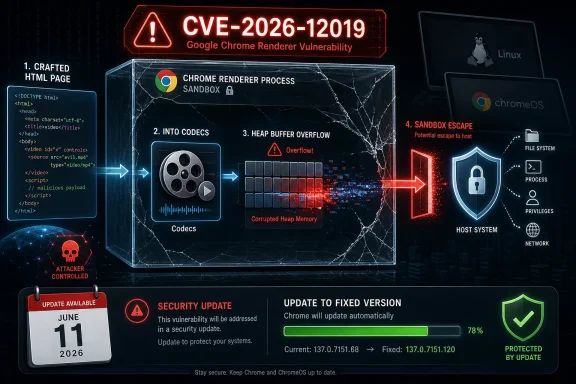 The Bug Is Narrow, but the Blast Radius Is Not
The plain-English description of CVE-2026-12019 sounds almost modest: a heap buffer overflow in Codecs, exploitable by a remote attacker who has already compromised the renderer process. For casual users, that qualifier may read like a major limitation. For security teams, it reads like a familiar and uncomfortable pattern.Chrome’s renderer sandbox exists because the browser assumes web content is hostile. JavaScript engines, media parsers, graphics stacks, font handlers, and codecs all process complex untrusted input at enormous scale. When one layer fails, the sandbox is meant to keep the failure contained.
CVE-2026-12019 matters because it is explicitly framed as a possible sandbox escape. In other words, it is not merely about crashing a tab or corrupting memory inside a disposable renderer. It is about the path from a compromised renderer toward privileges and access the web page was never supposed to have.
That makes the bug a reminder of the real shape of browser exploitation in 2026. The most serious attacks are rarely one-bug stories. They are chains: a renderer compromise, a sandbox escape, perhaps a privilege escalation, and then persistence or data theft. CVE-2026-12019 appears to occupy that middle rung.
Chrome’s Sandbox Is the Wall Attackers Keep Testing
For more than a decade, Chrome’s security reputation has rested on a simple bargain: expose a vast amount of functionality to the web, but isolate risky parsing and execution inside sharply constrained processes. The renderer can draw the page, run scripts, decode media, and handle the messy parts of the web, but it should not roam freely across the operating system.That architecture has made exploitation harder, not impossible. Attackers who can compromise a renderer still need a way out. That second step is often where browser bugs become operationally valuable, especially in targeted intrusion campaigns where the first-stage flaw is already available.
A Codecs flaw is a particularly plausible place for this tension to surface. Modern browsers are media engines as much as document viewers. Video conferencing, streaming, embedded previews, hardware acceleration, and web apps all push complicated media handling into the browser’s daily path.
The danger is not that every media bug becomes a full compromise. The danger is that codecs are deeply exercised, performance-sensitive, and historically difficult to harden completely. They parse attacker-controlled data at speed, often across platform-specific code paths, and they sit close to the places where memory safety bugs become exploitable.
The Linux and ChromeOS Angle Is Not a Footnote
One of the most important details in the CVE text is easy to skim past: the vulnerability is described as affecting Chrome on Linux and ChromeOS. That does not mean Windows administrators can ignore the broader Chrome update, but it does mean the named sandbox-escape condition is platform-specific in the public description.For WindowsForum readers, that distinction is worth treating carefully. The Chrome release that carried the fix was a broad desktop update, and Chrome’s version numbers differ slightly by platform. But the CVE’s own wording narrows this particular issue to Linux and ChromeOS prior to 149.0.7827.115.
That matters in enterprise environments where Chrome is managed across mixed fleets. A Windows-heavy shop may still have Linux developer workstations, ChromeOS kiosks, browser-based thin clients, test runners, CI systems, or cloud desktops. The machines most likely to be overlooked are often the ones least integrated into conventional endpoint management.
ChromeOS deserves special attention because the browser and platform are more tightly bound than on traditional desktop operating systems. A sandbox escape in that world is not just a browser bug in the way a Windows user might understand it. It potentially challenges the very separation model that makes ChromeOS attractive for schools, retail, and managed frontline devices.
NVD’s CPE Entry Tells a Messier Story Than the CVE Text
The NVD record adds an awkward wrinkle. Its initial configuration lists Google Chrome versions up to, but excluding, 149.0.7827.115, and also includes ChromeOS and the Linux kernel as part of the vulnerable software configuration. That is probably why the submitter’s “Are we missing a CPE?” question feels less like trivia and more like a real data-quality issue.CPE data is supposed to help scanners map a vulnerability to products. In practice, CPE matching can be blunt, especially when a browser vulnerability depends on a platform-specific build, a bundled component, or a condition that exists only when several pieces are present. The NVD configuration here appears to model Chrome plus operating-system context, rather than a clean “Linux kernel is vulnerable” statement.
That distinction matters because automated scanners can turn ambiguous CPEs into noisy findings. A Linux server with a kernel installed is not necessarily exposed to a Chrome Codecs sandbox escape. A ChromeOS device, a Linux desktop running Chrome, or a managed browser package inside a workstation image is a much more plausible match.
The lesson is not that NVD is wrong in some dramatic sense. The lesson is that vulnerability management systems need human interpretation when CPEs describe a chain-like condition. CVE-2026-12019 is a browser flaw, but the affected configuration depends on how Chrome is packaged and where the relevant sandbox boundary exists.
The Score Is High Because the Preconditions Are Realistic
CISA-ADP assigned a CVSS 3.1 score of 8.3, with the vector showing network attackability, high attack complexity, no privileges required, user interaction required, changed scope, and high impact to confidentiality, integrity, and availability. That vector captures the tension in the bug better than a headline score alone.User interaction is required because the victim must encounter attacker-controlled content, such as a crafted HTML page. High attack complexity reflects the need for a prior renderer compromise or a chained exploit condition. But the changed scope and high impact values explain why defenders should not dismiss it.
A sandbox escape is, by definition, a boundary failure. The attacker begins in one security context and moves into another. In Chrome’s world, that means a web-origin compromise can become something with much broader access than a tab should have.
The score also hints at why this sort of vulnerability is often more useful to sophisticated attackers than commodity drive-by crews. If you need a separate renderer exploit, you either already have one, buy one, discover one, or wait for a publicly known bug to be incorporated into a chain. The existence of a precondition does not make the bug benign. It often makes it a specialized tool.
The Release Cadence Is Becoming Its Own Security Signal
Chrome 149 has been a busy branch. The CVE-2026-12019 fix landed in a June 11 stable-channel desktop update that addressed a large batch of critical and high-severity issues. That came shortly after another Chrome 149 update for CVE-2026-11645, a V8 issue that Google said had an exploit in the wild.This does not mean CVE-2026-12019 itself is known to be exploited. Google’s advisory and the NVD entry do not state that it is under active attack. That distinction is important, especially when browser security news tends to collapse every serious flaw into the same “update now” headline.
But the broader cadence still matters. When a browser receives multiple high-severity fixes in rapid succession, defenders should treat update latency as the enemy. The specific bug that makes the news may not be the one that hits your environment; the unpatched browser state is the problem.
In consumer Chrome, automatic updates do much of the work. In enterprise Chrome, policy does the work only if administrators let it. Deferred updates, compatibility holds, frozen VDI images, unmanaged Linux repositories, and kiosk devices can all stretch a vendor patch into a weeks-long exposure window.
The Real Target Is the Gap Between Renderer Compromise and System Trust
A modern browser exploit chain is not merely a technical stunt. It is a business model for intrusion. The attacker wants the browser because it is exposed to the internet, trusted by the user, packed with sensitive session material, and almost always running.Renderer compromise gives the attacker a foothold in the browser’s least trusted compartment. That may be enough for some data theft, depending on the flaw and context, but the sandbox limits what can be touched. A sandbox escape changes the value of the first bug.
With an escape, the attacker may reach files, credentials, local services, inter-process communication surfaces, or browser internals that were previously protected. The exact outcome depends on platform hardening, exploit quality, and the rest of the chain. Still, the strategic point is straightforward: sandbox escapes convert browser bugs from contained incidents into platform events.
This is why CVE-2026-12019 deserves attention even without a public exploit. A second-stage bug becomes more dangerous when paired with a first-stage flaw, and browser first-stage flaws are not rare. The public record of Chrome security updates shows a steady churn of memory safety and validation issues across components that parse web content.
Codecs Remain an Uncomfortable Edge of the Web Platform
The web’s appetite for media keeps expanding. Every year, browsers take on more playback paths, conferencing features, streaming formats, graphics acceleration options, and platform integrations. Users experience this as convenience. Security engineers experience it as attack surface.Codecs are particularly unforgiving because they sit at the intersection of complexity and performance. They must parse dense binary formats quickly. They often use low-level languages. They are optimized aggressively. They interact with hardware acceleration and platform media services. Each of those traits has historically raised the cost of memory safety.
A heap buffer overflow is an old class of bug, but old does not mean solved. The industry has spent years adding mitigations, fuzzing harnesses, safer allocators, control-flow protections, and sandboxing precisely because these mistakes still happen. The question is not whether a parser can be made perfect. It is whether the system still fails safely when the parser is wrong.
CVE-2026-12019 suggests that, in this case, the answer was not good enough before the fix. The public description does not reveal the vulnerable codec path or exploitation technique, and the Chromium issue remains access-restricted. That is normal for fresh browser bugs, but it also means defenders should avoid speculation and focus on patch state.
Windows Admins Still Have Work to Do
The CVE names Linux and ChromeOS, but Windows administrators should not treat this as someone else’s fire drill. Chrome updates are shipped as channel releases, and the June 11 desktop update included many other critical and high-severity fixes across Chrome components. Even if CVE-2026-12019’s public scope is not Windows, the same update train matters for Windows fleets.The practical question is not “Does this single CVE affect my Windows laptops?” It is “Are all Chrome installations actually on the fixed channel level, and can I prove it?” That includes Chrome stable, extended stable, Chromium-based alternatives where applicable, embedded browser runtimes, and machines outside the cleanest management boundary.
For Windows environments, Microsoft Edge deserves a parallel check whenever Chromium fixes land. Edge is based on Chromium, but Microsoft ships its own builds and advisories. Not every Chrome CVE maps identically to Edge at the same moment, especially when platform-specific code paths are involved, but administrators should verify rather than assume.
There is also a policy lesson here. Browser update management should be treated like endpoint security infrastructure, not user preference. A browser that is one or two point releases behind may carry several exploitable memory bugs, and the delta between “patched upstream” and “patched everywhere” is where attackers live.
The CPE Question Is Really About Scanner Trust
The submitter’s CPE concern is the sort of thing security teams encounter constantly: a vulnerability record says one thing in prose, a CPE configuration says something broader or stranger, and a scanner turns that into a dashboard item. The result is a triage meeting about whether a kernel CPE means a browser sandbox escape applies to servers.For CVE-2026-12019, the safest interpretation is that the vulnerability is in Google Chrome’s Codecs component, with publicly described affected platforms of Linux and ChromeOS before the fixed version. The Linux kernel CPE in the NVD configuration should not be read in isolation as evidence of a standalone kernel vulnerability. It is part of the affected environment modeling.
That modeling may still be useful to machines, but it is hazardous for humans who read CPEs as prose. A CPE is not a threat model. It is a product identifier arranged for matching. When the vulnerability depends on a chained browser condition, the product list can become an approximation rather than a clean explanation.
Organizations should tune their vulnerability management around installed software evidence, not merely OS identity. If Chrome is installed on Linux workstations, the finding is actionable. If the asset is a headless Linux server with no Chrome package, it is likely noise. If the asset is ChromeOS, it belongs in the priority lane.
Patch Management Has Become Browser Incident Response
The appropriate response to CVE-2026-12019 is not exotic. Update Chrome. Confirm the version. Restart the browser. Validate managed devices. Watch for laggards. The mundane nature of that response should not obscure its urgency.Chrome’s auto-update model can create a false sense of completion. Many users receive the patch quickly, but “available” is not the same as “running.” A browser often needs a restart to move from downloaded update to active protection. Long-lived sessions on developer workstations and shared machines can quietly stretch exposure.
Enterprise Chrome management gives administrators more levers, but it also gives them more ways to delay. Rollout rings, compatibility testing, extension validation, and VDI image refresh cycles can all be legitimate. They can also become excuses for leaving a browser exposed after a high-severity security release.
The right balance is to separate feature updates from security dot releases. If a security-only Chrome update fixes critical and high-severity flaws, the default should be rapid deployment, with exceptions documented rather than assumed. Browser compatibility testing matters, but a sandbox escape candidate is not the place to indulge indefinite caution.
The Quiet Fixes Are the Ones That Test Discipline
Security teams are naturally drawn to zero-days. “Exploited in the wild” is a clarifying phrase; it turns patching from hygiene into incident response. CVE-2026-12019 does not currently carry that label in the public record, and that makes it a better test of operational maturity.Good patch programs do not wait for exploitation headlines. They weigh exploitability, exposure, asset importance, and vendor confidence. A high-severity Chrome sandbox-escape candidate on managed Linux or ChromeOS endpoints should clear that bar easily.
The harder part is knowing where Chrome actually runs. Developer laptops are notorious for unmanaged package sources and manual browser installs. Lab machines drift. Kiosks are forgotten. Cloud images get cloned with stale browsers. ChromeOS fleets may be better managed, but only if update policy and device eligibility are being monitored.
This is where inventory becomes security, not paperwork. A patch you cannot verify is a patch you have not deployed. CVE-2026-12019 is another argument for treating browser version telemetry as a first-class signal in endpoint dashboards.
The June 11 Chrome Fix Leaves a Short Checklist for Real Environments
CVE-2026-12019 is best understood as a serious chained-exploitation risk rather than a standalone panic button. The public details are sparse, but the combination of Codecs, heap overflow, renderer compromise, and sandbox escape is enough to justify fast verification across affected fleets.- Chrome on Linux and ChromeOS should be updated beyond the vulnerable range, with attention to version 149.0.7827.115 or the applicable fixed build delivered by the channel.
- Windows administrators should still deploy the associated Chrome 149 security update because the same release addressed numerous other serious vulnerabilities.
- The NVD CPE configuration should be interpreted carefully, since the Linux kernel entry does not turn this into a generic Linux kernel vulnerability.
- Scanners should be checked against actual Chrome installation evidence, especially on developer workstations, kiosks, VDI images, and ChromeOS devices.
- A browser restart should be treated as part of remediation, because downloaded updates do not protect users until the patched binary is running.
- Microsoft Edge and other Chromium-derived browsers should be verified through their own update channels rather than assumed safe from Chrome’s release notes alone.
References
- Primary source: NVD / Chromium
Published: 2026-06-15T07:00:40-07:00
NVD - CVE-2026-12019
 nvd.nist.gov
- Security advisory: MSRC
Published: 2026-06-15T07:00:40-07:00
Original feed URL
Security Update Guide - Microsoft Security Response Center
 msrc.microsoft.com
- Related coverage: cvefeed.io
CVE-2026-12019 - Google Chrome Codecs Heap Buffer Overflow Sandbox Escape
Heap buffer overflow in Codecs in Google Chrome on Linux and ChromeOS prior to 149.0.7827.115 allowed a remote attacker who had compromised the renderer process to potentially perform a sandbox escape via a crafted HTML page. (Chromium security severity: High)cvefeed.io - Related coverage: govcert.gov.hk
GovCERT.HK - Security Alert (A26-06-27): Multiple Vulnerabilities in Google Chrome
Security Alert (A26-06-27): Multiple Vulnerabilities in Google Chromewww.govcert.gov.hk
