

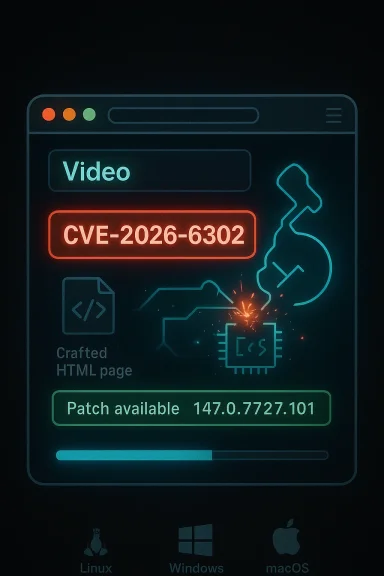
Google has patched CVE-2026-6302, a high-severity use-after-free flaw in Chrome’s Video component, in Chrome version 147.0.7727.101 for Linux and 147.0.7727.101/102 for Windows and Mac. The issue could let a remote attacker achieve arbitrary code execution inside the browser sandbox by luring a victim to a crafted HTML page, which is exactly the kind of web-facing bug security teams dread because it combines easy delivery with potentially serious impact. Google disclosed the fix on Wednesday, April 15, 2026, and it is now rolling out across stable-channel users over the coming days and weeks. (chromereleases.googleblog.com)
Chromium and Chrome have spent years refining their memory-safety defenses, yet use-after-free bugs continue to appear because modern browsers are extraordinarily complex, with video, GPU, rendering, and media pipelines all interacting in tight loops. A defect in one part of that pipeline can become a reliable exploitation primitive if an attacker can shape object lifetimes precisely enough. In practical terms, that means a malicious page can sometimes turn a logic bug into code execution, even when the browser sandbox is still doing its job. (chromereleases.googleblog.com)
The Video subsystem is a particularly sensitive area because it sits at the intersection of parsing, decoding, rendering, and hardware acceleration. That makes it attractive to attackers and hard for engineers to simplify, especially as browser vendors continue to add support for richer media formats and more complex playback paths. Google’s April 15 update is a reminder that security hardening is not a one-time achievement; it is an ongoing race against the combinatorial complexity of the web platform. (chromereleases.googleblog.com)
Chrome’s stable-channel cadence also matters here. Google’s April 15 release bundled 31 security fixes in a single desktop update, showing that CVE-2026-6302 was one item in a broader patch train rather than an isolated emergency. That is typical for Chrome: security fixes often arrive in clusters, with disclosure timing managed so that most users can update before bug details become broadly visible. (chromereleases.googleblog.com)
The release notes also show how common memory corruption remains across browser subsystems. In the same update, Google listed high-severity issues in Proxy, Prerender, XR, CSS, Codecs, Graphite, PDFium, Viz, Permissions, Forms, Cast, and Dawn, alongside the Video bug at the center of this article. That breadth is important because it underlines a structural reality: browser security is not just about one engine or one language, but about the entire stack from UI to rendering to media. (chromereleases.googleblog.com)
For Microsoft customers, the CVE also appeared in the Microsoft Security Update Guide, which is how many enterprise teams track cross-vendor Chromium issues affecting Microsoft Edge and Windows-managed environments. Microsoft’s guide is often used as an operational lens on vulnerabilities that originate elsewhere but affect the browser estate administrators actually deploy. In that sense, CVE-2026-6302 is not just a Chrome story; it is a browser fleet management story.
The disclosure metadata in Chrome’s April 15 release links the issue to CVE-2026-6302 and the Chromium issue tracker entry 495477995. Google credited the report to Syn4pse, which is useful context because it suggests the bug was found through external research rather than internal triage alone. That is an important reminder that the browser security ecosystem still depends heavily on independent researchers surfacing flaws before criminals can weaponize them. (chromereleases.googleblog.com)
The Chrome security note also fits a recurring disclosure model. Google often keeps exploit details limited until a large share of users has updated, which is why the blog post warns that bug information may remain restricted during rollout. That practice is designed to reduce the odds of copycat exploitation during the narrow window between patch publication and widespread adoption. (chromereleases.googleblog.com)
A use-after-free in media code is especially concerning because memory corruption in that area can sometimes be triggered through format handling, streaming behavior, or object lifetime confusion that is difficult to spot during ordinary browsing. The immediate lesson is straightforward: even “just a video bug” can still be a high-value entry point for a real-world attacker. That should not be underestimated. (chromereleases.googleblog.com)
That sequencing tells an operational story. Major browser releases are often rushed into stable because of feature and platform deadlines, but security issues continue to surface as the code lands in the wild. The result is a familiar two-step rhythm: a feature upgrade, then a security hardening pass. Chrome 147 followed that pattern closely.
For consumers, the practical implication is simple: if Chrome prompts for a restart, do it promptly. For enterprises, the implication is even more direct: browser patch cycles should be treated as time-sensitive, especially when the vendor identifies a flaw as High and the exploit path requires only web content. Waiting for the next maintenance window can be a risky gamble. (chromereleases.googleblog.com)
A use-after-free happens when software continues to access memory after it has been released. In browser exploitation, that can sometimes be turned into controlled object reuse, corrupted pointers, or arbitrary code execution if the attacker can shape memory layout and timing well enough. The specific difficulty varies by architecture and mitigation, but the underlying danger remains the same: once memory management goes wrong, the rest of the process is playing defense. (chromereleases.googleblog.com)
In the real world, video-related browser vulnerabilities are often especially concerning for organizations that allow broad web access, unmanaged personal devices, or extensive use of streaming and embedded media. The exploit surface is simply too wide to assume users will avoid it. If the browser can render it, the attacker can try to weaponize it. (chromereleases.googleblog.com)
Microsoft’s inclusion of the issue in the Security Update Guide is especially relevant for Windows environments, because Edge is Chromium-based and shares the underlying codebase that produced the Chrome fix. Even when Microsoft does not release a separate vendor bulletin at the same moment, the vulnerability remains operationally meaningful for endpoint teams managing browser fleets through Intune, Group Policy, or software distribution tooling.
There is also a policy lesson here. Organizations that delay browser updates because they fear breaking internal web apps are effectively trading a known external exposure for an uncertain compatibility risk. That may be defensible in isolated cases, but in 2026 it is increasingly hard to justify for a flaw with this profile. Browser patch latency is a security metric now. (chromereleases.googleblog.com)
Because the issue sits in Video, users may assume they are safe if they avoid watching suspicious clips. That assumption is too narrow. Modern web pages can load media assets invisibly or use scripted interactions that are not obvious to the eye. In practice, the attack surface is broader than “playing a video.” (chromereleases.googleblog.com)
In practical terms, the advice is simple: check the version, let the update finish, and relaunch the browser. A few minutes of inconvenience is a small price compared with the possibility of a malicious page triggering a memory corruption chain in an unpatched browser process. (chromereleases.googleblog.com)
That broader pattern is familiar to anyone who follows Chrome releases closely. The browser team regularly credits fuzzing, sanitizers, and external research for finding defects before they turn into public incidents. In the April 15 post, Google explicitly thanked the community and noted the use of AddressSanitizer, MemorySanitizer, UndefinedBehaviorSanitizer, Control Flow Integrity, libFuzzer, and AFL. Those tools are now core to Chromium’s defensive posture, not side projects. (chromereleases.googleblog.com)
For observers trying to assess Chromium’s security trajectory, the lesson is not that the browser is unusually vulnerable. The lesson is that Chrome’s high-velocity release model depends on rapid detection, rapid fixing, and rapid adoption. When any of those three slows down, risk rises quickly. (chromereleases.googleblog.com)
This dynamic favors vendors that can move quickly and explain clearly. Users rarely care which Chromium-based browser discovered the bug first; they care whether their own browser has the fix and whether the patch breaks anything. The vendor that makes update adoption easiest often earns disproportionate trust. Security UX is product strategy. (chromereleases.googleblog.com)
That is good for users when the ecosystem works as intended. But it is also a reminder that if one vendor lags, the shared codebase becomes a shared liability. The same architecture that spreads innovation also spreads risk. (chromereleases.googleblog.com)
There is also an opportunity in enterprise update orchestration. Better restart nudges, better compliance telemetry, and clearer risk communication can shorten the time between patch release and real-world protection. In browser security, the final mile often matters as much as the code fix itself. (chromereleases.googleblog.com)
There is also the perennial risk of exploit chaining. A sandboxed remote code execution bug may not sound as alarming as a full system compromise, but it can be the opening move in a larger attack. Once inside the browser, an adversary may only need one more weakness to move from the sandbox to the host. That second step is often what turns a browser bug into an incident. (chromereleases.googleblog.com)
Google’s next challenge is the same one every browser vendor faces: keep reducing the number of memory-corruption bugs without slowing down the pace of product evolution. That balance becomes harder as browsers absorb more AI features, richer media capabilities, and deeper integration with local and cloud services. The more the browser does, the more places there are for a lifetime bug to hide. (chromereleases.googleblog.com)
If the past few Chrome cycles are any guide, CVE-2026-6302 will soon become one line in a longer history of browser memory-safety fixes. But for defenders, this line matters because it speaks to the enduring challenge of secure media handling on the modern web. The patch is in place, the window is open, and the remaining task is simple but urgent: make sure every user actually gets it.
Source: NVD / Chromium Security Update Guide - Microsoft Security Response Center
 Background
Chromium and Chrome have spent years refining their memory-safety defenses, yet use-after-free bugs continue to appear because modern browsers are extraordinarily complex, with video, GPU, rendering, and media pipelines all interacting in tight loops. A defect in one part of that pipeline can become a reliable exploitation primitive if an attacker can shape object lifetimes precisely enough. In practical terms, that means a malicious page can sometimes turn a logic bug into code execution, even when the browser sandbox is still doing its job. (chromereleases.googleblog.com)The Video subsystem is a particularly sensitive area because it sits at the intersection of parsing, decoding, rendering, and hardware acceleration. That makes it attractive to attackers and hard for engineers to simplify, especially as browser vendors continue to add support for richer media formats and more complex playback paths. Google’s April 15 update is a reminder that security hardening is not a one-time achievement; it is an ongoing race against the combinatorial complexity of the web platform. (chromereleases.googleblog.com)
Chrome’s stable-channel cadence also matters here. Google’s April 15 release bundled 31 security fixes in a single desktop update, showing that CVE-2026-6302 was one item in a broader patch train rather than an isolated emergency. That is typical for Chrome: security fixes often arrive in clusters, with disclosure timing managed so that most users can update before bug details become broadly visible. (chromereleases.googleblog.com)
The release notes also show how common memory corruption remains across browser subsystems. In the same update, Google listed high-severity issues in Proxy, Prerender, XR, CSS, Codecs, Graphite, PDFium, Viz, Permissions, Forms, Cast, and Dawn, alongside the Video bug at the center of this article. That breadth is important because it underlines a structural reality: browser security is not just about one engine or one language, but about the entire stack from UI to rendering to media. (chromereleases.googleblog.com)
For Microsoft customers, the CVE also appeared in the Microsoft Security Update Guide, which is how many enterprise teams track cross-vendor Chromium issues affecting Microsoft Edge and Windows-managed environments. Microsoft’s guide is often used as an operational lens on vulnerabilities that originate elsewhere but affect the browser estate administrators actually deploy. In that sense, CVE-2026-6302 is not just a Chrome story; it is a browser fleet management story.
What Google Actually Fixed
Google’s description is concise but consequential: “Use after free in Video” in Chrome prior to 147.0.7727.101 allowed remote code execution inside a sandbox via crafted HTML. That wording signals a classic browser exploitation pattern. The attacker does not need local access, credentials, or elevated privileges; instead, they need only persuade a user to visit a malicious page or open content that embeds the exploit path. (chromereleases.googleblog.com)The disclosure metadata in Chrome’s April 15 release links the issue to CVE-2026-6302 and the Chromium issue tracker entry 495477995. Google credited the report to Syn4pse, which is useful context because it suggests the bug was found through external research rather than internal triage alone. That is an important reminder that the browser security ecosystem still depends heavily on independent researchers surfacing flaws before criminals can weaponize them. (chromereleases.googleblog.com)
Why “inside the sandbox” still matters
A sandboxed exploit is not harmless. It means the attacker’s code runs with reduced OS-level privilege, but code execution in the browser process can still enable credential theft, session hijacking, data exfiltration, and chained escalation through a second vulnerability. In other words, the sandbox is a barrier, not a guarantee of safety. (chromereleases.googleblog.com)The Chrome security note also fits a recurring disclosure model. Google often keeps exploit details limited until a large share of users has updated, which is why the blog post warns that bug information may remain restricted during rollout. That practice is designed to reduce the odds of copycat exploitation during the narrow window between patch publication and widespread adoption. (chromereleases.googleblog.com)
A use-after-free in media code is especially concerning because memory corruption in that area can sometimes be triggered through format handling, streaming behavior, or object lifetime confusion that is difficult to spot during ordinary browsing. The immediate lesson is straightforward: even “just a video bug” can still be a high-value entry point for a real-world attacker. That should not be underestimated. (chromereleases.googleblog.com)
How the Patch Fits the Broader April 2026 Chrome Update
The April 15 stable-channel update landed just days after Chrome 147’s earlier stable release on April 7, 2026, when the browser first moved to stable at 147.0.7727.55/56 on Windows and Mac and 147.0.7727.55 on Linux. That means CVE-2026-6302 was fixed in a follow-up maintenance build rather than the initial 147 GA release, which is common when bugs are discovered after a major channel promotion.That sequencing tells an operational story. Major browser releases are often rushed into stable because of feature and platform deadlines, but security issues continue to surface as the code lands in the wild. The result is a familiar two-step rhythm: a feature upgrade, then a security hardening pass. Chrome 147 followed that pattern closely.
A crowded security bulletin
The April 15 release included 31 security fixes, and several were rated Critical or High. That is not unusual for Chrome, but it does show why enterprises should not treat browser updates as optional convenience patches. Browser maintenance has become a first-order security control, comparable in importance to endpoint protection or VPN hardening. (chromereleases.googleblog.com)- The update fixed a Critical issue in ANGLE.
- It fixed a Critical use-after-free in Proxy.
- It fixed multiple High issues in Video, CSS, Codecs, PDFium, and Graphite.
- It also included a use-after-free in Prerender and XR.
- Chrome’s security note again emphasized delayed disclosure until most users are updated. (chromereleases.googleblog.com)
For consumers, the practical implication is simple: if Chrome prompts for a restart, do it promptly. For enterprises, the implication is even more direct: browser patch cycles should be treated as time-sensitive, especially when the vendor identifies a flaw as High and the exploit path requires only web content. Waiting for the next maintenance window can be a risky gamble. (chromereleases.googleblog.com)
Why Video Bugs Are Such Attractive Targets
Video processing in a browser is not a single feature; it is a chain of decoders, container parsers, frame buffers, GPU handoffs, and synchronization logic. Every additional branch and state transition gives attackers more opportunities to disturb object lifetime assumptions. That makes the Video subsystem a durable target for exploitation research, even if it is invisible to everyday users. (chromereleases.googleblog.com)A use-after-free happens when software continues to access memory after it has been released. In browser exploitation, that can sometimes be turned into controlled object reuse, corrupted pointers, or arbitrary code execution if the attacker can shape memory layout and timing well enough. The specific difficulty varies by architecture and mitigation, but the underlying danger remains the same: once memory management goes wrong, the rest of the process is playing defense. (chromereleases.googleblog.com)
The media stack problem
Video bugs tend to be high-value because they combine complexity with reach. A crafted HTML page can load media objects, manipulate playback state, and interact with JavaScript-driven timing in ways that stress edge cases inside the engine. That means the attacker’s delivery mechanism can be very ordinary-looking, which is exactly why these bugs are dangerous. (chromereleases.googleblog.com)- Media bugs can be triggered by ordinary web content.
- They may involve multiple threads and state transitions.
- They often sit near hardware acceleration or codec interfaces.
- They can be chained with other flaws for higher impact.
- They are difficult to eliminate without broader memory-safety work. (chromereleases.googleblog.com)
In the real world, video-related browser vulnerabilities are often especially concerning for organizations that allow broad web access, unmanaged personal devices, or extensive use of streaming and embedded media. The exploit surface is simply too wide to assume users will avoid it. If the browser can render it, the attacker can try to weaponize it. (chromereleases.googleblog.com)
Enterprise Impact and Patch Prioritization
For enterprise defenders, CVE-2026-6302 is the kind of issue that should move Chrome and Edge patching near the top of the queue. The vulnerability is network-reachable, requires no privileges, and depends only on user interaction with web content. That is a classic profile for mass exploitation once a proof-of-concept or working exploit becomes available. (chromereleases.googleblog.com)Microsoft’s inclusion of the issue in the Security Update Guide is especially relevant for Windows environments, because Edge is Chromium-based and shares the underlying codebase that produced the Chrome fix. Even when Microsoft does not release a separate vendor bulletin at the same moment, the vulnerability remains operationally meaningful for endpoint teams managing browser fleets through Intune, Group Policy, or software distribution tooling.
What security teams should do
A disciplined patch plan matters more than ad hoc update approval. If Chrome or Edge is still on a vulnerable build, the window of exposure is not theoretical; it is actively usable by a remote attacker delivering a malicious page. Security teams should move quickly because browser vulnerabilities are among the easiest to reach at scale. (chromereleases.googleblog.com)- Verify that Chrome is at 147.0.7727.101 or later.
- Confirm that Edge deployments have received the corresponding Chromium-based fix.
- Prioritize users with broad external web exposure.
- Review endpoint telemetry for unusual browser crashes or exploit-like behavior.
- Push restart reminders rather than waiting for voluntary reboot cycles.
There is also a policy lesson here. Organizations that delay browser updates because they fear breaking internal web apps are effectively trading a known external exposure for an uncertain compatibility risk. That may be defensible in isolated cases, but in 2026 it is increasingly hard to justify for a flaw with this profile. Browser patch latency is a security metric now. (chromereleases.googleblog.com)
Consumer Impact and Everyday Risk
For home users, the threat is more straightforward but no less real. A vulnerability like CVE-2026-6302 can be exploited through links, ads, embedded content, or compromised websites, and the user may not notice anything unusual until after the damage is done. The best defense is to keep Chrome updated and restart the browser when the update is ready. (chromereleases.googleblog.com)Because the issue sits in Video, users may assume they are safe if they avoid watching suspicious clips. That assumption is too narrow. Modern web pages can load media assets invisibly or use scripted interactions that are not obvious to the eye. In practice, the attack surface is broader than “playing a video.” (chromereleases.googleblog.com)
Why ordinary browsing is enough
The exploit description says a crafted HTML page is sufficient. That means the attacker does not need a file download, a malicious extension, or a fake installer. They need only get the user to visit content they control or content they have compromised. That is why browser patching belongs in the same category as operating system and password-manager updates. (chromereleases.googleblog.com)- Visiting unknown pages is enough to create exposure.
- Attackers do not need admin rights.
- Sandbox escape is not required for harmful outcomes.
- Unpatched systems remain attractive targets for drive-by attacks.
- Users should treat browser restarts as part of normal hygiene. (chromereleases.googleblog.com)
In practical terms, the advice is simple: check the version, let the update finish, and relaunch the browser. A few minutes of inconvenience is a small price compared with the possibility of a malicious page triggering a memory corruption chain in an unpatched browser process. (chromereleases.googleblog.com)
The Broader Security Pattern in Chrome 147
CVE-2026-6302 did not appear in isolation. Chrome’s April 15 stable release listed a wide range of high-risk bugs, and the broader Chrome 147 cycle already showed that the browser was working through a substantial security backlog. This matters because it signals both pressure and progress: the platform is constantly finding issues, but it is also constantly shipping mitigations. (chromereleases.googleblog.com)That broader pattern is familiar to anyone who follows Chrome releases closely. The browser team regularly credits fuzzing, sanitizers, and external research for finding defects before they turn into public incidents. In the April 15 post, Google explicitly thanked the community and noted the use of AddressSanitizer, MemorySanitizer, UndefinedBehaviorSanitizer, Control Flow Integrity, libFuzzer, and AFL. Those tools are now core to Chromium’s defensive posture, not side projects. (chromereleases.googleblog.com)
Why the toolchain matters
Browser security has become a pipeline discipline. The earlier bugs are caught by fuzzing and sanitizers, the less likely they are to reach users, and the less dramatic the eventual patch cycle becomes. CVE-2026-6302 appears to be another example of that system working, even if the bug itself was serious. (chromereleases.googleblog.com)- Sanitizers reduce the odds of silent memory corruption.
- Fuzzing uncovers unexpected parser and state-machine behavior.
- External researchers add perspective the vendor cannot fully replicate.
- Controlled disclosure buys time for patch rollout.
- Continuous hardening is as important as individual fixes. (chromereleases.googleblog.com)
For observers trying to assess Chromium’s security trajectory, the lesson is not that the browser is unusually vulnerable. The lesson is that Chrome’s high-velocity release model depends on rapid detection, rapid fixing, and rapid adoption. When any of those three slows down, risk rises quickly. (chromereleases.googleblog.com)
Competitive Implications for Browser Vendors
Chrome’s response to CVE-2026-6302 also has competitive implications for Microsoft Edge, Brave, Opera, Vivaldi, and any other browser built on Chromium. When Google patches a shared engine defect, downstream vendors inherit both the mitigation opportunity and the customer communication burden. That makes the Chromium release train a de facto security backbone for much of the browser market. (chromereleases.googleblog.com)This dynamic favors vendors that can move quickly and explain clearly. Users rarely care which Chromium-based browser discovered the bug first; they care whether their own browser has the fix and whether the patch breaks anything. The vendor that makes update adoption easiest often earns disproportionate trust. Security UX is product strategy. (chromereleases.googleblog.com)
Shared code, shared urgency
The Chromium ecosystem creates an unusual situation where one upstream fix can protect millions of downstream users, but only if distribution channels remain healthy. That is especially true in managed Windows environments where Edge may be the default browser and Chrome may coexist alongside it. Administrators cannot assume that patching one automatically resolves the other. (chromereleases.googleblog.com)- Upstream Chromium fixes shape downstream browser risk.
- Enterprise teams must track both Chrome and Edge release cadence.
- User-facing messaging can influence restart compliance.
- Delays in deployment magnify exposure across the ecosystem.
- Memory-safety bugs often have cross-browser strategic impact. (chromereleases.googleblog.com)
That is good for users when the ecosystem works as intended. But it is also a reminder that if one vendor lags, the shared codebase becomes a shared liability. The same architecture that spreads innovation also spreads risk. (chromereleases.googleblog.com)
Strengths and Opportunities
Google’s handling of CVE-2026-6302 shows several strengths in the modern browser-security model, and it also points to opportunities for even better resilience. The update landed quickly, the disclosure was clear enough to guide administrators, and the issue was tied to a concrete build number rather than left vague. That is exactly the kind of precision defenders need when they are triaging fleet-wide updates. (chromereleases.googleblog.com)- Fast patching reduced the exposure window.
- Clear build targets make remediation easier.
- Controlled disclosure limits early exploit development.
- Broad security tooling continues to find defects before release.
- Cross-vendor visibility helps enterprises track Chromium-based risk.
- Researcher credit reinforces the bug bounty ecosystem.
- Sandboxing still provides meaningful blast-radius reduction. (chromereleases.googleblog.com)
There is also an opportunity in enterprise update orchestration. Better restart nudges, better compliance telemetry, and clearer risk communication can shorten the time between patch release and real-world protection. In browser security, the final mile often matters as much as the code fix itself. (chromereleases.googleblog.com)
Risks and Concerns
The most obvious concern is that high-severity browser memory bugs remain common despite years of hardening. CVE-2026-6302 is another reminder that attackers still have a rich target surface in modern media pipelines. Even if public exploitation is not yet known, the bug class itself is well understood and historically dangerous. (chromereleases.googleblog.com)- User interaction still creates exploitable pathways.
- Sandboxed execution can still enable meaningful compromise.
- Delayed restarts prolong exposure on real systems.
- Shared Chromium code spreads risk across multiple browsers.
- Media complexity keeps generating hard-to-audit behavior.
- Patch fatigue may cause users and admins to delay updates.
- Exploit researchers will likely study the fix closely. (chromereleases.googleblog.com)
There is also the perennial risk of exploit chaining. A sandboxed remote code execution bug may not sound as alarming as a full system compromise, but it can be the opening move in a larger attack. Once inside the browser, an adversary may only need one more weakness to move from the sandbox to the host. That second step is often what turns a browser bug into an incident. (chromereleases.googleblog.com)
Looking Ahead
What happens next will depend less on the existence of the fix and more on how quickly users, enterprises, and downstream browser vendors absorb it. The April 15 patch is already public, which means the defensive race now shifts from discovery to adoption and from adoption to verification. In browser security, the release note is only the beginning of the operational story. (chromereleases.googleblog.com)Google’s next challenge is the same one every browser vendor faces: keep reducing the number of memory-corruption bugs without slowing down the pace of product evolution. That balance becomes harder as browsers absorb more AI features, richer media capabilities, and deeper integration with local and cloud services. The more the browser does, the more places there are for a lifetime bug to hide. (chromereleases.googleblog.com)
What to watch next
- Whether any public exploit or proof-of-concept appears after disclosure.
- How quickly Chrome’s stable channel reaches near-universal adoption.
- Whether Microsoft issues additional Edge-specific guidance.
- Whether follow-up Chrome releases reveal more media-stack issues.
- Whether researchers identify similar patterns in adjacent Chromium components. (chromereleases.googleblog.com)
If the past few Chrome cycles are any guide, CVE-2026-6302 will soon become one line in a longer history of browser memory-safety fixes. But for defenders, this line matters because it speaks to the enduring challenge of secure media handling on the modern web. The patch is in place, the window is open, and the remaining task is simple but urgent: make sure every user actually gets it.
Source: NVD / Chromium Security Update Guide - Microsoft Security Response Center
Last edited:
