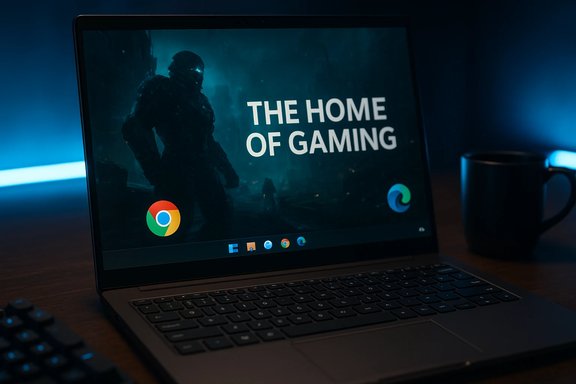
Microsoft’s latest Windows 11 commercial — a short, high‑tempo spot billed as “Windows 11: The Home of Gaming” — does exactly what it set out to do on paper: push Windows as the platform for gamers. But a tiny detail in the video has become the internet’s favorite eyebrow‑raiser: the Windows taskbar shown in the ad includes a pinned Google Chrome icon, an odd sight for a company that has spent years nudging users toward Microsoft Edge and Bing. The placement is small, but the message is loud — and it exposes a fascinating seam where marketing, platform strategy, and product reality intersect.
Microsoft and Google have fought for desktop attention for more than a decade. On Windows, that fight shows up in default choices, in‑product banners, and promotional flows that — intentionally or not — steer some users toward Microsoft’s own services. Over recent years Microsoft has layered UX nudges, in‑product banners and even rewards to encourage users to stick with Edge and Bing rather than download Chrome. These tactics have been called aggressive by community observers and have been documented in multiple reports and forum threads.
That context is important: when a Microsoft ad publicly displays Chrome on the taskbar, it collides with a narrative Microsoft itself has been building. Whether the pinned Chrome was a creative oversight, a deliberate authenticity choice, or something else entirely, it’s not a neutral event — it’s a small visual that recalls a much larger competitive story.
Common examples of Microsoft’s tactics include:
Strengths to note:
This moment exposes the tension at the heart of modern platform competition: companies spend massive effort shaping user flows and defaults, while everyday user behavior (and pragmatic choices by staff and contractors) produce realistic, messy artifacts that complicate tidy narratives. The takeaway for readers: look beyond the slogan to the product signals that matter — driver maturity, OS overhead, game compatibility — and treat the viral moment as a useful reminder that marketing and product reality are often at odds.
For gamers and Windows users, the bigger, more practical questions remain unchanged: which OS or browser gives the best performance and experience for your hardware and your priorities? On handheld devices and some optimized systems, SteamOS has shown measurable advantages in independent tests; for broad compatibility and the widest game library, Windows 11 still leads. Choose based on evidence and testing, not on an ad’s aesthetics — but enjoy the meme while it lasts.
Source: Windows Latest Microsoft shows Chrome pinned on the taskbar in a Windows 11 “Home of Gaming” ad, while it tells you to never use Google's browser
 Background: one small icon, a long history
Microsoft and Google have fought for desktop attention for more than a decade. On Windows, that fight shows up in default choices, in‑product banners, and promotional flows that — intentionally or not — steer some users toward Microsoft’s own services. Over recent years Microsoft has layered UX nudges, in‑product banners and even rewards to encourage users to stick with Edge and Bing rather than download Chrome. These tactics have been called aggressive by community observers and have been documented in multiple reports and forum threads.That context is important: when a Microsoft ad publicly displays Chrome on the taskbar, it collides with a narrative Microsoft itself has been building. Whether the pinned Chrome was a creative oversight, a deliberate authenticity choice, or something else entirely, it’s not a neutral event — it’s a small visual that recalls a much larger competitive story.
What the ad shows (the facts)
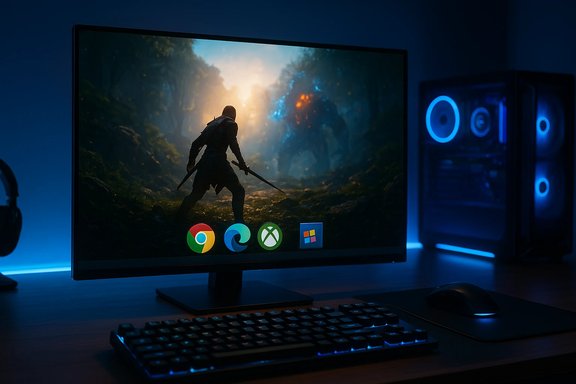
The ad in question, uploaded under the title “Windows 11: The Home of Gaming,” features quick cuts of gameplay, the Xbox app, and a Windows 11 desktop. Observant viewers noticed the taskbar in at least one clip includes Google Chrome as a pinned app icon. The clip has circulated on social platforms and been captured in screenshots and short video reposts, prompting commentary across Reddit and tech forums. Important, verifiable points:- Microsoft published a short gaming ad that highlights Windows 11 features.
- The ad’s taskbar includes a visible Google Chrome icon pinned alongside Microsoft and Xbox elements.
- Community reaction was swift: users pointed out the icon and used it to highlight the meme that “Edge exists to download Chrome,” and to criticize Windows 11’s gaming behavior in the same breath.
Why this matters: brand control, authenticity, and cognitive dissonance
A pinned application icon in a 10–20 second commercial is a micro‑detail, but commercial production is usually extremely deliberate. Creative teams routinely prepare “clean” desktop shots for tech ads — replacing real user profiles, clearing personal icons, and often locking down the taskbar so only desired elements are visible. That makes Chrome’s presence notable for three reasons:- Brand contradiction. Microsoft has spent years nudging Windows users to use Edge. Showing Chrome in a mainstream ad creates a contrast between product positioning and the depicted user behavior. That contrast feeds headlines and memes faster than any polished marketing line can manage.
- Perceived authenticity. The ad may have intentionally left in common, real‑world elements to make the desktop look authentic. A setup with Chrome pinned is familiar to many viewers and can convey “this is how real gamers have their PCs.” That authenticity can help an ad land emotionally — but it also opens the company to ridicule when the ‘authentic’ detail contradicts company messaging.
- Signal about internal behavior. If deliberate, the image suggests Microsoft’s own ad teams — or the talent on set — use Chrome. If accidental, it signals a production oversight or a rushed approval chain. Either way, the icon becomes a small but durable indicator of how closely brand messaging and internal reality align.
Two plausible explanations
- Production oversight. Ads are assembled from multiple sources (staged desktop footage, stock captures, composited UI), and small frames can slip past quality control. The icon might simply have been overlooked in final checks — credible given that other recent Microsoft ads reportedly did not show Chrome in the taskbar.
- Intentional realism. Marketers sometimes prefer “real desktops” to sterile, curated UI shots because realism increases relatability. A gamer’s desktop with Chrome pinned feels familiar to many viewers and could be a conscious authenticity choice. That would be a choice at odds with Microsoft’s broader effort to position Edge as the default browser.
The browser war: nudges, banners, and user flows
Microsoft’s efforts to retain or win back browser usage on Windows are well documented. Tactics have ranged from prominent Edge banners and default‑setting nudges to UI placements and rewards programs aimed at reducing churn to competitors. These moves are visible across community threads and archived reporting; they form the backdrop for why a Chrome icon in a Microsoft ad is eyebrow‑raising rather than merely cute.Common examples of Microsoft’s tactics include:
- Safety‑framed banners that appear when users navigate to Chrome download pages within Edge, highlighting security benefits of staying with Edge.
- “Try Edge” promotions embedded in Bing search results that can visually overshadow competitor download links.
- Temporary promotions tied to Microsoft Rewards to incentivize users to try Edge instead of switching.
Gaming claims vs. reality: “Home of Gaming” and the performance debate
The ad’s headline claim — “Experience gaming like never before on Windows 11” — is part marketing, part product promise. In real usage, Windows 11 has both clear strengths and ongoing criticisms as a gaming platform.Strengths to note:
- Strong compatibility with the vast majority of PC games and storefronts (Steam, Epic, Xbox app).
- Mature driver ecosystems for major GPU vendors and wide third‑party game support.
- Integrated Xbox features (Game Pass, Xbox app, Game Bar overlays) that are convenient for many players.
- Background OS tasks, notifications, and non‑game processes can still interfere with battery life or frame‑consistent performance in certain scenarios. Several users report interruptions or unwanted popups during gameplay on Windows 11.
- Windows 11 remains the broadest, most compatible gaming platform for PC titles at scale.
- On specific hardware and in handheld/streamlined environments, SteamOS’s lower overhead and Proton improvements can and have yielded better raw frame‑rate results.
Production pipelines and quality control: what likely went wrong
Commercials for major platforms are usually run through multiple approval stages: creative concept, pre‑production, shoot, edit, and legal/brand signoff. In desktop shots the usual steps include:- Using a “clean” machine image with a curated taskbar and no personal data.
- Replacing any remaining real UI with composited assets where necessary.
- Final creative review to ensure brand consistency and remove accidental competitor placements.
- Tight deadlines and fast turnaround over the holidays contributed to an oversight.
- The footage was repurposed from a real user session to save production time, and compositing wasn’t applied.
- A conscious creative choice favored realism, but the decision didn’t pass through brand‑safety review.
Reputational and product risks
This tiny miscue exposes several risk vectors for Microsoft:- Brand inconsistency. The company’s public posture and in‑product nudges convey a preference for Edge; a widely viewed ad showing Chrome undercuts that posture and creates cognitive dissonance.
- Amplification through social media. Small visual inconsistencies are perfect fodder for memes. Microsoft’s large scale makes such moments disproportionately visible and long‑lived online.
- Credibility gap. If consumers see Microsoft discouraging Chrome while its own ad appears to promote it (even inadvertently), it weakens persuasive messaging and invites critics to question the sincerity of Microsoft’s claims.
What it means for consumers and enthusiasts
For regular PC gamers and Windows users, the episode is mostly entertainment — a memetic moment. Practically:- Browser choice remains a user decision. Microsoft will continue to nudge users toward Edge, but Chrome’s dominance and user familiarity mean many will still choose Chrome.
- When evaluating gaming OS performance, it’s worth checking device‑specific benchmarks. For certain handhelds or highly tuned hardware, SteamOS has demonstrated better raw FPS and lower overhead in published tests. Users focused purely on frame rates should consider independent testing on their target device.
- For privacy and safety, the browser conversation should focus on feature differences, update cadences, extension ecosystems, and the tradeoffs presented by each company’s business model — not on a single ad frame.
Lessons for marketers and platform teams
- Small visual details matter. Even a single icon can shift the narrative.
- Align creative and product messaging early. Marketing teams should coordinate with product and legal to ensure visuals don’t contradict broader platform strategy.
- Test final cuts against brand guidelines that explicitly list unacceptable competitor placements.
- If you decide authenticity is crucial, be prepared to own that choice publicly — and explain it simply if questioned.
Final analysis: amusing slip or telling symptom?
The Chrome icon in Microsoft’s Windows 11 ad is a small production detail with outsized public resonance. It’s simultaneously funny, humanizing, and politically loaded. Without a public statement from Microsoft, the safest claim is this: the fact is verifiable (Chrome appears in the ad), the interpretation is not (intent is unknown), and the broader context gives the detail meaning beyond the frame.This moment exposes the tension at the heart of modern platform competition: companies spend massive effort shaping user flows and defaults, while everyday user behavior (and pragmatic choices by staff and contractors) produce realistic, messy artifacts that complicate tidy narratives. The takeaway for readers: look beyond the slogan to the product signals that matter — driver maturity, OS overhead, game compatibility — and treat the viral moment as a useful reminder that marketing and product reality are often at odds.
Conclusion
A pinned Chrome icon is not the end of Microsoft’s marketing credibility, but it is the kind of small mismatch that brands should avoid — especially when their wider strategy has been to discourage the exact behavior that visual suggests. The ad will be remembered not for its cinematography or feature list, but for that tiny, persistent icon: a funny scrap of evidence that platform wars are fought not only in code and policy, but in the margins of a single frame.For gamers and Windows users, the bigger, more practical questions remain unchanged: which OS or browser gives the best performance and experience for your hardware and your priorities? On handheld devices and some optimized systems, SteamOS has shown measurable advantages in independent tests; for broad compatibility and the widest game library, Windows 11 still leads. Choose based on evidence and testing, not on an ad’s aesthetics — but enjoy the meme while it lasts.
Source: Windows Latest Microsoft shows Chrome pinned on the taskbar in a Windows 11 “Home of Gaming” ad, while it tells you to never use Google's browser