

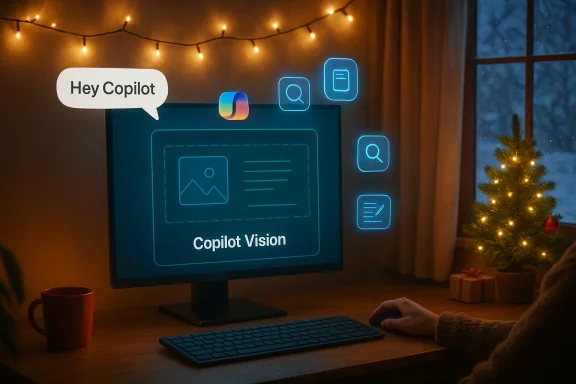
Microsoft’s latest holiday-themed YouTube ad that spotlights Copilot Vision and the “Hey, Copilot” voice experience landed with more heat than cheer — a short, warm-hearted commercial meant to normalize talking to your PC instead amplified a long‑running user revolt over Microsoft’s ever‑deeper push to make Windows 11 an “agentic OS.”
Microsoft has been systematically repositioning Windows from a passive platform into an AI‑centric, multimodal environment where Copilot (voice, vision, and agents) sits at the center of daily tasks. The company’s marketing — from short social clips to high‑profile stage demos — paints a picture of a PC you can speak to and that can see and assist with whatever’s on the screen. That vision is tied to product moves such as Copilot Vision in Edge and Windows, Copilot+ hardware tiers for on‑device inference, and a public narrative that Windows is “evolving into an agentic OS.” The holiday ad series was explicitly designed to show Copilot as a friendly, hands‑free helper: syncing lights to music, interpreting assembly instructions, or checking HOA rules for inflatable yard decorations. The aim was clear — lower the barrier for everyday users by making AI feel domestic and useful. But the clip also created a potent mismatch between marketing imagery and what the current releases reliably deliver in the field. Observers and testers have repeatedly found gaps between staged demos and real‑world behavior, and this advert simply crystallized those tensions for a broad audience.
Microsoft has demonstrable strengths: a huge installed base, deep integration across productivity apps, and meaningful investments in on‑device inference. Those assets create a pathway to a genuinely useful, privacy‑sensitive Copilot experience. But the company is at a crossroads: continue pushing theatrical demos that overpromise, and the trust deficit will grow; or slow, prioritize reliability and transparency, and convert early noise into durable product value. The holiday ad made the choice for the public: the conversation is now about trust and execution as much as imagination.
Microsoft’s Copilot will likely remain a strategic bet for the company. Whether Windows users ultimately embrace it depends less on its ambition and more on whether the product team can reliably deliver the everyday value the ads imply — with obvious, enforceable privacy controls, predictable behavior, and marketing that maps truthfully to the experience in your home or workplace. The ad may have aimed for warmth; the response shows how fragile trust can be when expectations and reality diverge.
Source: Windows Report Microsoft's holiday-themed YouTube ad for Copilot sparks user backlash
 Background
Microsoft has been systematically repositioning Windows from a passive platform into an AI‑centric, multimodal environment where Copilot (voice, vision, and agents) sits at the center of daily tasks. The company’s marketing — from short social clips to high‑profile stage demos — paints a picture of a PC you can speak to and that can see and assist with whatever’s on the screen. That vision is tied to product moves such as Copilot Vision in Edge and Windows, Copilot+ hardware tiers for on‑device inference, and a public narrative that Windows is “evolving into an agentic OS.” The holiday ad series was explicitly designed to show Copilot as a friendly, hands‑free helper: syncing lights to music, interpreting assembly instructions, or checking HOA rules for inflatable yard decorations. The aim was clear — lower the barrier for everyday users by making AI feel domestic and useful. But the clip also created a potent mismatch between marketing imagery and what the current releases reliably deliver in the field. Observers and testers have repeatedly found gaps between staged demos and real‑world behavior, and this advert simply crystallized those tensions for a broad audience. What the ad showed — and what viewers expected
The ad’s vignettes work on a simple storytelling principle: speak, and the PC does useful things. Scenes cut quickly from a parent saying “Hey, Copilot” to immediate, polished assistance: lights that sync to music, a conversational readout of product manuals, and confident guidance through local rules about decorations. For viewers unfamiliar with feature nuance, those visuals naturally imply direct hardware control, flawless on‑screen interpretation, and immediate, accurate answers. But tech scrutiny and community reproductions revealed important differences between impression and reality. For instance, syncing consumer smart‑lights from a Windows PC via Copilot is not a broadly supported, turnkey scenario today; Copilot Vision is mainly a viewing and guidance capability — it “sees” what’s on the screen and explains it rather than acting as a universal home‑automation hub. Likewise, Copilot’s ability to identify UI elements and point users to exact controls is real but imperfect; testers have logged cases where the assistant highlights the wrong control or suggests an option that’s already selected. Those observable failures are the source of the ridicule and the credibility hit.The immediate reaction: amused, sarcastic — and fiercely skeptical
Within hours of the ad surfacing, YouTube comments and social feeds turned into a rolling satire of Microsoft’s AI ambitions. Jokes like “Hey Copilot, how can I uninstall you?” and “Hey Copilot, how do I delete Windows 11?” summed up a sentiment that runs deeper than a single marketing misstep: many users feel inundated by AI prompts and promotional nudges inside the OS, and they regard Copilot as an invasive presence rather than an optional helper. High‑visibility reactions — from community leaders and tech influencers — amplified the debate, feeding wider press coverage. The tone across many threads was not merely humorous. Some replies were angry; others framed the ad as symptomatic of a long‑term trust problem: features that change system behavior, defaults that steer users toward cloud sign‑ins, and product messaging that stretches perceived capability. In short, the ad acted as a catalyst for frustration that had already accumulated across months of Copilot rollouts and UI changes.Technical reality: what Copilot Vision actually does today
Copilot Vision is a permissioned, session‑based feature that allows the assistant to interpret the contents of a chosen window or browser tab and respond via voice or text. It’s not a persistent, always‑on camera or an autonomous agent that operates outside the explicit session. Microsoft’s documentation and product demos consistently emphasize opt‑in controls, session scoping, and the idea that Vision may highlight UI elements but won’t click or change them for you unless a permissioned workflow or sanctioned action is in place. Privacy and data handling are further qualifiers: Microsoft states that images, audio, and contextual content from a Vision session are deleted when the session ends, while model responses may be logged for safety monitoring. The company’s FAQ says transcripts of voice exchanges may persist in conversation history and can be deleted by users. Those claims address some privacy fears but do not eliminate concerns about when cloud routing occurs and what metadata is retained for system‑level diagnostics. Importantly, many advanced scenarios shown in ads — cross‑device home automation, low‑latency peripheral control, or seamless third‑party hardware integration — often depend on additional connectors, third‑party APIs, or future platform hooks that are not universally available on consumer devices today. The marketing frames a future that is technically plausible, but the present is still a patchwork of capabilities gated by hardware, subscriptions, and supported integrations.Leadership’s tone and the politics of enthusiasm
Microsoft’s AI leadership did not ignore the backlash. Mustafa Suleyman, CEO of Microsoft AI, publicly pushed back against critics, characterizing detractors as “cynics” and expressing incredulity that people would call modern AI “underwhelming.” His remark — framed as a generational take on technological progress — struck many as dismissive, because the criticism was less about whether AI can be impressive in principle and more about whether Microsoft’s current implementations are reliable, auditable, and respectful of control. That exchange further inflamed debate and made the conversation about tone as much as about technical facts. There are two communication traps here. First, celebrating the macro‑achievement of multimodal conversational AI risks appearing tone‑deaf when users are pointing to concrete product failures and confusing defaults. Second, executive dismissal of valid operational concerns (privacy, control, reliability) can harden resistance rather than persuade skeptics to wait for maturations. The leadership brief is clear: enthusiasm helps sell a vision, but earning pragmatic trust requires a different posture — transparent roadmaps, honest acknowledgements of limits, and concrete timelines for fixes.Privacy and the long shadow of Recall
One of the reasons Copilot ads touch a nerve is the recall of prior controversies. Microsoft’s earlier Copilot “Recall” concept — an opt‑in feature that took periodic screenshots to create a searchable on‑device history — provoked intense scrutiny from security researchers and privacy advocates. Critics warned that any system that archives screenshots could surface passwords, financial data, and other highly sensitive content; researchers flagged possible plaintext storage and local‑access attack vectors. Microsoft responded by hardening security mechanics, making recall disabled by default for many users, and emphasizing local encryption, but the episode left a residual credibility debt. When marketing shows an assistant seeing screens in a cheery commercial, some users reflexively fear a return to the privacy tradeoffs that Recall once highlighted. That scepticism is partly rational: surveillance metaphors are sticky. To repair trust, vendors must demonstrate not only opt‑in controls on paper but system defaults, independent audits, clear data‑flow diagrams, and administrative controls that enterprises can enforce. Absent those durable, verifiable guarantees, even accurate vendor claims about deletion and scoping feel insufficient to many users.Risk matrix: what’s at stake for Microsoft and for users
- Product trust and adoption: If staged demos continue to outpace reality, potential adopters will treat Copilot as a gimmick rather than a productivity gain. That makes it harder to justify paid tiers or hardware premiums tied to Copilot+ features.
- Privacy and legal risk: Even with local storage and deletion claims, the perception of a surveillance posture invites regulatory scrutiny and litigation in privacy‑sensitive markets. Consumer trust erosion is costly in a subscription economy where churn matters.
- Fragmentation and two‑tier experiences: Gating the fullest experiences to Copilot+ hardware (40+ TOPS NPUs) risks creating a premium island — compelling to buyers with new devices, but alienating for the broader base. That fragmentation complicates support, developer targeting, and user expectations.
- Security exposure: Features that process multimodal inputs and store transient transcripts create additional attack surface. Even locally stored artifacts — if improperly protected — can be exfiltrated by threat actors with admin access. Past security commentary on Recall demonstrates those vectors.
- Reputational damage: Messaging that downplays user concerns or celebrates unimpeachable progress can harden opposition and feed narratives that Microsoft prioritizes marketing over fundamentals. Sustained reputational damage reduces the impact of future product wins.
Why some of Microsoft’s technical choices are defensible
Despite valid criticism, Microsoft’s approach has rational pillars that bear recognition.- Multimodality is the natural next step. Combining voice + vision + contextual models reduces friction in scenarios where switching contexts is the main cost, such as following a recipe or reading assembly instructions. This design choice is aligned with how humans naturally seek help.
- Phased rollout and tiering are pragmatic. The Copilot+ hardware tier and staged preview channels allow Microsoft to ship features incrementally while reserving the most latency‑sensitive functions for devices with dedicated NPUs. That both manages expectations and protects lower‑end devices from heavy local inference overhead.
- Opt‑in session scoping reduces continuous recording risk. The decision to make Vision a sessioned, explicit action rather than an always‑on watcher is a sensible default that addresses some privacy concerns at the UX level.
Practical guidance for users and IT teams
- Treat Copilot suggestions as assistive — not authoritative — until you validate them in critical workflows.
- Use available opt‑out and privacy controls: disable Copilot Vision in Edge or in the Copilot settings if you’re uncomfortable with session transcripts persisting. Delete conversation history where appropriate.
- For enterprises: enforce governance through MDM/GPO controls that limit which Copilot features are available, and audit logs where agent actions are permitted. Plan pilot deployments with narrow use cases rather than full‑scale rollouts.
- Watch for independent audits or third‑party attestations about data handling and training exclusions. Relying solely on vendor claims is necessary but not sufficient when privacy risk is material.
How Microsoft can repair the narrative and rebuild trust
- Demonstrate parity between ads and shipped features: ensure marketing refrains from implying universal hardware and integration scenarios that aren’t broadly supported.
- Publish independent audit results and clear logging/retention policies that are easily discoverable and machine‑readable.
- Strengthen defaults: set privacy‑friendly default controls, make opt‑in choices obvious in setup, and simplify the opt‑out path for features users don’t want.
- Communicate engineering timelines and measurable KPIs (accuracy improvements, false‑positive rates, latency reduction) so users can judge progress empirically rather than rhetorically.
- Reframe leadership communications to acknowledge limits and outline remediation plans. Enthusiasm sells vision, but humility and metrics earn long‑term trust.
Final analysis: why this matters beyond a single ad
The holiday ad kerfuffle is more than a moment of viral mockery; it’s a stress test of a much bigger transformation: moving an operating system from a passive, predictable shell into a context‑rich, agentic platform. That shift carries both powerful user benefits and material risks. Marketing that accelerates expectations ahead of engineering maturity invites backlash. Conversely, a careful, evidence‑based rollout that demonstrates reliability, obvious controls, and meaningful privacy protections could convert skeptics into advocates over time.Microsoft has demonstrable strengths: a huge installed base, deep integration across productivity apps, and meaningful investments in on‑device inference. Those assets create a pathway to a genuinely useful, privacy‑sensitive Copilot experience. But the company is at a crossroads: continue pushing theatrical demos that overpromise, and the trust deficit will grow; or slow, prioritize reliability and transparency, and convert early noise into durable product value. The holiday ad made the choice for the public: the conversation is now about trust and execution as much as imagination.
Microsoft’s Copilot will likely remain a strategic bet for the company. Whether Windows users ultimately embrace it depends less on its ambition and more on whether the product team can reliably deliver the everyday value the ads imply — with obvious, enforceable privacy controls, predictable behavior, and marketing that maps truthfully to the experience in your home or workplace. The ad may have aimed for warmth; the response shows how fragile trust can be when expectations and reality diverge.
Source: Windows Report Microsoft's holiday-themed YouTube ad for Copilot sparks user backlash
