

Human and machine notions of time are not minor UX wrinkles — they are structural mismatches that shape how hybrid teams fail, succeed, and scale; ChronoProcess Networks (CPNs) give us a vocabulary and an engineering scaffold to see those mismatches, measure them, and train systems to act across multiple temporal horizons.
Time is often treated as a neutral backdrop in systems design: deadlines, clocks, and timestamps are technical details, while the lived experience of time stays in the domain of sociology and psychology. That division is increasingly untenable. As AI moves from feature to platform — with agentic behaviors, persistent memory, and runtime controls that trade latency for deliberation — temporal differences between human actors and computational agents become operational constraints that shape outcomes. Contemporary industry reporting shows this shift: products expose runtime knobs (latency-optimized vs. reasoning-optimized modes) and persistent state layers that make time an explicit design variable rather than an implicit one.
ChronoProcess Networks (CPNs) reframe the problem. Instead of flattening time into a single schedule or forcing human rhythms to match computational microcycles, CPNs model time as a web of interrelated processes — each with its own tempo, constraints, and coupling to other nodes. The payoff is not merely better synchronization; it is the creation of a hybrid temporal stance that neither fully reduces the human story to discrete machine steps nor leaves machine cycles untethered to durable human constraints.
This feature unpacks that argument for WindowsForum’s technical readership: what CPNs are, how human and AI temporal cognition differ in actionable ways, how to operationalize CPNs in production systems, and what risks and measurement regimes matter when time becomes part of the system design. I draw on contemporary industry reporting about agentic AI, memory primitives, time-aware safety proposals for sensitive domains, and long-context product shifts to ground the analysis.
Key characteristics:
Two practical consequences follow for systems design. First, humans expect continuity and accountability over time: we lean on narratives (why we made a decision) not only snapshots. Second, human cycles include windows of vulnerability (for example, late-night decision fatigue) that must be considered when delegating authority to automated agents. Industry discussions about time-aware safety frameworks for sensitive applications — such as mental-health chatbots that show higher risk during nocturnal hours — illustrate the operational importance of modeling when, not only what, an AI does.
Industry reporting of recent product families (behaviorally distinct fast vs. slow variants and agentic action primitives) shows that vendors are making time explicit in system design — but the mere presence of controls does not solve the alignment problem. Systems still need to learn when to stretch computation into anticipatory modes that respect human pacing and institutional deadlines.
Illustrative patterns:
A practical, staged approach for teams:
Caveat: this is ethically fraught. Lowering thresholds increases referrals and emergency calls, which can strain services and create false alarms; rigorous pilot testing and capacity planning are essential.
The practical imperative is simple: when humans and AI collaborate, ask not just “what should be automated?” but “when, and under what temporal constraints, should it happen?” Answering that question with a CPN mindset converts time from a hidden failure mode into a design axis that, when managed deliberately, improves safety, trust, and organizational resilience.
Source: The AI Journal Temporal Cognition in Human–AI Hybrids: A Chrono Process Network Perspective | The AI Journal
 Background / Overview
Time is often treated as a neutral backdrop in systems design: deadlines, clocks, and timestamps are technical details, while the lived experience of time stays in the domain of sociology and psychology. That division is increasingly untenable. As AI moves from feature to platform — with agentic behaviors, persistent memory, and runtime controls that trade latency for deliberation — temporal differences between human actors and computational agents become operational constraints that shape outcomes. Contemporary industry reporting shows this shift: products expose runtime knobs (latency-optimized vs. reasoning-optimized modes) and persistent state layers that make time an explicit design variable rather than an implicit one.ChronoProcess Networks (CPNs) reframe the problem. Instead of flattening time into a single schedule or forcing human rhythms to match computational microcycles, CPNs model time as a web of interrelated processes — each with its own tempo, constraints, and coupling to other nodes. The payoff is not merely better synchronization; it is the creation of a hybrid temporal stance that neither fully reduces the human story to discrete machine steps nor leaves machine cycles untethered to durable human constraints.
This feature unpacks that argument for WindowsForum’s technical readership: what CPNs are, how human and AI temporal cognition differ in actionable ways, how to operationalize CPNs in production systems, and what risks and measurement regimes matter when time becomes part of the system design. I draw on contemporary industry reporting about agentic AI, memory primitives, time-aware safety proposals for sensitive domains, and long-context product shifts to ground the analysis.
ChronoProcess Networks: beyond schedules, toward temporal architectures
What a ChronoProcess Network models
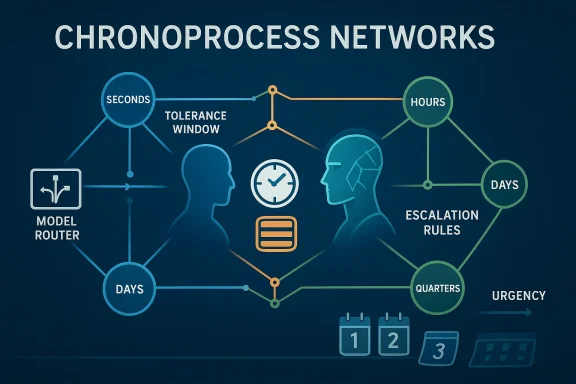
A CPN is a directed network of processes and constraints where nodes represent temporal processes (for example: nightly clinical intake, quarterly audit windows, per-request model inference, human decision checkpoints) and edges encode synchronization relationships, tolerance windows, and escalation rules.Key characteristics:
- Multilayered temporality — processes operate on different scales (seconds, hours, days, quarters) and are modeled together rather than collapsed into one timeline.
- Relational meaning — time is given meaning by how cycles align or misalign; a human escalation that must occur within 6–12 hours gains its significance from upstream model outputs and downstream regulatory windows.
- Adaptive flexibility — nodes can shift their emphasis dynamically (e.g., a model can increase deliberation effort when a slow-horizon human review is expected).
- Strategic foresight — by mapping overlaps and friction points, a CPN surfaces where mismatched tempos produce resilience gaps.
Human temporal cognition: layered, narrative, and constraint-aware
Humans learn temporal structure through embodied rhythms and cultural scaffolding. From infant sleep/wake cycles to adult career narratives and institutional calendars, human temporal cognition stitches together multiple layers:- Biological cycles (circadian rhythms, fatigue, attention spans).
- Social rhythms (work weeks, holidays, market hours).
- Narrative horizons (career plans, project roadmaps).
- Institutional constraints (regulatory deadlines, compliance reporting).
Two practical consequences follow for systems design. First, humans expect continuity and accountability over time: we lean on narratives (why we made a decision) not only snapshots. Second, human cycles include windows of vulnerability (for example, late-night decision fatigue) that must be considered when delegating authority to automated agents. Industry discussions about time-aware safety frameworks for sensitive applications — such as mental-health chatbots that show higher risk during nocturnal hours — illustrate the operational importance of modeling when, not only what, an AI does.
AI temporal cognition: iterations, parallel nows, and compressed horizons
AI systems do not experience time; they compute it. That difference is structural:- At the product and runtime level, modern systems expose discrete modes: latency-optimized agents for fast responses and reasoning-optimized agents for deep deliberation. Product teams now treat deliberation as a tunable runtime knob, which turns time into a resource that can be allocated per invocation.
- Architecturally, agents can persist state across sessions through memory layers, turning ephemeral queries into multi-session workflows. These memory primitives convert time from a purely operational metric into a feature: agents can now be pre-fed context at session start, enabling continuity that approximates human narrative over time.
- Computational parallelism lets AI inhabit many “nows” simultaneously: probabilistic models can evaluate multiple hypothetical futures in parallel and return choices based on expected utilities rather than sequential, story-like reasoning.
Industry reporting of recent product families (behaviorally distinct fast vs. slow variants and agentic action primitives) shows that vendors are making time explicit in system design — but the mere presence of controls does not solve the alignment problem. Systems still need to learn when to stretch computation into anticipatory modes that respect human pacing and institutional deadlines.
Hybrid systems: where the tensions show up in the wild
When humans and AI collaborate, temporal mismatches create subtle failures that are often operationally significant.Illustrative patterns:
- Over-acceleration: AI automations push decisions forward faster than human review cycles can accommodate, causing downstream audit, compliance, or coordination failures.
- Temporal blind spots: models fail to account for human vulnerability windows (late-night use, end-of-quarter resource crunches), producing brittle outcomes in safety-sensitive domains.
- Misplaced anticipation: AI anticipates futures with purely probabilistic heuristics, but the human narrative horizon is longer and contingent on different signals.
Training AI into hybrid temporal competence: design patterns and a step-by-step approach
CPNs are more than analytic frames — they can be engineered as developmental environments that teach AI agents how to respect and operate within human temporal norms. The essential idea: expose AI agents to multi-horizon workflows and explicit temporal constraints so that their policy and reward models internalize hybrid timing norms.A practical, staged approach for teams:
- Map temporal processes. Inventory biological, organizational, regulatory, and computational rhythms. Identify coupling constraints and "hard windows" (for example, legal deadlines or on-call rotations).
- Instrument temporal telemetry. Log anonymized timestamps, session durations, escalation events, and contextual signals (user timezone, declared availability). Use this telemetry to compute usage rate distributions and vulnerability windows.
- Create CPN testbeds. Build synthetic workflows that simulate overlapping cycles (short model inferences feeding into weekly human reviews feeding into quarterly audits). Use adversarial scenarios (holiday spikes, late-night surges) to probe failure modes.
- Train with temporally-aware objectives. Extend reward models and policy tuning to include temporal alignment penalties or bonuses (e.g., penalize automation that forces human review outside a permitted window; reward anticipatory summaries placed ahead of human decision points).
- Use memory and deliberate routing primitives. Architect agents to use persistent memory stores to align context across sessions, and route requests to slower, deeper reasoning modes when longer-horizon alignment is required. This mirrors recent platform moves that treat memory as a first-class runtime feature.
- Close the loop with human pacing signals. Human collaborators provide the pacing cues — scheduled check-ins, explicit "do not escalate outside X hours" markers, and synchronous “handoff” gestures. Feed these signals into the agent’s learning pipeline as supervision.
- Operationalize escalation policy. Define clear thresholds and routing rules that are time-aware (e.g., stricter human-in-the-loop requirements between 10:00 p.m.–6:00 a.m. local time for safety-critical conversations). Iteratively adjust thresholds using telemetry and outcome metrics.
Implementation patterns and building blocks
Practical building blocks for CPN-enabled systems are already appearing in platform work:- Memory stores (scoped by tenant or user) that persist salient facts and consolidate conflicting items — useful for multi-session alignment and narrative continuity.
- Model routers that select between latency-optimized and deliberation-optimized variants (trade latency for depth depending on temporal context).
- Action primitives (structured diffs, sandboxed shell calls) that let an orchestrator apply model proposals under human-specified temporal constraints. These primitives enable models to propose-and-apply within controlled windows rather than unilaterally acting.
- Temporal telemetry and governance layers that log when actions occurred, why they were proposed, and which human or machine accepted them — essential for post-hoc reviews aligned to regulatory cycles.
Risks, failure modes, and governance implications
CPNs improve visibility and alignment, but they are not a panacea. Implementation brings new risks:- Overfitting to engineered windows: If training fixes a model to a narrow set of temporal patterns, the system may fail under novel calendar events (for example, emergency schedule changes, political or social shocks). Continuous monitoring and re-training pipelines are essential.
- Escalation overload: Time-aware safety rules that become too sensitive (for example, always escalating late-night sessions to humans) can overwhelm human responders and create false-positive cascades. Any deployment of temporal thresholds must be capacity-aware.
- Privacy and surveillance: Instrumenting temporal behavior requires timestamps and session traces. Without strong anonymization and differential privacy, temporal signals can be reidentifying and raise legal/regulatory concerns.
- Opacity and provenance: Temporal decisions compound provenance problems. If an agent delays an action to a later window or synthesizes a long-term plan, auditors need clear, machine-readable provenance of both the plan and the temporal rationale. Contemporary discussions on provenance and model opacity underline how hard this is in practice.
- Dependence and behavioral reinforcement: Agents that manage temporal coordination (reminding, scheduling, on-demand escalation) can become behavioral scaffolds that reduce human temporal skill development, creating systemic dependence on AI for basic time management. This is a social risk that teams should weigh explicitly.
Case studies and thought experiments
Time-aware safety for mental-health assistants
An operationalized example that mirrors CPN principles: telemetry-driven escalation thresholds for mental-health chatbots. The recommended blueprint includes collecting 90 days of anonymized timestamped session logs, overlaying incident reports to identify high-risk windows, dynamically lowering human-escalation thresholds during identified vulnerability windows (for example, late night and holidays), and iterating thresholds with clinician review. The approach embodies CPN ideas: model short feedback loops (real-time detection) in the context of long institutional cycles (clinical follow-up, reporting).Caveat: this is ethically fraught. Lowering thresholds increases referrals and emergency calls, which can strain services and create false alarms; rigorous pilot testing and capacity planning are essential.
Agentic task systems and the pacing problem
Agentic platforms that persist state and schedule long-running workflows (for example, systems that execute a multi-step task across hours or days) must encode temporal constraints into their orchestration logic. Reports on agentic startups and platform memory features emphasize that persistence plus action primitives makes timing a first-class design challenge: when should an agent try a risky action autonomously vs. when must it wait for human review? The trade-offs are concrete, not theoretical, and platform primitives for memory and action routing are already being used to manage them.How to evaluate temporal alignment: metrics and monitoring
Designing for temporal competence requires measurement. Useful telemetry and evaluation signals include:- Temporal coverage: fraction of decision points that include an explicit temporal constraint or window.
- Escalation latency: distribution of delays between detected high-risk events and human escalation.
- Calendar drift: frequency with which automated actions misalign with institutional deadlines.
- Capacity ratio: escalation volume versus available human reviewer capacity, by hour/day/season.
- Outcome alignment: correlation between temporal alignment measures and downstream outcomes (for example, incident rates, user satisfaction, audit findings).
Practical checklist for IT teams and product leaders
- Map: inventory all temporal processes that touch your product or workflow.
- Instrument: collect anonymized time-series telemetry with strict access controls.
- Simulate: run CPN testbeds that model overlapping rhythms and failure modes.
- Route: implement model routers to select between instant and deliberative behaviors based on temporal context.
- Memory: adopt scoped memory primitives for cross-session continuity when narrative continuity matters.
- Escalate: define and test time-sensitive escalation thresholds and capacity plans.
- Audit: store machine-readable provenance of both the action and the timing rationale for regulatory review.
- Reassess: run periodic temporal audits aligned to quarterly or yearly governance cycles.
A candid assessment: strengths and limitations of CPNs
Strengths- Visibility: CPNs make hidden temporal constraints explicit, improving resilience and foresight.
- Design leverage: treating time as a design variable unlocks new UX patterns (e.g., progressive disclosure tied to human availability).
- Trainability: exposing agents to temporally-structured experiences creates a plausible path to hybrid temporal competence.
- Empirical uncertainty: while platform primitives exist (memory, routing), the claim that AI can fully internalize human temporal norms at scale remains early-stage — it requires longitudinal data and careful evaluation. Contemporary industry reporting is optimistic but not definitive. Treat claims about rapid trainability as hypotheses to be tested rather than established facts.
- Governance complexity: building CPNs demands cross-functional coordination: product, legal, compliance, and operations must all contribute. This coordination is often the harder problem than the engineering work itself.
- Resource trade-offs: making systems more time-aware (higher escalation sensitivity at night, longer deliberation on some flows) has operational costs — human capacity, compute budgets, and latency friction.
Conclusion: designing for temporal competence
Time stops being background noise when systems span human lives and institutional rhythms. ChronoProcess Networks give engineers and product leaders a framework to model temporal heterogeneity, design rules that respect human pacing, and train agents to operate across multiple horizons. The initial building blocks are already in platform stacks — memory primitives, model routers, and action APIs — but moving from primitives to robust hybrid temporal competence will require disciplined telemetry, governance, and careful pilot programs.The practical imperative is simple: when humans and AI collaborate, ask not just “what should be automated?” but “when, and under what temporal constraints, should it happen?” Answering that question with a CPN mindset converts time from a hidden failure mode into a design axis that, when managed deliberately, improves safety, trust, and organizational resilience.
Source: The AI Journal Temporal Cognition in Human–AI Hybrids: A Chrono Process Network Perspective | The AI Journal
