

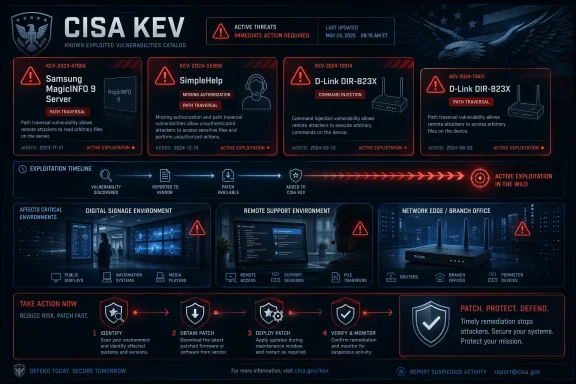
CISA’s decision on April 24, 2026, to add four more flaws to its Known Exploited Vulnerabilities Catalog is another reminder that the most dangerous bugs are not always the ones with the highest theoretical scores, but the ones attackers are already using. The new entries span a Samsung MagicINFO 9 Server path traversal issue, two SimpleHelp flaws, and a D-Link DIR-823X command injection weakness, a mix that highlights how quickly exposure can spread across digital signage, remote support tooling, and consumer networking gear. For federal agencies, the update immediately matters because KEV listings drive mandated remediation timelines under Binding Operational Directive 22-01. For everyone else, the message is simpler and more urgent: if it’s on KEV, assume it is being hunted in the wild and act accordingly.
The KEV Catalog is one of the most practical pieces of cyber policy in the United States because it converts abstract vulnerability management into a concrete, attacker-informed priority list. Instead of forcing defenders to guess which CVEs deserve attention first, CISA curates the defects it has evidence are already being exploited, then uses that list to drive federal remediation. That approach is especially useful in environments where patch backlogs are large, asset inventories are incomplete, and security teams must make hard tradeoffs every day.
The April 24 update fits a familiar pattern. CISA tends to add issues after exploitation becomes visible enough to justify inclusion, which means the catalog is not a forecast of future risk so much as a record of present danger. That distinction matters. A vulnerability can be technically severe but sit quietly for months; another can be less dramatic on paper and still become a favorite path for intrusion crews because it is easy to reach, easy to automate, or common in poorly managed environments.
These four entries also underline a broader truth about today’s threat economy: attackers love products that sit at the edge of the network, bridge multiple customers, or run with elevated privileges. MagicINFO is used in environments where public-facing content systems often receive less scrutiny than core IT platforms. SimpleHelp is remote support software, which can become a trusted access path into many downstream networks. D-Link routers, meanwhile, remain attractive because edge devices are often forgotten after installation, then exposed for years.
The KEV model works because it pushes organizations toward a risk-based response rather than a checkbox exercise. Microsoft and other platform vendors increasingly align their own vulnerability tooling with KEV-style prioritization, because enterprises cannot patch everything at once and need the sort of live intelligence that helps them focus on what is most likely to be used against them. In practice, that means asset visibility, exposure scoring, and rapid remediation are now inseparable parts of modern security hygiene.
Samsung MagicINFO has already appeared repeatedly in CISA’s own KEV feed over the past year, which tells a story of an ecosystem that keeps producing exploitable flaws and keepers of digital signage systems that may not always move quickly enough on updates. The fact that another MagicINFO issue is now in the catalog reinforces the risk of product-level exposure, not just single-CVE exposure. Once a software line becomes known as an attractive target, defenders should assume follow-on issues will continue to appear.
The SimpleHelp additions are particularly noteworthy because they arrive in the shadow of earlier campaign activity. SimpleHelp has already been the subject of CISA advisory work and prior KEV attention, and the platform’s role in remote monitoring and management makes any weakness more consequential than the average application bug. When remote support software is abused, the damage often extends far beyond the server itself because it can create a bridge into many customer environments.
The D-Link router entry brings the focus back to network edge devices, where command injection remains one of the oldest and most expensive security headaches. Consumer and small-office routers are notorious for long service lives, weak maintenance habits, and limited visibility once deployed. If a device like this is remotely exploitable and already being used in the wild, then the practical risk is not just compromise of the router itself but interception, pivoting, and persistence across the local network.
CISA’s KEV approach reflects a hard-earned lesson from years of incident response: real-world exploitation compresses timelines. Once attackers begin using a flaw, the window for safe remediation shrinks rapidly. A vulnerability that may have looked like a backlog item in January can become the starting point for widespread compromise by spring, especially if exploit code becomes easy to adapt or bundle into attack kits.
This is why CISA’s policy has resonance beyond the federal sector. Even though BOD 22-01 formally applies to Federal Civilian Executive Branch agencies, the logic is broadly relevant. Every organization has limited bandwidth, and a curated list of known exploited issues is an efficient way to steer scarce attention toward the vulnerabilities most likely to cause immediate harm. That is especially true for organizations without large threat-hunting teams.
The underlying issue here is a path traversal vulnerability, a class of defect that can allow an attacker to break out of intended file paths and access or manipulate files they should not reach. In a server product, that can translate into file reads, file writes, configuration tampering, or even a stepping stone toward code execution depending on how the application handles paths and permissions. CISA’s prior catalog entries suggest this family of issues has already been a recurring concern for MagicINFO.
The larger implication is that organizations must stop viewing signage and device-management platforms as low-risk peripherals. These systems are often internet-accessible, remotely administered, and maintained by lean IT teams that may not even know they are exposed externally. That makes them prime candidates for opportunistic exploitation.
A missing authorization flaw is especially dangerous because it can let an attacker perform actions or access data without the permissions the system is supposed to enforce. Paired with a path traversal issue, that can create a powerful chain: one bug opens access checks, another exposes files or sensitive resources, and together they can enable deeper compromise. In tools that facilitate remote support, those resources may include configuration files, tokens, or session artifacts that attackers can leverage.
CISA has already warned about exploitation of unpatched SimpleHelp in earlier advisories, and that history makes this KEV addition less surprising than it is sobering. It suggests the product remains actively targeted and that defenders cannot treat it as a one-time cleanup job. If anything, prior exploitation should sharpen attention, because attackers often return to the same ecosystem until the installed base shrinks.
What makes this especially troubling is the long tail of consumer and small-business networking equipment. Many such devices are deployed once and then forgotten until they fail. Firmware updates are irregular, ownership changes are messy, and administrators may not even know the device is still in active use. That creates a perfect environment for exploitability to outlast public attention.
From a broader threat perspective, edge devices are often valuable not because they store sensitive data, but because they control data flow. A compromised router can be used for interception, redirection, persistence, or staging. In other words, the damage can exceed the device’s modest footprint on an asset inventory.
The operational challenge is not merely downloading patches. It is identifying where the vulnerable software exists, whether it is internet-facing, whether compensating controls are in place, and whether the patch can be deployed without breaking mission systems. That is especially difficult in mixed estates with aging appliances, third-party management tools, and incomplete software inventories.
This is where modern vulnerability-management tooling becomes critical. Microsoft, for example, emphasizes continuous discovery and remediation workflows in Microsoft Defender Vulnerability Management, including software inventories, named CVEs, and device-level exposure views. That kind of visibility matters because the largest cost in urgent remediation is often not the patch itself, but the time spent finding what is vulnerable.
For enterprises, SimpleHelp stands out as a business-continuity risk because remote management products are part of the administrative fabric. If those tools are abused, responders may lose visibility or control at exactly the wrong moment. MagicINFO is more of a niche enterprise concern, but because signage systems are usually integrated into broader IT environments, the blast radius can be larger than it appears.
For consumers and small offices, the D-Link issue is the most relatable and potentially the most underappreciated. A router compromise can affect browsing traffic, DNS resolution, and downstream devices without obvious signs. That makes it a quiet but dangerous class of exploitation, especially when users assume their network gear is too mundane to be targeted.
The other thing to watch is whether these four vulnerabilities generate follow-on advisories, vendor hardening guidance, or broader campaign reporting. When multiple flaws cluster around a single product category, that often signals either weak secure development practices or especially attractive deployment patterns for attackers. In both cases, organizations should expect more pressure, not less.
Source: CISA CISA Adds Four Known Exploited Vulnerabilities to Catalog | CISA
 Overview
The KEV Catalog is one of the most practical pieces of cyber policy in the United States because it converts abstract vulnerability management into a concrete, attacker-informed priority list. Instead of forcing defenders to guess which CVEs deserve attention first, CISA curates the defects it has evidence are already being exploited, then uses that list to drive federal remediation. That approach is especially useful in environments where patch backlogs are large, asset inventories are incomplete, and security teams must make hard tradeoffs every day.The April 24 update fits a familiar pattern. CISA tends to add issues after exploitation becomes visible enough to justify inclusion, which means the catalog is not a forecast of future risk so much as a record of present danger. That distinction matters. A vulnerability can be technically severe but sit quietly for months; another can be less dramatic on paper and still become a favorite path for intrusion crews because it is easy to reach, easy to automate, or common in poorly managed environments.
These four entries also underline a broader truth about today’s threat economy: attackers love products that sit at the edge of the network, bridge multiple customers, or run with elevated privileges. MagicINFO is used in environments where public-facing content systems often receive less scrutiny than core IT platforms. SimpleHelp is remote support software, which can become a trusted access path into many downstream networks. D-Link routers, meanwhile, remain attractive because edge devices are often forgotten after installation, then exposed for years.
The KEV model works because it pushes organizations toward a risk-based response rather than a checkbox exercise. Microsoft and other platform vendors increasingly align their own vulnerability tooling with KEV-style prioritization, because enterprises cannot patch everything at once and need the sort of live intelligence that helps them focus on what is most likely to be used against them. In practice, that means asset visibility, exposure scoring, and rapid remediation are now inseparable parts of modern security hygiene.
What CISA Added
CISA’s latest catalog entry includes four vulnerabilities, each with a different exploitation profile but a common outcome: unauthorized access or remote code execution opportunities that can be weaponized at scale. The newly listed CVEs are CVE-2024-7399 in Samsung MagicINFO 9 Server, CVE-2024-57726 and CVE-2024-57728 in SimpleHelp, and CVE-2025-29635 in the D-Link DIR-823X. CISA says the additions are based on evidence of active exploitation, which is the threshold that gives KEV its operational value.Samsung MagicINFO has already appeared repeatedly in CISA’s own KEV feed over the past year, which tells a story of an ecosystem that keeps producing exploitable flaws and keepers of digital signage systems that may not always move quickly enough on updates. The fact that another MagicINFO issue is now in the catalog reinforces the risk of product-level exposure, not just single-CVE exposure. Once a software line becomes known as an attractive target, defenders should assume follow-on issues will continue to appear.
The SimpleHelp additions are particularly noteworthy because they arrive in the shadow of earlier campaign activity. SimpleHelp has already been the subject of CISA advisory work and prior KEV attention, and the platform’s role in remote monitoring and management makes any weakness more consequential than the average application bug. When remote support software is abused, the damage often extends far beyond the server itself because it can create a bridge into many customer environments.
The D-Link router entry brings the focus back to network edge devices, where command injection remains one of the oldest and most expensive security headaches. Consumer and small-office routers are notorious for long service lives, weak maintenance habits, and limited visibility once deployed. If a device like this is remotely exploitable and already being used in the wild, then the practical risk is not just compromise of the router itself but interception, pivoting, and persistence across the local network.
The Four CVEs at a Glance
- CVE-2024-7399: Samsung MagicINFO 9 Server path traversal vulnerability.
- CVE-2024-57726: SimpleHelp missing authorization vulnerability.
- CVE-2024-57728: SimpleHelp path traversal vulnerability.
- CVE-2025-29635: D-Link DIR-823X command injection vulnerability.
Why KEV Matters More Than Raw CVSS
One of the most common mistakes in vulnerability management is overvaluing the score and undervaluing the threat context. A high CVSS score tells you the bug is dangerous in principle, but KEV tells you the bug is dangerous in practice. That difference is not academic. It can be the difference between “we should patch this this quarter” and “we should isolate this asset today.”CISA’s KEV approach reflects a hard-earned lesson from years of incident response: real-world exploitation compresses timelines. Once attackers begin using a flaw, the window for safe remediation shrinks rapidly. A vulnerability that may have looked like a backlog item in January can become the starting point for widespread compromise by spring, especially if exploit code becomes easy to adapt or bundle into attack kits.
This is why CISA’s policy has resonance beyond the federal sector. Even though BOD 22-01 formally applies to Federal Civilian Executive Branch agencies, the logic is broadly relevant. Every organization has limited bandwidth, and a curated list of known exploited issues is an efficient way to steer scarce attention toward the vulnerabilities most likely to cause immediate harm. That is especially true for organizations without large threat-hunting teams.
Practical Consequences for Security Teams
- KEV items should move to the top of the patch queue immediately.
- Exposure checks should happen before routine maintenance windows.
- Internet-facing systems should be treated as urgent even if the asset is “low priority.”
- Compensating controls matter when patching cannot be immediate.
- Asset inventory quality directly affects response speed.
- Vulnerability management should be tied to threat intelligence, not only scan output.
Samsung MagicINFO in Context
Samsung MagicINFO 9 Server is a useful case study in how business software can become a security blind spot. Digital signage systems are often deployed to support marketing, operations, and facilities workflows, which means they may not get the same patch discipline as core servers or identity systems. Yet they often sit on networks with broad trust relationships and may have access to content management functions that attackers can abuse.The underlying issue here is a path traversal vulnerability, a class of defect that can allow an attacker to break out of intended file paths and access or manipulate files they should not reach. In a server product, that can translate into file reads, file writes, configuration tampering, or even a stepping stone toward code execution depending on how the application handles paths and permissions. CISA’s prior catalog entries suggest this family of issues has already been a recurring concern for MagicINFO.
The larger implication is that organizations must stop viewing signage and device-management platforms as low-risk peripherals. These systems are often internet-accessible, remotely administered, and maintained by lean IT teams that may not even know they are exposed externally. That makes them prime candidates for opportunistic exploitation.
What Defenders Should Check
- Whether MagicINFO is exposed to the internet.
- Whether the installed version is vulnerable.
- Whether file-system permissions are overly broad.
- Whether backup or admin interfaces are reachable from untrusted networks.
- Whether logs show unusual file access or upload activity.
SimpleHelp and the Danger of Trusted Remote Access
The two SimpleHelp flaws are probably the most strategically important of the group because remote support tooling can turn a local defect into an enterprise-scale incident. SimpleHelp is not just another application; it is a tool that is often installed precisely so administrators can reach into many environments at once. That means a compromise of the platform can become a compromise of trust relationships.A missing authorization flaw is especially dangerous because it can let an attacker perform actions or access data without the permissions the system is supposed to enforce. Paired with a path traversal issue, that can create a powerful chain: one bug opens access checks, another exposes files or sensitive resources, and together they can enable deeper compromise. In tools that facilitate remote support, those resources may include configuration files, tokens, or session artifacts that attackers can leverage.
CISA has already warned about exploitation of unpatched SimpleHelp in earlier advisories, and that history makes this KEV addition less surprising than it is sobering. It suggests the product remains actively targeted and that defenders cannot treat it as a one-time cleanup job. If anything, prior exploitation should sharpen attention, because attackers often return to the same ecosystem until the installed base shrinks.
Why Remote Support Tools Are High-Value Targets
- They connect outside and inside networks by design.
- They often store credentials or session material.
- They are trusted by support teams and endpoints alike.
- They may be exposed broadly for convenience.
- They can create downstream access across multiple customers.
D-Link DIR-823X and the Edge Device Problem
The inclusion of CVE-2025-29635 in the KEV Catalog is a reminder that routers and other edge devices remain one of the least forgiving classes of targets in modern security. A command injection flaw means an attacker can potentially make the device run arbitrary commands, which is about as direct a path to compromise as defenders ever see. On a router, that can affect routing, traffic inspection, DNS behavior, and network visibility.What makes this especially troubling is the long tail of consumer and small-business networking equipment. Many such devices are deployed once and then forgotten until they fail. Firmware updates are irregular, ownership changes are messy, and administrators may not even know the device is still in active use. That creates a perfect environment for exploitability to outlast public attention.
From a broader threat perspective, edge devices are often valuable not because they store sensitive data, but because they control data flow. A compromised router can be used for interception, redirection, persistence, or staging. In other words, the damage can exceed the device’s modest footprint on an asset inventory.
Why Routers Still Matter
- They sit at the network boundary.
- They are frequently under-managed.
- They may have broad visibility into traffic.
- They can facilitate lateral movement.
- They are attractive to both criminals and state-sponsored actors.
What This Means for Federal Agencies
For FCEB agencies, the practical implications are straightforward: KEV items are not optional reading. Under BOD 22-01, agencies are required to remediate identified vulnerabilities by the due date, and that means inventory accuracy, patch orchestration, and exception handling all need to work together. If an agency cannot prove exposure status quickly, it will struggle to prove compliance quickly.The operational challenge is not merely downloading patches. It is identifying where the vulnerable software exists, whether it is internet-facing, whether compensating controls are in place, and whether the patch can be deployed without breaking mission systems. That is especially difficult in mixed estates with aging appliances, third-party management tools, and incomplete software inventories.
This is where modern vulnerability-management tooling becomes critical. Microsoft, for example, emphasizes continuous discovery and remediation workflows in Microsoft Defender Vulnerability Management, including software inventories, named CVEs, and device-level exposure views. That kind of visibility matters because the largest cost in urgent remediation is often not the patch itself, but the time spent finding what is vulnerable.
A Simple Response Sequence
- Identify whether the affected products are present.
- Confirm the exact versions and exposure paths.
- Prioritize internet-facing or externally reachable instances.
- Apply vendor mitigations or patches immediately.
- Monitor for signs of exploitation before and after remediation.
Enterprise vs. Consumer Risk
The enterprise impact and the consumer impact are related, but they are not the same. In enterprise environments, the danger is often systemic: one exposed server or support tool can lead to multiple endpoints, customer data, or operational disruption. In consumer and small-office contexts, the danger is more fragmented but still serious because home and small-business devices often sit between the public internet and important local devices.For enterprises, SimpleHelp stands out as a business-continuity risk because remote management products are part of the administrative fabric. If those tools are abused, responders may lose visibility or control at exactly the wrong moment. MagicINFO is more of a niche enterprise concern, but because signage systems are usually integrated into broader IT environments, the blast radius can be larger than it appears.
For consumers and small offices, the D-Link issue is the most relatable and potentially the most underappreciated. A router compromise can affect browsing traffic, DNS resolution, and downstream devices without obvious signs. That makes it a quiet but dangerous class of exploitation, especially when users assume their network gear is too mundane to be targeted.
Different Security Priorities by Environment
- Enterprises should focus on exposure mapping and mass remediation.
- Small businesses should inventory edge devices and remote support tools.
- Consumers should update router firmware and replace unsupported hardware.
- Managed service providers should review all customer-facing support systems.
- All environments should assume publicly exploited flaws will be scanned quickly.
Strengths and Opportunities
CISA’s action shows the value of a living exploit-tracking model, and it gives defenders a clear signal to cut through the noise. The stronger organizations get at inventory, patch orchestration, and compensating controls, the more valuable KEV becomes as a prioritization engine.- Clarity: the catalog makes urgent issues obvious.
- Speed: defenders can move from scan results to action faster.
- Consistency: federal remediation gets a common standard.
- Threat alignment: patching follows exploitation, not guesswork.
- Visibility: organizations are pushed to improve asset inventories.
- Automation opportunity: exposure feeds can drive workflows.
- Risk reduction: the catalog helps reduce attack surface faster.
Risks and Concerns
The biggest concern is that many organizations still lack the visibility to know whether they are affected until after an incident. KEV only helps if the organization can map the vulnerability to a real asset, and in many environments that is still harder than it should be.- Incomplete inventories can hide exposed systems.
- Legacy devices may not receive timely updates.
- Remote support tools may be trusted too broadly.
- Edge devices are often left unmonitored.
- Patch delays increase the exploit window.
- Compensating controls are often inconsistently documented.
- Alert fatigue can cause KEV items to compete with too many other urgent tickets.
Looking Ahead
CISA’s catalog updates will almost certainly continue at a steady pace, because the adversary ecosystem still rewards rapid exploitation of widely deployed software. The practical lesson for defenders is to treat KEV as a living emergency queue, not a monthly housekeeping list. That means patch windows, change management, and executive reporting all need to be built around the assumption that exploitation may already be underway.The other thing to watch is whether these four vulnerabilities generate follow-on advisories, vendor hardening guidance, or broader campaign reporting. When multiple flaws cluster around a single product category, that often signals either weak secure development practices or especially attractive deployment patterns for attackers. In both cases, organizations should expect more pressure, not less.
What to Watch Next
- Vendor patch availability and version-specific mitigation guidance.
- Whether additional exploit activity emerges around the same products.
- New CISA advisories tied to related campaign behavior.
- Changes in KEV-driven remediation mandates or reporting expectations.
- Whether enterprise security tools integrate these CVEs into higher-priority workflows.
Source: CISA CISA Adds Four Known Exploited Vulnerabilities to Catalog | CISA
