

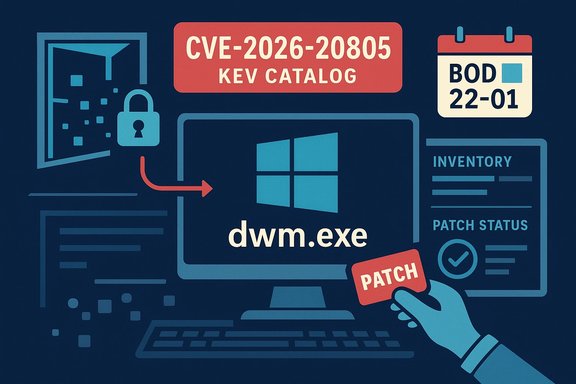
CISA has added a Microsoft Windows information‑disclosure vulnerability tracked as CVE‑2026‑20805 to its Known Exploited Vulnerabilities (KEV) Catalog, citing evidence of active exploitation and triggering urgent remediation expectations under Binding Operational Directive (BOD) 22‑01 for federal civilian agencies.
The Cybersecurity and Infrastructure Security Agency’s Known Exploited Vulnerabilities (KEV) Catalog is a living, evidence‑driven list of Common Vulnerabilities and Exposures (CVEs) that CISA has determined are being exploited in the wild. The catalog exists to convert observed exploitation into operational priorities: when a CVE appears on KEV, Federal Civilian Executive Branch (FCEB) agencies must remediate or document compensating controls by the deadline CISA specifies under Binding Operational Directive (BOD) 22‑01. Although BOD 22‑01 is legally binding only for FCEB agencies, CISA explicitly urges non‑federal organizations to treat KEV listings as critical priorities for their vulnerability‑management programs. This latest addition — announced on January 13, 2026 — is noteworthy because it affects a central Windows component and is characterized as an information disclosure vulnerability, a class of defects frequently leveraged by attackers to gather secrets, escalate follow‑on attacks, or break isolation guarantees in virtualized or sandboxed environments.
Recommended immediate actions for defenders:
Strengths of this approach:
Source: CISA CISA Adds One Known Exploited Vulnerability to Catalog | CISA
 Background
The Cybersecurity and Infrastructure Security Agency’s Known Exploited Vulnerabilities (KEV) Catalog is a living, evidence‑driven list of Common Vulnerabilities and Exposures (CVEs) that CISA has determined are being exploited in the wild. The catalog exists to convert observed exploitation into operational priorities: when a CVE appears on KEV, Federal Civilian Executive Branch (FCEB) agencies must remediate or document compensating controls by the deadline CISA specifies under Binding Operational Directive (BOD) 22‑01. Although BOD 22‑01 is legally binding only for FCEB agencies, CISA explicitly urges non‑federal organizations to treat KEV listings as critical priorities for their vulnerability‑management programs. This latest addition — announced on January 13, 2026 — is noteworthy because it affects a central Windows component and is characterized as an information disclosure vulnerability, a class of defects frequently leveraged by attackers to gather secrets, escalate follow‑on attacks, or break isolation guarantees in virtualized or sandboxed environments.What CISA announced (summary)
- CISA added one vulnerability to the KEV Catalog on January 13, 2026: CVE‑2026‑20805, described as a Microsoft Windows information disclosure vulnerability.
- The agency cited evidence of active exploitation as the reason for listing the CVE and reminded agencies of the remediation requirements under BOD 22‑01.
- CISA urged all organizations — not only federal agencies — to prioritize remediation of KEV items as part of sound vulnerability‑management practice.
Technical overview: what kind of flaw is CVE‑2026‑20805?
CISA’s public notice lists CVE‑2026‑20805 as an information disclosure issue in Microsoft Windows. Public technical trackers and vendor analyses that examined related Desktop Window Manager (DWM) issues describe how graphical/compositing subsystems can inadvertently expose memory contents or other sensitive information when they mishandle buffers, uninitialized resources, or inter‑process communication (IPC) objects. Independent vulnerability analysts have documented comparable DWM‑class flaws in recent months and years, where local or low‑privilege processes could read kernel or privileged process memory through crafted UI operations, leaking secrets such as authentication tokens, cryptographic material, or other sensitive data. One analyst summary that reviewed January patch and advisory material notes this CVE allows an unauthorized actor to access sensitive information via the Desktop Window Manager (DWM) component and rates the practical impact as disclosure of confidential data — a condition that can materially assist subsequent exploitation such as privilege escalation or sandbox escape. This fits a recurring pattern seen in DWM advisories where confidentiality, rather than immediate code execution, is the principal risk. Caveat: some public vulnerability databases and feeds show adjacent CVE identifiers with overlapping descriptions (DWM issues, use‑of‑uninitialized resource, or untrusted pointer dereference). Where multiple CVEs touch the same component, precise mapping of the CVE identifier to Microsoft bulletin numbers and KBs is essential before taking remediation actions. When in doubt, match installed KB/build numbers against vendor guidance.Why information disclosure in Windows DWM matters
- High‑value targets: Desktop Window Manager runs continuously and handles composited contents for many processes. If an attacker can obtain window contents or memory exposed by DWM, the value of leaked information is high — passwords, session tokens, cryptographic keys, or fragments of other processes’ memory can substantially lower the bar for lateral movement or persistence.
- Sandbox/container escape risk: In modern desktops, browser renderer processes, sandboxed apps, and virtualization/container environments partially rely on the integrity of user‑mode compositing to maintain isolation. Information leakage from a shared compositor can be combined with other primitives to break isolation. Security researchers have repeatedly shown that information disclosure is frequently the first step in more severe attacks, enabling targeted exploitation that bypasses mitigations like ASLR or control‑flow integrity.
- Low interaction and broad exposure: Many information‑disclosure bugs in UI subsystems can be triggered by any application that is permitted to create windows — a common capability. Where a bug has low prerequisites (an app that can draw a window is sufficient), exploitability increases across user processes, and thus across hosted environments such as virtual desktops or multi‑tenant services. Public reporting about similar DWM flaws has emphasized the low bar for triggering the issue.
Confirming specifics and recommended immediate actions
When a CVE is added to KEV, the concrete operational steps differ depending on whether a vendor patch is already available and on the vulnerability’s age. For CVE‑2026‑20805, the public record (CISA advisory + independent trackers) indicates active exploitation and places this entry squarely into the category of immediate priorities.Recommended immediate actions for defenders:
- Identify affected systems. Inventory Windows endpoints and servers by OS build and installed KBs; map any DWM‑related KB or MSRC bulletin IDs to installed systems. If a centralized inventory isn’t available, query with tools like SCCM/Intune, or run WMI/PowerShell queries to collect build/KV information. Do this first to scope the problem quickly.
- Apply vendor updates immediately where available. If Microsoft shipped security updates addressing CVE‑2026‑20805 or related DWM fixes, prioritize their deployment to vulnerable hosts. Test on a small cohort before wide rollout only when necessary; otherwise, roll out to all at‑risk systems quickly under emergency change controls. Public trackers and vendor patch notes should be matched to installed KB numbers.
- Implement compensating controls if patching is delayed. Where emergency patching is infeasible, consider:
- Restricting which user accounts may run untrusted GUI applications.
- Enforcing strict application allow‑listing for workstations that face high risk.
- Isolating critical workloads that should not host untrusted user apps (VDI, terminal servers) into segmented network zones.
- Tightening EDR/endpoint policies to block or log suspicious attempts to spawn UI processes in contexts where they normally shouldn’t appear.
- Hunt for indicators of exploitation. Information‑disclosure exploitation may leave limited direct artifacts, but defenders should hunt for:
- Unusual processes that create windows from low‑privilege accounts.
- Anomalous calls to relevant IPC or DWM‑associated APIs from non‑standard processes.
- Recent privilege‑escalation attempts or subsequent lateral‑movement activity that could combine with disclosure. Use EDR telemetry, Sysmon, or Microsoft Defender for Endpoint detections to correlate suspicious events.
- Document and report. Under BOD 22‑01, FCEB agencies must document remediation or compensating controls within the specified timeline. Even for private organizations, documenting decisions and timelines is critical for incident management and insurance/regulatory reasons.
Detection and hunting: practical signals to watch
- Process‑to‑window mappings: Monitor for unexpected processes creating or manipulating top‑level windows (create window, set window text, set window position). Aggressive attacks against DWM often involve manipulated window content flows.
- ALPC and IPC monitoring: Watch for unusual ALPC (Advanced Local Procedure Call) or user‑mode IPC traffic patterns involving dwm.exe. Tools that can capture and analyze ALPC activity or process call graphs can help. Note that high‑volume IPC from untrusted processes warrants scrutiny.
- Memory access patterns: Look for anomalous calls to APIs that read process memory or capture window content (for instance, calls resembling ReadProcessMemory, PrintWindow semantics used by off‑screen rendering). EDRs that instrument API calls and stack traces will be more effective than simple process‑name whitelists.
- Post‑disclosure indicators: Since information disclosure frequently precedes privilege escalation or lateral movement, search for signs of follow‑on behavior (sudden creation of privileged services, attempts to write to %windir% or system directories, unusual scheduled tasks, or unexpected credential dumping).
How KEV and BOD 22‑01 change operational priorities
CISA’s KEV process is designed to shorten the time between observed exploitation and remediation deadlines. For CVEs enumerated after 2021, the directive typically sets accelerated remediation windows (often measured in days or weeks) for federal agencies, though CISA may specify alternate timelines in high‑urgency cases.Strengths of this approach:
- Forces prioritization: KEV transforms threat intelligence into a concrete schedule, forcing organizations to allocate resources to the highest‑risk items instead of letting them languish in lower‑priority queues.
- Reduces window of exposure: By accelerating remediation timelines, KEV aims to shrink the period in which attackers can exploit widely known, unpatched flaws.
- Public signal: Inclusion in KEV is a strong, public, and unambiguous signal about active exploitation — useful for boards, CISOs, and third‑party risk teams that need to escalate fixes.
- Operational strain: Sudden KEV additions can overwhelm patching teams, especially when multiple high‑impact CVEs appear in short succession. This risk is acute for organizations with slow change windows, complex test matrices, or heavy legacy dependencies.
- Potential for incomplete coverage: KEV lists are evidence‑driven and therefore conservative — they include CVEs where exploitation is confirmed. That means other exploited or exploitable issues might not yet be listed, and organizations must maintain broader vulnerability hygiene beyond KEV items.
- False confidence from listing alone: KEV focuses on the presence of active exploitation and available fixes; it does not replace a full risk assessment. Blindly treating KEV entries as the only priorities risks neglecting environmental context (e.g., a KEV item that affects an unsupported product not present in a given network can still distract teams).
- Timing and verification frictions: In practice, matching KEV CVE IDs to local KB numbers and vendor fix IDs is non‑trivial. Inconsistent or changing vendor advisories, overlapping CVEs, and rapidly updated feeds make accurate mapping essential before broad enforcement.
Patch testing and rollout strategy for Windows environments
- Map CVE → KB → build. Before large‑scale deployment, identify the Microsoft KB articles that address CVE‑2026‑20805 and confirm the targeted builds and platform coverage. If Microsoft’s bulletin lists multiple KBs (for different Windows 10/11/Server channels), assemble a matrix for each environment.
- Stage updates in canary groups. Use a small but representative canary cohort (diverse hardware, key endpoint protection agents installed) to validate that the security update does not cause regressions in printing, graphics, or virtualization—areas historically sensitive to DWM changes.
- Prioritize critical services. After canary success, roll updates to:
- Domain controllers (if affected)
- VDI/remote desktop hosts
- Servers running multi‑user desktop workloads
- Development VMs and systems used for credential storage
- Coordinate reboot windows. Many Windows updates require reboots. Coordinate patching with business units to minimize operational disruption and use maintenance channels (SCCM/Intune) to orchestrate reboots.
- Post‑patch verification. Validate via telemetry that expected memory leaks, API call patterns, or other pre‑patched suspicious behaviors cease and that no new errors are appearing in Application/System event logs related to dwm.exe or dependent drivers.
- Document exceptions and compensations. For any systems that cannot be patched within the KEV timelines, document the compensating controls in a formal remediation plan and maintain increased detection/segmentation for those assets.
Longer‑term implications and strategic lessons
- Surface‑area reduction pays off. Reducing the number of processes and services allowed to run on workstations and servers — especially unauthorized UI‑capable apps — lowers exposure to DWM‑class attacks. Application allow‑listing and least‑privilege execution models are effective long‑term mitigations.
- Invest in telemetry that matters. Basic patching is necessary but not sufficient; organizations need EDR and observability that capture API‑level behavior, IPC usage, and window‑creation patterns to detect the subtle activity that precedes or accompanies information disclosure attacks.
- Vendor coordination is crucial. KEV listings accelerate timelines; vendors and integrators must provide clear, consistent mapping between CVEs, KBs, and update identifiers so operators can act without guesswork. Ambiguity in vendor advisories increases the chance of incorrect or missed remediations.
- Policy readiness matters. Organizations with established emergency change processes, frequent patch cycles, and automated deployment pipelines will be best positioned to meet the operational demands imposed by KEV additions. For others, KEV items expose capability gaps that require investment.
Critical analysis: strengths, blind spots, and recommendations
Strengths of CISA’s KEV approach:- Forces a measurable timeline onto real threats and helps prioritize scarce patching capacity.
- Improves alignment between threat intelligence and operational response.
- Provides a public, authoritative signal that vendors, integrators, and boards can use to justify emergency resources.
- KEV is reactive by design; it lists confirmed exploitation. Organizations that use KEV as their sole prioritization source risk missing active but unlisted threats.
- Rapid enforcement may exacerbate change‑control failures, causing business disruption when patches are not tested.
- Mapping between CVE IDs and vendor KBs remains a persistent operational challenge that introduces human error during emergency patching.
- Treat KEV as a top‑tier signal but maintain an independent risk‑based vulnerability program that also triages unlisted but high‑impact flaws.
- Build and exercise emergency patch playbooks, including rapid canarying, telemetry checks, and rollback procedures.
- Improve supplier/vendor communication channels to ensure timely, unambiguous translation of CVE→KB mappings.
Practical checklist (for immediate use)
- Apply the Microsoft security update(s) that address CVE‑2026‑20805 to all affected Windows hosts immediately, following a staged rollout and canary testing.
- If an immediate patch is not available or cannot be deployed, implement compensating controls: restrict execution of untrusted GUI apps, segment VDI environments, and increase EDR vigilance.
- Hunt proactively for suspicious window‑creation from untrusted processes, anomalous ALPC/IPC calls involving dwm.exe, and any follow‑on privilege escalation activity.
- Document remediation actions and, for federal entities, complete BOD 22‑01 reporting requirements by the deadline specified by CISA.
Conclusion
CISA’s January 13, 2026 listing of CVE‑2026‑20805 in the KEV Catalog sharpens a clear operational imperative: prioritize remediation for this Microsoft Windows information‑disclosure vulnerability now. The risk is tangible — information leaks from a compositor like Desktop Window Manager can materially facilitate follow‑on compromise, sandbox escape, or privilege escalation. CISA’s KEV addition provides the public signal and regulatory muscle to accelerate fixes, but the real work falls to IT and security teams: inventory accurately, test quickly, patch decisively, and tune detection to spot the subtle activity that often precedes and follows disclosure‑type exploits. Organizations that combine rapid patching with strengthened telemetry, application allow‑listing, and robust incident documentation will be best placed to absorb KEV‑level shocks while protecting critical services and data.Source: CISA CISA Adds One Known Exploited Vulnerability to Catalog | CISA
