

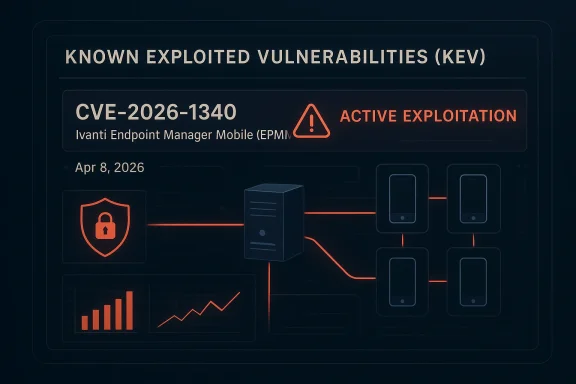
CISA’s latest addition to the Known Exploited Vulnerabilities Catalog is a reminder that the agency still sees active exploitation as the best signal for urgency, not just theoretical severity. On April 8, 2026, CISA added CVE-2026-1340, a code injection vulnerability in Ivanti Endpoint Manager Mobile (EPMM), to the KEV list because it is being used in the wild. That matters because KEV entries are not mere advisories; they are operational alarms that push defenders to act quickly, especially in federal environments bound by BOD 22-01. The update also reinforces a pattern we have seen repeatedly across Ivanti products: exposed management platforms continue to attract attackers because they sit close to the crown jewels of enterprise mobility and device control.
The Known Exploited Vulnerabilities Catalog was created to solve a problem that has only gotten worse over time: organizations were drowning in CVEs, but most of them never turned into real-world attacks. CISA’s BOD 22-01 turned that catalog into a living priority list, requiring Federal Civilian Executive Branch agencies to remediate listed items by specified deadlines. The logic is simple and brutally practical: if adversaries are already exploiting a flaw, then every day of delay is another day of unnecessary exposure. CISA’s own guidance says the catalog is meant to focus attention on vulnerabilities that have crossed the line from potential risk to active threat.
That operational framing is why KEV has become influential well beyond the federal government. Many private-sector security teams now treat it as a shorthand for “patch now, sort out the paperwork later,” because the catalog reduces noise and compresses decision-making. In a world where patch backlogs are common and asset inventories are imperfect, a list based on confirmed exploitation is far more actionable than a long spreadsheet of theoretical exposure. That is especially true for internet-facing systems and administrative platforms, where exploitation can move from first touch to persistence in hours rather than weeks.
Ivanti has occupied an uncomfortable place in that story for years. Its endpoint and mobility management products are deeply useful, but they are also highly attractive targets because they often sit inside trusted administrative zones. Once an attacker reaches an EPMM server, they are not merely poking at a user-facing app; they are probing the machinery that can manage devices, credentials, policies, and access. CISA has previously documented exploitation of Ivanti EPMM issues, including the 2025 pair that led to a malware analysis report and KEV inclusion. That history gives this new entry more weight than a standalone bulletin would deserve.
The April 8 action also fits a broader 2025-2026 trend: attackers are favoring reliable footholds over flashy one-off bugs. Code injection, deserialization, authentication bypass, and management-plane flaws keep showing up because they scale well across fleets and often deliver privileged access. In practice, that means the biggest risk is not simply whether a vulnerability exists, but whether it sits in software that organizations trust enough to expose widely and update slowly. Ivanti EPMM is exactly that kind of software.
CISA also repeated its standing warning that BOD 22-01 applies directly to FCEB agencies but should inform all organizations’ vulnerability management practices. That distinction is important. Federal agencies have an obligation to remediate by the deadline, while everyone else has a strong incentive to do the same, especially if they run the same product in a similar trust zone. The message is consistent across CISA’s KEV releases: once exploitation is confirmed, the risk calculus shifts immediately.
It is also worth noting that CISA’s KEV process is deliberately conservative. The catalog is not meant to be exhaustive; it is meant to be useful. By limiting entries to vulnerabilities with evidence of exploitation, CISA gives defenders a smaller but higher-confidence list to prioritize. That design is one reason the catalog has become such a common reference point for enterprise patch governance.
Ivanti’s own May 2025 security update said the EPMM issue at that time affected only the on-prem product and that the company was aware of a limited number of customers whose solutions had been exploited. A January 2026 update again warned of another EPMM security issue, and Ivanti said the problem affected only the on-prem deployment. That history suggests an uncomfortable but familiar pattern: on-prem management software remains a favorite target because it often has deep network reach and slower patch adoption than cloud services.
The recurring Ivanti theme also tells us something about defender behavior. Many organizations can patch consumer endpoints quickly, but management servers are harder. They may require change windows, validation, coordination with business owners, or even migration planning. That delay is understandable, but it is also precisely what makes management-plane vulnerabilities so valuable to attackers.
That is why KEV has become so influential in enterprise environments. CVSS scores tell you how bad a bug could be; KEV tells you whether attackers have already decided it is worth using. That difference is critical when resources are limited. A vulnerability can be dangerous in theory, but only an exploited vulnerability is a ticking clock.
Organizations that have already built KEV-driven patch workflows are in a much better position. Those that still treat every vulnerability as an equal ticket will struggle, because a live exploitation event demands a different cadence. The best programs do not just patch faster; they make the exception path smaller, the asset inventory cleaner, and the verification steps clearer.
That risk is amplified in organizations with hybrid environments, where mobile devices, remote work, and privileged admin tools are tightly coupled. If a management server is compromised, the attacker can often pivot toward identity systems or enrollment services that were never meant to be public-facing. That makes exposure management a board-level concern, not just a systems-administration chore.
The enterprise response should therefore be layered. Patch first, yes, but also examine whether the platform participated in credential handling, device enrollment, or privileged workflow automation. If attackers touched those functions, the blast radius may include more than one server. That is the hidden tax of management-plane compromise.
For end users, the most important point is that the remediation burden falls on the organization, not the individual. That can be a strength if the IT team moves quickly, but it can also be a weakness if the patch cycle is slow or if the vulnerable instance is not well inventoried. Consumers rarely see the server side of the problem, which is exactly why they are vulnerable to its consequences.
The broader consumer lesson is that managed-device security depends on the invisible layers behind it. Users may trust that a phone is safe because it is enrolled and supervised, but that trust only holds if the management server itself is healthy. This is one reason why KEV entries in enterprise software can have consumer-facing consequences without ever touching a browser tab on the user’s machine.
For Ivanti, the challenge is not just fixing vulnerabilities quickly but convincing customers that the platform is safe to keep in the center of device governance. That is a difficult message to sustain when the product keeps appearing in high-priority security alerts. Vendors in adjacent markets—mobile device management, unified endpoint management, and identity-adjacent tooling—will benefit if customers decide they want simpler architectures or cloud-managed alternatives.
At the same time, the market should not overcorrect into simplistic vendor shaming. On-prem management systems are inherently hard to secure because they combine privileged access, broad deployment, and operational complexity. The real question is whether vendors can provide shorter fix cycles, better hardening guidance, and clearer telemetry so that customers can move from detection to action faster.
The 2025 EPMM case is especially instructive because CISA analyzed malware that followed exploitation of earlier Ivanti flaws. That means attackers were not stopping at initial access; they were building persistence and using the environment for deeper operations. Any new code injection issue in the same product family should therefore be interpreted through that lens.
That is also why organizations should not wait for a flood of public reporting before acting. By the time a vulnerability lands in KEV, the offensive community already has a strong incentive to test it at scale. In practical terms, the best time to remediate is now, not after the next incident report lands.
The third job is to make sure the remediation process itself does not create new risk. Management servers are often fragile because they integrate with certificates, identity providers, device enrollment, and policy enforcement. A rushed change without validation can break business workflows, so organizations need a short but disciplined playbook rather than an improvised patch scramble.
Another concern is normalization. When KEV notices arrive frequently, teams can start treating them as background noise rather than urgent action items. That mindset is dangerous, because a KEV entry usually means the attack ecosystem has already moved from curiosity to operational use.
For enterprises, the next few days matter most. Teams should verify whether they run EPMM, determine whether it is exposed, and confirm whether remediation or containment is underway. They should also look for evidence of prior abuse, because a KEV designation means the risk is not just future-facing; it may already be present in the environment.
Source: CISA CISA Adds One Known Exploited Vulnerability to Catalog | CISA
 Background
The Known Exploited Vulnerabilities Catalog was created to solve a problem that has only gotten worse over time: organizations were drowning in CVEs, but most of them never turned into real-world attacks. CISA’s BOD 22-01 turned that catalog into a living priority list, requiring Federal Civilian Executive Branch agencies to remediate listed items by specified deadlines. The logic is simple and brutally practical: if adversaries are already exploiting a flaw, then every day of delay is another day of unnecessary exposure. CISA’s own guidance says the catalog is meant to focus attention on vulnerabilities that have crossed the line from potential risk to active threat.That operational framing is why KEV has become influential well beyond the federal government. Many private-sector security teams now treat it as a shorthand for “patch now, sort out the paperwork later,” because the catalog reduces noise and compresses decision-making. In a world where patch backlogs are common and asset inventories are imperfect, a list based on confirmed exploitation is far more actionable than a long spreadsheet of theoretical exposure. That is especially true for internet-facing systems and administrative platforms, where exploitation can move from first touch to persistence in hours rather than weeks.
Ivanti has occupied an uncomfortable place in that story for years. Its endpoint and mobility management products are deeply useful, but they are also highly attractive targets because they often sit inside trusted administrative zones. Once an attacker reaches an EPMM server, they are not merely poking at a user-facing app; they are probing the machinery that can manage devices, credentials, policies, and access. CISA has previously documented exploitation of Ivanti EPMM issues, including the 2025 pair that led to a malware analysis report and KEV inclusion. That history gives this new entry more weight than a standalone bulletin would deserve.
The April 8 action also fits a broader 2025-2026 trend: attackers are favoring reliable footholds over flashy one-off bugs. Code injection, deserialization, authentication bypass, and management-plane flaws keep showing up because they scale well across fleets and often deliver privileged access. In practice, that means the biggest risk is not simply whether a vulnerability exists, but whether it sits in software that organizations trust enough to expose widely and update slowly. Ivanti EPMM is exactly that kind of software.
What CISA Actually Said
CISA’s announcement is short, but its implications are substantial. The agency says it added one new vulnerability to the KEV Catalog based on evidence of active exploitation, and the vulnerability is CVE-2026-1340 in Ivanti Endpoint Manager Mobile (EPMM). That single sentence is enough to move the issue from “vendor patch” to “defensive priority,” because KEV status means the flaw is no longer hypothetical. It is already being used, which in turn changes how security teams should rank and schedule remediation.CISA also repeated its standing warning that BOD 22-01 applies directly to FCEB agencies but should inform all organizations’ vulnerability management practices. That distinction is important. Federal agencies have an obligation to remediate by the deadline, while everyone else has a strong incentive to do the same, especially if they run the same product in a similar trust zone. The message is consistent across CISA’s KEV releases: once exploitation is confirmed, the risk calculus shifts immediately.
Why the wording matters
The phrase “evidence of active exploitation” is doing a lot of work here. CISA is not merely responding to a vendor advisory, a high CVSS score, or an abstract proof-of-concept demonstration. It is signaling that defenders should assume the vulnerability is part of an operational attack path right now. That makes the alert more actionable than a generic patch notice and more urgent than an ordinary severity-based ranking.It is also worth noting that CISA’s KEV process is deliberately conservative. The catalog is not meant to be exhaustive; it is meant to be useful. By limiting entries to vulnerabilities with evidence of exploitation, CISA gives defenders a smaller but higher-confidence list to prioritize. That design is one reason the catalog has become such a common reference point for enterprise patch governance.
Why Ivanti EPMM Keeps Reappearing
Ivanti Endpoint Manager Mobile is the kind of product attackers love because it centralizes control. It is used to manage mobile fleets, enforce policy, and connect user devices to enterprise systems, which means compromise can expose a broad operational surface. When a flaw appears in a management plane like that, the blast radius is often larger than the product name suggests. In other words, the target is not the app itself; it is the trust that the app controls.Ivanti’s own May 2025 security update said the EPMM issue at that time affected only the on-prem product and that the company was aware of a limited number of customers whose solutions had been exploited. A January 2026 update again warned of another EPMM security issue, and Ivanti said the problem affected only the on-prem deployment. That history suggests an uncomfortable but familiar pattern: on-prem management software remains a favorite target because it often has deep network reach and slower patch adoption than cloud services.
The management-plane problem
Management tools are not ordinary applications. They are often trusted by identity systems, enrolled devices, and administrators who need broad access to keep fleets running. That trust is exactly why attackers focus on them. A code injection flaw in EPMM is especially dangerous because it can translate into execution on a system that already has privileged access to enterprise workflows.The recurring Ivanti theme also tells us something about defender behavior. Many organizations can patch consumer endpoints quickly, but management servers are harder. They may require change windows, validation, coordination with business owners, or even migration planning. That delay is understandable, but it is also precisely what makes management-plane vulnerabilities so valuable to attackers.
- EPMM sits close to the control plane for mobile fleets.
- On-prem deployments create patching and validation friction.
- Privileged access makes code injection more dangerous than a normal app bug.
- Compromise can cascade into device, policy, and credential exposure.
- Past Ivanti exploitation has already trained attackers to look here first.
How KEV Changes the Response Model
Once a vulnerability lands in KEV, the response model changes in three ways. First, defenders should treat it as a known exploitation event, not just a software defect. Second, remediation should move ahead of most other backlog items unless there is a stronger operational justification. Third, security teams should consider whether exposure already existed long enough for scanning, follow-on activity, or persistence to occur.That is why KEV has become so influential in enterprise environments. CVSS scores tell you how bad a bug could be; KEV tells you whether attackers have already decided it is worth using. That difference is critical when resources are limited. A vulnerability can be dangerous in theory, but only an exploited vulnerability is a ticking clock.
Patch priority versus patch workload
The practical challenge is not figuring out whether CVE-2026-1340 matters. It clearly does. The challenge is translating that urgency into a change process that can survive the realities of enterprise operations. Teams need to know which EPMM instances are exposed, who owns them, what version they are running, and whether a patch or compensating control is available.Organizations that have already built KEV-driven patch workflows are in a much better position. Those that still treat every vulnerability as an equal ticket will struggle, because a live exploitation event demands a different cadence. The best programs do not just patch faster; they make the exception path smaller, the asset inventory cleaner, and the verification steps clearer.
- Confirm whether EPMM is deployed on-prem.
- Identify the exact version and patch level.
- Prioritize internet-facing or externally reachable instances.
- Check for suspicious requests, webshells, or abnormal admin behavior.
- Validate whether a recovery or rollback plan exists before changing production systems.
Enterprise Impact
For enterprises, the most immediate risk is that EPMM may be part of a broader device-management stack with significant downstream dependencies. A weakness in that stack can undermine fleet policy, authentication assumptions, and endpoint posture. In other words, an exploit against EPMM may have consequences far beyond the server itself.That risk is amplified in organizations with hybrid environments, where mobile devices, remote work, and privileged admin tools are tightly coupled. If a management server is compromised, the attacker can often pivot toward identity systems or enrollment services that were never meant to be public-facing. That makes exposure management a board-level concern, not just a systems-administration chore.
What security teams should assume
Security teams should assume that any exposed EPMM instance is now a high-value target. They should also assume that exploitation may have begun before internal awareness, especially if the system was reachable from the internet. Finally, they should assume that patching alone is not enough unless they also review logs and hunt for signs of abuse.The enterprise response should therefore be layered. Patch first, yes, but also examine whether the platform participated in credential handling, device enrollment, or privileged workflow automation. If attackers touched those functions, the blast radius may include more than one server. That is the hidden tax of management-plane compromise.
- Inventory every Ivanti EPMM deployment.
- Check whether the server is internet-exposed.
- Review administrator activity around the disclosure window.
- Correlate EPMM logs with identity and VPN logs.
- Rotate credentials if compromise is suspected.
- Validate that any patching did not leave services misconfigured.
Consumer and Endpoint Risk
Consumer users may not interact directly with EPMM, but they can still be affected through the devices their employers manage. The product’s role in fleet governance means that a single vulnerable server can influence how phones and tablets are enrolled, monitored, and secured. That is why this is one of those cases where enterprise risk can quietly become endpoint risk.For end users, the most important point is that the remediation burden falls on the organization, not the individual. That can be a strength if the IT team moves quickly, but it can also be a weakness if the patch cycle is slow or if the vulnerable instance is not well inventoried. Consumers rarely see the server side of the problem, which is exactly why they are vulnerable to its consequences.
Why this matters even off the corporate network
Mobile management systems are designed to extend security beyond the office. When they fail, the failure can follow the user everywhere. If an attacker gains access to management infrastructure, they may be able to tamper with device policy, investigate enrolled assets, or create conditions for later compromise. That makes the attack surface persist even when the endpoint is physically elsewhere.The broader consumer lesson is that managed-device security depends on the invisible layers behind it. Users may trust that a phone is safe because it is enrolled and supervised, but that trust only holds if the management server itself is healthy. This is one reason why KEV entries in enterprise software can have consumer-facing consequences without ever touching a browser tab on the user’s machine.
- Managed devices inherit the security of the management plane.
- Compromise can affect policy, enrollment, and trust settings.
- Users often have no direct visibility into the server-side issue.
- Delayed patching can create a silent exposure window.
- A “corporate” vulnerability can still become a personal security problem.
Competitive and Market Implications
This kind of CISA update also has market consequences. When a vendor’s product repeatedly appears in KEV, buyers notice. Procurement teams may ask tougher questions about patch cadence, security architecture, cloud versus on-prem deployment, and the vendor’s history of rapid remediation. In that sense, active exploitation becomes a reputation issue as much as a technical one.For Ivanti, the challenge is not just fixing vulnerabilities quickly but convincing customers that the platform is safe to keep in the center of device governance. That is a difficult message to sustain when the product keeps appearing in high-priority security alerts. Vendors in adjacent markets—mobile device management, unified endpoint management, and identity-adjacent tooling—will benefit if customers decide they want simpler architectures or cloud-managed alternatives.
The trust premium in enterprise software
Enterprise software lives or dies on trust. When a management platform is exploited, the damage is not limited to the bug itself; it can affect the willingness of customers to rely on the product for critical workflows. That is why security teams increasingly treat exploitation history as a buying criterion, not just a patching concern.At the same time, the market should not overcorrect into simplistic vendor shaming. On-prem management systems are inherently hard to secure because they combine privileged access, broad deployment, and operational complexity. The real question is whether vendors can provide shorter fix cycles, better hardening guidance, and clearer telemetry so that customers can move from detection to action faster.
- Repeated KEV appearances can affect procurement decisions.
- Customers may compare on-prem and cloud management risk differently.
- Security posture increasingly influences vendor reputation.
- Faster disclosure and clearer mitigations can reduce market fallout.
- Product trust depends on both patch speed and operational guidance.
How This Fits the Broader Ivanti Pattern
Ivanti has already lived through multiple public security crises, and that history matters because threat actors learn from it too. Once a vendor’s management platform becomes known as a lucrative target, future exploit development tends to arrive faster. CISA’s earlier reporting on EPMM exploitation showed how a single management flaw can become a real intrusion path, not just a theoretical risk.The 2025 EPMM case is especially instructive because CISA analyzed malware that followed exploitation of earlier Ivanti flaws. That means attackers were not stopping at initial access; they were building persistence and using the environment for deeper operations. Any new code injection issue in the same product family should therefore be interpreted through that lens.
Why history changes the threat model
Historical exploitation changes the defender’s assumptions. If a product has already been used as an entry point before, then a new KEV listing is not just “another bug.” It is evidence that adversaries still see strategic value in the same platform surface. That increases the likelihood of follow-on exploit attempts, opportunistic scanning, and faster public weaponization.That is also why organizations should not wait for a flood of public reporting before acting. By the time a vulnerability lands in KEV, the offensive community already has a strong incentive to test it at scale. In practical terms, the best time to remediate is now, not after the next incident report lands.
- Ivanti management products have a known track record of attacker interest.
- Prior exploitation lowers the threshold for future campaign activity.
- Malware analysis often follows, not precedes, real-world abuse.
- New KEV entries should be treated as an escalation, not routine noise.
- Product history is part of the risk score whether buyers like it or not.
What Remediation Should Look Like
The response to this KEV entry should be precise, fast, and boring in the best possible way. If you run Ivanti EPMM, the first job is to confirm exposure and apply the vendor’s latest guidance as soon as it is available. The second job is to check whether the system has already been touched, because active exploitation means you cannot assume the issue is purely preventative.The third job is to make sure the remediation process itself does not create new risk. Management servers are often fragile because they integrate with certificates, identity providers, device enrollment, and policy enforcement. A rushed change without validation can break business workflows, so organizations need a short but disciplined playbook rather than an improvised patch scramble.
A practical response sequence
- Identify every EPMM deployment and its exposure status.
- Verify the exact product version and patch level.
- Apply the vendor fix or mitigation immediately.
- Review logs for suspicious requests or post-exploitation activity.
- Rotate credentials if there is any sign of compromise.
- Validate device-management and enrollment functions after remediation.
Strengths and Opportunities
The good news is that CISA’s model gives defenders a clear, evidence-based priority signal, and this update reinforces why that matters. A single KEV entry can concentrate executive attention, accelerate patching, and force better inventory discipline. It also gives security teams a strong, externally validated reason to move fast without having to justify every detail from scratch.- High-confidence prioritization instead of guesswork.
- Faster patch decisions for exposed management servers.
- Better executive reporting because active exploitation is easy to explain.
- Improved threat hunting around a known attack path.
- Stronger vendor accountability when products recur in KEV.
- More disciplined asset inventory as teams locate every instance.
- Useful compliance alignment for organizations already tracking KEV.
Risks and Concerns
The biggest concern is that active exploitation shortens the defensive timeline dramatically. Many organizations still struggle with incomplete inventories, delayed maintenance windows, or unclear ownership of management servers, and those weaknesses can turn a patchable issue into a persistent exposure. Ivanti EPMM is also the kind of product where compromise can have downstream effects on identity, device posture, and enterprise trust.Another concern is normalization. When KEV notices arrive frequently, teams can start treating them as background noise rather than urgent action items. That mindset is dangerous, because a KEV entry usually means the attack ecosystem has already moved from curiosity to operational use.
- Delayed patching expands attacker opportunity.
- Weak inventory leaves vulnerable instances untracked.
- Management-plane compromise can have broad blast radius.
- Insufficient logging makes intrusion harder to prove.
- Patch fatigue can cause teams to underreact.
- Normalizing exploited CVEs dulls urgency over time.
- On-prem complexity can slow the response even when the risk is obvious.
Looking Ahead
Expect CISA to keep using the KEV Catalog as a live pressure signal for defenders, especially for products that sit in privileged infrastructure roles. Ivanti EPMM’s new KEV entry is unlikely to be the last reminder that management software is one of the most attractive places for attackers to seek leverage. If anything, the pace of such alerts suggests the industry still has work to do on exposure management, asset visibility, and patch execution.For enterprises, the next few days matter most. Teams should verify whether they run EPMM, determine whether it is exposed, and confirm whether remediation or containment is underway. They should also look for evidence of prior abuse, because a KEV designation means the risk is not just future-facing; it may already be present in the environment.
- Confirm all Ivanti EPMM instances and versions.
- Check for signs of exploitation around the disclosure window.
- Prioritize internet-exposed systems first.
- Validate logs, credentials, and device-management integrity.
- Tighten patch workflows so KEV items can be handled faster next time.
Source: CISA CISA Adds One Known Exploited Vulnerability to Catalog | CISA
