

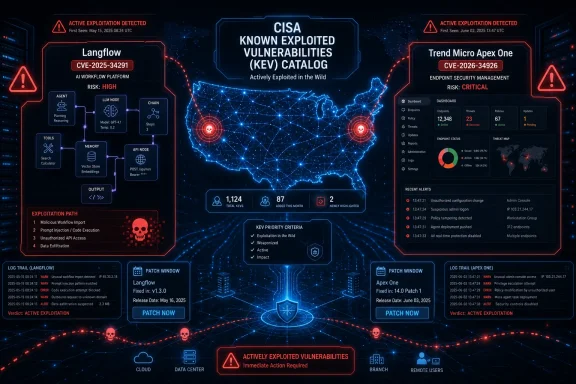
CISA’s Warning Lands Where Enterprises Are Already Stretched
The Known Exploited Vulnerabilities catalog was created for federal civilian agencies, but it has escaped its original bureaucratic container. For many private-sector security teams, a KEV listing is now the difference between “important” and “drop what you are doing.” It means the argument about exploitability is over.
That matters because vulnerability management has become an exercise in triage by exhaustion. Every month brings critical scores, proof-of-concept code, vendor advisories, and scanner noise. CISA’s KEV list cuts through that by saying: this is not merely possible, this is happening.
The two additions are especially telling because they hit different kinds of trust. Langflow is part of the new AI application plumbing, where developers assemble agents, workflows, and integrations at speed. Trend Micro Apex One is defensive infrastructure, the kind of management console many organizations mentally place on the “protective” side of the ledger.
Attackers do not respect that distinction. They look for exposed control planes, credential paths, and management interfaces. Whether the product is helping a developer wire together AI workflows or helping an administrator manage endpoint protection, it becomes attractive the moment it can move an attacker closer to privileged execution or lateral reach.
Langflow Shows the AI Stack Is Becoming Ordinary Attack Surface
CVE-2025-34291 is described as an origin validation error in Langflow, an AI agent and workflow platform used to build and connect language-model-driven applications. The public reporting around the issue has pointed to a dangerous chain: permissive cross-origin behavior, credentialed browser requests, token exposure, and the possibility of authenticated access leading toward remote code execution paths.
The uncomfortable lesson is not that Langflow is uniquely careless. It is that AI tooling is rapidly inheriting all the old web security failures while adding new incentives to expose interfaces quickly. Developer teams want these systems reachable, integrated, and useful; attackers want exactly the same properties.
Origin validation sounds dry until it is the boundary between a trusted session and an attacker-controlled page. If a browser can be tricked into sending credentials cross-origin, and if the application is loose about who may ask for what, a session becomes a bridge. In a tool that can orchestrate workflows and execute components, that bridge can lead far beyond a stolen token.
This is the pattern security teams should care about. AI platforms are not magic boxes floating outside the traditional risk model. They are web applications, API hubs, credential stores, plugin hosts, and often code-execution environments wrapped in a new vocabulary.
The industry spent the last two years treating AI application platforms as productivity infrastructure. The KEV listing is a reminder that attackers are beginning to treat them as exploitation infrastructure.
The Trend Micro Flaw Cuts Closer to the Defensive Bone
CVE-2026-34926 affects Trend Micro Apex One on-premise and is described as a directory traversal vulnerability. Directory traversal is one of the oldest classes of software weakness, but age has not made it harmless. In management software, the ability to reach files outside an intended path can become a staging point for data exposure, configuration abuse, or deeper compromise depending on the implementation.
The affected product category makes the issue more sensitive. Apex One is endpoint protection infrastructure, and its on-premise management console sits in a privileged relationship with the devices it supervises. If attackers can abuse that console, they are not merely attacking another server; they are probing a system designed to control security policy across fleets of Windows machines.
That is why flaws in security products have a different blast radius. A bug in a line-of-business web app may expose one application. A bug in a security management plane can expose assumptions about patching, agent trust, policy distribution, and administrative segmentation.
This does not mean every vulnerable Apex One deployment is automatically compromised. It does mean organizations should resist the instinct to treat security tools as implicitly safer because they are security tools. In practice, they are often among the highest-value systems on the network.
The irony is familiar but still sharp. Defensive products accumulate privileges because they need visibility and control. Those same privileges make them magnets when their own attack surface is neglected.
The KEV Catalog Has Become the Patch Queue Attackers Help Write
BOD 22-01 requires Federal Civilian Executive Branch agencies to remediate KEV-listed vulnerabilities by CISA’s due dates. That is the formal rule. The practical rule for everyone else is simpler: if it is in KEV, assume exploit code, attacker interest, and operational urgency.
The catalog’s power comes from evidence of exploitation, not theoretical severity. Plenty of vulnerabilities carry alarming CVSS scores and never become widely used in attacks. Others look narrower on paper but become favorites because they are exposed, reliable, easy to automate, or common in environments with weak monitoring.
That distinction is critical for WindowsForum’s audience. Most sysadmins do not have infinite maintenance windows. Most security teams cannot immediately patch every critical CVE across every appliance, agent, framework, and internal application. KEV is one of the few public signals that helps prioritize based on adversary behavior rather than vendor adjectives.
Still, KEV should not become a substitute for local context. An internet-facing Apex One console is not the same risk as one isolated behind strong access controls. A Langflow instance used for internal experimentation is not the same as one exposed to users or integrated with production secrets. The catalog tells you attackers are exploiting the class; your architecture tells you how badly that matters today.
The mature response is to combine both signals. KEV says move now. Asset inventory says where.
The Shared Thread Is Control Plane Exposure
The two vulnerabilities are technically different, but they converge around a common enterprise failure: sensitive control planes are too often reachable, under-monitored, and slow to patch. AI workflow platforms and endpoint management consoles both sit above other systems. They are designed to coordinate, invoke, configure, and automate.
That makes them powerful in legitimate hands and efficient in hostile ones. A compromised workflow tool may expose credentials, integrations, or execution paths. A compromised endpoint console may expose management functions, agent relationships, or administrative reach. In both cases, the attacker is not just breaking into a box; they are trying to borrow the authority of a platform.
For years, defenders have hardened perimeter services while leaving internal management surfaces treated as “trusted.” That model is increasingly obsolete. VPNs, identity providers, browser sessions, misconfigured reverse proxies, and contractor access have all blurred the old inside-outside boundary.
The result is that management interfaces need to be treated like production crown jewels. They should be isolated, strongly authenticated, patched aggressively, and logged with the assumption that they will be targeted. Anything less is an invitation to turn administration into exploitation.
This is where the old language of vulnerability management undersells the issue. These are not just missing patches. They are exposures in systems that amplify intent.
Windows Shops Should Read This as More Than a Linux or Web Problem
Langflow may not sound like a traditional Windows administrator’s concern, and directory traversal may sound like web-app territory. That is the wrong reading. Most enterprise compromises are cross-platform by the time defenders notice them.
A vulnerable AI workflow server can hold tokens for cloud services, databases, Git repositories, and internal APIs used by Windows-based business systems. An abused endpoint management console can affect Windows endpoints directly. The operating system boundary is not where the business risk stops.
For Windows-heavy environments, the practical question is whether these systems touch Active Directory, Entra ID, privileged service accounts, endpoint agents, SIEM pipelines, or software deployment workflows. If they do, they belong in the same risk conversation as domain controllers and management servers.
There is also a monitoring angle. Windows environments often have mature telemetry on endpoints but weaker visibility into the Linux appliances, containers, and developer platforms that increasingly drive automation. Attackers know this gap. They will happily compromise the less-watched platform if it gives them a path into the better-watched one.
The defensive move is to stop classifying assets by team ownership and start classifying them by privilege. If a server can issue commands, store secrets, distribute policy, or connect to identity infrastructure, it deserves first-tier treatment no matter who installed it.
The AI Security Conversation Is Finally Leaving the Demo Stage
The Langflow listing is part of a broader shift in how AI security will be discussed in 2026. The early conversation was dominated by prompt injection, model behavior, data leakage, and speculative misuse. Those topics still matter, but attackers also exploit ordinary software bugs in the products teams are using to operationalize AI.
That is less glamorous and more dangerous. A vulnerable AI workflow platform does not require a philosophical debate about whether a model can be persuaded to misbehave. It requires only reachable software, weak validation, valid credentials, and a path to execution.
This is where AI adoption has outpaced governance. Many organizations allowed experimentation first and inventory later. Small teams spun up tools, connected services, embedded tokens, and demonstrated value before security teams had a clean map of where those systems lived.
The KEV listing should prompt a specific internal audit. Not “do we use AI?” but “which AI workflow tools are deployed, who owns them, what identities do they use, what networks can they reach, and how quickly can we patch them?” Those are asset-management questions before they are AI questions.
The companies that answer them now will be less surprised when the next AI platform CVE becomes a KEV entry. The companies that cannot answer them will discover their AI inventory during incident response, which is the most expensive way to build one.
Vendor Advisories Are the Beginning, Not the End
When a vendor publishes a patch, many organizations mentally move the issue from “security risk” to “maintenance task.” KEV listings punish that delay. They arrive when adversaries have already found operational value in the flaw, which means the time between advisory and exploitation may already have collapsed.
That is especially true for internet-exposed systems and popular platforms. Attackers can scan quickly, adapt proof-of-concept code, and fold new checks into existing botnets or intrusion playbooks. A vulnerability does not need to be perfect to be useful; it needs to work often enough against enough neglected systems.
For administrators, the right response is not only to install updates. It is to check exposure, inspect logs, rotate potentially affected credentials, and verify that compensating controls actually exist. Patching closes the door; it does not prove nobody walked through it yesterday.
This is a hard message because it makes vulnerability management feel more like incident response. But that is exactly what a KEV addition implies. Active exploitation changes the burden of proof.
Organizations should assume that vulnerable, exposed instances may have been probed. They should also assume that a clean vulnerability scanner after patching is not a clean bill of health.
The Federal Mandate Keeps Becoming a Private-Sector Standard
BOD 22-01 formally binds federal civilian agencies, but its influence extends well beyond Washington. Cyber insurers, auditors, managed security providers, and enterprise customers increasingly treat KEV as a shorthand for demonstrable negligence. If a vulnerability is known to be exploited and there is available remediation, delay becomes harder to defend.
That does not mean every organization can patch every KEV entry instantly. Legacy dependencies, operational constraints, and uptime requirements are real. But it does mean leadership should understand the risk in plain language: this is not a theoretical weakness waiting for a researcher; this is a vulnerability attackers are already using.
The best private-sector programs treat KEV as a trigger for an accelerated workflow. Asset owners are identified, exposure is checked, emergency changes are approved, and monitoring rules are reviewed. Exceptions require documented compensating controls, not vague assurances.
This is where governance either helps or fails. A good process makes the urgent path easy. A bad process forces security teams to beg for downtime while attackers enjoy the calendar.
The uncomfortable truth is that many organizations still patch according to internal rhythm while attackers operate according to opportunity. KEV is CISA’s attempt to drag the enterprise calendar closer to the adversary’s.
The Practical Work Starts With Finding the Systems
For Langflow, the first challenge may be discovery. Developer platforms often appear outside traditional software inventories, especially when deployed in containers, cloud instances, lab environments, or business-unit sandboxes. Security teams should search for exposed Langflow services, review versions, and identify whether any instances are tied to production credentials or sensitive integrations.
For Apex One, the ownership path is likely clearer but the risk may be more politically sensitive. Security infrastructure is sometimes managed by the same team now being asked to treat its own tools as suspect. That requires discipline. The console’s exposure, patch level, authentication posture, and logs should all be reviewed without assuming that a security product is automatically configured securely.
Network placement is crucial for both. If management consoles or workflow builders are reachable from the public internet, the priority rises sharply. If access is restricted through VPN, identity-aware proxy, administrative jump host, or source allowlisting, risk may be reduced but not erased.
Credential review should also be part of the response. A token-hijacking path in an AI workflow tool raises obvious questions about session tokens, API keys, and downstream secrets. A traversal issue in a management console raises questions about file access, configuration leakage, and whether attackers could have reached sensitive material before patching.
The point is not to panic. It is to move from “we patched the CVE” to “we understand what the vulnerable system could reach.”
The Signal Beneath the Two CVEs
The most important fact about this CISA update is not the count. Two vulnerabilities is a small addition by KEV standards. The signal is in the product categories: AI workflow infrastructure and endpoint security management.
Those are places where enterprises are placing more trust, not less. AI workflow tools are being asked to connect services and accelerate automation. Endpoint platforms are being asked to enforce policy and detect compromise. Both become high-leverage targets because they sit close to the organization’s nervous system.
Attackers favor leverage. They would rather compromise a system that can reach many things than fight one endpoint at a time. They would rather steal a token that unlocks workflows than brute-force a door. They would rather abuse a management interface than deploy noisy malware everywhere.
That is why defenders should view this KEV update as a control-plane warning. The systems that coordinate your environment are increasingly the systems adversaries want first.
The Patch Window Is Now a Credibility Test
CISA’s addition of CVE-2025-34291 and CVE-2026-34926 should trigger a short, concrete response cycle rather than a long internal debate. The most valuable actions are not exotic; they are the fundamentals done quickly and verifiably.
- Organizations using Langflow should identify all deployed instances, confirm whether affected versions are present, update to fixed releases, and review whether exposed services had access to sensitive tokens or execution capabilities.
- Organizations using Trend Micro Apex One on-premise should verify the management console’s patch level, restrict access to administrative interfaces, and inspect relevant logs for suspicious file access or traversal-like activity.
- Internet exposure should be treated as a major risk multiplier for both products, especially where administrative interfaces or developer tools are reachable without tight source restrictions.
- Security teams should rotate credentials and tokens where exploitation could plausibly have exposed session material, API keys, configuration files, or service account secrets.
- Asset inventories should be updated to include AI workflow platforms and security management consoles as high-value control-plane systems, not merely application servers.
- Exceptions to immediate remediation should require documented compensating controls, active monitoring, and a defined expiration date.
This is the kind of work that separates a vulnerability management program from a patch spreadsheet. The spreadsheet records that a CVE existed. The program proves the organization understood what it meant.
The May 21 KEV update is another reminder that enterprise risk is migrating toward the platforms that make everything else easier to manage, automate, and defend. That migration will continue, because businesses want more automation and attackers want more leverage. The organizations that fare best will be the ones that treat AI tools and security consoles with the same suspicion they reserve for exposed VPNs and domain controllers: useful, powerful, and never too trusted to patch fast.