

CISA’s latest addition to the Known Exploited Vulnerabilities (KEV) Catalog is a sharp reminder that software supply chain risk is no longer an abstract concern for security teams. On March 26, 2026, the agency added CVE-2026-33634, described as an Aqua Security Trivy embedded malicious code vulnerability, after citing evidence of active exploitation. That matters because KEV entries are not just another list of bugs; they are operational signals that attackers are already turning a flaw into a real-world intrusion path. For federal agencies, the clock is now running under BOD 22-01; for everyone else, the message is just as urgent: patching can no longer be driven by severity alone. KEV Catalog exists because vulnerability management had become unmanageable at scale. Security teams were drowning in CVEs, but not every CVE was being used by attackers, and the difference between theoretical risk and active risk was often blurred in daily operations. CISA’s answer was to create a living list of vulnerabilities with evidence of exploitation, giving defenders a much sharper signal for triage and remediation. That idea became operationally meaningful when Binding Operational Directive 22-01 required Federal Civilian Executive Branch agencies to remediate listed vulnerabilities by specific deadlines.
That framework is iis not a popularity contest and not a pure severity ranking. A vulnerability can be technically severe, but if it is not being exploited in the wild, it may not demand the same immediate response as a lower-scoring issue already under active attack. CISA has repeatedly emphasized this distinction across its updates, explaining that KEV is a priority source of truth for patch management precisely because it reflects what attackers are doing now rather than what they might do someday.
The new Trivy entry fits a pattern that ly familiar in 2025 and 2026: attackers are focusing on trusted software components that sit close to the software supply chain. In practical terms, that means exploitation is not limited to operating systems, browsers, or network appliances anymore. Tooling that developers rely on to inspect code, containers, and dependencies can itself become part of the attack surface, which raises the stakes for build pipelines, CI/CD workflows, and artifact scanning environments.
This also helps explain why CISA’s wording matters. The agenc issue as a generic Trivy bug, but as an embedded malicious code vulnerability, which strongly suggests the concern goes beyond a normal crash or logic error. When a security tool is implicated in a KEV entry, the implications are broader than one product family: trust, integrity, and pipeline assurance all come under pressure. That is a very different category of risk than a typical application-layer vulnerability.
A high CVSS score is us tell defenders whether attackers are already using the flaw. KEV does, and that is the difference that matters in crowded enterprise environments. For teams juggling patch windows, change-control approvals, and incomplete asset inventories, a confirmed exploited-vulnerability list is much more actionable than a long queue of “important” findings.
The phrase embedded malicious code is especially unsettling because it hints at a scenario where the tool’s integrity is compromised rather than merely misconfigured. That raises the possibility of poisoned inputs, malicious update pathways, or concealed logic that could influence how scans are executed or how results are interpreted. In security operations, that kind of compromise is uniquely damaging because it attacks the trust boundary itself. When the watchdog is suspect, the whole kennel is at risk.
The fact that CISA moved quickly enough to classify the issue as known exploited suggests there is already enough evidence to warrant urgency. That does not necessarily mean every Trivy installation is currently compromised, but it does mean defenders should treat any exposure as immediately actionable. In a world where supply chain security is increasingly measured by integrity, not just availability, a compromised scanner can become a force multiplier for attackers.
This is one reason security platforms are now expected to be trustworthy in a deeper sense than simply “it runs.” Organizations rely on scanners to decide whether to ship, block, or investigate. If a malicious actor can influence that decision ene silent exposure rather than obvious incident noise. That makes KEV designations involving security infrastructure especially serious, because they can undermine the confidence model that modern DevSecOps depends on.
It is also worth noting that the software supply chain has become a battleground for attackers precisely because it offers scale. A compromise at the tooling layer can affect many projects at once, especially where the scanner is baked into automation or shared across teams. In that sense, the new CISA entry aligns with a broader trend: attackers increasingly look for one compromise that creates many outcomes rather than one endpoint at a time.
The practical burden is not simply patching a single host. Agencies must also identify where the tool is embedded into pipelines, where it is mirrored in container images, and where it may be part of a larger automated control stack. Security teams often underestimate how many places a “small” utility can be deployed once it becomes part of enterprise enghat makes inventory discipline as important as the fix itself.
Private companies should treat this as a reminder that security tools deserve the same governance as production applications. Too many organizations still patch endpoint agents and scanners later than customer-facing systems because they believe those tools are just internal utilities. In reality, internal utilities are often the most privileged parts of the environment, and they can sit on the shortest paes, registries, secrets, and release pipelines. Internal does not mean harmless.
The enterprise versus consumer divide is also important here. Consumers are unlikely to interact directly with Trivy in their daily lives, but they absolutely rely on the integrity of the software and services built using it. If a scanner compromise affects developer confidence, that can flow downstream into exposed websites, cloud services, and packaged software that ordinary users install or trust. That is a reminder that supply chain security is consumer security, even when the consumer never sees the tools behind the curtain.
That shift matters because the market for DevSecOps tools has increasingly competed on convenience and integration. The next differentiator may be trustworthiness under adversarial conditions. Vendors that can demonstrate stronger update integrity, better tamper resistance, and cleaner auditability will have a clearer story for enterprise buyers, particularly in regulated environments. That is a subtle but important evolution in product selection criteria.
There is also a broader ecosystem egin treating scanners, SBOM processors, and pipeline utilities as critical infrastructure, it could accelerate adoption of stricter controls such as code signing validation, binary provenance checks, isolated execution, and output attestation. Those controls are not new, but KEV entries involving security tooling make them easier to justify to leadership. The budget line item changes when the risk becomes visible.
The new Trivy entry also creates an opportunity to improve software supply chain hygiene more broadly. Teams can use the alert to audit where scanners are deployed, how their outputs are trusted, and whether update channels are properly controlled. That makes the incident useful beyond the specific CVE because it forces organizations to revisit architecture decisions they may have neglected for years.
There is also a structural risk in the way modern environments are built. Security products are deeply integrated into build systems, policy gates, and artifact registries, which means compromise can be persistent and hard to discover. Even if the affected Trivy deployment is patched, organizations may still need to re-check historical scan results, rebuild artifacts, and verify that any decisions made from compromised output were valid. That sort of cleanup can be expensive and disruptive, but ignoring it can be worse.
There is also a good chance this will influence procurement language. Buyers may ask for stronger assurances around update authenticity, runtime integrity, and output validation, especially in regulated industries where auditability matters. The vendors best positioned to benefit will be those that can prove not only that their products detect problems, but that their products can be trusted under attack pressure. That is a harder promise to make, and a more valuable one to keep.
Source: CISA CISA Adds One Known Exploited Vulnerability to Catalog | CISA
That framework is iis not a popularity contest and not a pure severity ranking. A vulnerability can be technically severe, but if it is not being exploited in the wild, it may not demand the same immediate response as a lower-scoring issue already under active attack. CISA has repeatedly emphasized this distinction across its updates, explaining that KEV is a priority source of truth for patch management precisely because it reflects what attackers are doing now rather than what they might do someday.
The new Trivy entry fits a pattern that ly familiar in 2025 and 2026: attackers are focusing on trusted software components that sit close to the software supply chain. In practical terms, that means exploitation is not limited to operating systems, browsers, or network appliances anymore. Tooling that developers rely on to inspect code, containers, and dependencies can itself become part of the attack surface, which raises the stakes for build pipelines, CI/CD workflows, and artifact scanning environments.
This also helps explain why CISA’s wording matters. The agenc issue as a generic Trivy bug, but as an embedded malicious code vulnerability, which strongly suggests the concern goes beyond a normal crash or logic error. When a security tool is implicated in a KEV entry, the implications are broader than one product family: trust, integrity, and pipeline assurance all come under pressure. That is a very different category of risk than a typical application-layer vulnerability.
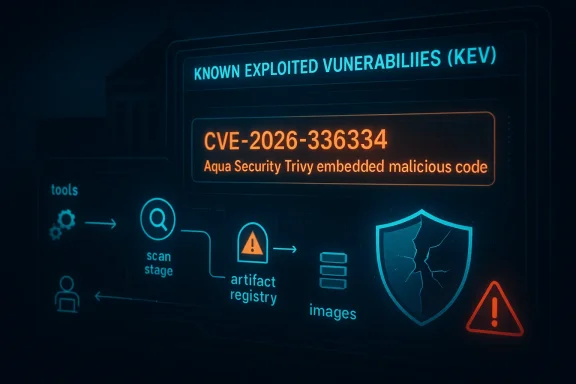 Why KEV entries carry more weight than severity scores
A high CVSS score is us tell defenders whether attackers are already using the flaw. KEV does, and that is the difference that matters in crowded enterprise environments. For teams juggling patch windows, change-control approvals, and incomplete asset inventories, a confirmed exploited-vulnerability list is much more actionable than a long queue of “important” findings.- KEV is evidence-driven, not hypothetical.
- BOD 22-01 creates deadlines for federal remediatio teams** often use KEV as a prioritization shortlist.
- Exploit confirmation compresses the response window dramatically.
- Supply chain software is now squarely part of the active attack surface.
What the New Trivy Entry Suggests
At face value, the listing of CVE-2026-33634 is about a single product: Aqua Security Trivy, the widely used scanner for containers, code repositories, Kubernetes, and cloud environments. But the operational meaning is larger than the product itself. If a vulnerability in a scanning or validation tool is being actively exploited, defenders should immediately ask whether the attacker’s goal is data theft, pipeline tampering, false trust creation, or a pivot into environments that depend on that scanner.The phrase embedded malicious code is especially unsettling because it hints at a scenario where the tool’s integrity is compromised rather than merely misconfigured. That raises the possibility of poisoned inputs, malicious update pathways, or concealed logic that could influence how scans are executed or how results are interpreted. In security operations, that kind of compromise is uniquely damaging because it attacks the trust boundary itself. When the watchdog is suspect, the whole kennel is at risk.
The fact that CISA moved quickly enough to classify the issue as known exploited suggests there is already enough evidence to warrant urgency. That does not necessarily mean every Trivy installation is currently compromised, but it does mean defenders should treat any exposure as immediately actionable. In a world where supply chain security is increasingly measured by integrity, not just availability, a compromised scanner can become a force multiplier for attackers.
Why scanner compromise is different from app compromise
A conventional application flaw usually affects the data or business logic inside one product. A scanner compromise can affect the confidence an organization has in multiple downstream systems, because the scanner’s purpose is to tell teams what is safe and what is not. If that assurance mechanism is tainted, false negatives become a strategic risk, not just an operational annoyance.- Security tooling is privileged by design.
- Pipeline trust can be more valuable than raw system access.
- False assurance is often more dangerous than a visible failure.
- Artifact scanning influences release decisions across teams.
- Compromised findings can mask later-stage persistence.
The Trivy Ecosystem and Its Broader Importance
Trivy has become one of the most recognizable names in modern vulnerability management because it spans so many use cases: container images, file systems, repositories,s environments. That reach is what makes the KEV entry important. A security tool with broad adoption becomes a high-leverage target, and any compromise in its execution path can ripple across development, operations, and compliance workflows.This is one reason security platforms are now expected to be trustworthy in a deeper sense than simply “it runs.” Organizations rely on scanners to decide whether to ship, block, or investigate. If a malicious actor can influence that decision ene silent exposure rather than obvious incident noise. That makes KEV designations involving security infrastructure especially serious, because they can undermine the confidence model that modern DevSecOps depends on.
It is also worth noting that the software supply chain has become a battleground for attackers precisely because it offers scale. A compromise at the tooling layer can affect many projects at once, especially where the scanner is baked into automation or shared across teams. In that sense, the new CISA entry aligns with a broader trend: attackers increasingly look for one compromise that creates many outcomes rather than one endpoint at a time.
Why scanner reach changes the risk equation
Broader adoption means greater blast radius, but it also means more opportunities for defenders to detect unusual behavior. The challenge is that teams often assume security tooling is itself inherently safe, which creates blind spots. When the tool’s role is to identify risk, teams may not scrutinize it with the same intensity they would apply to an application exposed to the internet. That assumption is convenient, but dangerous.- CI/CD integration increases the impact of compromise.
- Shared tooling multiplies exposure across projects.
- Trust assumptions can delay detection.
- Compliance pipelines may inherit bad evidence.
- Operational blind spots can persist longer in security tools than in business apps.
What Federal Agencies Must Do
For Federal Civilian Executive Branch agencies, the significance of a KEV addition is straightforward: if the vulnerability is in scope, it must be remediated by the due date required under BOD 22-01. That is not guidance in the soft sense; it is an operational obligation. Agencies that depeironments where Trivy is installed as part of development, build, or security workflows, will need to verify whether the affected version is present and move quickly on remediation.The practical burden is not simply patching a single host. Agencies must also identify where the tool is embedded into pipelines, where it is mirrored in container images, and where it may be part of a larger automated control stack. Security teams often underestimate how many places a “small” utility can be deployed once it becomes part of enterprise enghat makes inventory discipline as important as the fix itself.
The remediation workflow in practice
A disciplined response usually follows a familiar sequence, and it should begin immediately once a KEV entry is announced:- Confirm exposure across desktops, servers, build agents, and container images.
- Identify the installed Trivy version and compare it with the vendor’s fix guidance.
- Prioritize internet-facing and pipeline-critical systems before lower-risk lab environments.
- Update or replace the vulnerable deployment and verify the new binary or package.
- Review logs and scan results for signs of tampering, unexpected failures, or odd output.
- Asset inventory is the first control.
- Version tracking is the second.
- Ownership clarity is the third.
- Validation after patching is essential.
- Log review should be part of the same workstream.
What Private-Sector Organizations Should Take Away
CISA’s message is not limited to federal agencies, even though the formal deadline mechanism is. The agency has consistently urged all organizations to use KEV as a core input into vulnerability management, and that advice is especially relevant when the affected software is part of the software delivery chain itself. If a malicious actor can influence a scanner, defender behavior may become part of the attacker’s strategy.Private companies should treat this as a reminder that security tools deserve the same governance as production applications. Too many organizations still patch endpoint agents and scanners later than customer-facing systems because they believe those tools are just internal utilities. In reality, internal utilities are often the most privileged parts of the environment, and they can sit on the shortest paes, registries, secrets, and release pipelines. Internal does not mean harmless.
The enterprise versus consumer divide is also important here. Consumers are unlikely to interact directly with Trivy in their daily lives, but they absolutely rely on the integrity of the software and services built using it. If a scanner compromise affects developer confidence, that can flow downstream into exposed websites, cloud services, and packaged software that ordinary users install or trust. That is a reminder that supply chain security is consumer security, even when the consumer never sees the tools behind the curtain.
Operational priorities for enterprises
The best response is not panic; it is containment, validation, and process discipline. Organizations should ask where Trivy is used, whether it is bundled into images, whether its output is trusted automatically, and whether any recent build or scan results deserve a second look. Those questions are especially important in environments that rely on policy-as-code or automated release gates.- Treat scanner integrity as a security control.
- Review automation that consumes scanner output.
- Revalidate recent “clean” results from affected environments.
- Check for embedded copies inside images and runners.
- Separate detection from trust where possible.
The Competitive and Market Implications
This KEV addition also has market implications for the broader vulnerability-scanning ecosystem. Trivy is prominent because it is flexible, open, and deeply embedded in modern workflows. When a tool of that stature lands in KEV, competitors may gain short-term attention, but the more important outcome is likely a market-wide emphasis on provenance, hardening, and verification. Security buyers will ask not only whether a tool finds vulnerabilities, but whether the tool itself can withstand compromise pressure.That shift matters because the market for DevSecOps tools has increasingly competed on convenience and integration. The next differentiator may be trustworthiness under adversarial conditions. Vendors that can demonstrate stronger update integrity, better tamper resistance, and cleaner auditability will have a clearer story for enterprise buyers, particularly in regulated environments. That is a subtle but important evolution in product selection criteria.
There is also a broader ecosystem egin treating scanners, SBOM processors, and pipeline utilities as critical infrastructure, it could accelerate adoption of stricter controls such as code signing validation, binary provenance checks, isolated execution, and output attestation. Those controls are not new, but KEV entries involving security tooling make them easier to justify to leadership. The budget line item changes when the risk becomes visible.
Why trust features may become a buying criterion
- Code signing becomes more than a checkbox.
- Binary provenance becomes a purchasing question.
- Tamper resistance gains board-level relevance.
- Attestation may become a procurement expectation.
- Audit trails matter more when the security tool is part of the control plane.
Strengths and Opportunities
CISA’s move highlights a few strengths in the current defensive model, even if it also exposes real weaknesses. The KEV Catalog remains one of the best tools defenders have for prioritization because it compresses a chaotic vulnerability landscape into a list grounded in observed abuse. It also gives organizations a defensible way to focus scarce remediation resources on threats that are already operational, not merely hypothetical.The new Trivy entry also creates an opportunity to improve software supply chain hygiene more broadly. Teams can use the alert to audit where scanners are deployed, how their outputs are trusted, and whether update channels are properly controlled. That makes the incident useful beyond the specific CVE because it forces organizations to revisit architecture decisions they may have neglected for years.
- Faster prioritization of truly dangerous issues.
- Better patch discipline across complex estates.
- Improved inventory practices forooling.
- Stronger governance around trust in automation.
- A chance to harden supply chain controls before the next incident.
- Clearer executive reporting because KEV is easy to explain.
- Vendor pressure to raise integrity and provenance standards.
Risks and Concerns
The biggest concern is obvious: active exploitation shortens the defensive timeline. Once attackers have a working path, delay becomes a liability, and organizations with incomplete inventories will be the last to know they are exposed. Security tools are also psychologically dangerous targets because teams assume they are already trustworthy, which can lead to under-monitoring and overconfidence.There is also a structural risk in the way modern environments are built. Security products are deeply integrated into build systems, policy gates, and artifact registries, which means compromise can be persistent and hard to discover. Even if the affected Trivy deployment is patched, organizations may still need to re-check historical scan results, rebuild artifacts, and verify that any decisions made from compromised output were valid. That sort of cleanup can be expensive and disruptive, but ignoring it can be worse.
Key risks to keep in view
- Delayed remediation leaves a wider exploitation window.
- Incomplete asset visibility hides vulnerable deployments.
- Trust in scanner output may be misplaced after compromise.
- Pipeline contamination can persist beyond the initial fix.
- False confidence may lead to missed follow-up investigations.
- Operational fatigue can cause teams to treat KEV notices as routine noise.
- Supply chain exposure can spread far beyond a single host.
Looking Ahead
The most likely near-term development is a broader push to inspect how security tools are deployed, updated, and trusted. CISA’s catalog continues to function as an acceleration mechanism for defensive action, and vulnerabilities in the tooling layer are exactly the sort of issues that tend to trigger deeper governance changes. If this pattern continues, more organizations will begin treating scanners and pipeline utilities as critical assets rather than background utilities.There is also a good chance this will influence procurement language. Buyers may ask for stronger assurances around update authenticity, runtime integrity, and output validation, especially in regulated industries where auditability matters. The vendors best positioned to benefit will be those that can prove not only that their products detect problems, but that their products can be trusted under attack pressure. That is a harder promise to make, and a more valuable one to keep.
What security teams should watch next
- Vendor remediation guidance for affected Trivy versions.
- Any follow-up CISA clarifications on exposure scope or exploitation details.
- Evidence of broader supply-chain abuse involving build or scan pipelines.
- Adoption of stronger integrity controls for security tooling.
- Whether other scanner products come under similar scrutiny.
- How quickly organizations move from KEV alert to validated remediation.
Source: CISA CISA Adds One Known Exploited Vulnerability to Catalog | CISA
