

CISA’s latest advisory confirms that the agency has added another entry to its Known Exploited Vulnerabilities (KEV) Catalog — a move that again forces federal agencies to prioritize remediation and gives every organization a practical alarm bell for urgent patching and detection work. The advisory echoes the familiar language of Binding Operational Directive (BOD) 22‑01: CISA lists a CVE only where there is credible evidence of active exploitation and where a clear vendor remediation exists, and the listing triggers legally mandated remediation timelines for the Federal Civilian Executive Branch.
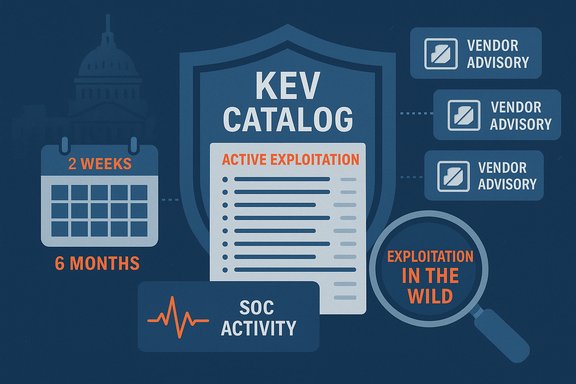
CISA’s KEV Catalog is not an abstract “watch list.” Under BOD 22‑01, the catalog is a policy mechanism that converts observed exploitation into operational deadlines for federal agencies and a high-priority signal for the private sector. The Directive requires agencies to remediate newly listed CVEs on accelerated timelines — normally two weeks for CVEs assigned after 2021 and six months for older CVEs — unless CISA specifies a different schedule because of extreme risk. CISA also states it will add a vulnerability to KEV only when three conditions are met: the vulnerability has a CVE ID, there is reliable evidence of active exploitation in the wild, and clear remediation guidance is available. CISA’s public alerts follow a standard pattern: a headline stating the KEV addition, a one-sentence description of the CVE, and reminders about BOD 22‑01. The plain operational takeaway is simple and repeated across alerts: if CISA lists a CVE, federal civilian agencies must act fast and document their remediation; other organizations should treat the entry as an immediate priority.
KEV additions will keep coming; defensive organizations must treat them as one critical input among many in a mature vulnerability management program. The practical response is straightforward: inventory, isolate, patch or mitigate, hunt, and document. For Windows administrators and security operations teams, that sequence converts an alert into operational work that measurably reduces exposure — which is exactly the intent behind BOD 22‑01 and the KEV Catalog’s design.
Key resources and policy anchors referenced during reporting: CISA’s Binding Operational Directive (BOD 22‑01) and the KEV catalog policy pages, plus contemporary technical writeups and vendor advisories that corroborated recent KEV additions and technical indicators.
Source: CISA CISA Adds One Known Exploited Vulnerability to Catalog | CISA
 Background: what every IT pro needs to know about the KEV and BOD 22‑01
CISA’s KEV Catalog is not an abstract “watch list.” Under BOD 22‑01, the catalog is a policy mechanism that converts observed exploitation into operational deadlines for federal agencies and a high-priority signal for the private sector. The Directive requires agencies to remediate newly listed CVEs on accelerated timelines — normally two weeks for CVEs assigned after 2021 and six months for older CVEs — unless CISA specifies a different schedule because of extreme risk. CISA also states it will add a vulnerability to KEV only when three conditions are met: the vulnerability has a CVE ID, there is reliable evidence of active exploitation in the wild, and clear remediation guidance is available. CISA’s public alerts follow a standard pattern: a headline stating the KEV addition, a one-sentence description of the CVE, and reminders about BOD 22‑01. The plain operational takeaway is simple and repeated across alerts: if CISA lists a CVE, federal civilian agencies must act fast and document their remediation; other organizations should treat the entry as an immediate priority.What CISA added this time — short summary of the advisory
The agency’s alert announced the addition of one actively exploited vulnerability to the KEV Catalog and reiterated the BOD 22‑01 requirements that apply to the Federal Civilian Executive Branch. The public advisory follows CISA’s standard format and highlights that the vulnerability is a frequent attack vector used by malicious cyber actors, urging rapid remediation to reduce risk to federal networks. The advisory text also links readers to the KEV Catalog and to the BOD 22‑01 fact sheet for remediation and reporting instructions. Note on verification: an attempt to retrieve the specific CISA "news-events/alerts" webpage for November 21 during reporting hit a retrieval error; however, CISA’s KEV policy and recent KEV additions are independently documented across the agency’s KEV pages and widely covered in security press outlets, and those sources were used to cross‑check timelines and operational guidance. Where live retrieval of a CISA alert page failed, this article relied on the authoritative BOD text and multiple independent technical reports that confirm the addition of KEV entries in the same time window. ([]Why this matters: operational risk and why KEV entries change behavior
Adding a CVE to the KEV Catalog is more than a publication — it is an operational forcing function:- Legal and compliance pressure for federal agencies. KEV additions activate BOD 22‑01 remediation requirements; agencies must remediate within the timelines set by the catalog and report compliance. This is mandatory and auditable.
- Practical prioritization for private sector. While KEV listings are not legally binding outside the federal space, they represent actionable intelligence: reliable evidence exists that adversaries are exploiting the flaw in the wild, so the vulnerability is no longer theoretical. Organizations that ignore a KEV-listed CVE are effectively accepting the same risk federal agencies are required to eliminate.
- Tactical urgency for defenders. KEV entries typically correlate with visible scanning, exploit proof‑of‑concepts, or confirmed incidents. Because attackers use the same low-effort, high-impact techniques repeatedly, defenders should schedule immediate asset inventory, patch verification, and detection hunts.
The technical angle: typical vulnerabilities CISA lists and attack patterns to watch
CISA’s KEV additions frequently fall into a few high-impact categories. Understanding these lets defenders prioritize detection and mitigation even before a patch is available:- Unauthenticated remote code execution (RCE) or pre-auth command injection. These defects let attackers execute arbitrary commands or code without valid credentials and frequently lead to full system compromise.
- Unsafe deserialization and legacy serialization chains. When deserialization is handled without type restrictions, attackers can craft payloads that instantiate attacker‑controlled object graphs, triggering code execution in the target process.
- Memory-corruption bugs (out-of-bounds reads/writes, use-after-free). These often enable remote exploit chains and are highly sought after by both APTs and criminal groups.
- Authentication bypasses and path traversal. These allow privileged access or disclosure of sensitive configuration files and credentials that can be chained into further exploitation.
Practical impact for Windows administrators and enterprise defenders
For Windows shops — including enterprise Active Directory environments, Microsoft‑managed services, and endpoint fleets — a KEV entry means immediate work across these four operational pillars:- Inventory and exposure assessment
- Identify all assets that could be affected: servers, workstations, mobile device management (MDM) controlled devices, third‑party appliances, cloud services, and vendor-supplied appliances.
- Prioritize internet‑facing and high‑privilege systems; these are the most likely targets in active campaigns.
- Apply vendor patches or documented mitigations
- Follow vendor security advisories; if a vendor patch exists, schedule emergency deployment into pilot groups and then broadly, respecting needed reboots and service windows.
- If a patch is unavailable, implement vendor‑recommended mitigations or compensating controls (block vulnerable endpoints, disable features, restrict access via firewall).
- Hunt and detect
- Deploy or update detections for known exploit indicators: unexpected POSTs to web service endpoints, abnormal deserialization artifacts, PowerShell/cmd command spawn traces, suspicious outbound connections, and suspicious process trees.
- Expand detection to endpoints that parse commonly weaponized artifacts (image libraries, document parsers, media codecs).
- Document and report
- For federal agencies, ensure remediation is tracked and reported through the CDM Federal Dashboard or CyberScope per BOD 22‑01. Private sector organizations should document remedial steps for vendors, auditors, and affected customers.
Short checklist for a rapid response (what to do in the first 24–72 hours)
- 1. Confirm the specific CVE and affected products in your environment.
- 2. Check vendor advisories for patches, KB numbers, and required reboots.
- 3. Apply patches to a pilot batch of high-value endpoints; verify stability and then push broadly.
- 4. If patching is delayed, isolate or remove internet exposure to the vulnerable service (network ACL, firewall block).
- 5. Run targeted hunts for IOCs described in vendor and public technical reports.
- 6. Record remediation evidence and update compliance dashboards and executives with ETA and status.
Detection and hunting guidance — practical indicators to add to EDR/SIEM
Active exploitation usually leaves observable traces. Use these prioritized detection ideas:- Monitor for unusual POSTs or SOAP calls to management endpoints and web services (e.g., ApiRemoting30/WebService.asmx patterns, WSUS endpoints) and flag requests that include long or encoded payloads in cookies or headers.
- Watch for parent‑child chains where trusted management services spawn cmd.exe, w3wp.exe → cmd/powershell, or unexpected PowerShell encoded commands.
- Hunt for processes that parse images or documents in non‑standard contexts (e.g., media processing routines executing from messaging clients or server‑side preview services).
- Use EDR to flag process creation that is atypical for the host (for example, w3wp.exe invoking PowerShell on a web server).
- Search logs for sudden increases in 4xx/5xx errors on management endpoints combined with scanning patterns from external IPs.
Vendor and supply‑chain considerations
- Verify vendor advisory timelines and required degrees of patching (some vendors publish SKUs and separate packages for cloud vs. on‑prem).
- Ask vendors for firm mitigation timelines where patches are not immediately available; require compensating controls in writing if the product affects federal customers.
- When the vulnerability is in a third‑party library (image codecs, compression libraries, etc., confirm which products embed the library and whether vendors have issued dependent‑product security updates.
- Maintain an inventory of products that consume or expose the vulnerable library — a single library flaw can ripple across multiple applications and services.
Strengths and risks of the KEV/BOD approach — a critical appraisal
Strengths
- Operational clarity. KEV entries provide an immediate, evidence‑backed set of priorities that reduce ambiguity in triage.
- Enforceable for federal agencies. BOD 22‑01 converts threat intelligence into legally mandated action and reporting, making remediation an auditable process.
- Rapid updates. CISA updates the KEV within 24 hours of credible exploitation evidence, giving defenders timely notice of weaponization patterns.
Risks and limitations
- Resource strain on smaller orgs. The accelerated cadence forces organizations — particularly small IT teams — to divert time and resources from other tasks, potentially causing operational friction.
- Potential for misalignment. A KEV entry may require reimaging, complex patching, or vendor interaction that cannot be completed in the default remediation window; agencies must either apply compensating controls or document risk decisions.
- Dependence on vendor fixes. If the vendor’s remediation is incomplete or a patch introduces regressions, the KEV directive still stands; that can create pressure to deploy imperfect fixes.
- False sense of absoluteness. KEV lists “known exploited” flaws, but the absence of a KEV listing doesn’t imply safety; defenders should not rely solely on KEV to run a vulnerability program.
Case study: recent KEV addition and the real-world impact
When CISA listed a recent high‑impact mobile vulnerability in November, the KEV entry forced rapid remediation across federal endpoints and caused broad coverage in the security press. The publicly reported vulnerability — an out‑of‑bounds write inside a widely used image processing library embedded on mobile devices — was actively exploited in a campaign that delivered commercial spyware via crafted images, and vendor patches were already available for updated releases. CISA’s KEV action carried a 21‑day or 30‑day operational remediation window for affected federal systems, depending on the specific entry; vendors and researchers published detection artifacts and indicators that defenders could use to hunt for exploitation. These independent technical reports and vendor advisories confirmed both the exploitation and the KEV catalog listing, illustrating how the KEV mechanism converts incident data into operational priorities. (Technical caveat: during research for this article the precise CISA alert URL supplied as the basis for this story returned an access error when directly retrieved; the KEV policy and the substance of the agency’s alert were corroborated using the BOD 22‑01 text and multiple independent security vendor writeups and news outlets that reported the same KEV additions and associated remediation windows. Where specific page retrieval failed, corroborating sources were used to verify timelines and technical details. ([]Practical mitigations and long‑term recommendations
- Maintain a prioritized asset inventory tied to business impact (crown‑jewel systems first). KEV events demonstrate why visibility into which systems host which libraries matters.
- Automate patch validation and telemetry reporting into a central dashboard — federal agencies must report to the CDM Dashboard or CyberScope; private sectors benefit from the same discipline.
- Use network segmentation to limit the blast radius of exploitation; isolate management services such as WSUS, SCCM, and other update distribution servers from untrusted networks.
- Harden deserialization and object‑creation pathways in custom applications; avoid legacy BinaryFormatter/SoapFormatter patterns and adopt safer serialization frameworks that support whitelisting and type restriction.
- Build detection content that can be deployed quickly: EDR rules for suspicious process trees, SIEM parsing for unusual web service traffic, and network IDS signatures for known exploit patterns.
- Demand better SLAs for security fixes from vendors that provide critical infrastructure components and insist on transparent communication channels during incident response windows.
Conclusion — treating KEV as a prioritized call to action, not a check‑the‑box event
CISA’s KEV Catalog exists to force clarity and speed where evidence shows adversaries are already operating. A new KEV entry is both a signal and a deadline: it signals credible, observed exploitation and it imposes (for federal agencies) a remediation clock. For private organizations it should function as a practical, non‑trivial cue to accelerate patching, run focused threat hunts, and validate compensating controls.KEV additions will keep coming; defensive organizations must treat them as one critical input among many in a mature vulnerability management program. The practical response is straightforward: inventory, isolate, patch or mitigate, hunt, and document. For Windows administrators and security operations teams, that sequence converts an alert into operational work that measurably reduces exposure — which is exactly the intent behind BOD 22‑01 and the KEV Catalog’s design.
Key resources and policy anchors referenced during reporting: CISA’s Binding Operational Directive (BOD 22‑01) and the KEV catalog policy pages, plus contemporary technical writeups and vendor advisories that corroborated recent KEV additions and technical indicators.
Source: CISA CISA Adds One Known Exploited Vulnerability to Catalog | CISA
